Newfoundland & Labrador · For parents

What your child learns in Grade 12 in Newfoundland & Labrador

Every subject, unit by unit, from Newfoundland & Labrador’s curriculum: 562 skills in plain words.

Subjects
5
Skills
562
Provincial exams
7
Official curriculum
gov.nl.ca

Math in Grade 12

4 courses. Choose the one your child takes.

Mathematics 3200

5 units · 44 skills

  1. Unit 1

    Logarithms

    A logarithm answers what exponent produces a value.

    • Logarithms and exponents
    • Exact and estimated log values
    • The laws of logarithms
  2. Unit 2

    Polynomial Functions and the Binomial Theorem

    Synthetic division is a shortcut for dividing by x minus a.

    • Polynomial and synthetic division
    • Remainder and factor theorems
    • Graphs of polynomial functions
    4 more skills
    • Sketching and modelling polynomials
    • Zeros and multiplicity
    • Pascal's triangle and coefficients
    • The binomial theorem
  3. Unit 3

    Functions, Transformations, Exponentials and Logarithms

    A relation passes the vertical-line test to be a function.

    • Relations, functions, and inverses
    • Sketching inverse relations
    • Equations of inverse functions
    13 more skills
    • Domain and range of a radical function
    • Graphing radical functions
    • Solving radical equations graphically
    • Translations of functions
    • Stretches of functions
    • Combined transformations
    • Reflections of functions
    • Solving exponential equations
    • Solving logarithmic equations
    • Graphs of exponential and log functions
    • Exponential growth and decay
    • Logarithmic scales
    • Graphs of logarithmic functions
  4. Unit 4

    Trigonometry

    Positive angles turn counterclockwise; negative angles clockwise.

    • Angles in standard position
    • Radian and degree measure
    • Coterminal angles and arc length
    11 more skills
    • The unit circle and trig ratios
    • Exact trig values
    • Solving trigonometric equations
    • Angles from a trig ratio
    • Sine and cosine graphs
    • Effects of the sinusoidal parameters
    • Transforming sinusoidal functions
    • Modelling with sinusoidal functions
    • The tangent graph
    • Identities vs equations
    • Proving and using identities
  5. Unit 5

    Permutations and Combinations

    Independent choices multiply, not add.

    • The fundamental counting principle
    • Permutations
    • Permutations with constraints
    1 more skill
    • Combinations

Mathematics 3201 (Academic)

6 units · 32 skills

  1. Unit 1

    Logarithms and Financial Mathematics

    A logarithm is the inverse of a power: log base b of x is the exponent that turns b into x.

    • Logarithmic and exponential form
    • The laws of logarithms
    • Evaluating logarithms
    4 more skills
    • Compound interest
    • Simple versus compound interest
    • Loans and credit options
    • Buying, leasing and renting decisions
  2. Unit 2

    Set Theory

    Sets can be empty, disjoint, subsets of one another, or part of a universal set.

    • Sets, subsets and Venn regions
    • Solving problems with set operations
    • Applications of set theory
  3. Unit 3

    Rational Expressions and Polynomial Functions

    A value is non-permissible when it makes a denominator zero.

    • Non-permissible values and simplifying
    • Adding and subtracting rational expressions
    • Multiplying and dividing rational expressions
    3 more skills
    • Solving rational equations
    • Characteristics of polynomial functions
    • Modelling data with polynomial functions
  4. Unit 4

    Exponential and Logarithmic Functions

    Exponential data grows or decays by a constant factor; logarithmic data rises quickly then levels off.

    • Fitting exponential and logarithmic models
    • Solving exponential equations and scales
    • Describing and matching exp/log functions
  5. Unit 5

    Sinusoidal Functions

    A radian measures an angle by arc length; a full circle is 2 pi radians or 360 degrees.

    • Degrees, radians and sinusoidal graphs
    • Equations and models of sinusoidal functions
  6. Unit 6

    Probability, Permutations and Combinations

    Probability compares favourable outcomes to all outcomes; odds compare favourable to unfavourable.

    • Odds and probability
    • Solving and deciding with probability
    • Mutually-exclusive and non-mutually-exclusive events
    8 more skills
    • Dependent and independent events
    • The Fundamental Counting Principle
    • Factorials and factorial notation
    • Solving equations with factorials
    • Permutations
    • Permutations with repeated elements
    • Combinations
    • Probability with combinations

Mathematics 3202

6 units · 23 skills

  1. Unit 1

    Financial Decisions

    Buying, leasing, and lease-to-buy each spread cost differently.

    • Buy, lease, or lease-to-buy a vehicle
    • Cost of operating a vehicle
    • Small-business options and expenses
    3 more skills
    • Profit, loss, and break-even
    • Renting vs owning a home
    • Filing an income tax return
  2. Unit 2

    Linear Relations

    A linear relation changes by a constant amount.

    • Identifying linear relations
    • Slope, variation, and equations
  3. Unit 3

    Measurement and Geometry

    Accuracy is closeness to the true value; precision is fineness of measure.

    • Precision vs accuracy
    • Instruments and tolerance
    • Solving tolerance problems
    5 more skills
    • Angle properties of polygons
    • Side lengths, symmetry, and applications
    • Similarity and dilations
    • Single transformations
    • Designs with combined transformations
  4. Unit 4

    Sine and Cosine Law

    The sine law relates sides to their opposite angles.

    • Sine law and cosine law
  5. Unit 5

    Statistics

    Mean, median, and mode each summarize data differently.

    • Mean, median, and mode
    • Weighted mean and outliers
    • Central tendency in the media
    1 more skill
    • Trends and scatter plots
  6. Unit 6

    Probability and Odds

    Probability is favourable outcomes over total outcomes.

    • Calculating probability
    • Odds and decisions

Mathematics 3208 (Calculus)

4 units · 34 skills

  1. Unit 1

    Pre-Calculus

    Functions add, subtract, multiply, and divide value by value at each x.

    • Combining functions
    • Composition of functions
    • Rational functions, asymptotes and holes
    2 more skills
    • Exponential and logarithmic functions
    • Inverse trigonometric functions
  2. Unit 2

    Limits and Continuity

    A limit is the value a function approaches as x nears a point, whether or not the function is defined there.

    • The idea and notation of a limit
    • Limits from graphs and tables
    • The properties of limits
    5 more skills
    • Evaluating limits algebraically
    • Infinite limits and vertical asymptotes
    • Limits at infinity and end behaviour
    • Continuity and discontinuities
    • Trigonometric and exponential limits
  3. Unit 3

    Derivatives and Their Applications

    The average rate of change is the slope of a secant line over an interval.

    • Average and instantaneous rate of change
    • The definition of the derivative
    • Tangent lines, notation, and differentiability
    14 more skills
    • Graphs of a function and its derivative
    • The basic differentiation rules
    • The chain rule
    • Implicit differentiation
    • First-derivative analysis of curves
    • Concavity and sketching
    • Sketching rational functions
    • Motion and rates of change
    • Related rates
    • Optimization
    • Derivatives of trigonometric functions
    • Derivatives of inverse trigonometric functions
    • Derivatives of exponential and logarithmic functions
    • Hyperbolic functions
  4. Unit 4

    Antidifferentiation and Integration

    An antiderivative F of f satisfies F prime equals f.

    • Antiderivatives and notation
    • Particular antiderivatives and motion
    • Area by Riemann sums
    1 more skill
    • Definite integrals and area between curves

Science in Grade 12

6 courses. Choose the one your child takes.

Biology 3201

3 units · 30 skills

  1. Unit 1

    Cell Reproduction and the Continuity of Life

    Mitosis produces two genetically identical diploid daughter cells.

    • The process of mitosis
    • The cell cycle and cancer
    • Evaluating medical treatments
    7 more skills
    • The process of meiosis
    • Spermatogenesis and oogenesis
    • Reproductive strategies
    • Human reproductive systems
    • The human reproductive cycle
    • Development from fertilization to birth
    • Reproductive technologies
  2. Unit 2

    Genetic Basis of Heredity

    Mendel inferred discrete 'factors' from pea-plant crosses before genes were known.

    • The concept of the gene
    • Mendelian genetics and predicting crosses
    • Chromosomes and the transmission of heredity
    7 more skills
    • Circumstances leading to genetic disorders
    • Structures of DNA and RNA
    • DNA replication
    • DNA, RNA, and protein synthesis
    • Effects of mutations
    • Factors causing mutations
    • Current genetic technologies
  3. Unit 3

    Evolutionary Change and Biodiversity

    Variation within a population is the raw material for selection.

    • Genetic variation and natural selection
    • Historical and cultural context of evolutionary ideas
    • Explanations for changes in populations
    7 more skills
    • Evidence for evolution by natural selection
    • How species evolve
    • The pace of evolution
    • The Hardy-Weinberg principle
    • Causes of gene-pool change
    • Principles of taxonomy
    • Comparative anatomy and evolutionary trends

Chemistry 3202

4 units · 36 skills

  1. Unit 1

    From Kinetics to Equilibrium

    Reactions occur when particles collide with enough energy and correct orientation.

    • Collision theory and reaction rate
    • Properties and factors affecting rate
    • Potential energy diagrams
    4 more skills
    • Reaction mechanisms and catalysts
    • Dynamic equilibrium
    • The equilibrium constant expression
    • Le Chatelier's principle
  2. Unit 2

    Acids and Bases

    Arrhenius: acids release H+, bases release OH- in water.

    • Acid-base definitions
    • Strong and weak acids and bases (equilibrium)
    • Predicting acid-base reaction products
    5 more skills
    • Calculating pH
    • Strong and weak acids and bases (mathematical)
    • How acid-base indicators work
    • H+ and OH- interactions and Le Chatelier
    • Titration and concentration
  3. Unit 3

    Thermochemistry

    Temperature measures the average kinetic energy of particles.

    • Temperature and heat
    • System, surroundings, and the universe
    • Specific heat
    9 more skills
    • Energy in temperature changes
    • Enthalpy and thermochemical terms
    • Energy diagrams for reactions
    • Energy in state and temperature changes
    • Energy in chemical reactions
    • Calorimetry
    • Combustion enthalpies of organic compounds
    • Thermochemical equations
    • Hess's law and bond energies
  4. Unit 4

    Electrochemistry

    Oxidation is loss of electrons; reduction is gain (OIL RIG).

    • Oxidation and reduction
    • Comparing redox with other reactions
    • Balancing half-reactions and redox equations
    6 more skills
    • Parts and operation of electrochemical cells
    • Galvanic vs electrolytic cells
    • Spontaneity from reduction potentials
    • Predicting cell voltage
    • Electrolysis and electroplating
    • The hydrogen fuel cell

Earth Systems 3209

5 units · 41 skills

  1. Unit 1

    Introduction to Earth Science

    The nebular hypothesis explains solar system formation from a collapsing cloud of gas and dust (a nebula).

    • The nebular hypothesis
    • Formation of Earth's layers
    • A dynamic Earth and its spheres
  2. Unit 2

    Historical Geology

    Uniformitarianism: the geologic processes we see today operated in the same way in the past — 'the present is the key to the past'.

    • Uniformitarianism
    • Principles of relative dating
    • Interpreting geological cross-sections
    7 more skills
    • Theories of Earth's internal structure
    • Radiometric dating and absolute time
    • Fossils and fossilization
    • Using fossils and evidence of change
    • Divisions of the geologic time scale
    • Eras and their dominant life forms
    • Evidence that Earth has changed over time
  3. Unit 3

    Earth Materials

    Minerals are chemical compounds — atoms bonded in fixed ratios.

    • Atoms, compounds, and mineral chemistry
    • Abundance of crustal elements
    • Defining minerals and mineral groups
    11 more skills
    • The silicate tetrahedron
    • Identifying minerals by properties
    • Rocks versus minerals
    • Igneous rocks: composition
    • Igneous texture and Bowen's series
    • Identifying igneous rocks and kimberlite
    • Formation and classes of sedimentary rocks
    • Clastic sedimentary rocks
    • Chemical and biochemical sedimentary rocks
    • The process of metamorphism
    • Types and locations of metamorphism
  4. Unit 4

    The Forces within Earth

    Divergent boundaries: plates move apart, new crust forms (mid-ocean ridges).

    • Plate boundaries and rift valleys
    • Evidence for plate tectonics
    • Crustal deformation and stress
    6 more skills
    • Faults and folds
    • Earthquakes and plate boundaries
    • Seismic waves and measuring earthquakes
    • Earthquake scales
    • Volcanoes and eruptions
    • Hotspots and sphere interactions
  5. Unit 5

    Earth Resources: Real-Life Applications

    Ore is rock containing a mineral in concentrations worth mining.

    • Minerals, exploration, and ore processing
    • Processing ore materials
    • Petroleum formation and kerogen
    2 more skills
    • Petroleum traps and reservoirs
    • Extracting and refining petroleum

Environmental Science 3205

5 units · 53 skills

  1. Unit 1

    Introduction to Environmental Science

    The biosphere is the zone of life — where living things interact with each other and with rock (geosphere), air (atmosphere), and water (hydrosphere).

    • The biosphere as an interacting system
    • Human impact on the NL land over time
    • What environmental science is
    8 more skills
    • Environmental issues and human demand
    • Conservation, stewardship, and the precautionary principle
    • The ecological footprint
    • Eco-citizenship and economic reality
    • NL eco-regions and biodiversity
    • Species at risk
    • Protecting biodiversity — species
    • Protecting biodiversity — spaces
  2. Unit 2

    Recreation and The Environment

    Wilderness is a natural area largely unmodified by human development.

    • Wilderness and its value
    • Consumptive and non-consumptive recreation
    • Ecological integrity and eco-tourism
    3 more skills
    • Wilderness access and its impacts
    • Hunting, quotas, and wildlife management
    • The inland recreational fishery
  3. Unit 3

    Land Use and the Environment

    Forests support the biosphere: they store carbon, produce oxygen, regulate water, and provide habitat.

    • Introducing forest ecosystems
    • The boreal forest and fire
    • Old-growth forests
    2 more skills
    • Sustainable forest management
    • Harvesting and caring for forests
  4. Unit 4

    Water Use and the Environment

    The water cycle constantly moves water, but the total amount is fixed — water is a finite resource.

    • Fresh water sources
    • Watersheds and their management
    • Water quality and riparian zones
    14 more skills
    • Impacts on fresh water ecosystems
    • Drinking water treatment
    • Wastewater and its treatment
    • Wastewater treatment methods
    • Marine ecosystems and NL
    • The state of the world's fishery
    • The fishery and its management
    • Sustainable fishing and its challenges
    • Fishing techniques, bycatch, and seals
    • Aquaculture
    • Marine debris and coastal impacts
    • Oil spills and mitigation
    • Impacts of marine oil spills
    • Mitigating marine oil pollution
  5. Unit 5

    The Atmosphere and the Environment

    The atmosphere is the layer of gases surrounding Earth, mostly nitrogen and oxygen.

    • The atmosphere and its interactions
    • Interactions in the atmosphere
    • Air quality and particulate matter
    11 more skills
    • Critical air contaminants and smog
    • Persistent organic pollutants
    • Sources of airborne pollutants
    • Air quality and human health
    • Improving air quality
    • Acid precipitation
    • The ozone layer and UV radiation
    • Climate change
    • Climate change impacts across Canada
    • Addressing climate change
    • Alternate energy sources

Physics 3204

4 units · 27 skills

  1. Unit 1

    Motion

    A 2-D vector resolves into perpendicular x and y components.

    • Vectors in two dimensions
    • Frames of reference
    • Motion in horizontal and vertical planes
    2 more skills
    • Projectile motion
    • Conservation of momentum in 2-D
  2. Unit 2

    Forces

    In uniform circular motion, speed is constant but velocity changes direction.

    • Uniform circular motion
    • Circular motion and Newton's laws
    • Motion in parallel and perpendicular planes
    1 more skill
    • Static equilibrium and torque
  3. Unit 3

    Fields

    A gravitational field surrounds any mass and exerts force on other masses.

    • Gravitational fields
    • Newton's law of universal gravitation
    • Electric fields
    7 more skills
    • Coulomb's law
    • Analyzing electric circuits
    • Magnetic fields
    • Magnetic fields from currents
    • Forces on moving charges and currents
    • Electromagnetic induction
    • Motors and generators
  4. Unit 4

    Introduction to Quantum Physics

    Energy is quantized: light carries energy in packets (photons), E = hf.

    • Blackbody radiation and the photoelectric effect
    • The photoelectric effect quantitatively
    • The Compton effect
    5 more skills
    • The Bohr atomic model
    • Energy levels and emitted photons
    • Quantum explanation of luminous phenomena
    • Wave and particle models of light
    • The de Broglie hypothesis

Science 3200

2 units · 30 skills

  1. Unit 1

    Physical Science: Matter and Chemical Change

    Alchemy was an early practice that mixed practical experiment with mysticism, aiming to turn base metals into gold and find an elixir of life.

    • From alchemy to modern chemistry
    • Properties that distinguish substances
    • Modelling atoms and ions
    12 more skills
    • Energy levels and photons
    • How Mendeleev built the periodic table
    • Names and formulas of binary ionic compounds
    • Names of complex (polyatomic) ionic compounds
    • The usefulness of IUPAC nomenclature
    • Representing reactions and conservation of mass
    • Balancing symbolic equations
    • Classifying acids, bases, and salts by properties
    • Classifying acids, bases, and salts by names and formulas
    • Neutralization reactions
    • Acids, bases, and air pollution
    • How antacids work
  2. Unit 2

    Physical Science: Motion

    Speed is how far something travels in a given time: speed = distance ÷ time.

    • Speed, distance, and time
    • Factors that affect speed
    • Analyzing average speed of linear motion
    12 more skills
    • Analyzing speed graphically and mathematically
    • Displacement and time in uniform motion
    • Displacement, time, and velocity in uniform motion
    • Instantaneous and average velocity
    • Using vectors to represent velocity
    • Position-time graphs
    • Analyzing displacements graphically
    • Velocity, time, and acceleration
    • Acceleration on a velocity-time graph
    • Motion of technologies
    • WHMIS and safe handling of lab materials
    • Displaying data in tables and graphs

English in Grade 12

4 courses. Choose the one your child takes.

English Language Arts 3201 (Academic)

3 units · 42 skills

  1. Unit 1

    Speaking and Listening

    Grade 12 reflects on how its own tone, register, and rhetoric shape interactions — critical self-awareness.

    • Impact of oral communication in own interactions
    • Analyzing concepts and information when listening
    • Evaluating others' ideas to clarify and extend understanding
    9 more skills
    • Examining thoughts and feelings through questioning and dialogue
    • Advocating a position with evidence
    • Strategies for formal and informal communication
    • Adapting language and delivery for audiences
    • Responding critically to texts, questions, and situations
    • Evaluating own and others' uses of language
    • Differentiating sensitivity by situation, audience, purpose
    • Analyzing how oral language reflects culture and identity
    • Responding with appropriate sensitivity
  2. Unit 2

    Reading and Viewing

    Grade 12 selects and reads demanding texts across genres for precise analytical purposes.

    • Reading and viewing texts for specific purposes
    • Strategies to enhance understanding of texts
    • Demonstrating understanding of texts
    15 more skills
    • Evaluating how texts create meaning and purpose
    • Explaining own processes and strategies with texts
    • Investigating topics and questions for inquiry
    • Selecting information from sources
    • Evaluating information from sources
    • Integrating information for a learning task
    • Evaluating own inquiry processes
    • Reflecting on own interpretation of texts
    • Justifying connections between self and texts
    • Evaluating own and others' opinions about texts
    • Analyzing how identities influence texts
    • Analyzing texts through critical response
    • Evaluating stylistic techniques for meaning and purpose
    • Assessing how language, form, and genre contribute
    • Justifying critical responses to texts
  3. Unit 3

    Writing and Representing

    Grade 12 uses writing and representing to think — clarifying complex ideas and feelings on the page.

    • Clarifying thoughts through writing and representing
    • Creating texts using stylistic techniques
    • Expressing creativity through texts
    9 more skills
    • Assessing own writing strategies and processes
    • Creating texts collaboratively and independently
    • Creating texts for audiences and purposes
    • How text construction influences audience
    • Assessing feedback when creating or revising
    • Using conventions of written language
    • Integrating information to enhance clarity and precision
    • Evaluating effectiveness of own texts
    • Evaluating strategies to engage the audience

English Language Arts 3202 (Applied)

3 units · 39 skills

  1. Unit 1

    Speaking and Listening

    How something is said — tone, volume, pace — changes how it's received.

    • Impact of the features of oral language
    • Analyzing concepts and information when listening
    • Developing thoughts through dialogue and questioning
    9 more skills
    • Examining others' ideas to clarify understanding
    • Advocating a position with evidence
    • Strategies for formal and informal communication
    • Adapting language and delivery for audiences
    • Responding to questions in a variety of situations
    • Evaluating own and others' uses of language
    • Differentiating sensitivity by situation, audience, purpose
    • Discussing how oral language reflects culture and identity
    • Responding with appropriate sensitivity
  2. Unit 2

    Reading and Viewing

    Choosing texts that fit set criteria — length, topic, reliability — helps you meet a real need.

    • Reading and viewing texts that meet criteria
    • Strategies to enhance understanding of texts
    • Demonstrating understanding of texts
    12 more skills
    • Evaluating how text features create meaning and purpose
    • Investigating topics for inquiry
    • Selecting information from sources
    • Analyzing how source information relates to a topic
    • Integrating information for a learning task
    • Reflecting on own interpretations of a text
    • Explaining connections between experience and texts
    • Justifying opinions about issues in texts
    • Formulating conclusions from connections to texts
    • How text features clarify and enhance the message
    • Evaluating stylistic techniques in texts
    • Justifying critical responses to texts
  3. Unit 3

    Writing and Representing

    Writing or sketching an idea out helps you work out what you really think.

    • Clarifying thoughts through writing and representing
    • Creating texts using stylistic techniques
    • Expressing creativity through texts
    9 more skills
    • Assessing own writing strategies and processes
    • Creating texts independently and collaboratively using strategies
    • How text form suits audiences and purposes
    • How text construction influences audience
    • Assessing feedback when creating texts
    • Using conventions of written language
    • Using strategies to enhance clarity and precision
    • Evaluating effectiveness of own texts
    • Refining texts to enhance effectiveness

Film Studies 3204

1 unit · 12 skills

  1. Unit 1

    Integrated ELA Strands

    Film evolved from silent, black-and-white shorts to modern cinema.

    • Exploring the evolution of film
    • Understanding filmmaking conventions
    • Exploring jobs in the film industry
    9 more skills
    • Exploring Realism and Formalism
    • Investigating the lenses of film theory
    • Investigating censorship in film
    • Planning a film with a storyboard
    • Writing a screenplay in proper format
    • Creating an original film
    • Analyzing adaptations against their source texts
    • Deconstructing films while viewing
    • Investigating trends and the future of cinema

World Literature 3207

1 unit · 15 skills

  1. Unit 1

    Integrated ELA Strands

    Writing about a text shows and sharpens your understanding of it.

    • Communicating understanding through writing
    • Communicating understanding through speaking
    • Communicating understanding through representing
    12 more skills
    • Respecting the viewpoints of others
    • Connecting texts to your own experiences
    • Justifying your own points of view
    • Examining others' opinions to reflect on your interpretation
    • Reflecting on how your bias affects your response
    • Refining critical-thinking strategies
    • Analyzing the use of literary elements
    • Comparing form, genre, and ideas across world texts
    • Examining moral and ethical issues in world texts
    • Reading world texts for varied purposes
    • Exploring how context shapes world texts
    • Examining how context transforms texts over time

French in Grade 12

Core French 3200

5 units · 38 skills

  1. Unit 1

    Oral Production

    3200 reaches beyond 1200's familiar contexts to global ones - the wider world.

    • Identifying across personal and global contexts
    • Describing across personal and global contexts
    • Explaining and justifying opinions
    4 more skills
    • Expressing agreement and disagreement
    • Fluency in increasingly diverse contexts
    • Recounting experiences and events
    • Oral presentation strategies
  2. Unit 2

    Oral Interaction (Speaking and Listening)

    3200 adds SPONTANEITY - form questions on the spot, not from a script.

    • Asking with increasing spontaneity
    • Responding with increasing spontaneity
    • Exchanging ideas with supporting detail
    7 more skills
    • Exchanging information about experiences
    • Comparing objects, people, places, and events
    • Comparing preferences and opinions
    • Directions with many steps
    • Speaking with fluency and accuracy
    • Main idea in oral texts
    • Specific details in oral texts
  3. Unit 3

    Reading and Viewing

    3200 texts include informational and argumentative ones.

    • Extracting main ideas from texts
    • Extracting specific details from texts
    • Following multi-step directions
    7 more skills
    • Using reading strategies
    • Reading with accuracy and precision
    • Organizing information from texts
    • Responding to texts
    • Expressing and justifying an opinion of a text
    • Using gathered information for a task
    • Reading aloud with fluency and accuracy
  4. Unit 4

    Writing and Representing

    3200 personal texts cover diverse topics, not only the familiar.

    • Creating personal texts on diverse topics
    • Creating informational texts on diverse topics
    • Completing applications, surveys, and inventories
    4 more skills
    • Using the writing process
    • Completing and publishing texts
    • Writing with precision and accuracy
    • Responding to blogs, e-mails, and editorials
  5. Unit 5

    Francophone Culture

    3200 compares and contrasts in depth across several cultures.

    • Comparing and contrasting cultures
    • Examining francophone contributions
    • Identifying the influence of other cultures
    1 more skill
    • Recognizing the importance of bilingualism

Social studies in Grade 12

3 courses. Choose the one your child takes.

Newfoundland and Labrador Studies 2205

6 units · 22 skills

  1. Unit 1

    Social Studies Concepts and Skills - 1. Culture and Diversity

    Creative works are a primary way a people's culture, heritage, and identity can be understood.

    • Examining creative works through artistic inquiry
    • Creating art to express identity
  2. Unit 2

    Social Studies Concepts and Skills - 2. Inquiry and Research

    Examining and resolving issues helps a society achieve the goals it values.

    • Applying an issues-analysis model
    • Using social science concepts of analysis
  3. Unit 3

    Anthropology - 3. Culture and Diversity

    Culture is composed of elements from the past and present and contributes to identity.

    • The elements of culture
    • Factors that shape culture
    • Factors that change culture
  4. Unit 4

    History - 4. People, Place, and Environment

    The Indigenous peoples of Newfoundland and Labrador developed sophisticated adaptations to a harsh environment.

    • The earliest peoples of Newfoundland and Labrador
    • The rise of the European migratory fisheries
    • The migratory fishery and its consequences
  5. Unit 5

    History - 5. Individuals, Societies, and Economic Decisions

    The shift to a resident fishery was preferable to merchants over the migratory fishery.

    • The emergence of the resident fishery
    • The resident fishery, its consequences, and remembering the Beothuk
    • The colony's evolving political status
    3 more skills
    • Economic diversification
    • Changing lifestyles and cultures
    • Significant experiences to 1934
  6. Unit 6

    History - 6. Time, Continuity, and Change

    A combination of factors led to Newfoundland and Labrador's entry into Confederation in 1949.

    • Entry into Confederation
    • Challenges of the Smallwood administration
    • Changing lifestyles and cultures under Smallwood
    3 more skills
    • Changes in the economy since 1972
    • Challenges of governance since 1972
    • Changing lifestyles and cultures since 1972

Social Studies 3201 (Academic)

6 units · 22 skills

  1. Unit 1

    Social Studies Concepts and Skills - 1. Civic Engagement

    Collaboration lets citizens combine effort to achieve a common goal.

    • The principles of Canadian democracy
    • Collaboration and acting on quality-of-life issues
  2. Unit 2

    Social Studies Concepts and Skills - 2. Inquiry and Research

    Supported conclusions about global issues rest on evidence judged for quality.

    • Evidence, comparison, and causation
    • Significance, perspective, and value judgements
    • Responding to a significant issue
    3 more skills
    • Responding to political and economic issues
    • Responding to population issues
    • Responding to human-environmental issues
  3. Unit 3

    Geography - 3. Interdependence

    Quality of life is the overall well-being of people in a society.

    • The concept of quality of life
    • Measuring quality of life, then and now
    • The concept of globalization
    3 more skills
    • Globalization's influence on quality of life
    • The concept of sustainability
    • Sustainability's influence on quality of life
  4. Unit 4

    Geography - 4. People, Place, and Environment

    Carrying capacity is the population an environment can support.

    • Carrying capacity and the demographic transition
    • The challenges of high and low population growth
    • Resource use and quality of life
    1 more skill
    • Consequences and responses to environmental issues
  5. Unit 5

    Economics - 5. Individuals, Societies, and Economic Decisions

    Economic disparity is the uneven distribution of wealth and income.

    • The concept of economic disparity
    • Causes of and responses to economic disparity
  6. Unit 6

    Politics - 6. Citizenship, Power, and Governance

    Political stability is the durability and legitimacy of a government.

    • The concept of political stability
    • Causes of and responses to political instability

Social Studies 3202 (Applied)

6 units · 22 skills

  1. Unit 1

    Social Studies Concepts and Skills - 1. Civic Engagement

    Working together lets a group do what one person could not.

    • The principles of Canadian democracy in everyday life
    • Working together and taking action on real problems
  2. Unit 2

    Social Studies Concepts and Skills - 2. Inquiry and Research

    Something matters more if it affects more people, more places, or for longer.

    • Checking evidence, comparing, and asking why
    • What matters, whose view, and what's fair
    • Taking on a significant issue
    3 more skills
    • Taking on political and economic issues
    • Taking on population issues
    • Taking on environmental issues
  3. Unit 3

    Geography - 3. Interdependence

    Quality of life is how good life is overall for people.

    • What quality of life means
    • How we measure quality of life
    • What a connected world means
    3 more skills
    • Does a connected world help or hurt
    • What sustainability means
    • Sustainability and a good life
  4. Unit 4

    Geography - 4. People, Place, and Environment

    A place can only support so many people with its resources.

    • How many people a place can support
    • Problems of fast and slow population growth
    • Using resources and quality of life
    1 more skill
    • Environmental problems and what we do about them
  5. Unit 5

    Economics - 5. Individuals, Societies, and Economic Decisions

    Some people and countries have far more money than others.

    • The gap between rich and poor
    • Why the gap exists and what we do about it
  6. Unit 6

    Politics - 6. Citizenship, Power, and Governance

    A steady government lasts, is accepted, and keeps the peace.

    • What makes a government steady
    • Why governments get shaky and what helps

MapleMind

See Grade 12 in MapleMind

Real screens from the app your child would use.

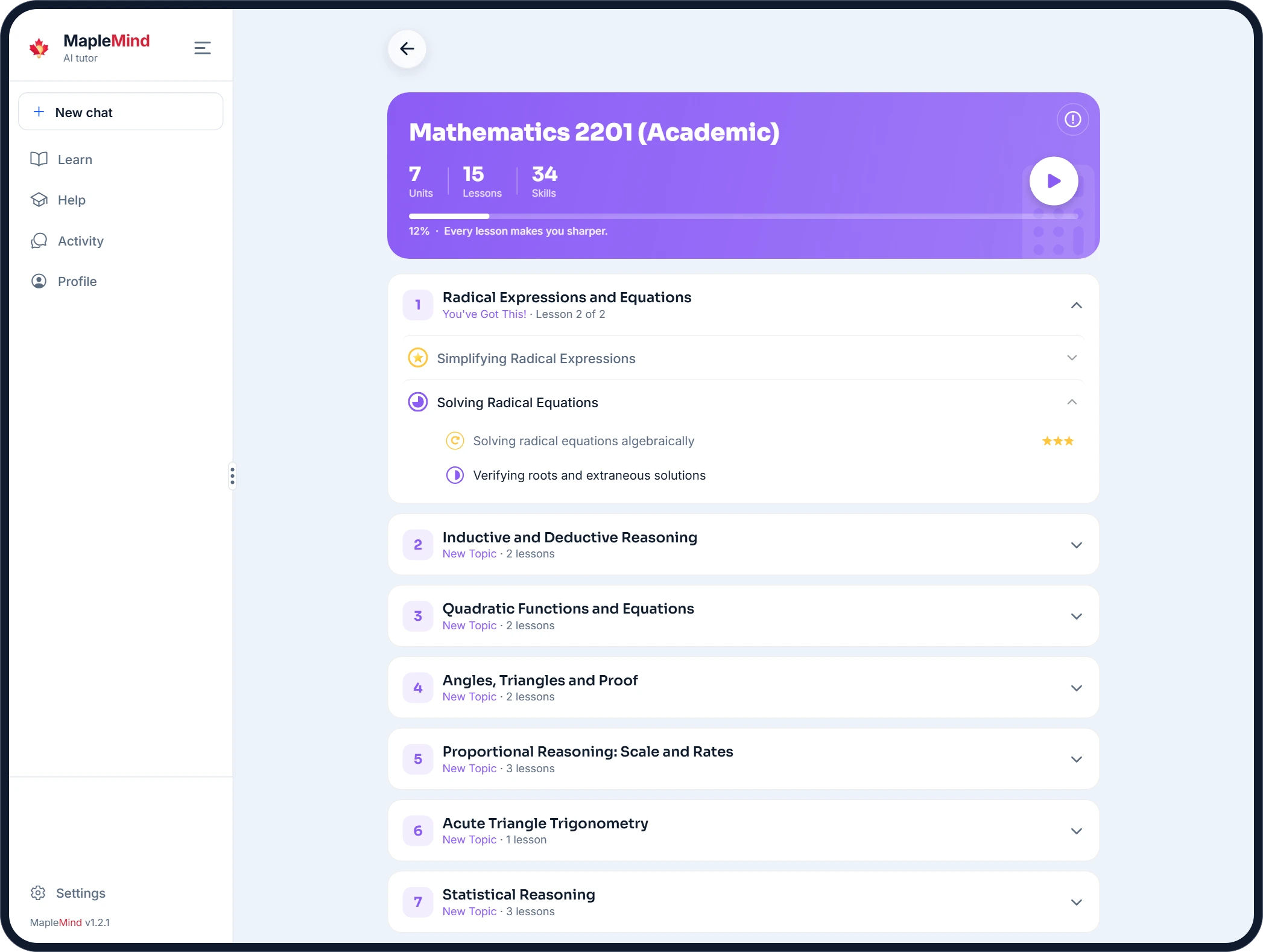
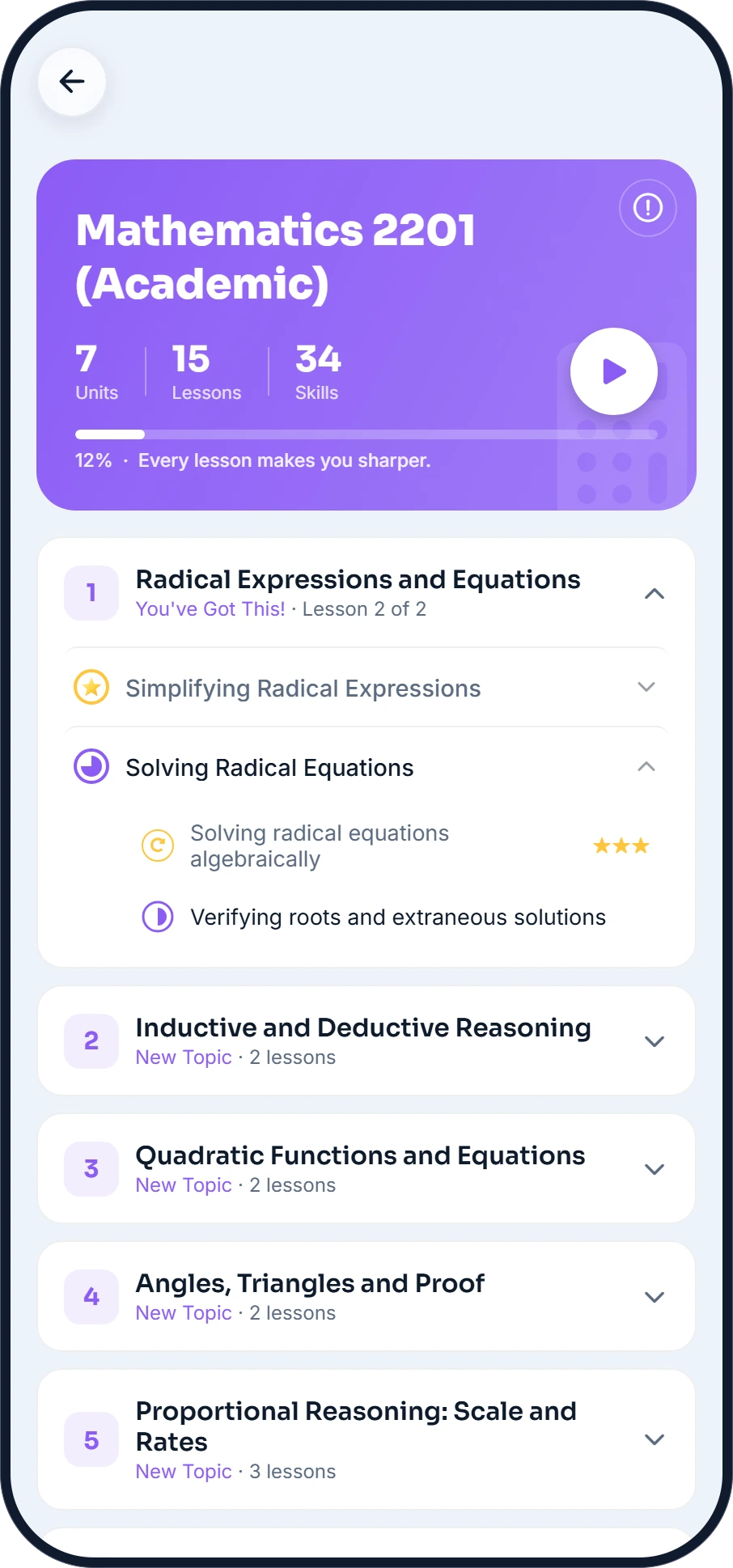
Mathematics 2201 (Academic) in MapleMind on a tablet: its units and lessons in order, a student partway through.Mathematics 2201 (Academic) in MapleMind on a phone: its units and lessons in order, a student partway through.
Their course, unit by unit, the way Newfoundland & Labrador teaches it.Shown: Mathematics 2201 (Academic)
Homework Help on a tablet: a photo of a worksheet, the tutor’s worked example of a two-step equation, and a question back to the student.Homework Help on a phone: a photo of a worksheet, the tutor’s worked example of a two-step equation, and a question back to the student.
Homework Help: they take a photo of the question, and the tutor works through it with them.
The Parent Dashboard on a tablet: a student’s days studied, streak, lessons, quiz average and recent activity.The Parent Dashboard on a phone: a student’s days studied, streak, lessons, quiz average and recent activity.
The Parent Dashboard: how each child’s week went, in lessons, quizzes and days studied.
A Grade 9 provincial mathematics exam on a tablet: a readiness score, the exam’s time and its next sitting.A Grade 9 provincial mathematics exam on a phone: a readiness score, the exam’s time and its next sitting.
A provincial exam: a practice sitting under the real time, and how ready they are.
The Learn tab on a tablet: a four-day streak, the week’s days, Homework Help, the next lesson and a review.The Learn tab on a phone: a four-day streak, the week’s days, Homework Help, the next lesson and a review.
The Learn tab: their week so far, and the next thing to do.

Help at home

Questions parents ask

What will my child learn in Grade 12 in Newfoundland & Labrador?

Math: Mathematics 3200, Mathematics 3201 (Academic), Mathematics 3202 and Mathematics 3208 (Calculus). Science: Biology 3201, Chemistry 3202, Earth Systems 3209, Environmental Science 3205, Physics 3204 and Science 3200. English: English Language Arts 3201 (Academic), English Language Arts 3202 (Applied), Film Studies 3204 and World Literature 3207. French: Core French 3200. Social studies: Newfoundland and Labrador Studies 2205, Social Studies 3201 (Academic) and Social Studies 3202 (Applied). That’s 562 skills in all, from Newfoundland & Labrador’s curriculum.

Does my child write a provincial exam in Grade 12?

No. Newfoundland & Labrador has no provincial exam in Grade 12.

Where does this list come from?

From Newfoundland & Labrador’s official curriculum, the documents its education ministry publishes for each course. Each skill here is one of their expectations, written in plain words.

Can MapleMind help my child in Grade 12?

Yes. Every course on this page is in MapleMind, with lessons, practice and a tutor that works through each step with them. A free account gets 30 messages and 4 activities a day.

Help with Grade 12, one skill at a time.

Every course on this page is in MapleMind, free with daily limits.