Get help with Environmental Science 3205
Most tutoring makes you sit through material you already know. MapleMind flips that: pick the exact skill that's causing trouble — any of the 53 below — and the tutor teaches just that one, step by step, as many times as it takes. Ask questions in plain words, any time of day, in English, French, or 12 other languages.
The official Newfoundland and Labrador Environmental Science 3205 curriculum
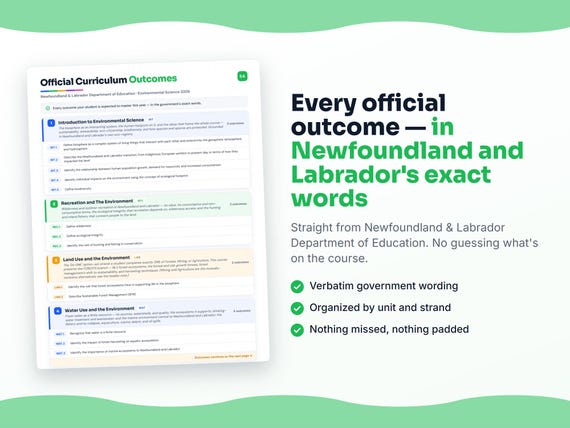
Newfoundland and Labrador defines Environmental Science 3205 by strands and outcomes. MapleMind teaches the same curriculum reorganized for one-skill-at-a-time tutoring — the table shows exactly where every official strand lands, and the ministry's own wording is quoted under each unit below.
Official source Newfoundland and Labrador's official curriculumRead it on the government site — gov.nl.ca ↗| Official strand | Outcomes | Where MapleMind teaches it |
|---|---|---|
| Strand 1 | 11 | Introduction to Environmental Science |
| Strand 2 | 6 | Recreation and The Environment |
| Strand 3 | 5 | Land Use and the Environment |
| Strand 4 | 17 | Water Use and the Environment |
| Strand 5 | 14 | The Atmosphere and the Environment |
Every skill below, taught one on one.
 Try the first session free
How MapleMind teaches Environmental Science 3205 — every unit, lesson, and skill
Every skill below runs as a short session: a plain-words lesson, a worked example, solving it together, then a five-question skill check that earns up to three stars. Guided Mode keeps it teaching instead of answer-handing — turning it off needs a parent's password.
Unit 1Introduction to Environmental ScienceOfficial strand · Strand 1
The biosphere as an interacting system, the human footprint on it, and the ideas that frame the whole course — sustainability, stewardship, eco-citizenship, biodiversity, and how species and spaces are protected. Grounded in Newfoundland and Labrador's own eco-regions.
The biosphere and the human place in it
- The biosphere as an interacting systemsci-envi-3205.1.1.1 — Define the biosphere as a system of living things that interact and reach into the geosphere, atmosphere, and hydrosphere — and recognize humans as one high-impact part of it.
The NL land, and what environmental science is
- Human impact on the NL land over timesci-envi-3205.1.2.1 — Describe how, from Indigenous peoples to European settlers to the present day, human use has changed the Newfoundland and Labrador landscape.
- What environmental science issci-envi-3205.1.3.1 — Describe environmental science as a discipline, correct common misconceptions about how science works, and list where environmental science is applied.
Why issues arise, and how we respond
- Environmental issues and human demandsci-envi-3205.1.4.2 — Explain how anthropocentric attitudes, population growth, resource demand, and consumerism drive environmental issues, and how balance is maintained in ecosystems.
- Conservation, stewardship, and the precautionary principlesci-envi-3205.1.5.2 — Define conservation and stewardship, identify the ecological/social/economic factors of sustainability, and explain the precautionary principle and the role of legislation and monitoring.
Your footprint and eco-citizenship
- The ecological footprintsci-envi-3205.1.6.2 — Use the ecological-footprint concept to identify individual and community impact, describe environmental responsibility, and recognize misconceptions about sustainability.
- Eco-citizenship and economic realitysci-envi-3205.1.7.1 — Define eco-citizenship, identify examples at different levels, and examine the conflict that can arise between eco-citizenship and economic realities.
Biodiversity, species at risk, and protection
- NL eco-regions and biodiversitysci-envi-3205.1.8.2 — Recognize NL's variety of eco-regions and ecosystems, define biodiversity, and identify the factors that relate to it.
- Species at risksci-envi-3205.1.9.2 — Explain the importance of species and genetic diversity, identify why organisms become at risk, distinguish natural from anthropogenic extinction, and describe the impact of introduced species.
- Protecting biodiversity — speciessci-envi-3205.1.10.2 — Describe how an organism is classified as a species at risk, the COSEWIC listing categories, and the recovery process.
- Protecting biodiversity — spacessci-envi-3205.1.11.1 — Define protected areas, identify NL's types, explain their benefits, and describe how they are created and managed.
The official wording — 11 outcomes in this unit
- sci-envi-3205.1.1.1
Define biosphere as a complex system of living things that interact with each other and extend into the geosphere, atmosphere, and hydrosphere
- sci-envi-3205.1.2.1
Describe the Newfoundland and Labrador transition, from Indigenous, European settlers to present day, in terms of how they impacted the land
- sci-envi-3205.1.3.1
Describe environmental science
- sci-envi-3205.1.4.2
Identify the relationship between human population growth, demand for resources, and increased consumerism
- sci-envi-3205.1.5.2
Define stewardship in relation to sustainability
- sci-envi-3205.1.6.2
Identify individual impacts on the environment using the concept of ecological footprint
- sci-envi-3205.1.7.1
Define eco-citizenship
- sci-envi-3205.1.8.2
Define biodiversity
- sci-envi-3205.1.9.2
Identify reasons why some organisms become species at risk
- sci-envi-3205.1.10.2
Identify the COSEWIC listings that categorize species at risk
- sci-envi-3205.1.11.1
Define protected area
Unit 2Recreation and The EnvironmentOfficial strand · Strand 2
Wilderness and outdoor recreation in Newfoundland and Labrador — its value, its consumptive and non-consumptive forms, the ecological integrity that recreation depends on, wilderness access, and the hunting and inland fishery that connect people to the land.
Wilderness and kinds of recreation
- Wilderness and its valuesci-envi-3205.2.1.1 — Define wilderness, identify its values and benefits, and describe recent changes in NL nature-based activities and their causes.
- Consumptive and non-consumptive recreationsci-envi-3205.2.2.2 — Define outdoor recreation and distinguish consumptive from non-consumptive activities, describing the environmental impacts of each with examples including cottage development.
Ecological integrity and wilderness access
- Ecological integrity and eco-tourismsci-envi-3205.2.3.1 — Define ecological integrity, identify measures used to preserve it, and identify the values of eco-tourism.
- Wilderness access and its impactssci-envi-3205.2.4.2 — Identify routes and modes of access to NL wilderness and their environmental impacts, and examine access issues in a local area.
Hunting, fishing, and conservation
- Hunting, quotas, and wildlife managementsci-envi-3205.2.5.1 — Explain the role of hunting in conservation, distinguish small from big game, describe hunting impacts and quota-setting, and analyze predator dynamics such as coyote impacts on moose and caribou.
- The inland recreational fisherysci-envi-3205.2.5.8 — List common NL recreational fish species, recognize the contribution of freshwater fishing, identify the branches of government regulating the inland fishery and their responsibilities, and the factors affecting inland fish populations.
The official wording — 6 outcomes in this unit
- sci-envi-3205.2.1.1
Define wilderness
- sci-envi-3205.2.2.2
Define consumptive and non-consumptive recreational activities
- sci-envi-3205.2.3.1
Define ecological integrity
- sci-envi-3205.2.4.2
Identify the environmental impacts of routes of access to Newfoundland and Labrador wilderness
- sci-envi-3205.2.5.1
Identify the role of hunting and fishing in conservation
- sci-envi-3205.2.5.8
List common recreational fish species in Newfoundland and Labrador
Unit 3Land Use and the EnvironmentOfficial strand · Strand 3
The 'Do ONE' option-set strand: a student completes exactly ONE of Forests, Mining, or Agriculture. This course presents the FORESTS branch — NL's forest ecosystems, the boreal and old-growth forests, forest management's shift to sustainability, and harvesting techniques. (Mining and Agriculture are the mutually-exclusive alternatives; see the header note.)
Forest ecosystems (Forests branch)
- Introducing forest ecosystemssci-envi-3205.3.1.1 — Identify the role of forest ecosystems in the biosphere, the types of global forest ecosystems, the forest regions of Canada, and forest usage in NL.
- The boreal forest and firesci-envi-3205.3.2.1 — List the characteristics of the boreal forest ecosystem and outline the role of fire in boreal forest succession.
- Old-growth forestssci-envi-3205.3.3.3 — Identify NL old-growth regions, describe the unique succession of the Main River old-growth forest, list old-growth characteristics, and weigh maintenance versus harvesting.
Forest management and harvesting (Forests branch)
- Sustainable forest managementsci-envi-3205.3.4.3 — Outline NL forest management history, the shift from exploitation to sustainable development, Sustainable Forest Management (SFM), the Model Forest Network, and the public role in planning.
- Harvesting and caring for forestssci-envi-3205.3.5.1 — Distinguish clear-cutting from selective cutting in NL, identify improvements to reduce impacts, define and describe silviculture, and contrast the effects of silvicultural practices.
The official wording — 5 outcomes in this unit
- sci-envi-3205.3.1.1
Identify the role that forest ecosystems have in supporting life in the biosphere
- sci-envi-3205.3.2.1
List the characteristics of the boreal forest ecosystem
- sci-envi-3205.3.3.3
List characteristics of old growth forests
- sci-envi-3205.3.4.3
Describe Sustainable Forest Management (SFM)
- sci-envi-3205.3.5.1
Distinguish between clear cutting and selective cutting as forest harvesting techniques in Newfoundland and Labrador
Unit 4Water Use and the EnvironmentOfficial strand · Strand 4
Fresh water as a finite resource — its sources, watersheds, and quality; the ecosystems it supports; drinking-water treatment and wastewater; and the marine environment central to Newfoundland and Labrador: the fishery and its collapse, aquaculture, marine debris, and oil spills.
Fresh water sources, watersheds, and quality
- Fresh water sourcessci-envi-3205.4.1.2 — Recognize water as a finite resource, describe the fresh–salt water connection, compare fresh and salt water, list fresh water sources, and define a watershed.
- Watersheds and their managementsci-envi-3205.4.2.1 — List the functions of a watershed and identify the types of fresh water ecosystems.
- Water quality and riparian zonessci-envi-3205.4.3.3 — Define riparian zones and their importance, define water quality, identify physical/biological/chemical impacts, and evaluate human impacts on water resources.
Fresh water ecosystems and treatment
- Impacts on fresh water ecosystemssci-envi-3205.4.4.2 — Identify the impacts of forest harvesting, mining, hydroelectric development, and urbanization on aquatic ecosystems, and evaluate human impacts on water resources.
- Drinking water treatmentsci-envi-3205.4.5.3 — List NL drinking water sources, the risks of untreated water, the multi-barrier approach, the phases of municipal treatment, and alternate methods.
- Wastewater and its treatmentsci-envi-3205.4.6.2 — List sources of wastewater, the impacts of untreated wastewater on freshwater and marine ecosystems, and the disposal and treatment methods for municipal and industrial effluent.
- Wastewater treatment methodssci-envi-3205.4.7.1 — Describe the disposal and treatment methods for municipal and industrial effluent, and the importance of marine ecosystems that receive it.
The marine environment and the fishery
- Marine ecosystems and NLsci-envi-3205.4.8.1 — Identify the importance of marine ecosystems to Newfoundland and Labrador as the foundation of the fishery and coastal life.
- The state of the world's fisherysci-envi-3205.4.9.1 — Describe the present state of the world's fishery, the major issues facing it, and define fish stock and fish population.
- The fishery and its managementsci-envi-3205.4.10.1 — Describe the state of the world's fishery, the NL cod collapse history, the roles of governments and international agencies, and how stock assessment guides management decisions.
- Sustainable fishing and its challengessci-envi-3205.4.11.2 — Define sustainable fishing, list factors affecting marine sustainability, describe responsible fishing and the impacts of fishing techniques including bycatch and seal–prey dynamics.
- Fishing techniques, bycatch, and sealssci-envi-3205.4.12.3 — Describe the environmental impacts of various fishing techniques, examples of responsible fishing, the two types of bycatch, and the research needed to assess seal impacts on prey.
- Aquaculturesci-envi-3205.4.13.1 — Define aquaculture, describe factors driving dependence on it, the main species raised in NL, and the environmental issues associated with aquaculture operations.
Marine debris and oil spills
- Marine debris and coastal impactssci-envi-3205.4.14.4 — Describe how currents move pollutants globally, how coastal habitat is destroyed, the impacts of marine invasive species and debris, and mitigation efforts.
- Oil spills and mitigationsci-envi-3205.4.15.1 — Describe how oil pollution occurs, its sources, its economic and wildlife impacts, and mitigation strategies for marine oil pollution.
- Impacts of marine oil spillssci-envi-3205.4.16.1 — Describe the economic impacts of marine oil spills and the impacts of surface oil on marine waterfowl and mammals.
- Mitigating marine oil pollutionsci-envi-3205.4.17.1 — Describe mitigation strategies for marine oil pollution and career opportunities relating to freshwater and marine ecosystems.
The official wording — 17 outcomes in this unit
- sci-envi-3205.4.1.2
Recognize that water is a finite resource
- sci-envi-3205.4.2.1
List the functions of a watershed
- sci-envi-3205.4.3.3
Define water quality
- sci-envi-3205.4.4.2
Identify the impact of forest harvesting on aquatic ecosystems
- sci-envi-3205.4.5.3
Identify the main components of the multi-barrier approach to ensure safe drinking water.
- sci-envi-3205.4.6.2
Indicate the impacts of untreated wastewater on freshwater and marine ecosystems
- sci-envi-3205.4.7.1
Describe the disposal and treatment methods for municipal and industrial effluent
- sci-envi-3205.4.8.1
Identify the importance of marine ecosystems to Newfoundland and Labrador
- sci-envi-3205.4.9.1
Describe the present state of the world’s fishery
- sci-envi-3205.4.10.1
List the significant events in the history of the cod fishery in Newfoundland and Labrador that have impacted on fish stocks
- sci-envi-3205.4.11.2
Define sustainable fishing
- sci-envi-3205.4.12.3
Describe the environmental impacts of various fishing techniques
- sci-envi-3205.4.13.1
Define aquaculture
- sci-envi-3205.4.14.4
List sources of marine debris
- sci-envi-3205.4.15.1
Describe how oil pollution occurs when oil products escape into the environment
- sci-envi-3205.4.16.1
Describe the economic impacts of marine oil spills
- sci-envi-3205.4.17.1
Describe mitigation strategies for marine oil pollution
Unit 5The Atmosphere and the EnvironmentOfficial strand · Strand 5
The atmosphere's structure and interactions, air quality and the pollutants that degrade it, acid precipitation, stratospheric ozone depletion, and climate change — its impacts across Canada and the actions and alternative energy sources used to address it.
The atmosphere and air quality
- The atmosphere and its interactionssci-envi-3205.5.1.2 — Define the atmosphere, identify its major layers, and identify the natural and anthropogenic interactions that affect it.
- Interactions in the atmospheresci-envi-3205.5.2.1 — Identify the natural and anthropogenic interactions that affect Earth's atmosphere.
- Air quality and particulate mattersci-envi-3205.5.3.1 — List factors affecting air quality and define particulate matter.
- Critical air contaminants and smogsci-envi-3205.5.4.1 — Describe how critical air contaminants and smog affect air quality.
- Persistent organic pollutantssci-envi-3205.5.5.1 — Describe how persistent organic pollutants (POPs) affect air quality and travel and accumulate in the environment.
- Sources of airborne pollutantssci-envi-3205.5.6.1 — Identify the sources of contaminants that degrade air quality.
- Air quality and human healthsci-envi-3205.5.7.1 — Describe the effects of poor air quality on human health.
- Improving air qualitysci-envi-3205.5.8.1 — Identify ways and methods to improve air quality.
Acid precipitation, ozone, and climate change
- Acid precipitationsci-envi-3205.5.9.1 — Describe acid precipitation, its formation, its ways to improve air quality, and how it damages ecosystems.
- The ozone layer and UV radiationsci-envi-3205.5.10.1 — Describe stratospheric ozone depletion, its cause, and its consequences for UV radiation reaching Earth.
- Climate changesci-envi-3205.5.11.1 — Recognize that climate change can have a catastrophic effect on Earth, driven largely by greenhouse-gas emissions.
- Climate change impacts across Canadasci-envi-3205.5.12.1 — Explain that climate change can have catastrophic effects and describe its impacts across Canada on wildlife, forests, agriculture, fishery, coastal zones, extreme weather, and human health.
- Addressing climate changesci-envi-3205.5.13.1 — Describe efforts made to address climate change through mitigation and adaptation.
- Alternate energy sourcessci-envi-3205.5.14.1 — Identify alternate sources of energy and their relevance to Newfoundland and Labrador.
The official wording — 14 outcomes in this unit
- sci-envi-3205.5.1.2
Identify the major layers of the atmosphere
- sci-envi-3205.5.2.1
Identify natural interactions that affect Earth’s atmosphere
- sci-envi-3205.5.3.1
List the factors that can affect air quality
- sci-envi-3205.5.4.1
Describe critical air contaminants effects on air quality
- sci-envi-3205.5.5.1
Describe how persistant organic pollutants affect air quality
- sci-envi-3205.5.6.1
Identify the sources of contaminants that degrade air quality
- sci-envi-3205.5.7.1
Describe the affects of poor air quality on human health
- sci-envi-3205.5.8.1
Identify ways to improve air quality
- sci-envi-3205.5.9.1
Describe acid precipitation
- sci-envi-3205.5.10.1
Describe stratospheric ozone depletion
- sci-envi-3205.5.11.1
Identify that climate change can have a catastrophic affect on Earth
- sci-envi-3205.5.12.1
Describe the impacts of climate change in Canada on wildlife and natural ecosystems
- sci-envi-3205.5.13.1
Describe efforts made to address climate change
- sci-envi-3205.5.14.1
Identify alternate sources of energy
Printable workbook · A keepsake of the year
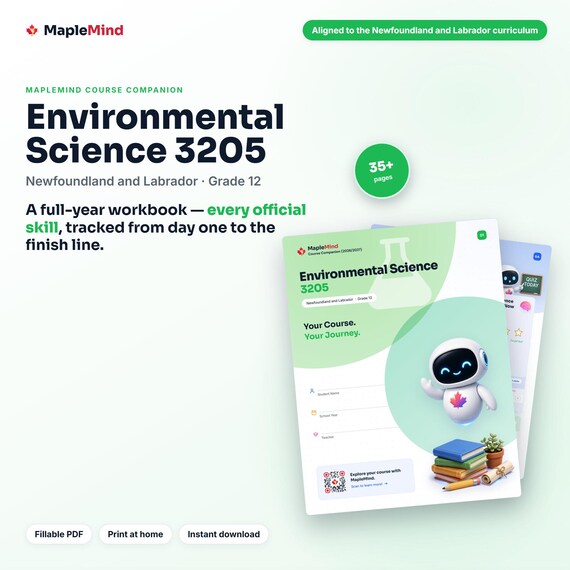
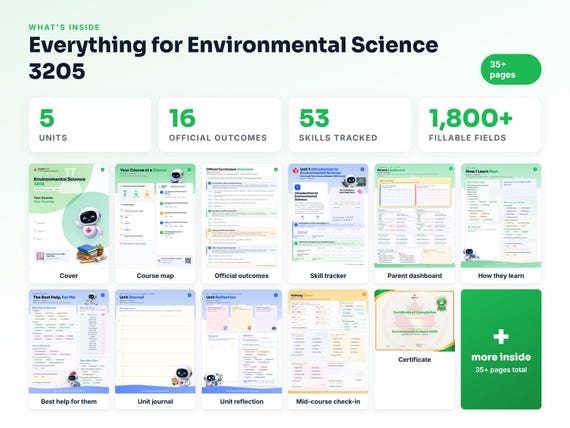
A Environmental Science 3205 workbook worth keeping
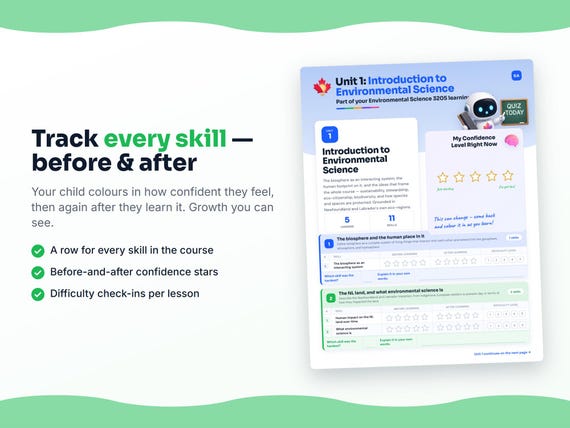
Built from the same official curriculum as this page. Before and after each skill above, your student colours in how sure they feel — so the two of you can see, on one page, what's clicking and what needs another look. It's a quiet way to follow how the year is really going.
By June it's full of their own handwriting: units worked through, confidence grown, a mid-year check-in, notes from parent-teacher night, and a certificate at the end. Less a worksheet, more a record of the year worth keeping on the shelf.
Instant download · see every page, reviews and the full description · five or more workbooks are $2.99 each
What it looks like in the app



Common questions
Can MapleMind help me with Environmental Science 3205?
Yes. MapleMind's AI tutor covers all 53 skills in Newfoundland and Labrador's Environmental Science 3205 — you pick the exact skill, and the tutor teaches it step by step: a short lesson, a worked example, solving together, then a skill check to show it stuck.
Is MapleMind aligned to Newfoundland and Labrador's official curriculum?
Yes. Every skill in this course maps to an official outcome code from Newfoundland and Labrador's Grade 12 Science curriculum, and the ministry's own wording is quoted under each unit on this page — with the official government source linked so you can check it yourself.
What does MapleMind cost?
It's free to start — 5 tutoring chats and a practice quiz every day, no credit card. A Pro subscription ($9.99/month or $49.99/year CAD, 7-day free trial) unlocks unlimited tutoring, practice, and exam simulations.
What if I'm stuck on just one topic?
That's the point of skill-level tutoring: open Environmental Science 3205 in the app, tap the exact skill from the list on this page, and the tutor teaches just that — no wading through lessons you don't need.
Does MapleMind work in French or other languages?
Yes — 14 languages, including French. Both the app and the tutor's explanations switch to the language you choose.
Where can I see the official Newfoundland and Labrador curriculum for Environmental Science 3205?
The official source is linked on this page — Newfoundland and Labrador's official curriculum. The outline here follows it: every MapleMind skill carries its official outcome code, and the ministry's own wording is quoted under each unit.
Keep exploring
Ready when you are
Pick a skill from this page and see it taught properly — free, in the browser, in under a minute.