Get help with Science 3200
Most tutoring makes you sit through material you already know. MapleMind flips that: pick the exact skill that's causing trouble — any of the 30 below — and the tutor teaches just that one, step by step, as many times as it takes. Ask questions in plain words, any time of day, in English, French, or 12 other languages.
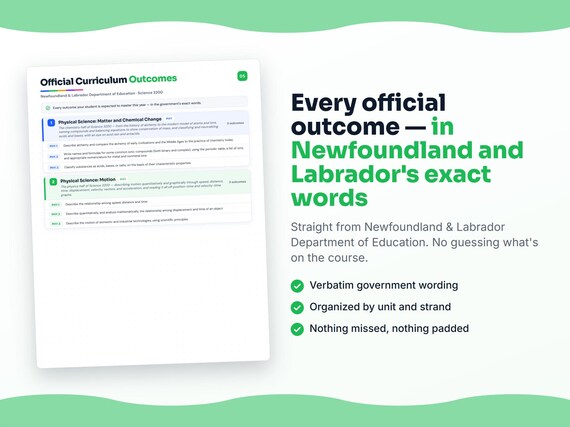
The official Newfoundland and Labrador Science 3200 curriculum
Newfoundland and Labrador defines Science 3200 by strands and outcomes. MapleMind teaches the same curriculum reorganized for one-skill-at-a-time tutoring — the table shows exactly where every official strand lands, and the ministry's own wording is quoted under each unit below.
Official source Newfoundland and Labrador's official curriculumRead it on the government site — gov.nl.ca ↗| Official strand | Outcomes | Where MapleMind teaches it |
|---|---|---|
| Strand 2 | 30 | Physical Science: Matter and Chemical Change · Physical Science: Motion |
Every skill below, taught one on one.
 Try the first session free
How MapleMind teaches Science 3200 — every unit, lesson, and skill
Every skill below runs as a short session: a plain-words lesson, a worked example, solving it together, then a five-question skill check that earns up to three stars. Guided Mode keeps it teaching instead of answer-handing — turning it off needs a parent's password.
Unit 1Physical Science: Matter and Chemical ChangeOfficial strand · Strand 2
The chemistry half of Science 3200 — from the history of alchemy to the modern model of atoms and ions, naming compounds and balancing equations to show conservation of mass, and classifying and neutralizing acids and bases, with an eye on acid rain and antacids.
Atoms, Ions, and the Periodic Table
- From alchemy to modern chemistrysci-3200.1.2.1 — Describe alchemy and compare the alchemy of early civilizations and the Middle Ages to chemistry today.
- Properties that distinguish substancessci-3200.1.2.2 — Identify the properties that allow substances to be distinguished from each other.
- Modelling atoms and ionssci-3200.1.2.3 — Use models to describe the structure and components of atoms and ions.
- Energy levels and photonssci-3200.1.2.4 — Explain the relationship between the energy levels in Bohr's model and the production of a photon.
- How Mendeleev built the periodic tablesci-3200.1.1.3 — Explain the roles of evidence, theories, and paradigms in the development of Mendeleev's periodic table.
Naming Compounds and Chemical Reactions
- Names and formulas of binary ionic compoundssci-3200.1.2.5 — Write names and formulas for common binary ionic compounds using the periodic table and a list of ions.
- Names of complex (polyatomic) ionic compoundssci-3200.1.2.6 — Write the names of complex (polyatomic) ionic compounds using the periodic table, a list of ions, and appropriate nomenclature.
- The usefulness of IUPAC nomenclaturesci-3200.1.1.6 — Describe the usefulness of IUPAC scientific nomenclature systems for conveying chemical information.
- Representing reactions and conservation of masssci-3200.1.2.7 — Represent chemical reactions and the conservation of mass using symbolic equations.
- Balancing symbolic equationssci-3200.1.2.8 — Represent chemical reactions and the conservation of mass using balanced symbolic equations.
Acids and Bases
- Classifying acids, bases, and salts by propertiessci-3200.1.2.9 — Classify substances as acids, bases, or salts on the basis of their characteristic properties.
- Classifying acids, bases, and salts by names and formulassci-3200.1.2.11 — Classify simple acids, bases, and salts on the basis of their names and formulas.
- Neutralization reactionssci-3200.1.2.10 — Describe how neutralization tempers the effects of an acid with a base and vice versa.
- Acids, bases, and air pollutionsci-3200.1.1.9 — Analyze the risks and benefits to society and the environment of applying knowledge of acids and bases to air pollution.
- How antacids worksci-3200.1.1.11 — Evaluate the effectiveness of antacids and the way they function using scientific principles.
The official wording — 15 outcomes in this unit
- sci-3200.1.2.1
Describe alchemy and compare the alchemy of early civilizations and the Middle Ages to the practice of chemistry today
- sci-3200.1.2.2
Identify properties that allow substances to be distinguished from each other
- sci-3200.1.2.3
Use models in describing the structure and components of atoms and ions
- sci-3200.1.2.4
Explain the relationship between the energy levels in Bohr
- sci-3200.1.1.3
Explain the roles of evidence, theories, and paradigms in the development of Mendeleev
- sci-3200.1.2.5
Write names and formulae for some common ionic compounds (both binary and complex), using the periodic table, a list of ions, and appropriate nomenclature for metal and nonmetal ions
- sci-3200.1.2.6
Write the names of complex (polyatomic) ionic compounds, using the periodic table, a list of ions, and appropriate nomenclature for metal and nonmetal ions
- sci-3200.1.1.6
Describe the usefulness of IUPAC scientific nomenclature systems to convey chemical information
- sci-3200.1.2.7
Represent chemical reactions and the conservation of mass, using symbolic equations
- sci-3200.1.2.8
Represent chemical reactions and the conservation of mass, using balanced symbolic equations
- sci-3200.1.2.9
Classify substances as acids, bases, or salts, on the basis of their characteristic properties
- sci-3200.1.2.11
Classify simple acids, bases and salts on the basis of their names and formulas
- sci-3200.1.2.10
Describe how neutralization involves tempering the effects of an acid with a base and vice versa
- sci-3200.1.1.9
Analyze the risks and benefits to society and the environment of applying knowledge of acids and bases to air pollution
- sci-3200.1.1.11
Evaluate the effectiveness of antacids and the way they function, using scientific principles
Unit 2Physical Science: MotionOfficial strand · Strand 2
The physics half of Science 3200 — describing motion quantitatively and graphically through speed, distance, time, displacement, velocity, vectors, and acceleration, and reading it all off position-time and velocity-time graphs.
Speed, Distance, and Time
- Speed, distance, and timesci-3200.1.2.12 — Describe the relationship among speed, distance, and time.
- Factors that affect speedsci-3200.1.2.13 — List the factors that affect the speed of an object.
- Analyzing average speed of linear motionsci-3200.1.2.14 — Describe quantitatively and analyze mathematically the relationship among distance, time, and average speed of linear motion.
- Analyzing speed graphically and mathematicallysci-3200.1.2.15 — Describe quantitatively and analyze both graphically and mathematically the relationship among distance, time, and speed of linear motion.
Displacement, Velocity, and Acceleration
- Displacement and time in uniform motionsci-3200.1.2.16 — Describe quantitatively and analyze mathematically the relationship among displacement and time for uniform motion.
- Displacement, time, and velocity in uniform motionsci-3200.1.2.18 — Describe quantitatively and analyze mathematically the relationship among displacement, time, and velocity for uniform motion.
- Instantaneous and average velocitysci-3200.1.2.19 — Distinguish between instantaneous and average velocity.
- Using vectors to represent velocitysci-3200.1.2.20 — Use vectors to represent velocity.
- Position-time graphssci-3200.1.2.21 — Display and analyze position and time information in a properly labelled position-time graph.
- Analyzing displacements graphicallysci-3200.1.2.17 — Analyze graphically the relationship among displacements.
- Velocity, time, and accelerationsci-3200.1.2.22 — Describe quantitatively the relationship among velocity, time, and acceleration.
- Acceleration on a velocity-time graphsci-3200.1.2.23 — Describe graphically the relationship among velocity, time, and acceleration.
Motion in Technology and Working Safely
- Motion of technologiessci-3200.1.1.30 — Describe the motion of domestic and industrial technologies using scientific principles.
- WHMIS and safe handling of lab materialssci-3200.1.3.2 — Demonstrate a knowledge of WHMIS standards for handling and disposing of lab materials.
- Displaying data in tables and graphssci-3200.1.3.32 — Compile and display evidence and information, by hand or computer, in tables and graphs.
The official wording — 15 outcomes in this unit
- sci-3200.1.2.12
Describe the relationship among speed, distance and time
- sci-3200.1.2.13
List factors which affect the speed of an object
- sci-3200.1.2.14
Describe quantitatively, and analyze mathematically, the relationship among distance, time, and average speed of an object
- sci-3200.1.2.15
Describe quantitatively, and analyze both graphically and mathematically, the relationship among distance, time, and speed of an object
- sci-3200.1.2.16
Describe quantitatively, and analyze mathematically, the relationship among displacement and time of an object
- sci-3200.1.2.18
Describe quantitatively, and analyze mathematically, the relationship among displacement, time, and velocity of an object
- sci-3200.1.2.19
Distinguish between instantaneous and average velocity
- sci-3200.1.2.20
Use vectors to represent velocity
- sci-3200.1.2.21
Display and analyze position and time information, by hand or computer in a properly labeled position-time graph
- sci-3200.1.2.17
Analyze graphically the relationship among displacements
- sci-3200.1.2.22
Describe quantitatively the relationship among velocity, time, and acceleration
- sci-3200.1.2.23
Describe graphically the relationship among velocity, time and acceleration
- sci-3200.1.1.30
Describe the motion of domestic and industrial technologies, using scientific principles
- sci-3200.1.3.2
Demonstrate a knowledge of WHMIS standards by selecting and applying proper techniques for handling and disposing of lab materials
- sci-3200.1.3.32
Compile and display evidence and information, by hand or computer, in a variety of formats, including tables and graphs
Printable workbook · A keepsake of the year
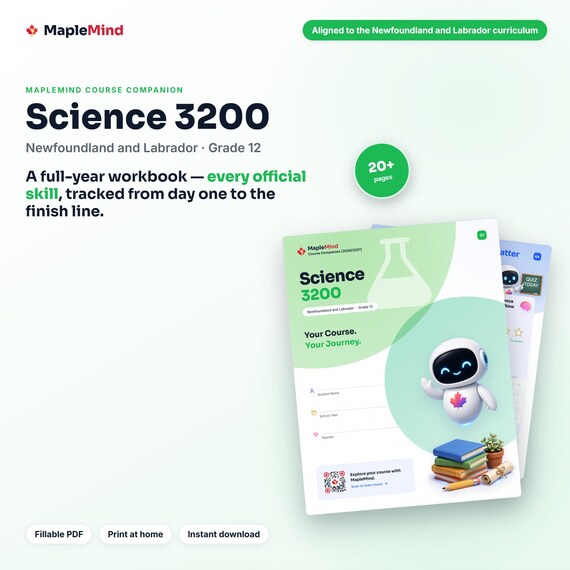
A Science 3200 workbook worth keeping
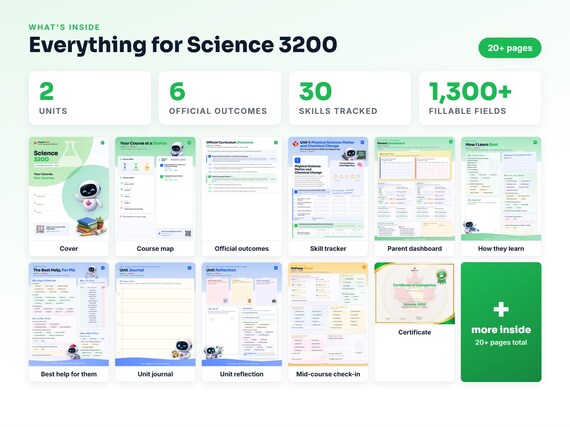
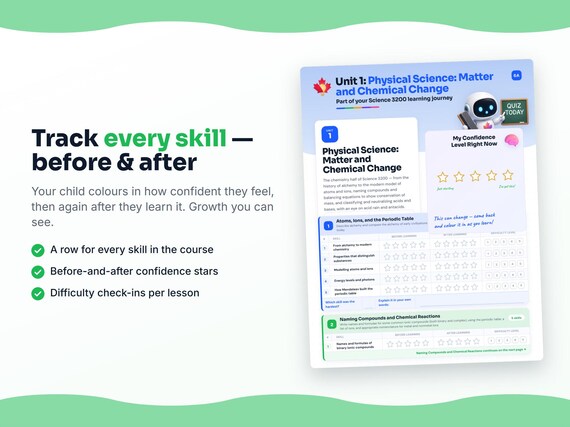
Built from the same official curriculum as this page. Before and after each skill above, your student colours in how sure they feel — so the two of you can see, on one page, what's clicking and what needs another look. It's a quiet way to follow how the year is really going.
By June it's full of their own handwriting: units worked through, confidence grown, a mid-year check-in, notes from parent-teacher night, and a certificate at the end. Less a worksheet, more a record of the year worth keeping on the shelf.
Instant download · see every page, reviews and the full description · five or more workbooks are $2.99 each
What it looks like in the app



Common questions
Can MapleMind help me with Science 3200?
Yes. MapleMind's AI tutor covers all 30 skills in Newfoundland and Labrador's Science 3200 — you pick the exact skill, and the tutor teaches it step by step: a short lesson, a worked example, solving together, then a skill check to show it stuck.
Is MapleMind aligned to Newfoundland and Labrador's official curriculum?
Yes. Every skill in this course maps to an official outcome code from Newfoundland and Labrador's Grade 12 Science curriculum, and the ministry's own wording is quoted under each unit on this page — with the official government source linked so you can check it yourself.
What does MapleMind cost?
It's free to start — 5 tutoring chats and a practice quiz every day, no credit card. A Pro subscription ($9.99/month or $49.99/year CAD, 7-day free trial) unlocks unlimited tutoring, practice, and exam simulations.
What if I'm stuck on just one topic?
That's the point of skill-level tutoring: open Science 3200 in the app, tap the exact skill from the list on this page, and the tutor teaches just that — no wading through lessons you don't need.
Does MapleMind work in French or other languages?
Yes — 14 languages, including French. Both the app and the tutor's explanations switch to the language you choose.
Where can I see the official Newfoundland and Labrador curriculum for Science 3200?
The official source is linked on this page — Newfoundland and Labrador's official curriculum. The outline here follows it: every MapleMind skill carries its official outcome code, and the ministry's own wording is quoted under each unit.
Keep exploring
Ready when you are
Pick a skill from this page and see it taught properly — free, in the browser, in under a minute.