Get help with Physics 3204
Most tutoring makes you sit through material you already know. MapleMind flips that: pick the exact skill that's causing trouble — any of the 27 below — and the tutor teaches just that one, step by step, as many times as it takes. Ask questions in plain words, any time of day, in English, French, or 12 other languages.
The official Newfoundland and Labrador Physics 3204 curriculum
Newfoundland and Labrador defines Physics 3204 by strands and outcomes. MapleMind teaches the same curriculum reorganized for one-skill-at-a-time tutoring — the table shows exactly where every official strand lands, and the ministry's own wording is quoted under each unit below.
Official source Newfoundland and Labrador's official curriculumRead it on the government site — gov.nl.ca ↗| Official strand | Outcomes | Where MapleMind teaches it |
|---|---|---|
| Strand 5 | 5 | Motion |
| Strand 6 | 4 | Forces |
| Strand 7 | 10 | Fields |
| Strand 8 | 8 | Introduction to Quantum Physics |
Every skill below, taught one on one.
 Try the first session free
How MapleMind teaches Physics 3204 — every unit, lesson, and skill
Every skill below runs as a short session: a plain-words lesson, a worked example, solving it together, then a five-question skill check that earns up to three stars. Guided Mode keeps it teaching instead of answer-handing — turning it off needs a parent's password.
Unit 1MotionOfficial strand · Strand 5
Two-dimensional motion — vectors for displacement, velocity, acceleration, and force, frames of reference, motion in horizontal and vertical planes, projectile motion, and 2-D conservation of momentum. STSE and inquiry skills woven through.
Two-dimensional kinematics
- Vectors in two dimensionssci-phys-3204.2.1.1 — Use vectors to represent displacement, velocity, acceleration, and force.
- Frames of referencesci-phys-3204.2.1.2 — Identify the frame of reference for a given motion.
- Motion in horizontal and vertical planessci-phys-3204.2.1.3 — Analyze quantitatively two-dimensional motion in a horizontal plane and a vertical plane.
- Projectile motionsci-phys-3204.2.1.4 — Analyze quantitatively the horizontal and vertical motion of a projectile.
- Conservation of momentum in 2-Dsci-phys-3204.2.1.5 — Apply the law of conservation of momentum quantitatively to two-dimensional collisions and explosions.
The official wording — 5 outcomes in this unit
- sci-phys-3204.2.1.1
Use vectors to represent displacement, velocity, acceleration, and force
- sci-phys-3204.2.1.2
Identify the frame of reference for a given motion
- sci-phys-3204.2.1.3
Analyze quantitatively two-dimensional motion in a horizontal plane and a vertical plane
- sci-phys-3204.2.1.4
Analyze quantitatively the horizontal and vertical motion of a projectile
- sci-phys-3204.2.1.5
Apply quantitatively the laws of conservation of momentum to two dimensional collisions and explosions
Unit 2ForcesOfficial strand · Strand 6
Circular motion and equilibrium — uniform circular motion by vectors, circular motion via Newton's laws, motion in parallel and perpendicular planes, and 2-D static equilibrium and torque. STSE and inquiry skills woven through.
Circular motion and equilibrium
- Uniform circular motionsci-phys-3204.2.2.1 — Describe uniform circular motion using algebraic and vector analysis.
- Circular motion and Newton's lawssci-phys-3204.2.2.2 — Explain quantitatively circular motion using Newton's laws.
- Motion in parallel and perpendicular planessci-phys-3204.2.2.3 — Analyze quantitatively two-dimensional motion in a parallel and perpendicular plane.
- Static equilibrium and torquesci-phys-3204.2.2.4 — Analyze quantitatively two-dimensional systems involving mass, static equilibrium, and torques.
The official wording — 4 outcomes in this unit
- sci-phys-3204.2.2.1
Describe uniform circular motion, using algebraic and vector analysis
- sci-phys-3204.2.2.2
Explain quantitatively circular motion using Newton's laws
- sci-phys-3204.2.2.3
Analyze quantitatively two dimensional motion in a parallel and perpendicular plane
- sci-phys-3204.2.2.4
Analyze quantitatively two-dimensional systems involving mass, static equilibrium, and torques
Unit 3FieldsOfficial strand · Strand 7
Field theory — gravitational, electric, and magnetic fields, Newton's law of gravitation, Coulomb's law, circuit analysis, magnetic fields from currents, forces on moving charges, electromagnetic induction, and motors and generators. STSE and inquiry skills woven through.
Gravitational and electric fields
- Gravitational fieldssci-phys-3204.2.3.1 — Describe gravitational field as regions of space that affect mass.
- Newton's law of universal gravitationsci-phys-3204.2.3.2 — Apply Newton's universal law of gravitation quantitatively.
- Electric fieldssci-phys-3204.2.3.3 — Describe electric fields as regions of space that affect charge.
- Coulomb's lawsci-phys-3204.2.3.4 — Apply Coulomb's law quantitatively.
- Analyzing electric circuitssci-phys-3204.2.3.5 — Analyze electric circuits with respect to energy, voltage, current, resistance, and power.
Magnetism and electromagnetic induction
- Magnetic fieldssci-phys-3204.2.3.6 — Describe magnetic fields as regions of space that affect mass and charge.
- Magnetic fields from currentssci-phys-3204.2.3.7 — Describe the magnetic field produced by current in a solenoid and a long straight conductor.
- Forces on moving charges and currentssci-phys-3204.2.3.8 — Analyze qualitatively and quantitatively the forces on a moving charge and on an electric current in a uniform magnetic field.
- Electromagnetic inductionsci-phys-3204.2.3.9 — Analyze qualitatively and quantitatively electromagnetic induction by a changing magnetic flux and a moving conductor.
- Motors and generatorssci-phys-3204.2.3.10 — Compare and contrast how a motor and a generator function using the principles of electromagnetism.
The official wording — 10 outcomes in this unit
- sci-phys-3204.2.3.1
Describe gravitational field as regions of space that affect mass
- sci-phys-3204.2.3.2
Apply Newton’s universal law of gravitation quantitatively
- sci-phys-3204.2.3.3
Describe electric fields as regions of space that affect charge
- sci-phys-3204.2.3.4
Apply Coulomb’s law quantitatively
- sci-phys-3204.2.3.5
Analyze electric circuits with respect to energy, voltage, current, resistance, and power
- sci-phys-3204.2.3.6
Describe magnetic fields as regions of space that affect mass and charge
- sci-phys-3204.2.3.7
Describe the magnetic field produced by current in both a solenoid and a long, straight conductor
- sci-phys-3204.2.3.8
Analyze, qualitatively and quantitatively, the forces acting on a moving charge and on an electric current in a uniform magnetic field
- sci-phys-3204.2.3.9
Analyze, qualitatively and quantitatively, electromagnetic induction by both a changing magnetic flux and a moving conductor
- sci-phys-3204.2.3.10
Compare and contrast the way a motor and a generator function, using the principles of electromagnetism
Unit 4Introduction to Quantum PhysicsOfficial strand · Strand 8
The quantum revolution — blackbody radiation and the photoelectric effect, the Compton effect, the Bohr model and atomic spectra, luminous phenomena, the wave-particle nature of light, and the de Broglie hypothesis. STSE and inquiry skills woven through.
The quantum of light
- Blackbody radiation and the photoelectric effectsci-phys-3204.2.4.1 — Describe how the quantum energy concept explains blackbody radiation and the photoelectric effect.
- The photoelectric effect quantitativelysci-phys-3204.2.4.2 — Explain qualitatively and quantitatively the photoelectric effect.
- The Compton effectsci-phys-3204.2.4.3 — Explain the Compton effect using mechanics, conservation of momentum, and the nature of light.
The atom and matter waves
- The Bohr atomic modelsci-phys-3204.2.4.4 — Explain quantitatively the Bohr atomic model as a synthesis of classical and quantum concepts.
- Energy levels and emitted photonssci-phys-3204.2.4.5 — Explain the relationship between energy levels in Bohr's model, the energy difference between levels, and the energy of emitted photons.
- Quantum explanation of luminous phenomenasci-phys-3204.2.4.6 — Use the quantum mechanical model to explain natural luminous phenomena.
- Wave and particle models of lightsci-phys-3204.2.4.7 — Summarize the evidence for the wave and particle models of light.
- The de Broglie hypothesissci-phys-3204.2.4.8 — Explain the de Broglie hypothesis.
The official wording — 8 outcomes in this unit
- sci-phys-3204.2.4.1
Describe how the quantum energy concept explains blackbody radiation and the photoelectric effect
- sci-phys-3204.2.4.2
Explain qualitatively and quantitatively the photoelectric effect
- sci-phys-3204.2.4.3
Explain the Compton effect using the laws of mechanics, the conservation of momentum, and the nature of light
- sci-phys-3204.2.4.4
Explain quantitatively the Bohr atomic model as a synthesis of classical and quantum concepts
- sci-phys-3204.2.4.5
Explain the relationship between the energy levels in Bohr’s model, the energy difference between the levels, and the energy of the emitted photons
- sci-phys-3204.2.4.6
Use the quantum mechanical model to explain natural luminous phenomena
- sci-phys-3204.2.4.7
Summarize the evidence for the wave and particle models of light
- sci-phys-3204.2.4.8
Explain the de Broglie hypothesis
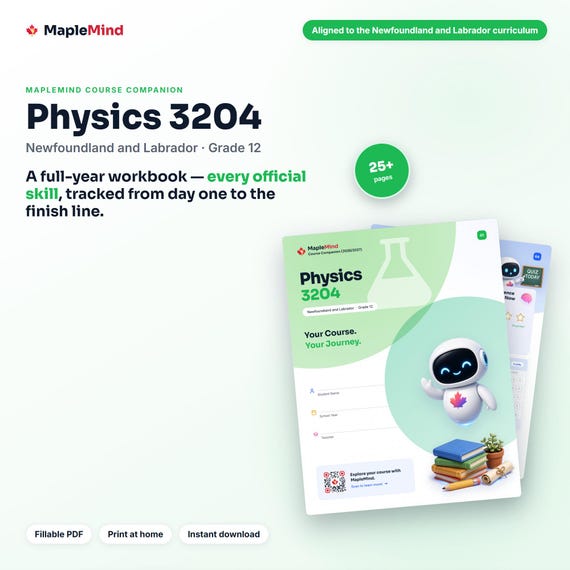
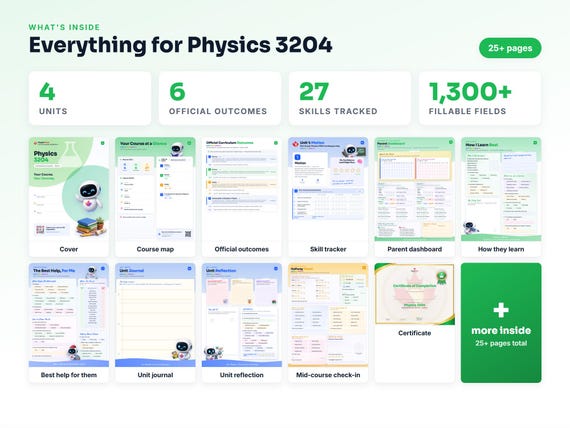


Printable workbook · A keepsake of the year
A Physics 3204 workbook worth keeping
Built from the same official curriculum as this page. Before and after each skill above, your student colours in how sure they feel — so the two of you can see, on one page, what's clicking and what needs another look. It's a quiet way to follow how the year is really going.
By June it's full of their own handwriting: units worked through, confidence grown, a mid-year check-in, notes from parent-teacher night, and a certificate at the end. Less a worksheet, more a record of the year worth keeping on the shelf.
Instant download · see every page, reviews and the full description · five or more workbooks are $2.99 each
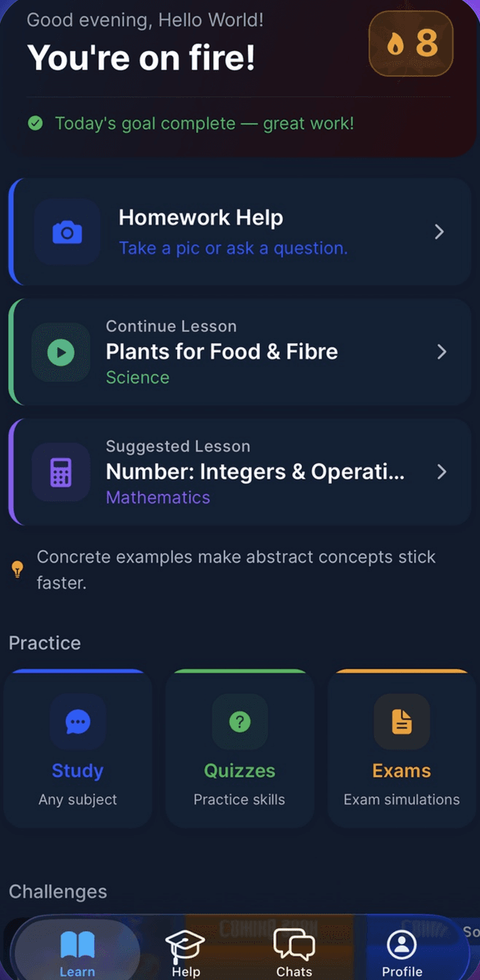
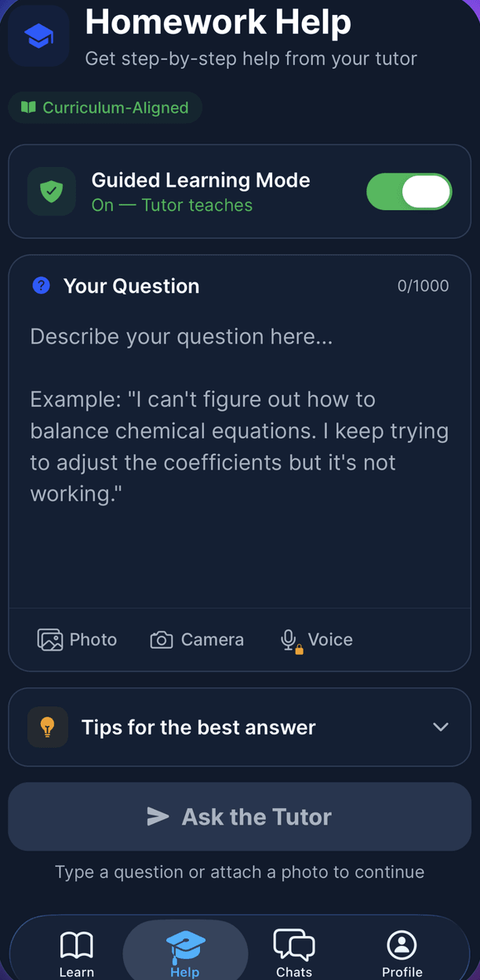
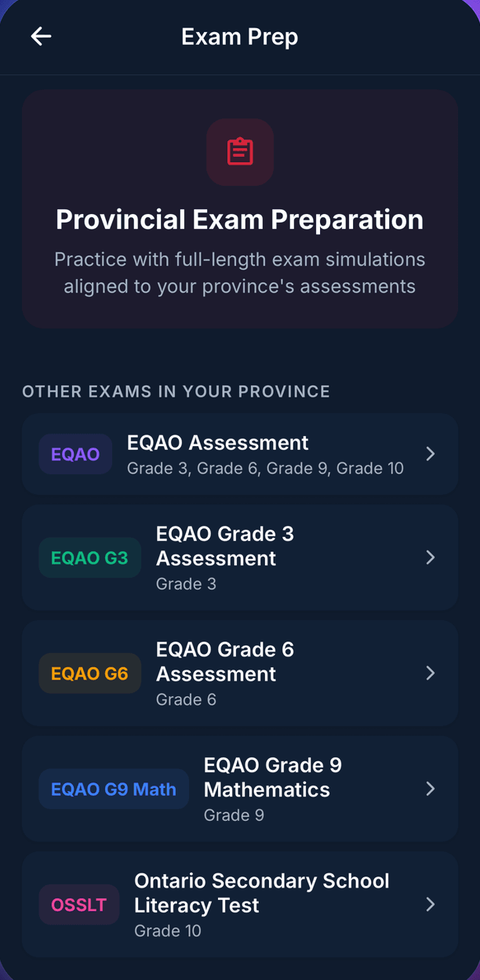
What it looks like in the app
Common questions
Can MapleMind help me with Physics 3204?
Yes. MapleMind's AI tutor covers all 27 skills in Newfoundland and Labrador's Physics 3204 — you pick the exact skill, and the tutor teaches it step by step: a short lesson, a worked example, solving together, then a skill check to show it stuck.
Is MapleMind aligned to Newfoundland and Labrador's official curriculum?
Yes. Every skill in this course maps to an official outcome code from Newfoundland and Labrador's Grade 12 Science curriculum, and the ministry's own wording is quoted under each unit on this page — with the official government source linked so you can check it yourself.
What does MapleMind cost?
It's free to start — 5 tutoring chats and a practice quiz every day, no credit card. A Pro subscription ($9.99/month or $49.99/year CAD, 7-day free trial) unlocks unlimited tutoring, practice, and exam simulations.
What if I'm stuck on just one topic?
That's the point of skill-level tutoring: open Physics 3204 in the app, tap the exact skill from the list on this page, and the tutor teaches just that — no wading through lessons you don't need.
Does MapleMind work in French or other languages?
Yes — 14 languages, including French. Both the app and the tutor's explanations switch to the language you choose.
Where can I see the official Newfoundland and Labrador curriculum for Physics 3204?
The official source is linked on this page — Newfoundland and Labrador's official curriculum. The outline here follows it: every MapleMind skill carries its official outcome code, and the ministry's own wording is quoted under each unit.
Keep exploring
Ready when you are
Pick a skill from this page and see it taught properly — free, in the browser, in under a minute.