Get help with Chemistry 2202
Most tutoring makes you sit through material you already know. MapleMind flips that: pick the exact skill that's causing trouble — any of the 31 below — and the tutor teaches just that one, step by step, as many times as it takes. Ask questions in plain words, any time of day, in English, French, or 12 other languages.
The official Newfoundland and Labrador Chemistry 2202 curriculum
Newfoundland and Labrador defines Chemistry 2202 by strands and outcomes. MapleMind teaches the same curriculum reorganized for one-skill-at-a-time tutoring — the table shows exactly where every official strand lands, and the ministry's own wording is quoted under each unit below.
Official source Newfoundland and Labrador's official curriculumRead it on the government site — gov.nl.ca ↗| Official strand | Outcomes | Where MapleMind teaches it |
|---|---|---|
| Strand 5 | 10 | Stoichiometry |
| Strand 6 | 13 | From Structures to Properties |
| Strand 7 | 8 | Organic Chemistry |
Every skill below, taught one on one.
 Try the first session free
How MapleMind teaches Chemistry 2202 — every unit, lesson, and skill
Every skill below runs as a short session: a plain-words lesson, a worked example, solving it together, then a five-question skill check that earns up to three stars. Guided Mode keeps it teaching instead of answer-handing — turning it off needs a parent's password.
Unit 1StoichiometryOfficial strand · Strand 5
Naming and formula-writing, the mole and molar mass, solubility and equilibrium in solution, and the quantitative relationships in chemical reactions. STSE framing and inquiry/safety skills woven through.
Formulas, names, and the mole
- Naming and writing chemical formulassci-chem-2202.2.1.1 — Write and name the formulas of ionic and molecular compounds using simple IUPAC rules.
- Molar mass and mole-mass conversionssci-chem-2202.2.1.2 — Define molar mass and perform mole-mass inter-conversions for pure substances.
Solubility and equilibrium in solution
- Solubility and equilibriumsci-chem-2202.2.1.3 — Explain solubility using the concept of equilibrium.
- Equilibrium in solutionssci-chem-2202.2.1.4 — Define the concept of equilibrium as it pertains to solutions.
- Variations in solubilitysci-chem-2202.2.1.5 — Explain the variations in solubility of different pure substances in the same solvent.
- Predicting precipitatessci-chem-2202.2.1.6 — Use solubility generalizations to predict the formation of precipitates.
Reaction stoichiometry
- Mole ratios from balanced equationssci-chem-2202.2.1.7 — Identify mole ratios of reactants and products from balanced chemical equations.
- Stoichiometric calculationssci-chem-2202.2.1.8 — Perform stoichiometric calculations related to chemical equations.
- Maximizing yieldsci-chem-2202.2.1.9 — Predict how the yield of a chemical process can be maximized.
- Stoichiometric applicationssci-chem-2202.2.1.10 — Identify various applications of stoichiometry.
The official wording — 10 outcomes in this unit
- sci-chem-2202.2.1.1
Write and name the formulas of ionic and molecular compounds, following simple IUPAC rules
- sci-chem-2202.2.1.2
Define molar mass and perform mole-mass inter-conversions for pure substances
- sci-chem-2202.2.1.3
Explain solubility, using the concept of equilibrium
- sci-chem-2202.2.1.4
Define the concept of equilibrium as it pertains to solutions
- sci-chem-2202.2.1.5
Explain the variations in the solubility of various pure substances, given the same solvent
- sci-chem-2202.2.1.6
Use the solubility generalizations to predict the formation of precipitates
- sci-chem-2202.2.1.7
Identify mole ratios of reactants and products from balanced chemical equations
- sci-chem-2202.2.1.8
Perform stoichiometric calculations related to chemical equations
- sci-chem-2202.2.1.9
Predict how the yield of a particular chemical process can be maximized
- sci-chem-2202.2.1.10
Identify various stoichiometric applications
Unit 2From Structures to PropertiesOfficial strand · Strand 6
How bonding and structure explain the properties of substances — covalent, ionic, and metallic bonding, intermolecular forces, dissolving, and classifying substances. STSE and inquiry skills woven through.
Covalent bonding and molecular substances
- Formation of covalent bondssci-chem-2202.2.2.1 — Illustrate and explain the formation of covalent bonds.
- Structural model and electron pairssci-chem-2202.2.2.2 — Explain the structural model of a molecular substance in terms of its electron pairs.
- Hydrogen bonds and van der Waals forcessci-chem-2202.2.2.3 — Illustrate and explain hydrogen bonds and van der Waals' forces.
- Properties of molecular substancessci-chem-2202.2.2.4 — Identify and describe the properties of molecular substances.
- Intermolecular forces and propertiessci-chem-2202.2.2.5 — Describe how intermolecular forces account for the properties of molecular compounds.
Ionic and metallic bonding; dissolving and classification
- Formation of ionic bondssci-chem-2202.2.2.6 — Illustrate and explain the formation of ionic bonds.
- Structural model of ionic substancessci-chem-2202.2.2.7 — Explain the structural model of an ionic substance in terms of the bonds that define it.
- Properties of ionic substancessci-chem-2202.2.2.8 — Identify and describe the properties of ionic substances and relate them to ionic bonding and structure.
- Metallic bondingsci-chem-2202.2.2.9 — Illustrate and explain the formation of metallic bonds and how their structure accounts for the properties of metals.
- The process of dissolvingsci-chem-2202.2.2.10 — Describe the process of dissolving using intramolecular and intermolecular forces.
- Molar solubility in watersci-chem-2202.2.2.11 — Determine the molar solubility of a pure substance in water.
- Solutes and freezing pointsci-chem-2202.2.2.12 — Explain the effect of solutes on the melting point of solid water using intermolecular forces.
- Classifying ionic, molecular, and metallic substancessci-chem-2202.2.2.13 — Classify ionic, molecular, and metallic substances according to their properties.
The official wording — 13 outcomes in this unit
- sci-chem-2202.2.2.1
Illustrate and explain the formation of covalent bonds
- sci-chem-2202.2.2.2
Explain the structural model of a molecular substance in terms of the various electron pairs that define it
- sci-chem-2202.2.2.3
Illustrate and explain hydrogen bonds and van der Waals’ forces
- sci-chem-2202.2.2.4
Identify and describe the properties of molecular substances
- sci-chem-2202.2.2.5
Describe how intermolecular forces account for the properties of molecular compounds
- sci-chem-2202.2.2.6
Illustrate and explain the formation of ionic bonds
- sci-chem-2202.2.2.7
Explain the structural model of an ionic substance in terms of the various bonds that define it
- sci-chem-2202.2.2.8
Identify and describe the properties of ionic substances and relate them to iconic bonding and their structure
- sci-chem-2202.2.2.9
Illustrate and explain the formation of metallic bonds and how their structure accounts for the properties of metallic substances
- sci-chem-2202.2.2.10
Describe the process of dissolving, using concepts of intramolecular and intermolecular forces
- sci-chem-2202.2.2.11
Determine the molar solubility of a pure substance in water
- sci-chem-2202.2.2.12
Explain the effect of solutes on the melting point of solid water, using intermolecular forces
- sci-chem-2202.2.2.13
Classify ionic, molecular, and metallic substances according to their properties
Unit 3Organic ChemistryOfficial strand · Strand 7
The chemistry of carbon — why carbon builds so many compounds, organic families, IUPAC naming of aliphatics, aromatics and derivatives, isomers, organic reactions, and polymers. STSE and inquiry skills woven through.
Carbon and organic families
- Carbon and the diversity of organic compoundssci-chem-2202.2.3.1 — Explain the large number and diversity of organic compounds through the unique nature of the carbon atom.
- Classifying organic compoundssci-chem-2202.2.3.2 — Classify organic compounds by the families they belong to, based on names or structures.
- Naming aliphatic compoundssci-chem-2202.2.3.3 — Write the formula and IUPAC name for a variety of aliphatic compounds.
- Isomerssci-chem-2202.2.3.4 — Define isomers and illustrate the structural formulas of a variety of organic isomers.
Aromatics, derivatives, reactions, and polymers
- Naming aromatic compoundssci-chem-2202.2.3.5 — Write the formula and IUPAC name for a variety of aromatic compounds.
- Naming hydrocarbon derivativessci-chem-2202.2.3.6 — Write the formula and IUPAC name for a variety of hydrocarbon derivatives.
- Reactions of organic compoundssci-chem-2202.2.3.7 — Write and balance chemical equations to predict the reactions of selected organic compounds.
- Polymerization and polymerssci-chem-2202.2.3.8 — Describe processes of polymerization and identify important natural and synthetic polymers.
The official wording — 8 outcomes in this unit
- sci-chem-2202.2.3.1
Explain the large number and diversity of organic compounds with reference to the unique nature of the carbon atom
- sci-chem-2202.2.3.2
Classify various organic compounds by determining to which families they belong, based on their names or structures
- sci-chem-2202.2.3.3
Write the formula and provide the IUPAC name for a variety of aliphatic compounds
- sci-chem-2202.2.3.4
Define isomers and illustrate the structural formulas for a variety of organic isomers
- sci-chem-2202.2.3.5
Write the formula and provide the IUPAC name for a variety of aromatic compounds
- sci-chem-2202.2.3.6
Write the formula and provide the IUPAC name for a variety of hydrocarbon derivatives
- sci-chem-2202.2.3.7
Write and balance chemical equations to predict the reactions of selected organic compounds
- sci-chem-2202.2.3.8
Describe processes of polymerization and identify some important natural and synthetic polymers
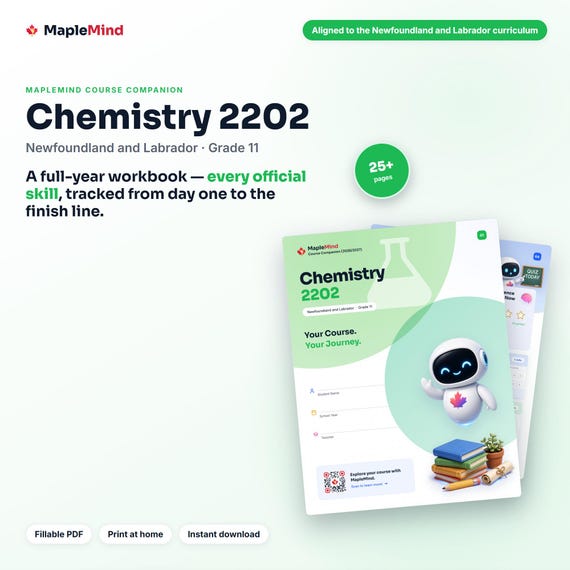
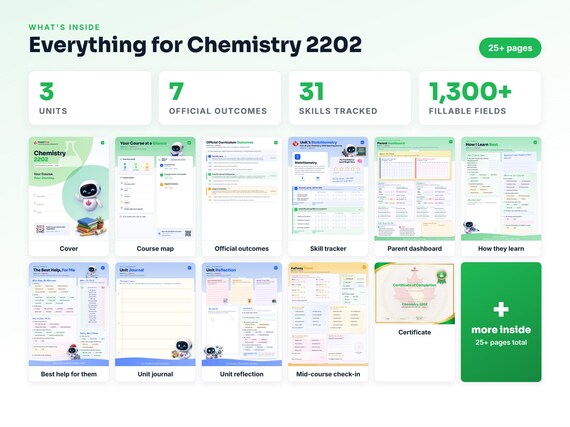
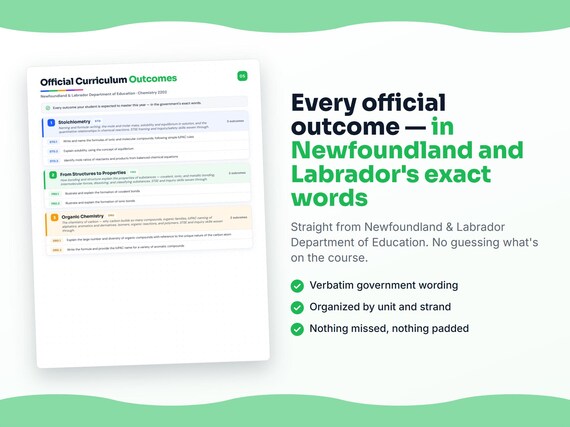
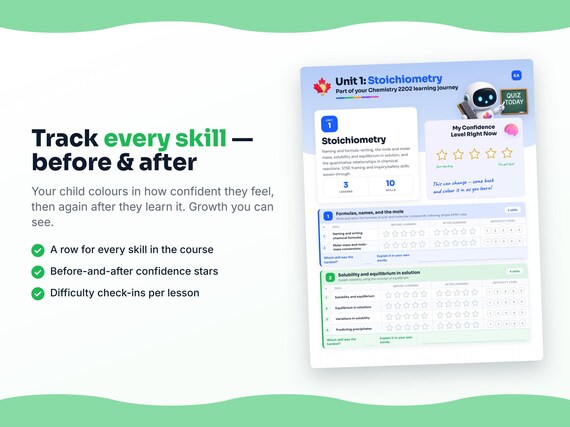
Printable workbook · A keepsake of the year
A Chemistry 2202 workbook worth keeping
Built from the same official curriculum as this page. Before and after each skill above, your student colours in how sure they feel — so the two of you can see, on one page, what's clicking and what needs another look. It's a quiet way to follow how the year is really going.
By June it's full of their own handwriting: units worked through, confidence grown, a mid-year check-in, notes from parent-teacher night, and a certificate at the end. Less a worksheet, more a record of the year worth keeping on the shelf.
Instant download · see every page, reviews and the full description · five or more workbooks are $2.99 each
What it looks like in the app



Common questions
Can MapleMind help me with Chemistry 2202?
Yes. MapleMind's AI tutor covers all 31 skills in Newfoundland and Labrador's Chemistry 2202 — you pick the exact skill, and the tutor teaches it step by step: a short lesson, a worked example, solving together, then a skill check to show it stuck.
Is MapleMind aligned to Newfoundland and Labrador's official curriculum?
Yes. Every skill in this course maps to an official outcome code from Newfoundland and Labrador's Grade 11 Science curriculum, and the ministry's own wording is quoted under each unit on this page — with the official government source linked so you can check it yourself.
What does MapleMind cost?
It's free to start — 5 tutoring chats and a practice quiz every day, no credit card. A Pro subscription ($9.99/month or $49.99/year CAD, 7-day free trial) unlocks unlimited tutoring, practice, and exam simulations.
What if I'm stuck on just one topic?
That's the point of skill-level tutoring: open Chemistry 2202 in the app, tap the exact skill from the list on this page, and the tutor teaches just that — no wading through lessons you don't need.
Does MapleMind work in French or other languages?
Yes — 14 languages, including French. Both the app and the tutor's explanations switch to the language you choose.
Where can I see the official Newfoundland and Labrador curriculum for Chemistry 2202?
The official source is linked on this page — Newfoundland and Labrador's official curriculum. The outline here follows it: every MapleMind skill carries its official outcome code, and the ministry's own wording is quoted under each unit.
Keep exploring
Ready when you are
Pick a skill from this page and see it taught properly — free, in the browser, in under a minute.