Get help with Physics 2204
Most tutoring makes you sit through material you already know. MapleMind flips that: pick the exact skill that's causing trouble — any of the 33 below — and the tutor teaches just that one, step by step, as many times as it takes. Ask questions in plain words, any time of day, in English, French, or 12 other languages.
The official Newfoundland and Labrador Physics 2204 curriculum
Newfoundland and Labrador defines Physics 2204 by strands and outcomes. MapleMind teaches the same curriculum reorganized for one-skill-at-a-time tutoring — the table shows exactly where every official strand lands, and the ministry's own wording is quoted under each unit below.
Official source Newfoundland and Labrador's official curriculumRead it on the government site — gov.nl.ca ↗| Official strand | Outcomes | Where MapleMind teaches it |
|---|---|---|
| Strand 5 | 3 | Kinematics |
| Strand 6 | 5 | Dynamics |
| Strand 7 | 16 | Work and Energy |
| Strand 8 | 9 | Waves |
Every skill below, taught one on one.
 Try the first session free
How MapleMind teaches Physics 2204 — every unit, lesson, and skill
Every skill below runs as a short session: a plain-words lesson, a worked example, solving it together, then a five-question skill check that earns up to three stars. Guided Mode keeps it teaching instead of answer-handing — turning it off needs a parent's password.
Unit 1KinematicsOfficial strand · Strand 5
Describing motion with vectors — displacement, velocity, and acceleration — analyzing horizontal and vertical motion, and choosing a frame of reference. STSE and inquiry skills woven through.
Describing motion
- Vectors for displacement, velocity, and accelerationsci-phys-2204.2.1.1 — Use vectors to represent displacement, velocity, and acceleration.
- Analyzing 1-D motion quantitativelysci-phys-2204.2.1.2 — Analyze quantitatively the horizontal or vertical motion of an object.
- Frames of referencesci-phys-2204.2.1.3 — Identify the frame of reference for a given motion.
The official wording — 3 outcomes in this unit
- sci-phys-2204.2.1.1
Use vectors to represent displacement, velocity, and acceleration
- sci-phys-2204.2.1.2
Analyze quantitatively the horizontal or vertical motion of an object
- sci-phys-2204.2.1.3
Identify the frame of reference for a given motion
Unit 2DynamicsOfficial strand · Strand 6
The causes of motion — force and acceleration vectors, Newton's laws, impulse and momentum, a design challenge, and conservation of momentum in 1-D. STSE and inquiry skills woven through.
Forces and Newton's laws
- Vectors for force and accelerationsci-phys-2204.2.2.1 — Use vectors to represent force and acceleration.
- Newton's laws of motionsci-phys-2204.2.2.2 — Apply Newton's laws to explain inertia, the force-mass-acceleration relationship, and interacting forces.
Impulse, momentum, and collisions
- Impulse and momentumsci-phys-2204.2.2.3 — Apply Newton's laws quantitatively to impulse and momentum.
- Egg-drop design challengesci-phys-2204.2.2.4 — Engage in a design challenge to create a structure to protect an egg when dropped from a height.
- Conservation of momentum in 1-Dsci-phys-2204.2.2.5 — Apply the law of conservation of momentum quantitatively to one-dimensional collisions and explosions.
The official wording — 5 outcomes in this unit
- sci-phys-2204.2.2.1
Use vectors to represent force and acceleration
- sci-phys-2204.2.2.2
Apply Newton’s laws of motion to explain inertia, the relationship between force, mass, and acceleration, and the interaction of forces between two objects
- sci-phys-2204.2.2.3
Apply quantitatively Newton’s laws of motion to impulse and momentum
- sci-phys-2204.2.2.4
Engage in a design challenge to create a structure to protect an egg when dropped from a height
- sci-phys-2204.2.2.5
Apply quantitatively the laws of conservation of momentum to one dimensional collisions and explosions
Unit 3Work and EnergyOfficial strand · Strand 7
Work, kinetic and potential energy, the work-energy theorem, conservation of energy, efficiency, power, springs, simple harmonic motion, elastic/inelastic collisions, and an introduction to radioactivity and nuclear energy. STSE and inquiry skills woven through.
Work, energy, and power
- Force, distance, and worksci-phys-2204.2.3.1 — Analyze quantitatively the relationships among force, distance, and work.
- Energy, mass, height, and speedsci-phys-2204.2.3.2 — Analyze quantitatively the relationships among mass, height, and speed using energy.
- The work-energy theoremsci-phys-2204.2.3.3 — Analyze common energy transformation situations using the work-energy theorem.
- Mechanical energysci-phys-2204.2.3.4 — Describe quantitatively mechanical energy as the sum of kinetic and potential energies.
- Kinematics and dynamics via mechanical energysci-phys-2204.2.3.5 — Analyze quantitatively problems related to kinematics and dynamics using the mechanical energy concept.
- Conservation of energy with heatsci-phys-2204.2.3.6 — Analyze quantitatively the relationships among gravitational potential, kinetic, and heat energy using conservation of energy.
- Efficiency of energy transformationssci-phys-2204.2.3.7 — Determine the percent efficiency of energy transformations.
- Work, time, and powersci-phys-2204.2.3.8 — Analyze quantitatively the relationships among work, time, and power.
Springs, oscillations, and the nucleus
- Force, displacement, and spring constantssci-phys-2204.2.3.9 — Analyze quantitatively the relationships among force, displacement, and spring constants.
- Simple harmonic motion kinematicssci-phys-2204.2.3.10 — Explain quantitatively the relationships between displacement, velocity, time, and acceleration for simple harmonic motion.
- Energy in simple harmonic motionsci-phys-2204.2.3.11 — Explain quantitatively the relationship between potential and kinetic energies of a mass in simple harmonic motion.
- Choosing conservation laws for collisionssci-phys-2204.2.3.12 — Determine which conservation laws of energy or momentum best solve real-life elastic and inelastic collisions.
- Radioactive decay and radiationsci-phys-2204.2.3.13 — Describe the products of radioactive decay and the characteristics of alpha, beta, and gamma radiation.
- Sources of radioactivitysci-phys-2204.2.3.14 — Describe sources of radioactivity in the natural and constructed environments.
- Mass-energy equivalencesci-phys-2204.2.3.15 — Apply quantitatively the law of conservation of mass and energy using Einstein's mass-energy equivalence.
- Nuclear fission and fusionsci-phys-2204.2.3.16 — Compare and contrast qualitatively and quantitatively nuclear fission and fusion.
The official wording — 16 outcomes in this unit
- sci-phys-2204.2.3.1
Analyze quantitatively the relationships among force, distance, and work
- sci-phys-2204.2.3.2
Analyze quantitatively the relationships among mass, height, and speed using energy
- sci-phys-2204.2.3.3
Analyze common energy transformation situations using the work-energy theorem
- sci-phys-2204.2.3.4
Describe quantitatively mechanical energy as the sum of kinetic and potential energies
- sci-phys-2204.2.3.5
Analyze quantitatively problems related to kinematics and dynamics using the mechanical energy concept
- sci-phys-2204.2.3.6
Analyze quantitatively the relationships among gravitational potential energy, kinetic energy and heat energy using the law of conservation of energy
- sci-phys-2204.2.3.7
Determine the percent efficiency of energy transformations
- sci-phys-2204.2.3.8
Analyze quantitatively the relationships among work, time, and power
- sci-phys-2204.2.3.9
Analyze quantitatively the relationships among force, displacement, and spring constants
- sci-phys-2204.2.3.10
Explain quantitatively the relationships between displacement, velocity, time, and acceleration for simple harmonic motion
- sci-phys-2204.2.3.11
Explain quantitatively the relationship between potential and kinetic energies of a mass in simple harmonic motion
- sci-phys-2204.2.3.12
Determine which laws of conservation of energy or momentum are best used to solve particular real life situations involving elastic and inelastic collisions
- sci-phys-2204.2.3.13
Describe the products of radioactive decay and the characteristics of alpha, beta, and gamma radiation
- sci-phys-2204.2.3.14
Describe sources of radioactivity in the natural and constructed environments
- sci-phys-2204.2.3.15
Apply quantitatively the law of conservation of mass and energy, using Einstein’s mass-energy equivalence
- sci-phys-2204.2.3.16
Compare and contrast qualitatively and quantitatively nuclear fission and fusion
Unit 4WavesOfficial strand · Strand 8
Wave behaviour — longitudinal and transverse waves, the wave equation, sound, interference and reflection, electromagnetic radiation, diffraction, the Doppler effect, and refraction. STSE and inquiry skills woven through.
Wave basics and sound
- Longitudinal and transverse wavessci-phys-2204.2.4.1 — Describe the characteristics of longitudinal and transverse waves.
- The wave equationsci-phys-2204.2.4.2 — Apply the wave equation to explain and predict the behaviour of waves.
- How sound is produced and transmittedsci-phys-2204.2.4.3 — Describe how sound, as a form of energy, is produced and transmitted.
- Interference and reflection of soundsci-phys-2204.2.4.4 — Explain qualitatively and quantitatively the phenomena of wave interference and reflection of sound.
Light, the Doppler effect, and refraction
- Electromagnetic radiation and soundsci-phys-2204.2.4.5 — Compare and describe the properties of electromagnetic radiation and sound.
- Interference and diffraction of lightsci-phys-2204.2.4.6 — Explain qualitatively and quantitatively the phenomena of wave interference and diffraction of light.
- The Doppler-Fizeau effectsci-phys-2204.2.4.7 — Explain qualitatively and quantitatively the Doppler-Fizeau effect.
- Wave refractionsci-phys-2204.2.4.8 — Explain qualitatively and quantitatively the phenomenon of wave refraction.
- Laws of reflection and refractionsci-phys-2204.2.4.9 — Apply the laws of reflection and refraction to predict wave behaviour.
The official wording — 9 outcomes in this unit
- sci-phys-2204.2.4.1
Describe the characteristics of longitudinal and transverse waves
- sci-phys-2204.2.4.2
Apply the wave equation to explain and predict the behaviour of waves
- sci-phys-2204.2.4.3
Describe how sound, as a form of energy, is produced and transmitted
- sci-phys-2204.2.4.4
Explain qualitatively and quantitatively the phenomena of wave interference and reflection of sound
- sci-phys-2204.2.4.5
Compare and describe the properties of electromagnetic radiation and sound
- sci-phys-2204.2.4.6
Explain qualitatively and quantitatively the phenomena of wave interference and diffraction of light
- sci-phys-2204.2.4.7
Explain qualitatively and quantitatively the Doppler-Fizeau effect
- sci-phys-2204.2.4.8
Explain qualitatively and quantitatively the phenomena of wave refraction
- sci-phys-2204.2.4.9
Apply the laws of reflection and the laws of refraction to predict wave behaviour


Printable workbook · A keepsake of the year
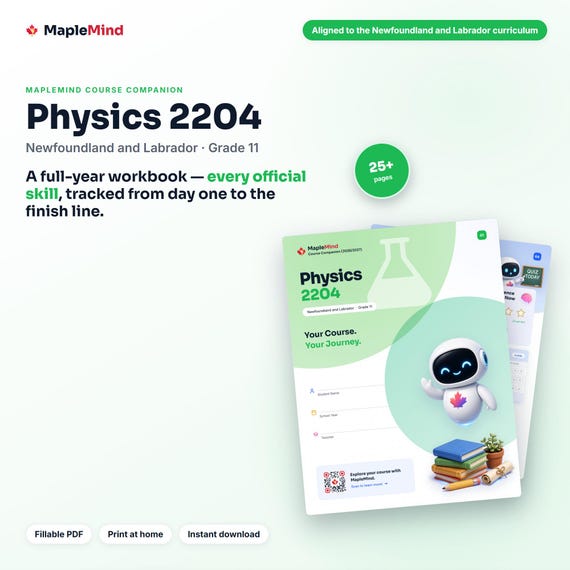
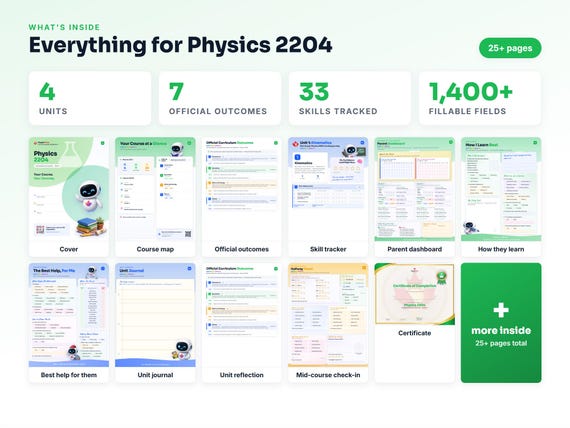
A Physics 2204 workbook worth keeping
Built from the same official curriculum as this page. Before and after each skill above, your student colours in how sure they feel — so the two of you can see, on one page, what's clicking and what needs another look. It's a quiet way to follow how the year is really going.
By June it's full of their own handwriting: units worked through, confidence grown, a mid-year check-in, notes from parent-teacher night, and a certificate at the end. Less a worksheet, more a record of the year worth keeping on the shelf.
Instant download · see every page, reviews and the full description · five or more workbooks are $2.99 each
What it looks like in the app



Common questions
Can MapleMind help me with Physics 2204?
Yes. MapleMind's AI tutor covers all 33 skills in Newfoundland and Labrador's Physics 2204 — you pick the exact skill, and the tutor teaches it step by step: a short lesson, a worked example, solving together, then a skill check to show it stuck.
Is MapleMind aligned to Newfoundland and Labrador's official curriculum?
Yes. Every skill in this course maps to an official outcome code from Newfoundland and Labrador's Grade 11 Science curriculum, and the ministry's own wording is quoted under each unit on this page — with the official government source linked so you can check it yourself.
What does MapleMind cost?
It's free to start — 5 tutoring chats and a practice quiz every day, no credit card. A Pro subscription ($9.99/month or $49.99/year CAD, 7-day free trial) unlocks unlimited tutoring, practice, and exam simulations.
What if I'm stuck on just one topic?
That's the point of skill-level tutoring: open Physics 2204 in the app, tap the exact skill from the list on this page, and the tutor teaches just that — no wading through lessons you don't need.
Does MapleMind work in French or other languages?
Yes — 14 languages, including French. Both the app and the tutor's explanations switch to the language you choose.
Where can I see the official Newfoundland and Labrador curriculum for Physics 2204?
The official source is linked on this page — Newfoundland and Labrador's official curriculum. The outline here follows it: every MapleMind skill carries its official outcome code, and the ministry's own wording is quoted under each unit.
Keep exploring
Ready when you are
Pick a skill from this page and see it taught properly — free, in the browser, in under a minute.