Get help with Science 2200
Most tutoring makes you sit through material you already know. MapleMind flips that: pick the exact skill that's causing trouble — any of the 30 below — and the tutor teaches just that one, step by step, as many times as it takes. Ask questions in plain words, any time of day, in English, French, or 12 other languages.
The official Newfoundland and Labrador Science 2200 curriculum
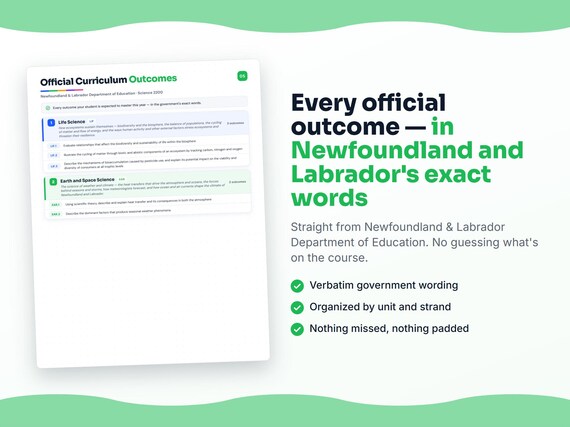
Newfoundland and Labrador defines Science 2200 by strands and outcomes. MapleMind teaches the same curriculum reorganized for one-skill-at-a-time tutoring — the table shows exactly where every official strand lands, and the ministry's own wording is quoted under each unit below.
Official source Newfoundland and Labrador's official curriculumRead it on the government site — gov.nl.ca ↗| Official strand | Outcomes | Where MapleMind teaches it |
|---|---|---|
| Strand 2 | 19 | Life Science |
| Strand 5 | 11 | Earth and Space Science |
Every skill below, taught one on one.
 Try the first session free
How MapleMind teaches Science 2200 — every unit, lesson, and skill
Every skill below runs as a short session: a plain-words lesson, a worked example, solving it together, then a five-question skill check that earns up to three stars. Guided Mode keeps it teaching instead of answer-handing — turning it off needs a parent's password.
Unit 1Life ScienceOfficial strand · Strand 2
How ecosystems sustain themselves — biodiversity and the biosphere, the balance of populations, the cycling of matter and flow of energy, and the ways human activity and other external factors stress ecosystems and threaten their resilience.
Biodiversity and the Balance of Ecosystems
- Biodiversity and sustainability of the biospheresci-2200.1.2.1 — Evaluate the relationships that affect biodiversity and the sustainability of life within the biosphere.
- Biodiversity loss from human activitysci-2200.1.2.2 — Understand that biodiversity loss due to human activity adversely affects ecosystems.
- How biodiversity sustains an ecosystemsci-2200.1.2.6 — Explain how the biodiversity of an ecosystem contributes to its sustainability.
- Earth: closed for matter, open for energysci-2200.1.2.3 — Explain that Earth is a closed system with regard to matter and an open system with regard to energy.
- Population equilibrium and resource limitssci-2200.1.2.4 — Explain the biotic and abiotic factors that keep natural populations in equilibrium and relate this to resource limits.
- Trophic levels and classificationsci-2200.1.2.5 — Describe and apply classification systems and nomenclature for trophic levels in ecosystems.
Cycling of Matter and Flow of Energy
- Cycling of matter through an ecosystemsci-2200.1.2.9 — Illustrate the cycling of matter through the biotic and abiotic parts of an ecosystem by tracking carbon, nitrogen, and oxygen.
- Change of matter and the cycling conceptsci-2200.1.2.10 — Examine the change of matter in ecosystems using the concept of the cycling of matter.
- Energy flow and the pyramid of energysci-2200.1.2.11 — Analyze the flow of energy in ecosystems using the concept of the pyramid of energy.
- Human alteration of the carbon and nitrogen cyclessci-2200.1.2.8 — Analyze the impact of external factors by describing how humans have altered the carbon and nitrogen cycles.
- Changes to terrestrial systemssci-2200.1.2.7 — Describe and predict the nature and effects of changes to terrestrial systems.
Ecosystem Stress and Human Impact
- Bioaccumulation from pesticide usesci-2200.1.2.13 — Describe the mechanisms of bioaccumulation caused by pesticide use and explain its impact on consumers at all trophic levels.
- Impact of fertilizer overusesci-2200.1.2.14 — Describe the potential impact that overuse of fertilizers can have on ecosystems.
- Analyzing the impact of external factorssci-2200.1.2.12 — Plan changes to predict the effects of, and analyze the impact of, external factors on an ecosystem.
- Similar ecosystems in different locationssci-2200.1.2.17 — Explain why ecosystems with similar characteristics can exist in different geographical locations.
- Soil composition and fertilitysci-2200.1.2.18 — Describe how soil composition and fertility can be altered and how these changes could affect an ecosystem.
- Short-term stress and long-term changesci-2200.1.2.19 — Explain why an ecosystem may respond differently to short-term stress and long-term change.
- Human impact on biome distributionsci-2200.1.3.11 — Select and display evidence to explain how external factors such as global warming may affect the distribution of biomes within Canada.
- WHMIS and safe handling of lab materialssci-2200.1.3.15 — Demonstrate a knowledge of WHMIS standards for the safe handling and disposal of lab materials and equipment.
The official wording — 19 outcomes in this unit
- sci-2200.1.2.1
Evaluate relationships that affect the biodiversity and sustainability of life within the biosphere
- sci-2200.1.2.2
Understand that biodiversity loss due to human activity adversely affects ecosystems
- sci-2200.1.2.6
Explain how biodiversity of an ecosystem contributes to its sustainability
- sci-2200.1.2.3
Explain that Earth is a closed system with regard to matter and an open system with regard to energy
- sci-2200.1.2.4
Explain biotic and abiotic factors that keep natural populations in equilibrium and relate this equilibrium to the resource limits of an ecosystem
- sci-2200.1.2.5
Describe and apply classification systems and nomenclature with respect to trophic levels in ecosystems
- sci-2200.1.2.9
Illustrate the cycling of matter through biotic and abiotic components of an ecosystem by tracking carbon, nitrogen and oxygen
- sci-2200.1.2.10
Examine the change of matter in ecosystems using the concept of the cycling of matter
- sci-2200.1.2.11
Analyze the flow of energy in ecosystems using the concept of the pyramid of energy
- sci-2200.1.2.8
Analyze the impact of external factors on an ecosystem by describing how humans have altered the carbon cycle and nitrogen cycle in ecosystems
- sci-2200.1.2.7
Describe and predict the nature and effects of changes to terrestrial systems
- sci-2200.1.2.13
Describe the mechanisms of bioaccumulation caused by pesticide use, and explain its potential impact on the viability and diversity of consumers at all trophic levels
- sci-2200.1.2.14
Describe the potential impact that overuse of fertilizers can have on ecosystems
- sci-2200.1.2.12
Plan changes to predict the effects of, and analyze the impact of external factors on an ecosystem
- sci-2200.1.2.17
Explain why ecosystems with similar characteristic can exist in different geographical locations
- sci-2200.1.2.18
Describe how soil composition and fertility can be altered and how these changes could affect an ecosystem
- sci-2200.1.2.19
Explain why the ecosystem may respond differently to short term stress and long-term change
- sci-2200.1.3.11
Select and display evidence and information, from a variety of sources, to explain how external factors such as global warming or other human activities may have an impact on the distribution of biomes within Canada
- sci-2200.1.3.15
Demonstrate a knowledge of WHMIS standards by selecting and applying proper techniques for the safe handling and disposing of lab materials and equipment
Unit 2Earth and Space ScienceOfficial strand · Strand 5
The science of weather and climate — the heat transfers that drive the atmosphere and oceans, the forces behind seasons and storms, how meteorologists forecast, and how ocean and air currents shape the climate of Newfoundland and Labrador.
Heat Transfer, Currents, and Climate
- Heat transfer in the atmosphere and hydrospheresci-2200.2.2.6 — Use scientific theory to describe and explain heat transfer and its consequences in the atmosphere and hydrosphere.
- Heat transfer in the water cyclesci-2200.2.2.7 — Use scientific theory to illustrate and explain the heat-energy transfers that occur in the water cycle.
- Heat transfer and air and water currentssci-2200.2.2.8 — Use weather data to describe and explain heat transfers that affect air and water currents.
- Currents, latitude, and Newfoundland's climatesci-2200.2.2.5 — Apply the effects of ocean currents, air currents, and latitude on the climate of Newfoundland and Labrador.
Weather, Forecasting, and Extreme Events
- Factors behind seasonal weathersci-2200.2.2.1 — Describe the dominant factors that produce seasonal weather phenomena.
- Collecting and analyzing weather datasci-2200.2.2.2 — Collect and analyze weather data from observational networks to predict future weather.
- Forecasting terms and methodssci-2200.2.2.3 — Define the key terms and describe the main methods of weather forecasting.
- Heat transfer and weather systemssci-2200.2.2.9 — Describe and explain the effects of heat transfer on the development, severity, and movement of weather systems.
- The atmosphere and human activitiessci-2200.2.2.10 — Analyze the interactions between the atmosphere and human activities.
- Causes and effects of extreme weathersci-2200.2.2.11 — Analyze a possible cause for extreme weather and describe some of its effects.
- Seasonal weather events and floodingsci-2200.2.2.12 — Describe the cause and effects of seasonal weather events such as localized flash flooding.
The official wording — 11 outcomes in this unit
- sci-2200.2.2.6
Using scientific theory, describe and explain heat transfer and its consequences in both the atmosphere
- sci-2200.2.2.7
Using scientific theory, illustrate and explain heat energy transfers that occur in the water cycle
- sci-2200.2.2.8
Use weather data to describe and explain heat transfers in the hydrosphere and atmosphere showing how these affect air and water currents
- sci-2200.2.2.5
Apply the effects of ocean currents, air currents and latitude on the climate of Newfoundland and Labrador
- sci-2200.2.2.1
Describe the dominant factors that produce seasonal weather phenomena
- sci-2200.2.2.2
Use print and electronic sources to collect and analyze weather data from regional and national weather observational networks and predict future weather conditions
- sci-2200.2.2.3
Define terms related to weather forecasting
- sci-2200.2.2.9
Describe and explain the effects of heat transfer on the development, severity, and movement of weather systems
- sci-2200.2.2.10
Analyze the interactions between the atmosphere and human activities
- sci-2200.2.2.11
Analyze a possible cause for extreme weather and describe some of the effects
- sci-2200.2.2.12
Describe the cause and effects of seasonal weather events such as localized flash flooding
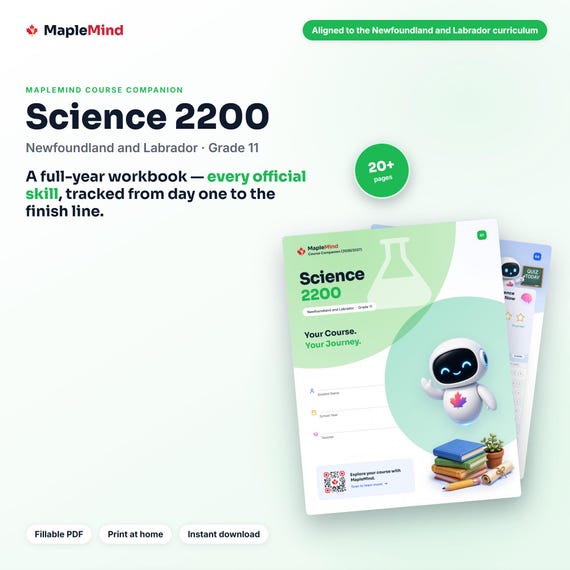
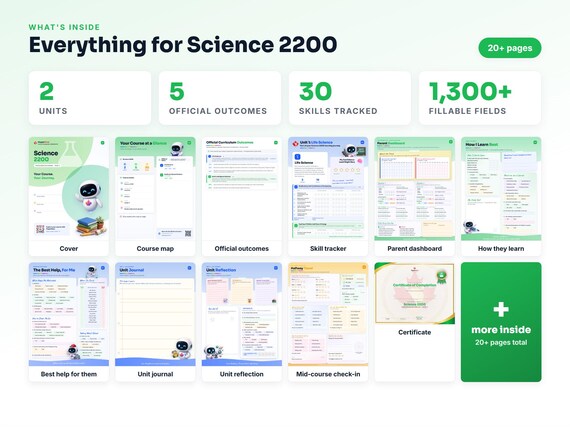
Printable workbook · A keepsake of the year
A Science 2200 workbook worth keeping
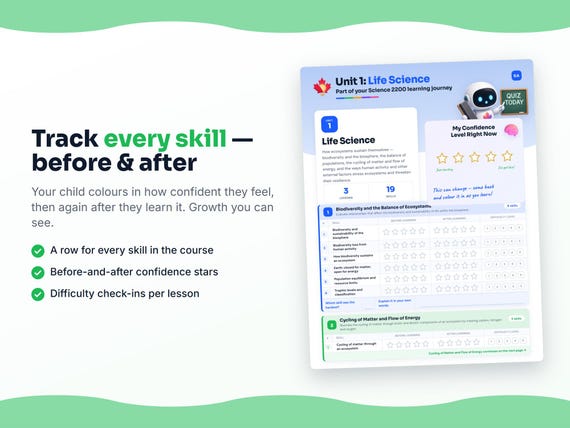
Built from the same official curriculum as this page. Before and after each skill above, your student colours in how sure they feel — so the two of you can see, on one page, what's clicking and what needs another look. It's a quiet way to follow how the year is really going.
By June it's full of their own handwriting: units worked through, confidence grown, a mid-year check-in, notes from parent-teacher night, and a certificate at the end. Less a worksheet, more a record of the year worth keeping on the shelf.
Instant download · see every page, reviews and the full description · five or more workbooks are $2.99 each
What it looks like in the app



Common questions
Can MapleMind help me with Science 2200?
Yes. MapleMind's AI tutor covers all 30 skills in Newfoundland and Labrador's Science 2200 — you pick the exact skill, and the tutor teaches it step by step: a short lesson, a worked example, solving together, then a skill check to show it stuck.
Is MapleMind aligned to Newfoundland and Labrador's official curriculum?
Yes. Every skill in this course maps to an official outcome code from Newfoundland and Labrador's Grade 11 Science curriculum, and the ministry's own wording is quoted under each unit on this page — with the official government source linked so you can check it yourself.
What does MapleMind cost?
It's free to start — 5 tutoring chats and a practice quiz every day, no credit card. A Pro subscription ($9.99/month or $49.99/year CAD, 7-day free trial) unlocks unlimited tutoring, practice, and exam simulations.
What if I'm stuck on just one topic?
That's the point of skill-level tutoring: open Science 2200 in the app, tap the exact skill from the list on this page, and the tutor teaches just that — no wading through lessons you don't need.
Does MapleMind work in French or other languages?
Yes — 14 languages, including French. Both the app and the tutor's explanations switch to the language you choose.
Where can I see the official Newfoundland and Labrador curriculum for Science 2200?
The official source is linked on this page — Newfoundland and Labrador's official curriculum. The outline here follows it: every MapleMind skill carries its official outcome code, and the ministry's own wording is quoted under each unit.
Keep exploring
Ready when you are
Pick a skill from this page and see it taught properly — free, in the browser, in under a minute.