Get help with Biology 3201
Most tutoring makes you sit through material you already know. MapleMind flips that: pick the exact skill that's causing trouble — any of the 30 below — and the tutor teaches just that one, step by step, as many times as it takes. Ask questions in plain words, any time of day, in English, French, or 12 other languages.
The official Newfoundland and Labrador Biology 3201 curriculum
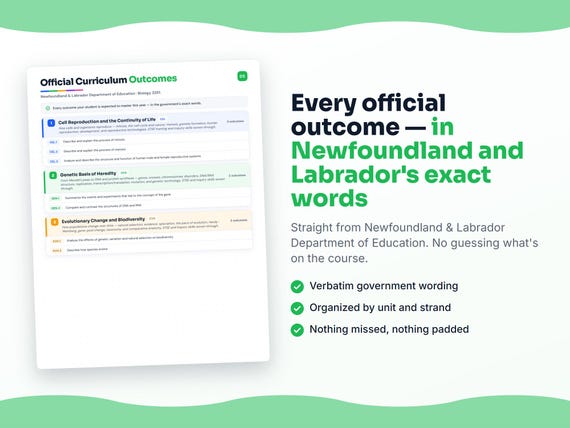
Newfoundland and Labrador defines Biology 3201 by strands and outcomes. MapleMind teaches the same curriculum reorganized for one-skill-at-a-time tutoring — the table shows exactly where every official strand lands, and the ministry's own wording is quoted under each unit below.
Official source Newfoundland and Labrador's official curriculumRead it on the government site — gov.nl.ca ↗| Official strand | Outcomes | Where MapleMind teaches it |
|---|---|---|
| Strand 5 | 10 | Cell Reproduction and the Continuity of Life |
| Strand 6 | 10 | Genetic Basis of Heredity |
| Strand 7 | 10 | Evolutionary Change and Biodiversity |
Every skill below, taught one on one.
 Try the first session free
How MapleMind teaches Biology 3201 — every unit, lesson, and skill
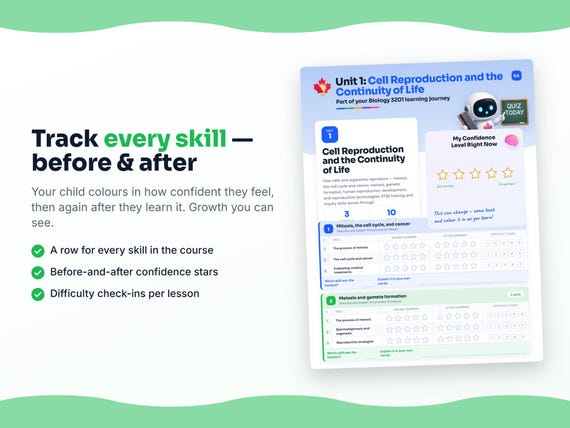
Every skill below runs as a short session: a plain-words lesson, a worked example, solving it together, then a five-question skill check that earns up to three stars. Guided Mode keeps it teaching instead of answer-handing — turning it off needs a parent's password.
Unit 1Cell Reproduction and the Continuity of LifeOfficial strand · Strand 5
How cells and organisms reproduce — mitosis, the cell cycle and cancer, meiosis, gamete formation, human reproduction, development, and reproductive technologies. STSE framing and inquiry skills woven through.
Mitosis, the cell cycle, and cancer
- The process of mitosissci-biol-3201.2.1.1 — Describe and explain the process of mitosis and its role in growth and repair.
- The cell cycle and cancersci-biol-3201.2.1.2 — Explain the relationship between the cell cycle and cancer.
- Evaluating medical treatmentssci-biol-3201.2.1.3 — Evaluate the consequences of medical treatments related to cell division, such as cancer therapies.
Meiosis and gamete formation
- The process of meiosissci-biol-3201.2.1.4 — Describe and explain the process of meiosis and how it generates genetic variation.
- Spermatogenesis and oogenesissci-biol-3201.2.1.5 — Describe and compare the processes of spermatogenesis and oogenesis.
- Reproductive strategiessci-biol-3201.2.1.6 — Analyze and explain reproductive strategies among living organisms.
Human reproduction and development
- Human reproductive systemssci-biol-3201.2.1.7 — Analyze and describe the structure and function of human male and female reproductive systems.
- The human reproductive cyclesci-biol-3201.2.1.8 — Explain the human reproductive cycle and its hormonal control.
- Development from fertilization to birthsci-biol-3201.2.1.9 — Describe the process of human development from fertilization to birth.
- Reproductive technologiessci-biol-3201.2.1.10 — Evaluate and describe reproductive technologies and their applications.
The official wording — 10 outcomes in this unit
- sci-biol-3201.2.1.1
Describe and explain the process of mitosis
- sci-biol-3201.2.1.2
Explain the relationship between the cell cycle and cancer
- sci-biol-3201.2.1.3
Evaluate the consequences of medical treatments
- sci-biol-3201.2.1.4
Describe and explain the process of meiosis
- sci-biol-3201.2.1.5
Describe and compare the processes of spermatogenesis and oogenesis
- sci-biol-3201.2.1.6
Analyze and explain reproductive strategies among living organisms
- sci-biol-3201.2.1.7
Analyze and describe the structure and function of human male and female reproductive systems
- sci-biol-3201.2.1.8
Explain the human reproductive cycle
- sci-biol-3201.2.1.9
Describe the process of human development from fertilization to birth
- sci-biol-3201.2.1.10
Evaluate and describe reproductive technologies
Unit 2Genetic Basis of HeredityOfficial strand · Strand 6
From Mendel's peas to DNA and protein synthesis — genes, crosses, chromosomes, disorders, DNA/RNA structure, replication, transcription/translation, mutation, and genetic technology. STSE and inquiry skills woven through.
Genes, crosses, and chromosomes
- The concept of the genesci-biol-3201.2.2.1 — Summarize the events and experiments that led to the concept of the gene.
- Mendelian genetics and predicting crossessci-biol-3201.2.2.2 — Demonstrate an understanding of Mendelian genetics and predict various genetic crosses.
- Chromosomes and the transmission of hereditysci-biol-3201.2.2.3 — Describe the role of chromosomes in the transmission of hereditary information between cells.
- Circumstances leading to genetic disorderssci-biol-3201.2.2.4 — Explain the circumstances that lead to genetic disorders.
DNA, RNA, and protein synthesis
- Structures of DNA and RNAsci-biol-3201.2.2.5 — Compare and contrast the structures of DNA and RNA.
- DNA replicationsci-biol-3201.2.2.6 — Explain the semiconservative replication of DNA.
- DNA, RNA, and protein synthesissci-biol-3201.2.2.7 — Explain the roles of DNA and RNA in protein synthesis (transcription and translation).
- Effects of mutationssci-biol-3201.2.2.8 — Predict the effects of mutations on protein synthesis, phenotypes, and heredity.
- Factors causing mutationssci-biol-3201.2.2.9 — Describe factors that may lead to mutations in a cell's genetic information.
- Current genetic technologiessci-biol-3201.2.2.10 — Demonstrate an understanding of current genetic technologies.
The official wording — 10 outcomes in this unit
- sci-biol-3201.2.2.1
Summarize the events and experiments that led to the concept of the gene
- sci-biol-3201.2.2.2
Demonstrate an understanding of Mendelian genetics and predict various genetic crosses
- sci-biol-3201.2.2.3
Describe the role of chromosomes in the transmission of hereditary information from one cell to another
- sci-biol-3201.2.2.4
Explain circumstances that lead to genetic disorders
- sci-biol-3201.2.2.5
Compare and contrast the structures of DNA and RNA
- sci-biol-3201.2.2.6
Explain the replication of DNA
- sci-biol-3201.2.2.7
Explain the roles of DNA and RNA in protein synthesis
- sci-biol-3201.2.2.8
Predict the effects of mutations on protein synthesis, phenotypes, and heredity
- sci-biol-3201.2.2.9
Describe factors that may lead to mutations in a cell’s genetic information
- sci-biol-3201.2.2.10
Demonstrate an understanding of current genetic technologies
Unit 3Evolutionary Change and BiodiversityOfficial strand · Strand 7
How populations change over time — natural selection, evidence, speciation, the pace of evolution, Hardy-Weinberg, gene-pool change, taxonomy, and comparative anatomy. STSE and inquiry skills woven through.
Natural selection and the evidence for evolution
- Genetic variation and natural selectionsci-biol-3201.2.3.1 — Analyze the effects of genetic variation and natural selection on biodiversity.
- Historical and cultural context of evolutionary ideassci-biol-3201.2.3.2 — Describe historical and cultural contexts that changed evolutionary concepts.
- Explanations for changes in populationssci-biol-3201.2.3.3 — Compare different explanations for changes in populations over time.
- Evidence for evolution by natural selectionsci-biol-3201.2.3.4 — Evaluate and describe the evidence supporting the theory of evolution by natural selection.
Speciation, pace, and population genetics
- How species evolvesci-biol-3201.2.3.5 — Describe how species evolve through reproductive isolation and speciation.
- The pace of evolutionsci-biol-3201.2.3.6 — Compare and contrast models describing the pace of evolution.
- The Hardy-Weinberg principlesci-biol-3201.2.3.7 — Describe how the Hardy-Weinberg principle is used to determine whether a population is undergoing microevolution.
- Causes of gene-pool changesci-biol-3201.2.3.8 — Analyze the causes of gene-pool change in populations.
- Principles of taxonomysci-biol-3201.2.3.9 — Demonstrate an understanding of the fundamental principles of taxonomy.
- Comparative anatomy and evolutionary trendssci-biol-3201.2.3.10 — Examine and describe the anatomy and physiology of representative organisms, identifying evolutionary milestones and trends.
The official wording — 10 outcomes in this unit
- sci-biol-3201.2.3.1
Analyze the effects of genetic variation and natural selection on biodiversity
- sci-biol-3201.2.3.2
Describe historical and cultural contexts that have changed evolutionary concepts
- sci-biol-3201.2.3.3
Compare different explanations for changes in populations over time
- sci-biol-3201.2.3.4
Evaluate and describe evidence to support the theory of evolution by natural selection
- sci-biol-3201.2.3.5
Describe how species evolve
- sci-biol-3201.2.3.6
Compare and contrast models describing the pace of evolution
- sci-biol-3201.2.3.7
Describe how the Hardy-Weinberg principle is used to determine whether a population is undergoing microevolution
- sci-biol-3201.2.3.8
Analyze causes of gene pool change
- sci-biol-3201.2.3.9
Demonstrate an understanding of the fundamental principles of taxonomy
- sci-biol-3201.2.3.10
Examine and describe the anatomy and physiology of representative organisms, identifying and describing evolutionary milestones and trends
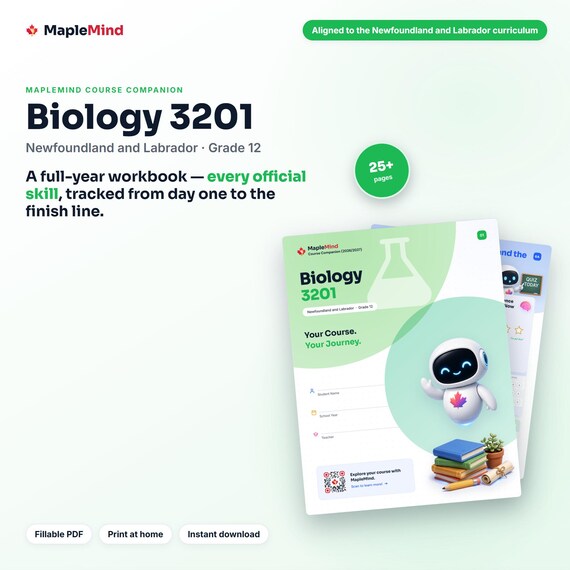
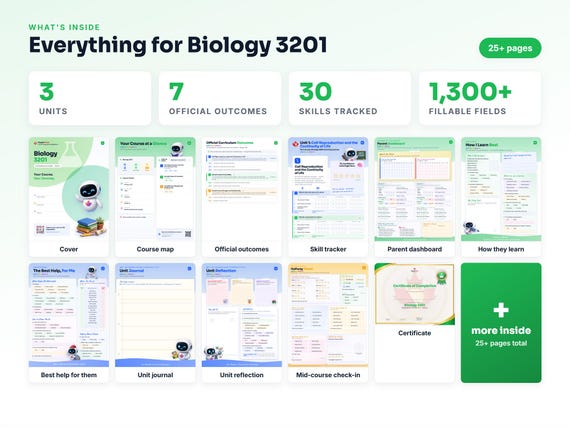
Printable workbook · A keepsake of the year
A Biology 3201 workbook worth keeping
Built from the same official curriculum as this page. Before and after each skill above, your student colours in how sure they feel — so the two of you can see, on one page, what's clicking and what needs another look. It's a quiet way to follow how the year is really going.
By June it's full of their own handwriting: units worked through, confidence grown, a mid-year check-in, notes from parent-teacher night, and a certificate at the end. Less a worksheet, more a record of the year worth keeping on the shelf.
Instant download · see every page, reviews and the full description · five or more workbooks are $2.99 each
What it looks like in the app



Common questions
Can MapleMind help me with Biology 3201?
Yes. MapleMind's AI tutor covers all 30 skills in Newfoundland and Labrador's Biology 3201 — you pick the exact skill, and the tutor teaches it step by step: a short lesson, a worked example, solving together, then a skill check to show it stuck.
Is MapleMind aligned to Newfoundland and Labrador's official curriculum?
Yes. Every skill in this course maps to an official outcome code from Newfoundland and Labrador's Grade 12 Science curriculum, and the ministry's own wording is quoted under each unit on this page — with the official government source linked so you can check it yourself.
What does MapleMind cost?
It's free to start — 5 tutoring chats and a practice quiz every day, no credit card. A Pro subscription ($9.99/month or $49.99/year CAD, 7-day free trial) unlocks unlimited tutoring, practice, and exam simulations.
What if I'm stuck on just one topic?
That's the point of skill-level tutoring: open Biology 3201 in the app, tap the exact skill from the list on this page, and the tutor teaches just that — no wading through lessons you don't need.
Does MapleMind work in French or other languages?
Yes — 14 languages, including French. Both the app and the tutor's explanations switch to the language you choose.
Where can I see the official Newfoundland and Labrador curriculum for Biology 3201?
The official source is linked on this page — Newfoundland and Labrador's official curriculum. The outline here follows it: every MapleMind skill carries its official outcome code, and the ministry's own wording is quoted under each unit.
Keep exploring
Ready when you are
Pick a skill from this page and see it taught properly — free, in the browser, in under a minute.