Get help with Chemistry 3202
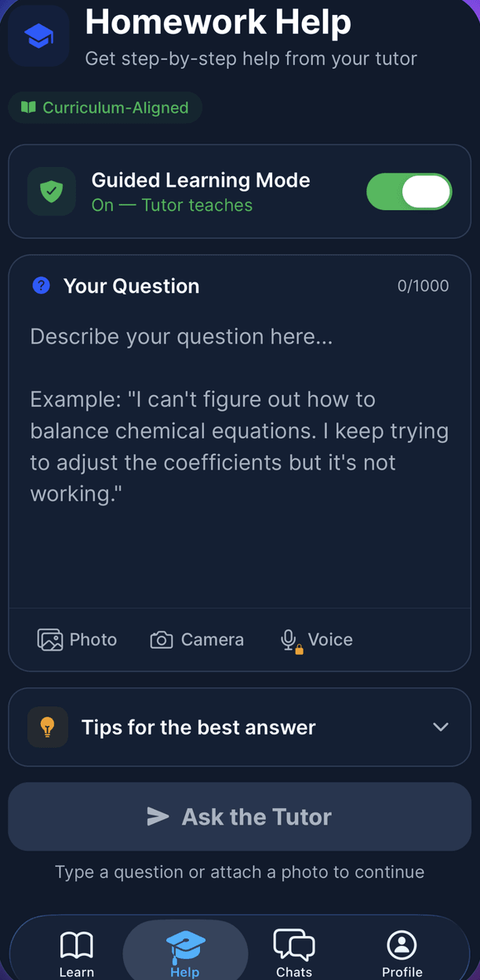
Most tutoring makes you sit through material you already know. MapleMind flips that: pick the exact skill that's causing trouble — any of the 36 below — and the tutor teaches just that one, step by step, as many times as it takes. Ask questions in plain words, any time of day, in English, French, or 12 other languages.
The official Newfoundland and Labrador Chemistry 3202 curriculum
Newfoundland and Labrador defines Chemistry 3202 by strands and outcomes. MapleMind teaches the same curriculum reorganized for one-skill-at-a-time tutoring — the table shows exactly where every official strand lands, and the ministry's own wording is quoted under each unit below.
Official source Newfoundland and Labrador's official curriculumRead it on the government site — gov.nl.ca ↗| Official strand | Outcomes | Where MapleMind teaches it |
|---|---|---|
| Strand 5 | 7 | From Kinetics to Equilibrium |
| Strand 6 | 8 | Acids and Bases |
| Strand 7 | 12 | Thermochemistry |
| Strand 8 | 9 | Electrochemistry |
Every skill below, taught one on one.
 Try the first session free
How MapleMind teaches Chemistry 3202 — every unit, lesson, and skill
Every skill below runs as a short session: a plain-words lesson, a worked example, solving it together, then a five-question skill check that earns up to three stars. Guided Mode keeps it teaching instead of answer-handing — turning it off needs a parent's password.
Unit 1From Kinetics to EquilibriumOfficial strand · Strand 5
How fast reactions go and where they settle — collision theory, rate factors, potential-energy diagrams, mechanisms and catalysts, dynamic equilibrium, the equilibrium constant, and Le Chatelier's principle. STSE and inquiry skills woven through.
Reaction kinetics
- Collision theory and reaction ratesci-chem-3202.2.1.1 — Describe collision theory and its connection to the factors that alter reaction rates.
- Properties and factors affecting ratesci-chem-3202.2.1.2 — Identify and discuss the properties and factors that affect reaction rate.
- Potential energy diagramssci-chem-3202.2.1.3 — Sketch and interpret potential energy diagrams for chemical reactions.
- Reaction mechanisms and catalystssci-chem-3202.2.1.4 — Describe a reaction mechanism and the role of a catalyst in a chemical reaction.
Chemical equilibrium
- Dynamic equilibriumsci-chem-3202.2.1.5 — Define dynamic equilibrium as it pertains to reversible chemical reactions.
- The equilibrium constant expressionsci-chem-3202.2.1.6 — Define the equilibrium constant expression as it pertains to chemical systems.
- Le Chatelier's principlesci-chem-3202.2.1.7 — Explain how different factors affect chemical equilibrium.
The official wording — 7 outcomes in this unit
- sci-chem-3202.2.1.1
Describe collision theory and its connection to factors involved in altering reaction rates
- sci-chem-3202.2.1.2
Identify and discuss the properties and factors which affect reaction rate
- sci-chem-3202.2.1.3
Sketch and interpret potential energy diagrams for chemical reactions
- sci-chem-3202.2.1.4
Describe a reaction mechanism and a catalyst's role in a chemical reaction
- sci-chem-3202.2.1.5
Define the concept of dynamic equilibrium as it pertains to reversible chemical reactions
- sci-chem-3202.2.1.6
Define the concept of equilibrium constant expression as it pertains to chemical systems
- sci-chem-3202.2.1.7
Explain how different factors affect chemical equilibrium
Unit 2Acids and BasesOfficial strand · Strand 6
Acid-base definitions, strength via equilibrium, predicting products, pH calculation, indicators, and titration stoichiometry. STSE and inquiry skills woven through.
Acid-base definitions and strength
- Acid-base definitionssci-chem-3202.2.2.1 — Describe various acid-base definitions up to and including the Bronsted-Lowry definition.
- Strong and weak acids and bases (equilibrium)sci-chem-3202.2.2.2 — Compare strong and weak acids and bases using the concept of equilibrium (theoretical).
- Predicting acid-base reaction productssci-chem-3202.2.2.3 — Predict the products of acid-base reactions.
- Calculating pHsci-chem-3202.2.2.4 — Calculate the pH of an acid or base from its concentration, and vice versa.
- Strong and weak acids and bases (mathematical)sci-chem-3202.2.2.5 — Compare strong and weak acids and bases using the concept of equilibrium (mathematical).
Indicators, Le Chatelier, and titration
- How acid-base indicators worksci-chem-3202.2.2.6 — Explain how acid-base indicators function.
- H+ and OH- interactions and Le Chateliersci-chem-3202.2.2.7 — Describe the interactions between hydrogen and hydroxide ions using Le Chatelier's principle.
- Titration and concentrationsci-chem-3202.2.2.8 — Determine the concentration of an acid or base solution using stoichiometry.
The official wording — 8 outcomes in this unit
- sci-chem-3202.2.2.1
Describe various acid-base definitions up to and including the
- sci-chem-3202.2.2.2
Compare strong and weak acids and bases using the concept of equilibrium
- sci-chem-3202.2.2.3
Predict products of acid-base reactions
- sci-chem-3202.2.2.4
Calculate the pH of an acid or a base given its concentration, and vice versa
- sci-chem-3202.2.2.5
Compare strong and weak acids and bases using the concept of equilibrium
- sci-chem-3202.2.2.6
Explain how acid-base indicators function
- sci-chem-3202.2.2.7
Describe the interactions between
- sci-chem-3202.2.2.8
Determine the concentration of an acid or base solution using stoichiometry
Unit 3ThermochemistryOfficial strand · Strand 7
Energy in chemical change — temperature and heat, systems and surroundings, specific heat, enthalpy, energy diagrams, calorimetry, combustion enthalpies, thermochemical equations, and Hess's law. STSE and inquiry skills woven through.
Heat, energy, and enthalpy
- Temperature and heatsci-chem-3202.2.3.1 — Explain temperature and heat using kinetic energy and the particle model of matter.
- System, surroundings, and the universesci-chem-3202.2.3.2 — Distinguish between a system and surroundings and their relationship to the universe.
- Specific heatsci-chem-3202.2.3.3 — Define specific heat.
- Energy in temperature changessci-chem-3202.2.3.4 — Calculate and compare the energy involved in changes of temperature.
- Enthalpy and thermochemical termssci-chem-3202.2.3.5 — Define endothermic reaction, exothermic reaction, enthalpy, bond energy, heat of reaction, and molar enthalpy.
- Energy diagrams for reactionssci-chem-3202.2.3.6 — Illustrate changes in energy of chemical reactions using potential energy diagrams.
Measuring and calculating reaction energy
- Energy in state and temperature changessci-chem-3202.2.3.7 — Calculate and compare the energy involved in changes of state and temperature.
- Energy in chemical reactionssci-chem-3202.2.3.8 — Calculate and compare the energy involved in chemical reactions.
- Calorimetrysci-chem-3202.2.3.9 — Determine experimentally the changes in energy of chemical reactions.
- Combustion enthalpies of organic compoundssci-chem-3202.2.3.10 — Compare the molar enthalpies of several combustion reactions involving organic compounds.
- Thermochemical equationssci-chem-3202.2.3.11 — Write and balance thermochemical equations including the combustion of alkanes.
- Hess's law and bond energiessci-chem-3202.2.3.12 — Calculate the energy changes of reactions using bond energy, heats of formation, and Hess's law.
The official wording — 12 outcomes in this unit
- sci-chem-3202.2.3.1
Explain temperature and heat using the concept of kinetic energy and the particle model of matter
- sci-chem-3202.2.3.2
Distinguish between a system and surroundings and the relationship of each to the universe
- sci-chem-3202.2.3.3
Define specific heat
- sci-chem-3202.2.3.4
Calculate and compare the energy involved in changes of temperature
- sci-chem-3202.2.3.5
Define endothermic reaction, exothermic reaction, enthalpy, bond energy, heat of reaction, and molar enthalpy
- sci-chem-3202.2.3.6
Illustrate changes in energy of various chemical reactions, using potential energy diagrams
- sci-chem-3202.2.3.7
Calculate and compare the energy involved in changes of state and temperature
- sci-chem-3202.2.3.8
Calculate and compare the energy involved in chemical reactions
- sci-chem-3202.2.3.9
Determine experimentally the changes in energy of various chemical reactions
- sci-chem-3202.2.3.10
Compare the molar enthalpies of several combustion reactions involving organic compounds
- sci-chem-3202.2.3.11
Write and balance thermochemical equations including the combustion reactions of alkanes
- sci-chem-3202.2.3.12
Calculate the changes in energy of various chemical reactions using bond energy, heats of formation, and Hess's law
Unit 4ElectrochemistryOfficial strand · Strand 8
Electron-transfer chemistry — oxidation and reduction, comparing redox with other reactions, half-reactions, electrochemical cells, galvanic vs electrolytic cells, spontaneity and voltage from reduction potentials, electrolysis and electroplating, and fuel cells. STSE and inquiry skills woven through.
Redox reactions and half-reactions
- Oxidation and reductionsci-chem-3202.2.4.1 — Define oxidation and reduction experimentally and theoretically.
- Comparing redox with other reactionssci-chem-3202.2.4.2 — Compare oxidation-reduction reactions with other kinds of reactions.
- Balancing half-reactions and redox equationssci-chem-3202.2.4.3 — Write and balance half-reactions and net reactions for redox equations.
Electrochemical cells and applications
- Parts and operation of electrochemical cellssci-chem-3202.2.4.4 — Illustrate and label the parts of electrochemical cells and explain how they work.
- Galvanic vs electrolytic cellssci-chem-3202.2.4.5 — Compare galvanic and electrolytic cells in terms of energy, electron flow, and chemical change.
- Spontaneity from reduction potentialssci-chem-3202.2.4.6 — Predict whether redox reactions are spontaneous based on reduction potentials.
- Predicting cell voltagesci-chem-3202.2.4.7 — Predict the voltage of various electrochemical cells.
- Electrolysis and electroplatingsci-chem-3202.2.4.8 — Explain the processes of electrolysis and electroplating.
- The hydrogen fuel cellsci-chem-3202.2.4.9 — Explain how electrical energy is produced in a hydrogen fuel cell.
The official wording — 9 outcomes in this unit
- sci-chem-3202.2.4.1
Define oxidation and reduction experimentally and theoretically
- sci-chem-3202.2.4.2
Compare oxidation-reduction reactions with other kinds of reactions
- sci-chem-3202.2.4.3
Write and balance half-reactions and net reactions for redox equations
- sci-chem-3202.2.4.4
Illustrate and label the parts of electrochemical cells and explain how they work
- sci-chem-3202.2.4.5
Compare galvanic and electrolytic cells in terms of energy efficiency, electron flow/transfer, and chemical change
- sci-chem-3202.2.4.6
Predict whether oxidation-reduction reactions are spontaneous based on their reduction potentials
- sci-chem-3202.2.4.7
Predict the voltage of various electrochemical cells
- sci-chem-3202.2.4.8
Explain the processes of electrolysis and electroplating
- sci-chem-3202.2.4.9
Explain how electrical energy is produced in a hydrogen fuel cell


Printable workbook · A keepsake of the year
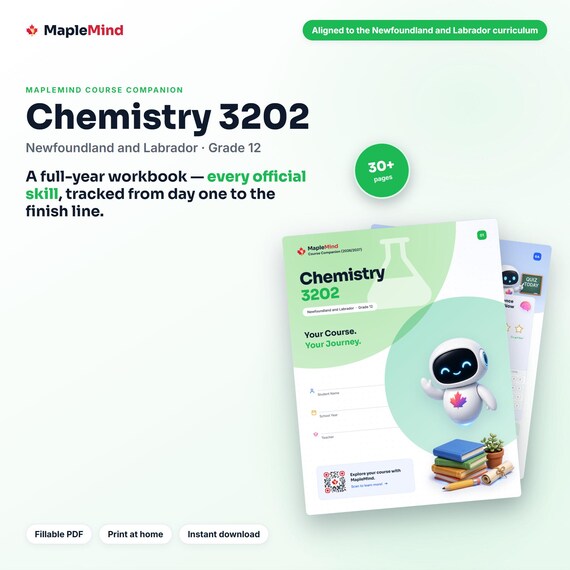
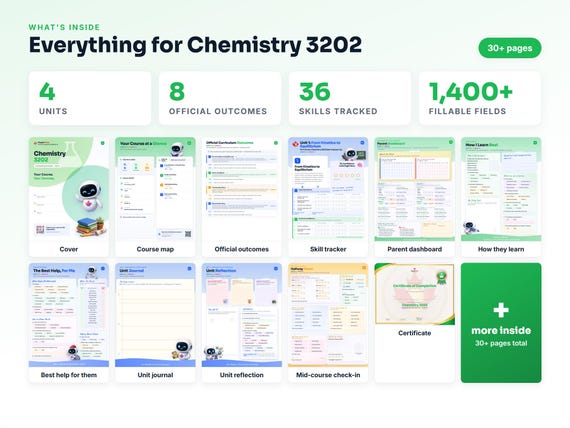
A Chemistry 3202 workbook worth keeping
Built from the same official curriculum as this page. Before and after each skill above, your student colours in how sure they feel — so the two of you can see, on one page, what's clicking and what needs another look. It's a quiet way to follow how the year is really going.
By June it's full of their own handwriting: units worked through, confidence grown, a mid-year check-in, notes from parent-teacher night, and a certificate at the end. Less a worksheet, more a record of the year worth keeping on the shelf.
Instant download · see every page, reviews and the full description · five or more workbooks are $2.99 each
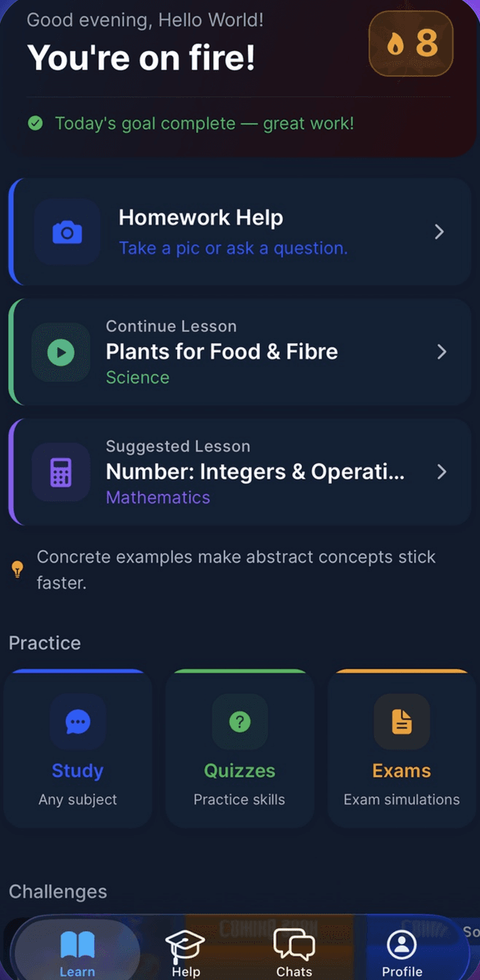
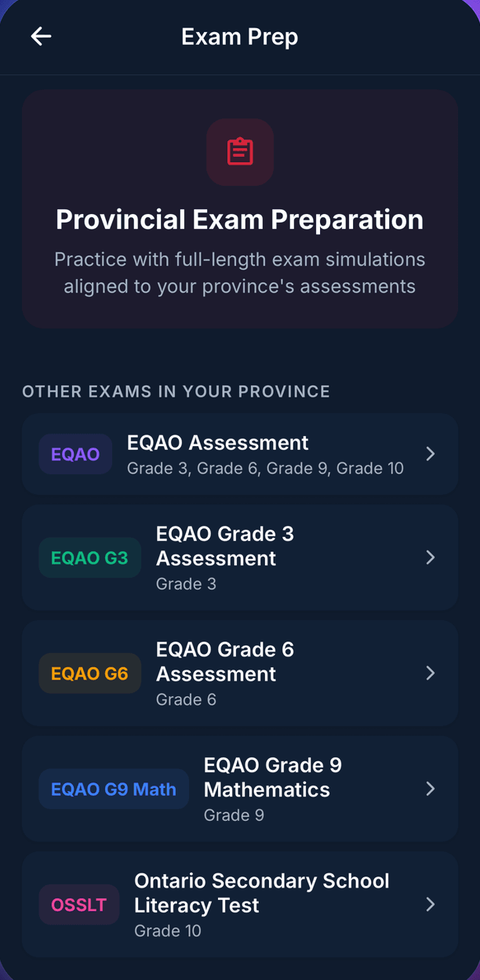
What it looks like in the app
Common questions
Can MapleMind help me with Chemistry 3202?
Yes. MapleMind's AI tutor covers all 36 skills in Newfoundland and Labrador's Chemistry 3202 — you pick the exact skill, and the tutor teaches it step by step: a short lesson, a worked example, solving together, then a skill check to show it stuck.
Is MapleMind aligned to Newfoundland and Labrador's official curriculum?
Yes. Every skill in this course maps to an official outcome code from Newfoundland and Labrador's Grade 12 Science curriculum, and the ministry's own wording is quoted under each unit on this page — with the official government source linked so you can check it yourself.
What does MapleMind cost?
It's free to start — 5 tutoring chats and a practice quiz every day, no credit card. A Pro subscription ($9.99/month or $49.99/year CAD, 7-day free trial) unlocks unlimited tutoring, practice, and exam simulations.
What if I'm stuck on just one topic?
That's the point of skill-level tutoring: open Chemistry 3202 in the app, tap the exact skill from the list on this page, and the tutor teaches just that — no wading through lessons you don't need.
Does MapleMind work in French or other languages?
Yes — 14 languages, including French. Both the app and the tutor's explanations switch to the language you choose.
Where can I see the official Newfoundland and Labrador curriculum for Chemistry 3202?
The official source is linked on this page — Newfoundland and Labrador's official curriculum. The outline here follows it: every MapleMind skill carries its official outcome code, and the ministry's own wording is quoted under each unit.
Keep exploring
Ready when you are
Pick a skill from this page and see it taught properly — free, in the browser, in under a minute.