public-exam · Newfoundland & Labrador
Chemistry 3202 Public Exam
- Grade 12
Dates and details can change. We do our best to keep this page up to date, but check the official sources before relying on it.
- Total time
- 3 h
- Marked questions
- 62
- Parts
- 2
- Counts for
- 15% of the final mark
- Calculator
- Approved models
- Format
- On a computer
Chemistry 3202 Public Exam practice test
The whole exam or the parts you choose, in its own format, on the clock.
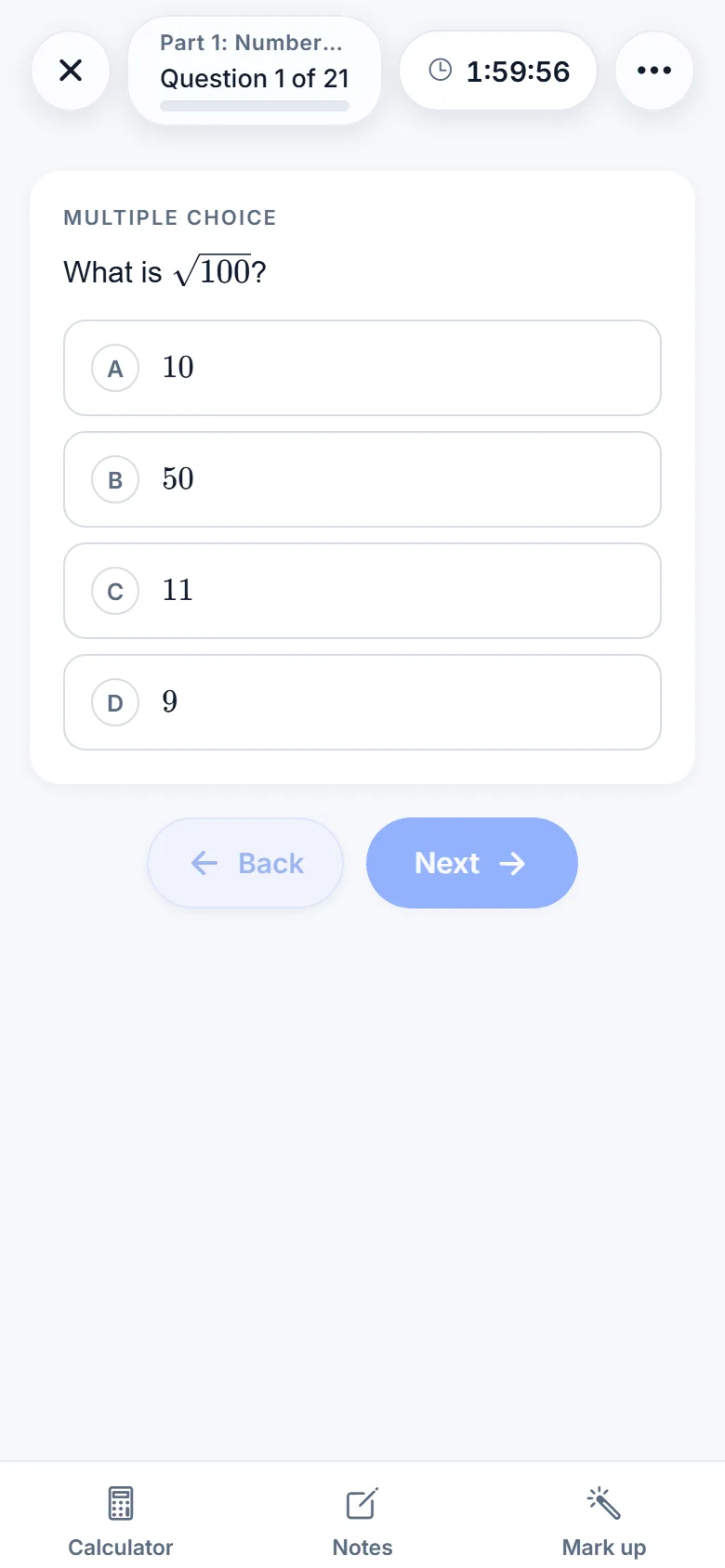 A question, timed, with the exam’s tools
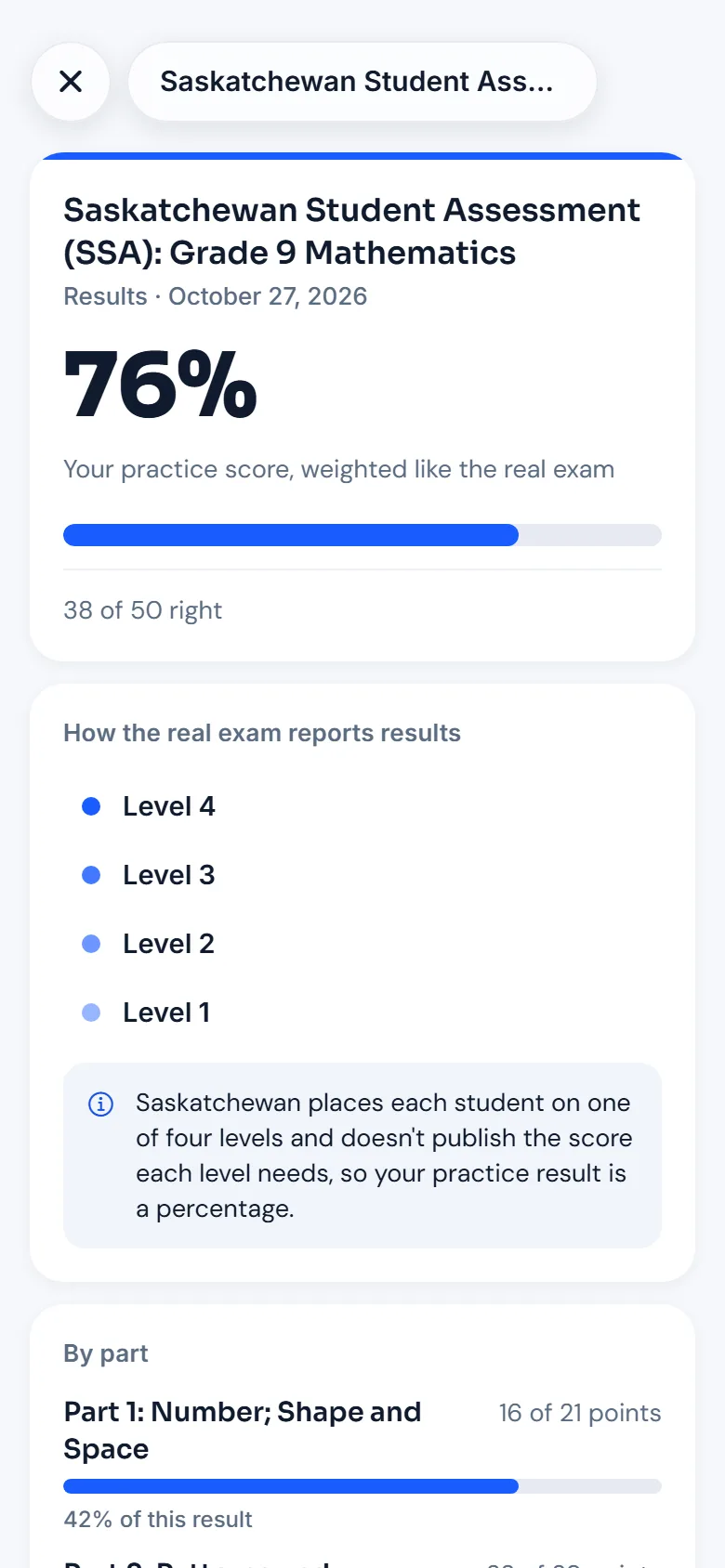 The marked result, part by part
A practice run of Saskatchewan’s Grade 9 math assessment.
Free with a MapleMind account
When
2 sessions this school year: Late January to early February 2027 (the date isn't published; inferred) and Mid to late June 2027 (the date isn't published; inferred from the old public exams' June sittings).
Late January to early February 2027 (the date isn't published; inferred)
- January 25 to February 5, 2027School day · Chemistry 3202 mid-term exam
Mid to late June 2027 (the date isn't published; inferred from the old public exams' June sittings)
- June 14 to June 25, 2027School day · Chemistry 3202 final exam
The dates are Newfoundland & Labrador’s own, read on November 9, 2026. See the official schedule (gov.nl.ca)
What’s on it
4 topics. Unit 2: Acids and Bases counts most, at 30%.
- Unit 1: From Kinetics to Equilibrium25%
- Unit 2: Acids and Bases30%
- Unit 3: Thermochemistry25%
- Unit 4: Electrochemistry20%
The skills it tests · 36 skills
- Acid-base definitions
- Balancing half-reactions and redox equations
- Calculating pH
- Calorimetry
- Collision theory and reaction rate
- Combustion enthalpies of organic compounds
- Comparing redox with other reactions
- Dynamic equilibrium
- Electrolysis and electroplating
- Energy diagrams for reactions
- Energy in chemical reactions
- Energy in state and temperature changes
- Energy in temperature changes
- Enthalpy and thermochemical terms
- Galvanic vs electrolytic cells
- H+ and OH- interactions and Le Chatelier
- Hess's law and bond energies
- How acid-base indicators work
- Le Chatelier's principle
- Oxidation and reduction
- Parts and operation of electrochemical cells
- Potential energy diagrams
- Predicting acid-base reaction products
- Predicting cell voltage
- Properties and factors affecting rate
- Reaction mechanisms and catalysts
- Specific heat
- Spontaneity from reduction potentials
- Strong and weak acids and bases (equilibrium)
- Strong and weak acids and bases (mathematical)
- System, surroundings, and the universe
- Temperature and heat
- The equilibrium constant expression
- The hydrogen fuel cell
- Thermochemical equations
- Titration and concentration
How it’s built
Multiple-choice questions and written answers.
- Part I: Selected Response
- Questions
- 50
- Marks
- 50
- Of the marks
- 62.5%
- Multiple choice
Multiple-choice questions, one mark each, on kinetics and equilibrium, acids and bases, thermochemistry and electrochemistry.
- Part II: Constructed Response
- Questions
- 12
- Marks
- 30
- Of the marks
- 37.5%
- Written answers
Questions where you show your work: calculations with correct significant figures and units, explanations, and a diagram to draw and label.
How it’s marked
Multiple-choice questions are worth one mark each. Written questions are worth 1 to 4 marks, with marks for your workings. The exam counts toward 15 per cent of your final grade.
On the day
- Calculator
- Bring a calculator that doesn't graph. Graphing calculators aren't permitted.
- Provided
- Periodic Table, Chemistry Data Sheet, Chemistry AB Tables and Chemistry Reduction Potentials
One sitting on a school computer. On screen: Periodic Table, Chemistry Data Sheet, Chemistry AB Tables, Chemistry Reduction Potentials. The province hasn't published the real exam's length; this practice allows three hours.
Getting ready
2 official documents to practise with, and 5 tips.
Official practice
Tips from the people who write it
- Read each question carefully and answer every one.
- Open the data sheets from the document icon when you need a formula or a value.
- Show all your workings on the written questions: the work earns marks.
- Give answers with the right significant figures and units.
- Check your answers before you submit: you can't go back after.
The mark you need
Your class mark counts for 85% of the final mark, the exam for 15%.
You need
42% on the exam
With 75% in class, your final mark lands between 63.8% (0 on the exam) and 78.8% (100% on it).
More for you
Students
Start with the topics worth the most marks, then write full practice exams under the real time limit.
Practise itParents
Put the dates on the family calendar. The Parent Dashboard shows each practice exam’s result and the skills that need another look.
See the Parent DashboardEducators
The topic weights and the official practice above make a review plan. Students can practise each skill on its own in MapleMind, free with daily limits.
For schools
Questions about this exam
When is the Chemistry 3202 Public Exam in 2026–27?
The next sitting is January 25 to February 5, 2027. This school year it’s written in Late January to early February 2027 (the date isn't published; inferred) and Mid to late June 2027 (the date isn't published; inferred from the old public exams' June sittings).
How long is the Chemistry 3202 Public Exam?
It takes 3 hours in all, over 2 parts.
How many questions are on the Chemistry 3202 Public Exam?
It has 62 marked questions: 50 in Part I: Selected Response and 12 in Part II: Constructed Response.
Can you use a calculator on the Chemistry 3202 Public Exam?
Yes, a calculator from the approved list.
How much does the Chemistry 3202 Public Exam count?
It’s worth 15% of the final mark in Chemistry 3202.
Where can I find practice tests for the Chemistry 3202 Public Exam?
Newfoundland & Labrador publishes Chemistry 3202 sample test on the department's computer-based testing platform (Sample Items, 3000 Level Courses). MapleMind also builds a full practice exam in its format, free with an account.

Practise for the Chemistry 3202 Public Exam
Every skill on the Chemistry 3202 Public Exam, taught one at a time, then practised on questions written like the real ones.


