public-exam · Newfoundland & Labrador
English 3201 Public Exam
- Grade 12
Dates and details can change. We do our best to keep this page up to date, but check the official sources before relying on it.
- Total time
- 3 h
- Marked questions
- 27
- Parts
- 6
- Counts for
- 15% of the final mark
- Calculator
- Not allowed
- Format
- On a computer
English 3201 Public Exam practice test
The whole exam or the parts you choose, in its own format, on the clock.
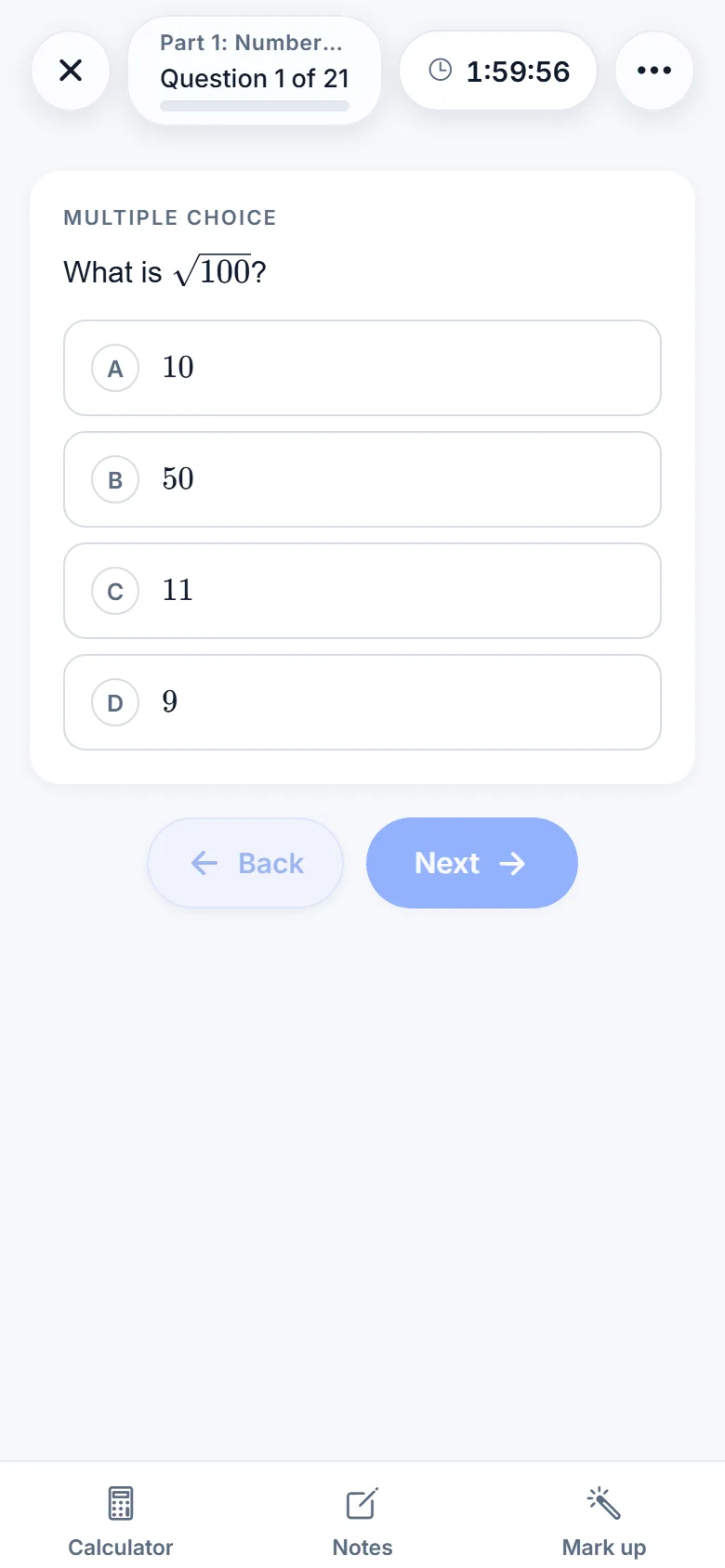 A question, timed, with the exam’s tools
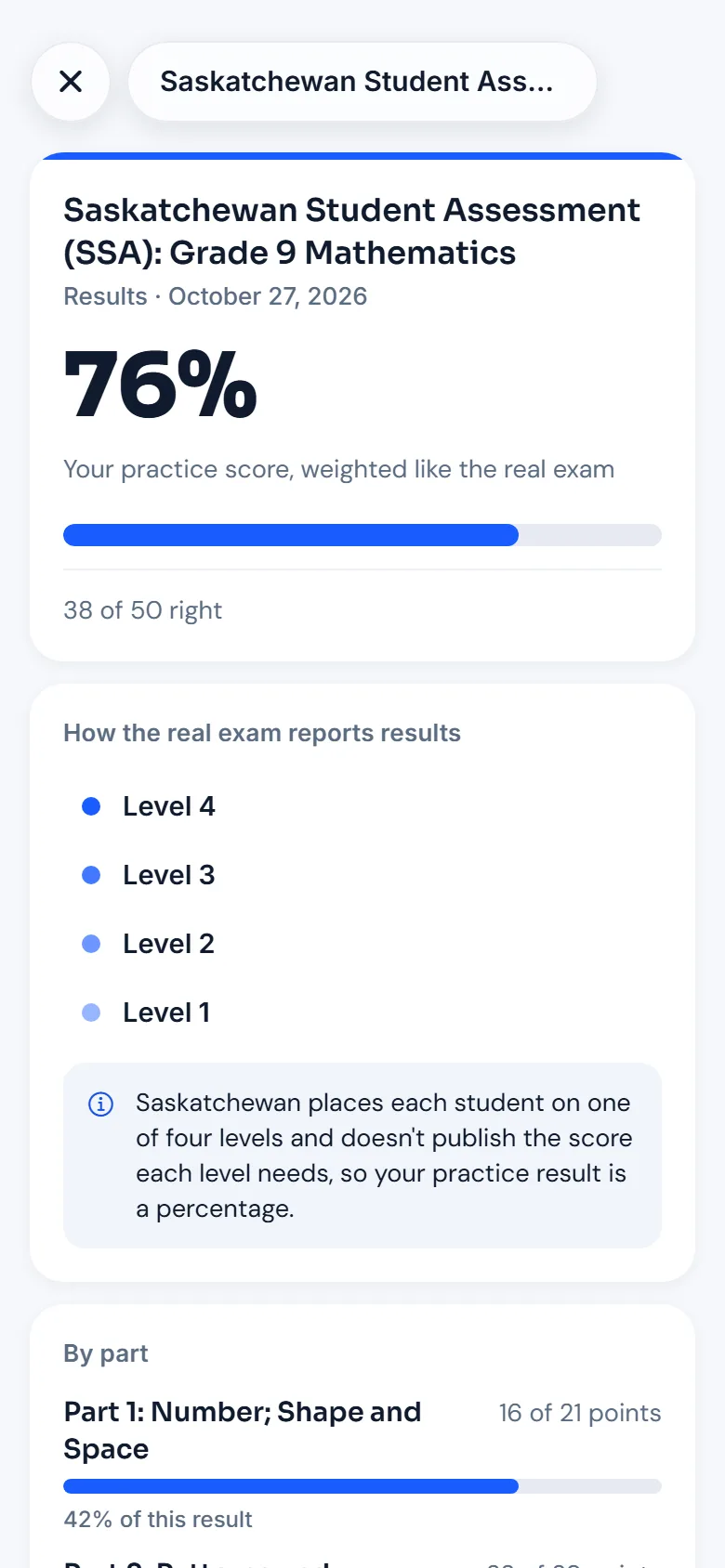 The marked result, part by part
A practice run of Saskatchewan’s Grade 9 math assessment.
Free with a MapleMind account
When
2 sessions this school year: Late January to early February 2027 (the date isn't published; inferred) and Mid to late June 2027 (the date isn't published; inferred from the old public exams' June sittings).
Late January to early February 2027 (the date isn't published; inferred)
- January 25 to February 5, 2027School day · English 3201 mid-term exam
Mid to late June 2027 (the date isn't published; inferred from the old public exams' June sittings)
- June 14 to June 25, 2027School day · English 3201 final exam
The dates are Newfoundland & Labrador’s own, read on November 9, 2026. See the official schedule (gov.nl.ca)
What’s on it
6 topics. Poetic Study and Analytical Essay count most, at 25% each.
- Viewing11%Media
- Viewing8%Artistic
- Poetic Study25%
- Prose Study19%
- Analytical Essay25%
- Personal Response13%
The skills it tests · 30 skills
- Analyzing how identities influence texts
- Analyzing texts through critical response
- Assessing feedback when creating or revising
- Assessing how language, form, and genre contribute
- Assessing own writing strategies and processes
- Clarifying thoughts through writing and representing
- Creating texts collaboratively and independently
- Creating texts for audiences and purposes
- Creating texts using stylistic techniques
- Demonstrating understanding of texts
- Evaluating effectiveness of own texts
- Evaluating how texts create meaning and purpose
- Evaluating information from sources
- Evaluating own and others' opinions about texts
- Evaluating own inquiry processes
- Evaluating strategies to engage the audience
- Evaluating stylistic techniques for meaning and purpose
- Explaining own processes and strategies with texts
- Expressing creativity through texts
- How text construction influences audience
- Integrating information for a learning task
- Integrating information to enhance clarity and precision
- Investigating topics and questions for inquiry
- Justifying connections between self and texts
- Justifying critical responses to texts
- Reading and viewing texts for specific purposes
- Reflecting on own interpretation of texts
- Selecting information from sources
- Strategies to enhance understanding of texts
- Using conventions of written language
How it’s built
Multiple-choice questions, questions in sets, written answers and an essay.
- Section A, Part 1: Viewing (Media)
- Questions
- 4
- Marks
- 9
- Of the marks
- 11.25%
- Multiple choice
- Questions in sets
- Written answers
A media visual, such as an advertisement: three multiple-choice questions and one written answer worth six marks on how its media strategies work.
- Section A, Part 2: Viewing (Artistic)
- Question
- 1
- Marks
- 6
- Of the marks
- 7.5%
- Questions in sets
- Written answers
An artistic visual, such as a painting or a photograph: one written answer worth six marks on its visual elements.
- Section A, Part 3: Poetic Study
- Questions
- 10
- Marks
- 20
- Of the marks
- 25%
- Multiple choice
- Questions in sets
- Written answers
A poem: eight multiple-choice questions and two written answers worth six marks each, on its language, form and technique.
- Section A, Part 4: Prose Study
- Questions
- 10
- Marks
- 15
- Of the marks
- 18.75%
- Multiple choice
- Questions in sets
- Written answers
A prose piece, such as a short story or an essay: nine multiple-choice questions and one written answer worth six marks.
- Section B, Writing: Analytical Essay
- Question
- 1
- Marks
- 20
- Of the marks
- 25%
- Essay
One multi-paragraph essay that analyzes a text given on the exam, on the prompt given. Worth 20 marks, half for content and half for composition.
- Section C, Writing: Personal Response
- Question
- 1
- Marks
- 10
- Of the marks
- 12.5%
- Essay
One personal response to a prompt: your own thoughts, feelings and experiences. Worth 10 marks.
How it’s marked
Multiple-choice questions are worth one mark each and written answers six marks each. The essay is worth 20 marks, half for content and half for composition, and the personal response 10. The exam counts toward 15 per cent of your final grade.
On the day
One sitting on a school computer. The province hasn't published the real exam's length; this practice allows three hours, as the last exams did.
Getting ready
2 official documents to practise with, and 5 tips.
Official practice
Tips from the people who write it
- Look closely at each visual's forms and elements before you answer.
- Support each written answer with details from the text or visual.
- If a note gives a passage's context, read it carefully.
- The essay prompt says "you may consider": choose your own thesis.
- Leave time for the essay and the personal response: together they are 30 of the 80 marks.
The mark you need
Your class mark counts for 85% of the final mark, the exam for 15%.
You need
42% on the exam
With 75% in class, your final mark lands between 63.8% (0 on the exam) and 78.8% (100% on it).
More for you
Students
Start with the topics worth the most marks, then write full practice exams under the real time limit.
Practise itParents
Put the dates on the family calendar. The Parent Dashboard shows each practice exam’s result and the skills that need another look.
See the Parent DashboardEducators
The topic weights and the official practice above make a review plan. Students can practise each skill on its own in MapleMind, free with daily limits.
For schools
Questions about this exam
When is the English 3201 Public Exam in 2026–27?
The next sitting is January 25 to February 5, 2027. This school year it’s written in Late January to early February 2027 (the date isn't published; inferred) and Mid to late June 2027 (the date isn't published; inferred from the old public exams' June sittings).
How long is the English 3201 Public Exam?
It takes 3 hours in all, over 6 parts.
How many questions are on the English 3201 Public Exam?
It has 27 marked questions: 4 in Section A, Part 1: Viewing (Media), 1 in Section A, Part 2: Viewing (Artistic), 10 in Section A, Part 3: Poetic Study, 10 in Section A, Part 4: Prose Study, 1 in Section B, Writing: Analytical Essay and 1 in Section C, Writing: Personal Response.
Can you use a calculator on the English 3201 Public Exam?
No. Calculators aren’t allowed.
How much does the English 3201 Public Exam count?
It’s worth 15% of the final mark in English Language Arts 3201 (Academic).
Where can I find practice tests for the English 3201 Public Exam?
Newfoundland & Labrador publishes English 3201 sample test on the department's computer-based testing platform (Sample Items, 3000 Level Courses). MapleMind also builds a full practice exam in its format, free with an account.

Practise for the English 3201 Public Exam
Every skill on the English 3201 Public Exam, taught one at a time, then practised on questions written like the real ones.


