Get help with Mathematics 3201 (Academic)
Most tutoring makes you sit through material you already know. MapleMind flips that: pick the exact skill that's causing trouble — any of the 32 below — and the tutor teaches just that one, step by step, as many times as it takes. Ask questions in plain words, any time of day, in English, French, or 12 other languages.
The official Newfoundland and Labrador Mathematics 3201 (Academic) curriculum
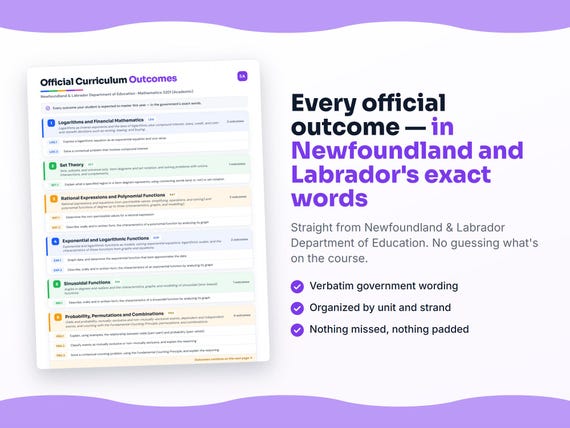
Newfoundland and Labrador defines Mathematics 3201 (Academic) by strands and outcomes. MapleMind teaches the same curriculum reorganized for one-skill-at-a-time tutoring — the table shows exactly where every official strand lands, and the ministry's own wording is quoted under each unit below.
Official source Newfoundland and Labrador's official curriculumRead it on the government site — gov.nl.ca ↗| Official strand | Outcomes | Where MapleMind teaches it |
|---|---|---|
| Strand N | 10 | Logarithms and Financial Mathematics · Set Theory |
| PAR | 9 | Rational Expressions and Polynomial Functions · Exponential and Logarithmic Functions |
| SAS | 2 | Sinusoidal Functions |
| SAP | 11 | Probability, Permutations and Combinations |
Every skill below, taught one on one.
 Try the first session free
How MapleMind teaches Mathematics 3201 (Academic) — every unit, lesson, and skill
Every skill below runs as a short session: a plain-words lesson, a worked example, solving it together, then a five-question skill check that earns up to three stars. Guided Mode keeps it teaching instead of answer-handing — turning it off needs a parent's password.
Unit 1Logarithms and Financial MathematicsOfficial strand · Strand N
Logarithms as inverse exponents and the laws of logarithms, plus compound interest, loans, credit, and cost-and-benefit decisions such as renting, leasing, and buying.
Logarithms
- Logarithmic and exponential formN.1.1 — Express a logarithmic equation as an exponential equation and vice versa, and determine the value of a logarithmic expression without technology.
- The laws of logarithmsN.1.3 — Develop the laws of logarithms using numeric examples and the exponent laws, and determine an equivalent expression by applying the laws.
- Evaluating logarithmsN.1.5 — Determine an equivalent expression for a logarithmic expression by applying the laws of logarithms, and determine the approximate value of a logarithmic expression with technology.
Compound Interest and Loans
- Compound interestN.1.8 — Explain the advantages and disadvantages of compound versus simple interest, identify situations involving compound interest, solve contextual compound-interest problems, and compare the total interest for different compounding periods.
- Simple versus compound interestN.1.6 — Explain the advantages and disadvantages of compound interest and simple interest, and identify situations that involve compound interest.
- Loans and credit optionsN.1.11 — Determine the total interest and total cost of a loan under a variety of conditions using technology, determine an unknown variable in compound-interest loan situations, and compare different credit options that involve compound interest.
- Buying, leasing and renting decisionsN.1.16 — Identify assets that appreciate or depreciate, compare renting, leasing, and buying, justify which is advantageous for a set of circumstances, and solve a cost-and-benefit problem using technology.
The official wording — 7 outcomes in this unit
- N.1.1
Express a logarithmic equation as an exponential equation and vice versa
- N.1.3
Develop the laws of logarithms, using numeric examples and the exponent laws
- N.1.5
Determine the approximate value of a logarithmic expression, such as log 2 9 , with technology
- N.1.8
Solve a contextual problem that involves compound interest
- N.1.6
Explain the advantages and disadvantages of compound interest and simple interest
- N.1.11
Determine, using technology, the total cost of a loan under a variety of conditions; e.g., different amortization periods, interest rates, compounding periods and terms
- N.1.16
Justify, for a specific set of circumstances, if renting, buying or leasing would be advantageous
Unit 2Set TheoryOfficial strand · Strand N
Sets, subsets, and universal sets, Venn diagrams and set notation, and solving problems with unions, intersections, and complements.
Sets and Venn Diagrams
- Sets, subsets and Venn regionsN.2.3 — Provide examples of empty, disjoint, subset, and universal sets in context; organize information using graphic organizers; and explain what a specified region in a Venn diagram represents using connecting words or set notation.
- Solving problems with set operationsN.2.4 — Determine the elements in the complement, intersection, and union of two sets, solve a contextual problem involving sets and record it using set notation, and identify and correct errors in a set solution.
- Applications of set theoryN.2.7 — Explain how set theory is used in applications such as Internet searches, database queries, data analysis, games, and puzzles.
The official wording — 3 outcomes in this unit
- N.2.3
Explain what a specified region in a Venn diagram represents, using connecting words (and, or, not) or set notation
- N.2.4
Determine the elements in the complement, the intersection and the union of two sets
- N.2.7
Explain how set theory is used in applications such as Internet searches, database queries, data analysis, games and puzzles
Unit 3Rational Expressions and Polynomial FunctionsOfficial strand · PAR
Rational expressions and equations (non-permissible values, simplifying, operations, and solving) and polynomial functions of degree up to three (characteristics, graphs, and modelling).
Rational Expressions
- Non-permissible values and simplifyingPAR.3.2 — Explain why a value is non-permissible for a rational expression, determine the non-permissible values, simplify a rational expression, and explain why the non-permissible values are unchanged by simplifying (numerators and denominators limited to monomials and binomials).
- Adding and subtracting rational expressionsPAR.3.11 — Determine, in simplified form, the sum or difference of rational expressions that have the same or different denominators, tracking non-permissible values (numerators and denominators limited to monomials and binomials).
- Multiplying and dividing rational expressionsPAR.3.12 — Determine, in simplified form, the product or quotient of rational expressions, tracking non-permissible values (numerators and denominators limited to monomials and binomials).
- Solving rational equationsPAR.3.14 — Determine the non-permissible values for a rational equation, solve it algebraically and explain the strategy, explain why a value found may not be a solution, and solve a contextual problem that involves a rational equation.
Polynomial Functions
- Characteristics of polynomial functionsPAR.3.17 — Describe the characteristics of a polynomial function of degree at most three by analyzing its graph and its equation, and match equations in a set to their corresponding graphs.
- Modelling data with polynomial functionsPAR.3.20 — Graph data and determine the polynomial function that best approximates it, interpret the graph of a polynomial function that models a situation, and solve a contextual problem using technology.
The official wording — 6 outcomes in this unit
- PAR.3.2
Determine the non-permissible values for a rational expression
- PAR.3.11
Determine, in simplified form, the sum or difference of two rational expressions that have different denominators
- PAR.3.12
Determine, in simplified form, the product or quotient of rational expressions
- PAR.3.14
Determine the solution to a rational equation algebraically, and explain the strategy used to solve the equation
- PAR.3.17
Describe, orally and in written form, the characteristics of a polynomial function by analyzing its graph
- PAR.3.20
Graph data, and determine the polynomial function that best approximates the data
Unit 4Exponential and Logarithmic FunctionsOfficial strand · PAR
Exponential and logarithmic functions as models, solving exponential equations, logarithmic scales, and the characteristics of these functions from graphs and equations.
Exponential and Logarithmic Models
- Fitting exponential and logarithmic modelsPAR.4.1 — Graph data and determine the exponential or logarithmic function that best approximates it, and interpret the graph of such a function that models a situation.
- Solving exponential equations and scalesPAR.4.7 — Determine the solution of an exponential equation whether or not the bases are powers of one another, solve problems that apply exponential equations, and solve problems involving logarithmic scales such as the Richter or pH scale.
Characteristics of Exponential and Logarithmic Functions
- Describing and matching exp/log functionsPAR.4.12 — Describe the characteristics of an exponential function by analyzing its graph and its equation, describe the characteristics of a logarithmic function likewise, and match equations in a set to their corresponding graphs.
The official wording — 3 outcomes in this unit
- PAR.4.1
Graph data, and determine the exponential function that best approximates the data
- PAR.4.7
Determine the solution of an exponential equation in which the bases are powers of one another
- PAR.4.12
Describe, orally and in written form, the characteristics of an exponential function by analyzing its graph
Unit 5Sinusoidal FunctionsOfficial strand · SAS
Angles in degrees and radians and the characteristics, graphs, and modelling of sinusoidal (sine-based) functions.
Sinusoidal Functions
- Degrees, radians and sinusoidal graphsSAS.7.2 — Demonstrate an understanding of angles in degrees and radians, and describe the characteristics of a sinusoidal function by analyzing its graph and interpreting a graph that models a situation.
- Equations and models of sinusoidal functionsSAS.7.4 — Describe the characteristics of a sinusoidal function by analyzing its equation, match equations to their graphs, graph data and determine the sinusoidal function that best approximates it, and solve a contextual problem using technology.
The official wording — 2 outcomes in this unit
- SAS.7.2
Describe, orally and in written form, the characteristics of a sinusoidal function by analyzing its graph
- SAS.7.4
Describe, orally and in written form, the characteristics of a sinusoidal function by analyzing its equation
Unit 6Probability, Permutations and CombinationsOfficial strand · SAP
Odds and probability, mutually-exclusive and non-mutually-exclusive events, dependent and independent events, and counting with the Fundamental Counting Principle, permutations, and combinations.
Odds and Probability
- Odds and probabilitySAP.9.2 — Explain the relationship between odds (part-part) and probability (part-whole) with examples, provide examples of probability and odds from real fields, determine the probability or odds for an outcome, and express odds as a probability and vice versa.
- Solving and deciding with probabilitySAP.9.5 — Solve a contextual problem that involves odds or probability, and explain how decisions may be based on probability or odds together with subjective judgments.
Combined and Dependent Events
- Mutually-exclusive and non-mutually-exclusive eventsSAP.9.7 — Classify events as mutually exclusive or non-mutually-exclusive and explain the reasoning, determine whether two events are complementary, represent events using set notation or graphic organizers, and solve and create problems involving these events.
- Dependent and independent eventsSAP.9.13 — Compare dependent and independent events using examples, determine the probability of two independent events, determine the probability of an event given a previous event, and create and solve problems involving dependent or independent events.
The Fundamental Counting Principle
- The Fundamental Counting PrincipleSAP.9.19 — Represent counting problems with a graphic organizer, generalize the Fundamental Counting Principle by inductive reasoning, identify assumptions in a counting problem, and solve a contextual counting problem using the principle.
- Factorials and factorial notationSAP.9.20 — Determine the value of a factorial with or without technology, simplify a numeric or algebraic fraction containing factorials, and represent the arrangements of n elements taken n at a time using factorial notation.
- Solving equations with factorialsSAP.9.22 — Solve an equation that involves factorials by simplifying the factorial expressions and solving the resulting equation.
Permutations and Combinations
- PermutationsSAP.9.24 — Determine the number of permutations of n elements taken r at a time, generalize strategies for permutations, and solve a contextual problem involving probability and permutations.
- Permutations with repeated elementsSAP.9.26 — Determine the number of permutations of n elements taken n at a time where some elements are not distinct, and explain the effect on the total number of permutations when two or more elements are identical.
- CombinationsSAP.9.30 — Determine the number of combinations of n elements taken r at a time, generalize strategies for combinations, explain when order matters, and solve a contextual problem involving probability and combinations.
- Probability with combinationsSAP.9.32 — Solve a contextual problem that involves probability and combinations, using combinations to count favourable and total outcomes.
The official wording — 11 outcomes in this unit
- SAP.9.2
Explain, using examples, the relationship between odds (part-part) and probability (part-whole)
- SAP.9.5
Solve a contextual problem that involves odds or probability
- SAP.9.7
Classify events as mutually exclusive or non–mutually exclusive, and explain the reasoning
- SAP.9.13
Determine the probability of two independent events
- SAP.9.19
Solve a contextual counting problem, using the Fundamental Counting Principle, and explain the reasoning
- SAP.9.20
Determine, with or without technology, the value of a factorial
- SAP.9.22
Solve an equation that involves factorials
- SAP.9.24
Determine the number of permutations of n elements taken r at a time
- SAP.9.26
Determine the number of permutations of n elements taken n at a time where some elements are not distinct
- SAP.9.30
Determine the number of combinations of n elements, taken r at a time
- SAP.9.32
Solve a contextual problem that involves probability and combinations
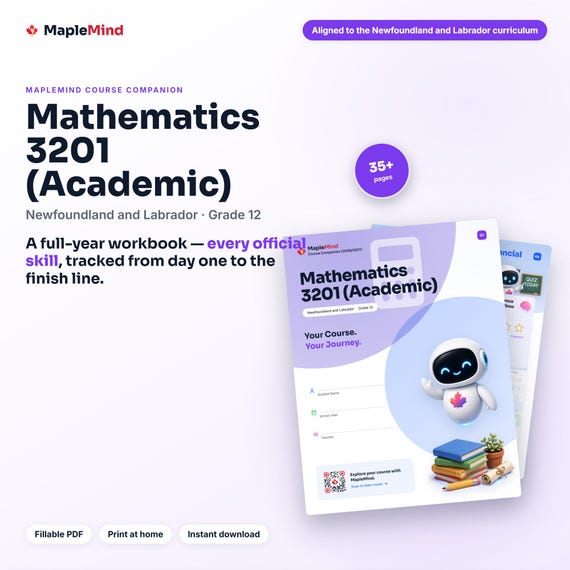
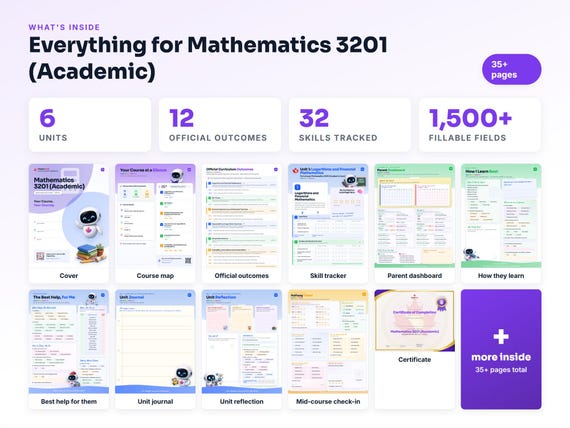

Printable workbook · A keepsake of the year
A Mathematics 3201 (Academic) workbook worth keeping
Built from the same official curriculum as this page. Before and after each skill above, your student colours in how sure they feel — so the two of you can see, on one page, what's clicking and what needs another look. It's a quiet way to follow how the year is really going.
By June it's full of their own handwriting: units worked through, confidence grown, a mid-year check-in, notes from parent-teacher night, and a certificate at the end. Less a worksheet, more a record of the year worth keeping on the shelf.
Instant download · see every page, reviews and the full description · five or more workbooks are $2.99 each
What it looks like in the app



Common questions
Can MapleMind help me with Mathematics 3201 (Academic)?
Yes. MapleMind's AI tutor covers all 32 skills in Newfoundland and Labrador's Mathematics 3201 (Academic) — you pick the exact skill, and the tutor teaches it step by step: a short lesson, a worked example, solving together, then a skill check to show it stuck.
Is MapleMind aligned to Newfoundland and Labrador's official curriculum?
Yes. Every skill in this course maps to an official outcome code from Newfoundland and Labrador's Grade 12 Mathematics curriculum, and the ministry's own wording is quoted under each unit on this page — with the official government source linked so you can check it yourself.
What does MapleMind cost?
It's free to start — 5 tutoring chats and a practice quiz every day, no credit card. A Pro subscription ($9.99/month or $49.99/year CAD, 7-day free trial) unlocks unlimited tutoring, practice, and exam simulations.
What if I'm stuck on just one topic?
That's the point of skill-level tutoring: open Mathematics 3201 (Academic) in the app, tap the exact skill from the list on this page, and the tutor teaches just that — no wading through lessons you don't need.
Does MapleMind work in French or other languages?
Yes — 14 languages, including French. Both the app and the tutor's explanations switch to the language you choose.
Where can I see the official Newfoundland and Labrador curriculum for Mathematics 3201 (Academic)?
The official source is linked on this page — Newfoundland and Labrador's official curriculum. The outline here follows it: every MapleMind skill carries its official outcome code, and the ministry's own wording is quoted under each unit.
Keep exploring
Ready when you are
Pick a skill from this page and see it taught properly — free, in the browser, in under a minute.