Get help with Mathematics 31
Most tutoring makes you sit through material you already know. MapleMind flips that: pick the exact skill that's causing trouble — any of the 37 below — and the tutor teaches just that one, step by step, as many times as it takes. Ask questions in plain words, any time of day, in English, French, or 12 other languages.
The official Alberta Mathematics 31 curriculum
Alberta defines Mathematics 31 by strands and outcomes. MapleMind teaches the same curriculum reorganized for one-skill-at-a-time tutoring — the table shows exactly where every official strand lands, and the ministry's own wording is quoted under each unit below.
Official source Alberta's official programs of studyRead it on the government site — alberta.ca ↗| Official strand | Outcomes | Where MapleMind teaches it |
|---|---|---|
| Precalculus and Limits | 4 | Precalculus and Limits |
| Derivatives | 3 | Derivatives |
| Applications of Derivatives | 2 | Applications of Derivatives |
| Integrals, Integral Theorems and Applications | 4 | Integrals |
| Elective Topics | 8 | Electives: Growth, Numerical and Integration Methods · Electives: Volumes and Applied Calculus · Electives: Calculus Theorems and Proof |
Every skill below, taught one on one.
 Try the first session free
How MapleMind teaches Mathematics 31 — every unit, lesson, and skill
Every skill below runs as a short session: a plain-words lesson, a worked example, solving it together, then a five-question skill check that earns up to three stars. Guided Mode keeps it teaching instead of answer-handing — turning it off needs a parent's password.
Unit 1Precalculus and LimitsOfficial strand · Precalculus and Limits
The algebra needed for calculus and the central idea that begins it: the limit. Algebra and composition of functions, transformations, equivalent forms, and a rigorous treatment of limits, continuity and limit theorems — including the trigonometric limits.
The Algebra of Functions
- Operations and composition of functions31.PL.1 — Form the sum, difference, product, quotient and composition of two or more functions, both algebraically and graphically, and state the domain and range of each result in interval notation.
- Solution sets of inequalities31.PL.1 — Solve and illustrate the solution sets of linear, quadratic and absolute value inequalities, expressing the answers in interval notation.
- Simplifying and solving with trigonometric identities31.PL.1 — Use the primary and reciprocal, sum and difference, double and half angle, and Pythagorean identities to simplify trigonometric expressions and solve trigonometric equations, distinguishing an equation from an identity.
Transformations of Functions
- Translation, reflection and dilatation31.PL.2 — Sketch and describe algebraically the effect of any translation, reflection or dilatation on linear, quadratic, cubic, absolute value, reciprocal, exponential and step functions, comparing y = f(x) with y = a·f[k(x + c)] + d.
- Parallel, perpendicular, tangent, normal and secant lines31.PL.2 — Describe parallel, perpendicular, tangent, normal and secant lines to a curve, and find the equation of a line from any two conditions that define it.
- Solving systems of equations31.PL.2 — Solve linear-linear, linear-quadratic and quadratic-quadratic systems of equations, translating a pair of problem conditions into a system of two equations in two unknowns.
Equivalent Forms
- Factoring, rationalizing and simplifying31.PL.3 — Factor expressions with integral and rational exponents, rationalize numerators or denominators containing a radical, and simplify rational expressions — recognizing what makes two expressions equivalent.
Limits and Limit Theorems
- The concept of a limit and continuity31.PL.4 — Explain what a limit is, give examples of one-sided limits and functions with no limit, and distinguish continuous from discontinuous functions. Notation: $\lim_{x \to a} f(x)$.
- Evaluating limits with the limit theorems31.PL.4 — Determine the limit of any algebraic function as the variable approaches finite or infinite values using the sum, difference, multiple, product, quotient and power theorems, evaluating 0/0 forms by factoring or rationalizing first.
- Geometric series and trigonometric limits31.PL.4 — Calculate the sum of an infinite convergent geometric series, and prove and apply the basic trigonometric limits (such as $\lim_{x\to 0}\frac{\sin x}{x}=1$) with the limit theorems to evaluate more complex trigonometric limits.
The official wording — 4 outcomes in this unit
- 31.PL.1
finding the sum, difference, product, quotient and composition of functions
- 31.PL.2
sketching the graph of, and describing algebraically, the effects of any translation, reflection or dilatation
- 31.PL.3
simplifying rational expressions, using any of the four basic operations
- 31.PL.4
explaining, and giving examples of, continuous and discontinuous functions
Unit 2DerivativesOfficial strand · Derivatives
The derivative as the limit of a slope. From the definition and the tangent-as-limit idea, through the power/sum/difference theorems, the product, quotient and chain rules, implicit and higher-order differentiation, to the derivatives of the trigonometric functions.
The Derivative from First Principles
- The tangent slope as a limit31.D.1 — Show that the slope of a tangent line is a limit approached by a sequence of secant lines, and connect the derivative to that slope. Definition: $f'(x) = \lim_{h\to 0}\frac{f(x+h)-f(x)}{h}$.
- Power, sum and difference theorems31.D.1 — Use the definition to differentiate $x^n$, then differentiate polynomial functions with the sum and difference theorems. Notation: $\frac{d}{dx}[x^n] = nx^{n-1}$.
The Product, Quotient and Chain Rules
- The product, quotient and chain rules31.D.2 — Apply the chain, power, product and quotient rules — including the chain rule in combination with the product and quotient rules — to differentiate complicated functions, writing final answers in factored form.
Implicit Differentiation
- Differentiating implicitly31.D.2 — Use implicit differentiation where a variable is hard to isolate, relating it to the chain rule, and use it to find slopes and tangent lines on relations such as the standard conics.
Higher-Order Derivatives
- Second and higher derivatives31.D.2 — Find the second, third and higher derivatives of algebraic functions and describe the second derivative geometrically (as the rate of change of slope, governing concavity).
Derivatives of Trigonometric Functions
- Differentiating trigonometric functions31.D.3 — Calculate the derivatives of the three primary and three reciprocal trigonometric functions, use the power/chain/product/quotient rules on them, and explain why radian measure is required in the calculus of trigonometric functions.
The official wording — 3 outcomes in this unit
- 31.D.1
showing that the slope of a tangent line is a limit
- 31.D.2
applying the chain rule in combination with the product and quotient rule
- 31.D.3
calculating the derivatives of the three primary and three reciprocal trigonometric functions
Unit 3Applications of DerivativesOfficial strand · Applications of Derivatives
The derivative as a tool. Using the first and second derivatives to sketch curves and locate maxima, minima and inflection points and to solve optimization problems; and using the chain rule to relate rates of change through time.
Maxima, Minima and Curve Sketching
- First and second derivative analysis31.AD.1 — Use the sign of the first derivative for increasing/decreasing behaviour and the sign of the second derivative for concavity, locating maxima, minima and inflection points to sketch a graph.
- Optimization problems31.AD.1 — Build a mathematical model of a geometric, economic or motion problem and use calculus to find maxima or minima — volumes, areas, perimeters, costs, profits, times or distances.
Related Rates
The official wording — 2 outcomes in this unit
- 31.AD.1
using the first and second derivatives to find maxima, minima and inflection points to aid in graph sketching
- 31.AD.2
using the chain rule to find the derivative of a function with respect to an external variable, such as time
Unit 4IntegralsOfficial strand · Integrals, Integral Theorems and Applications
Integration as the inverse of differentiation and as accumulated area. Antiderivatives and the family of curves, separable first-order differential equations, area under a curve as a limit of rectangle sums, the definite integral and the Fundamental Theorem of Calculus, and the displacement-velocity-acceleration chain of motion.
Antiderivatives
- Antiderivatives and families of curves31.I.1 — Recognize antidifferentiation as the inverse of differentiation, find antiderivatives of polynomials, rational and trigonometric functions, and the family of curves sharing a given derivative. Notation: $\int f(x)\,dx$.
- Separable first-order differential equations31.I.1 — Solve separable first-order differential equations for general and specific solutions by separating variables and antidifferentiating each side, using an initial condition to fix the constant.
Area Under a Curve as a Limit
- Area as a limit of rectangle sums31.I.2 — Define the area under a curve as a limit of sums of rectangle areas, establish upper and lower bounds, and approximate the area over an interval by summing individual rectangles.
The Definite Integral and the Fundamental Theorem
- The definite integral and the FTC31.I.3 — Explain how the definite integral between fixed limits a and b is the number F(b) − F(a), and how the Fundamental Theorem of Calculus relates the area limit to the antiderivative. Notation: $\int_a^b f(x)\,dx = F(b)-F(a)$.
- Evaluating integrals and area between curves31.I.3 — Calculate definite integrals of polynomial, rational and trigonometric functions and find the area between a curve and the x-axis (constant or changing sign) and between intersecting curves.
Motion: Displacement, Velocity and Acceleration
- Kinematics with derivatives and antiderivatives31.I.4 — Differentiate a position function to get velocity and acceleration, antidifferentiate to reverse the chain, and derive the kinematic equations and simple harmonic motion from x = A·cos(kt + c).
The official wording — 4 outcomes in this unit
- 31.I.1
finding the antiderivatives of polynomials, rational algebraic functions and trigonometric functions
- 31.I.2
defining the area under a curve as a limit of the sums of the areas of rectangles
- 31.I.3
explaining how the definite integral between fixed limits a and b is a number whose value is F(b) - F(a)
- 31.I.4
using antiderivatives of acceleration and velocity functions to get velocity and displacement functions
Unit 5Electives: Growth, Numerical and Integration MethodsOfficial strand · Elective Topics
Elective strands extending the calculus toolkit: the calculus of exponential and logarithmic functions built on e, numerical methods for roots and integrals, and further techniques of integration (substitution, parts, partial fractions).
Derivatives of Exponential and Logarithmic Functions
- Differentiating and antidifferentiating exp/log functions31.EL.1 — Define exponential and logarithmic functions as inverses, work with e as a limit, and find the derivative and antiderivative of the base-e functions and of exponential/logarithmic functions in other bases.
Exponential Growth and Decay Models
- Modelling growth, decay and return to equilibrium31.EL.1 — Set up and solve the differential equations $y'=ky$ and $y'=k(y-y_0)$ to model natural growth, decay and return to equilibrium — including doubling time and half-life — and fit exponential models to data.
Newton-Raphson Root Finding
- Approximating roots with Newton-Raphson31.NM.1 — Distinguish exact from approximate solutions and iterative from non-iterative procedures, and solve $f(x) = 0$ by systematic trial and error and by the Newton-Raphson method $x_{n+1}=x_n-\frac{f(x_n)}{f'(x_n)}$.
Numerical Integration
- Riemann sums and the quadrature rules31.NM.1 — Estimate a definite integral with upper and lower Riemann sums and the midpoint, trapezoidal and Simpson's rules, connecting the number of subdivisions to the accuracy of the estimate.
Integration by Substitution
- Substitution and trigonometric substitution31.FI.1 — Recognize when substitution applies, use a change of variable to reverse the chain rule (changing the limits for a definite integral), and use a trigonometric substitution or identity to integrate radical and algebraic expressions.
Integration by Parts and Partial Fractions
- Integration by parts31.FI.1 — Use integration by parts, $\int u\,dv = uv - \int v\,du$, to integrate a product, choosing u and dv so the resulting integral is simpler than the original.
- Integration by partial fractions31.FI.1 — Write a rational function as a sum of partial fractions and integrate each simpler fraction, combining methods where a rational integrand requires it.
The official wording — 3 outcomes in this unit
- 31.EL.1
finding the derivative and antiderivative of the base- e exponential function
- 31.NM.1
solving the equation f(x) = 0 by systematic trial and error, and by the Newton-Raphson method
- 31.FI.1
using a change of variable to integrate by substitution
Unit 6Electives: Volumes and Applied CalculusOfficial strand · Elective Topics
Elective strands applying calculus: volumes of revolution by the disc method, and modelling in the physical sciences and engineering, the biological sciences, and business and economics.
Volumes of Revolution
- The disc method31.VR.1 — Identify the solid a rotated graph generates, connect a volume of revolution to a stack of cylindrical discs, and use $V = \pi\int_a^b [f(x)]^2\,dx$ — including the volume between two curves after finding their intersection points.
Physical Sciences and Engineering Applications
- Differential equations in physical models31.PS.1 — Develop and solve differential equations for linear motion, simple harmonic motion, work, hydrostatic force, moments of inertia and radioactive decay, and compute work done by a nonuniform force.
Biological Applications
- Growth, decay and the logistic equation31.BS.1 — Model biological growth, decay and movement across a boundary with y' = ky and y' = k(y − y0), verify solutions, and relate limited growth to the logistic equation y' = ky(L − y).
Business and Economics Applications
- Optimizing revenue, profit and cost31.BE.1 — Use revenue, profit and cost functions to find and justify optimum values — maximizing revenue or profit and minimizing cost as functions of price or quantity — and model the business cycle with trigonometric functions.
The official wording — 4 outcomes in this unit
- 31.VR.1
explaining the connection between the volume of revolution and the volume of a cylindrical disc
- 31.PS.1
solving differential equations of type y"(t) = f(t)
- 31.BS.1
solving natural growth and decay problems starting from the equations
- 31.BE.1
finding the maximum of a revenue or profit function that is expressed as a function of price or number sold
Unit 7Electives: Calculus Theorems and ProofOfficial strand · Elective Topics
The elective proof strand: the nature of proof for limit, derivative and integral theorems, and the great existence theorems — intermediate value, Rolle's, mean value and the Fundamental Theorem of Calculus.
Calculus Theorems and Proof
- Proof and the value theorems31.CT.1 — Distinguish example from counterexample and intuitive from rigorous proof; illustrate the intermediate value theorem, Rolle's theorem, the mean value theorem and the FTC; and compose rigorous derivative proofs from limit theorems.
The official wording — 1 outcome in this unit
- 31.CT.1
comparing the nature of intuitive and rigorous proofs
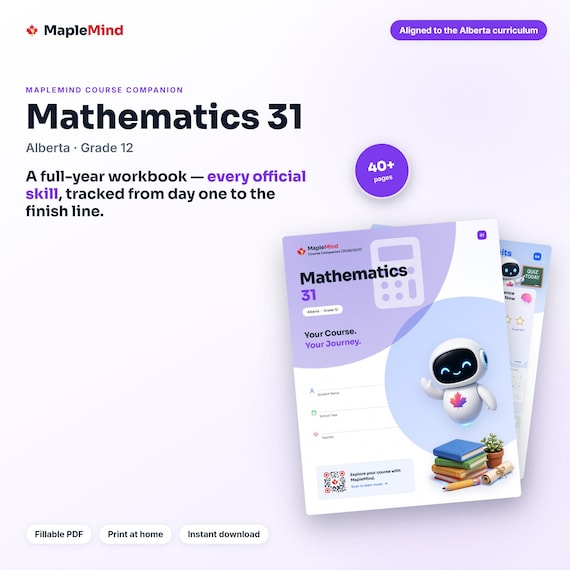


Printable workbook · A keepsake of the year
A Mathematics 31 workbook worth keeping
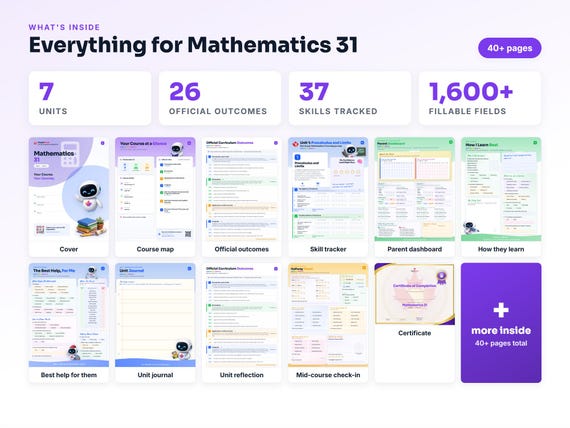
Built from the same official curriculum as this page. Before and after each skill above, your student colours in how sure they feel — so the two of you can see, on one page, what's clicking and what needs another look. It's a quiet way to follow how the year is really going.
By June it's full of their own handwriting: units worked through, confidence grown, a mid-year check-in, notes from parent-teacher night, and a certificate at the end. Less a worksheet, more a record of the year worth keeping on the shelf.
Instant download · see every page, reviews and the full description · five or more workbooks are $2.99 each
What it looks like in the app



Common questions
Can MapleMind help me with Mathematics 31?
Yes. MapleMind's AI tutor covers all 37 skills in Alberta's Mathematics 31 — you pick the exact skill, and the tutor teaches it step by step: a short lesson, a worked example, solving together, then a skill check to show it stuck.
Is MapleMind aligned to Alberta's official curriculum?
Yes. Every skill in this course maps to an official outcome code from Alberta's Grade 12 Mathematics curriculum, and the ministry's own wording is quoted under each unit on this page — with the official government source linked so you can check it yourself.
What does MapleMind cost?
It's free to start — 5 tutoring chats and a practice quiz every day, no credit card. A Pro subscription ($9.99/month or $49.99/year CAD, 7-day free trial) unlocks unlimited tutoring, practice, and exam simulations.
What if I'm stuck on just one topic?
That's the point of skill-level tutoring: open Mathematics 31 in the app, tap the exact skill from the list on this page, and the tutor teaches just that — no wading through lessons you don't need.
Does MapleMind work in French or other languages?
Yes — 14 languages, including French. Both the app and the tutor's explanations switch to the language you choose.
Where can I see the official Alberta curriculum for Mathematics 31?
The official source is linked on this page — Alberta's official programs of study. The outline here follows it: every MapleMind skill carries its official outcome code, and the ministry's own wording is quoted under each unit.
Keep exploring
Ready when you are
Pick a skill from this page and see it taught properly — free, in the browser, in under a minute.