Get help with Mathematics 2200
Most tutoring makes you sit through material you already know. MapleMind flips that: pick the exact skill that's causing trouble — any of the 43 below — and the tutor teaches just that one, step by step, as many times as it takes. Ask questions in plain words, any time of day, in English, French, or 12 other languages.
The official Newfoundland and Labrador Mathematics 2200 curriculum
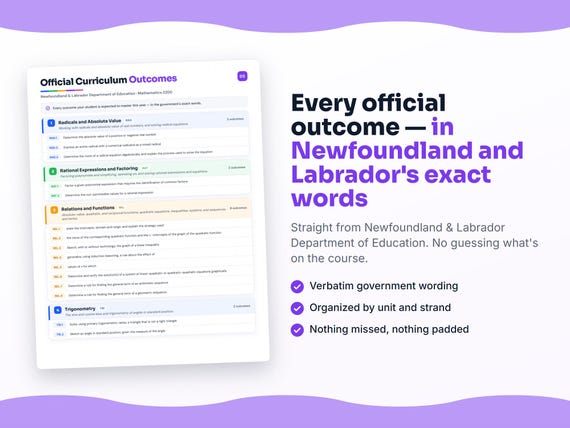
Newfoundland and Labrador defines Mathematics 2200 by strands and outcomes. MapleMind teaches the same curriculum reorganized for one-skill-at-a-time tutoring — the table shows exactly where every official strand lands, and the ministry's own wording is quoted under each unit below.
Official source Newfoundland and Labrador's official curriculumRead it on the government site — gov.nl.ca ↗| Official strand | Outcomes | Where MapleMind teaches it |
|---|---|---|
| Strand N | 7 | Radicals and Absolute Value |
| PAR | 29 | Rational Expressions and Factoring · Relations and Functions |
| SAS | 7 | Trigonometry |
Every skill below, taught one on one.
 Try the first session free
How MapleMind teaches Mathematics 2200 — every unit, lesson, and skill
Every skill below runs as a short session: a plain-words lesson, a worked example, solving it together, then a five-question skill check that earns up to three stars. Guided Mode keeps it teaching instead of answer-handing — turning it off needs a parent's password.
Unit 1Radicals and Absolute ValueOfficial strand · Strand N
Working with radicals and absolute value of real numbers, and solving radical equations.
Absolute Value of Real Numbers
- Absolute value and distanceN.1.6 — Determine the absolute value of a real number and of a numerical expression, relate absolute value to distance on a number line, and compare and order absolute values.
- Square roots and absolute valueN.1.11 — Explain, using examples, the relationship between the square root of a squared expression and absolute value, distinguishing the principal root from plus-or-minus.
Radical Expressions
- Mixed and entire radicalsN.1.1 — Express an entire radical as a mixed radical and a mixed radical as an entire radical, for numerical and variable radicands, and compare and order radical expressions.
- Simplifying radical expressionsN.1.13 — Identify the values for which a radical expression is defined and perform operations to simplify radical expressions with numerical or variable radicands.
- Rationalizing denominatorsN.1.14 — Rationalize monomial and binomial denominators of a rational expression, and relate rationalizing a binomial denominator to the difference-of-squares product.
- Where a radical is definedN.1.12 — Identify the values of the variable for which a given radical expression is defined, and compare and order radical expressions.
Radical Equations
- Solving radical equationsN.1.17 — Determine restrictions on the variable, solve a radical equation algebraically, verify roots by substitution, explain why some roots are extraneous, and model situations with radical equations.
The official wording — 7 outcomes in this unit
- N.1.6
Determine the absolute value of a positive or negative real number
- N.1.11
Explain, using examples
- N.1.1
Express an entire radical with a numerical radicand as a mixed radical
- N.1.13
Perform one or more operations to simplify radical expressions with numerical or variable radicands
- N.1.14
Rationalize the denominator of a rational expression with monomial or binomial denominators
- N.1.12
Identify the values of the variable for which a given radical expression is defined
- N.1.17
Determine the roots of a radical equation algebraically, and explain the process used to solve the equation
Unit 2Rational Expressions and FactoringOfficial strand · PAR
Factoring polynomials and simplifying, operating on, and solving rational expressions and equations.
Factoring Polynomials
- Factoring polynomial expressionsPAR.3.14 — Factor polynomial expressions by common factors, trinomials and differences of squares, quadratic-pattern expressions, and determine whether a binomial is a factor of a polynomial.
- Factoring quadratic-pattern expressionsPAR.3.17 — Factor polynomial expressions that have a quadratic pattern, including differences of squares in that pattern, and determine whether a binomial is a factor of a polynomial.
Simplifying Rational Expressions
- Non-permissible values and equivalentsPAR.3.2 — Determine and explain non-permissible values of a rational expression, and write equivalent forms by multiplying numerator and denominator by the same factor.
- Simplifying rational expressionsPAR.3.5 — Simplify a rational expression, explain why the non-permissible values are preserved, and identify and correct errors in a simplification.
- Operations on rational expressionsPAR.3.10 — Add, subtract, multiply, and divide rational expressions in simplified form, including denominators that are not the same, and simplify expressions with two or more operations.
- Multi-step rational expression workPAR.3.13 — Simplify an expression that involves two or more operations on rational expressions, tracking non-permissible values throughout.
- Solving rational equationsPAR.3.19 — Determine non-permissible values in a rational equation, solve it algebraically, explain why a value may not be a solution, and model situations with rational equations.
The official wording — 7 outcomes in this unit
- PAR.3.14
Factor a given polynomial expression that requires the identification of common factors
- PAR.3.17
Factor a given polynomial expression that has a quadratic pattern
- PAR.3.2
Determine the non-permissible values for a rational expression
- PAR.3.5
Simplify a rational expression
- PAR.3.10
Determine, in simplified form, the sum or difference of rational expressions with the same denominator
- PAR.3.13
Simplify an expression that involves two or more operations on rational expressions
- PAR.3.19
Determine the solution to a rational equation algebraically, and explain the strategy used to solve the equation
Unit 3Relations and FunctionsOfficial strand · PAR
Absolute-value, quadratic, and reciprocal functions; quadratic equations, inequalities, systems, and sequences and series.
Absolute Value Functions
- Graphing absolute value functionsPAR.4.1 — Sketch the graph of an absolute value function, state intercepts, domain, and range, create tables from a related function, and write absolute value functions in piecewise notation.
- Solving absolute value equationsPAR.4.6 — Solve an absolute value equation graphically and algebraically, verify the solution, correct errors, and explain why an equation set less than zero has no solution.
- Absolute value function problemsPAR.4.5 — Solve problems that involve an absolute value function, using its graph and piecewise form.
Quadratic Equations
- Roots, zeros, and x-interceptsPAR.4.9 — Explain the relationship among the roots of a quadratic equation, the zeros of its function, and the x-intercepts of its graph.
- Solving quadratic equationsPAR.4.10 — Solve quadratic equations by square roots, factoring, completing the square, the quadratic formula, and graphing; select and justify a method, correct errors, and verify solutions.
- The quadratic formula and discriminantPAR.4.11 — Derive the quadratic formula by deductive reasoning, use the discriminant to determine the number of real roots, and relate that to the graph and to problem solving.
- Quadratic equation problemsPAR.4.15 — Solve a problem by analyzing a quadratic equation, or by determining and then analyzing a quadratic equation from a situation.
Linear and Quadratic Inequalities
- Linear inequalities in two variablesPAR.4.18 — Sketch the graph of a linear inequality, use test points to find the solution region, decide when a solid or broken line is used, and solve linear-inequality problems.
- Quadratic inequalities in two variablesPAR.4.22 — Sketch the graph of a quadratic inequality using test points, decide when a solid or broken curve is used, and solve quadratic-inequality problems.
- Quadratic inequalities in one variablePAR.4.24 — Solve a quadratic inequality in one variable using case analysis, graphing, roots and test points, or sign analysis, and represent and interpret problems that involve it.
- Quadratic inequality problemsPAR.4.25 — Represent, solve, and interpret a problem that involves a quadratic inequality in one variable.
Quadratic Functions
- Transformations of quadratic functionsPAR.4.29 — Compare graphs of quadratic functions to y = x squared and generalize the effect of the a, p, and q parameters, and use them to determine the number of x-intercepts.
- Vertex form and the vertexPAR.4.28 — Sketch a quadratic in vertex form using transformations, identify the vertex, domain, range, direction of opening, axis of symmetry, and intercepts, and write a function from a graph or characteristics.
- Completing the squarePAR.4.43 — Convert a quadratic from standard form to vertex form by completing the square, explain and correct the process, and verify the two forms represent the same function.
- Modelling with quadratic functionsPAR.4.46 — Determine the characteristics of a quadratic given in standard form, write a quadratic that models a situation, and solve problems by analyzing a quadratic function.
Reciprocal Functions
- Graphing reciprocal functionsPAR.4.34 — Compare the graph of y = 1/f(x) to y = f(x), identify vertical asymptotes from the non-permissible values, and graph reciprocal functions in both directions.
Systems of Equations
- Solving non-linear systemsPAR.4.50 — Determine and verify solutions of linear-quadratic and quadratic-quadratic systems graphically and algebraically, and explain the meaning and number of intersection points.
- Modelling with systemsPAR.4.52 — Model a situation with a linear-quadratic or quadratic-quadratic system, relate it to the problem context, and solve it, explaining the strategy.
Arithmetic Sequences and Series
- Arithmetic sequencesPAR.4.57 — Identify assumptions of an arithmetic sequence, determine a rule for its general term, solve for a term or its position, and relate arithmetic sequences to linear functions.
- Arithmetic seriesPAR.4.61 — Determine a rule for the sum of n terms of an arithmetic series and solve problems involving the first term, difference, number of terms, or sum.
Geometric Sequences and Series
- Geometric sequencesPAR.4.65 — Identify assumptions of a geometric sequence, determine a rule for its general term, and solve for a term, ratio, or position.
- Geometric seriesPAR.4.67 — Determine a rule for the sum of n terms of a geometric series, solve related problems, and determine whether an infinite geometric series converges and find its sum.
The official wording — 22 outcomes in this unit
- PAR.4.1
state the intercepts, domain and range; and explain the strategy used
- PAR.4.6
Solve, algebraically, an equation with a single absolute value, and verify the solution
- PAR.4.5
Solve a problem that involves an absolute value function
- PAR.4.9
the zeros of the corresponding quadratic function and the x -intercepts of the graph of the quadratic function
- PAR.4.10
Solve a quadratic equation of the form
- PAR.4.11
Derive the quadratic formula, using deductive reasoning
- PAR.4.15
Solve a problem by: analyzing a quadratic equation determining and analyzing a quadratic equation
- PAR.4.18
Sketch, with or without technology, the graph of a linear inequality
- PAR.4.22
Sketch, with or without technology, the graph of a quadratic inequality
- PAR.4.24
Determine the solution of a quadratic inequality in one variable
- PAR.4.25
Represent and solve a problem that involves a quadratic inequality in one variable
- PAR.4.29
generalize, using inductive reasoning, a rule about the effect of
- PAR.4.28
identify the vertex, domain and range, direction of opening, axis of symmetry
- PAR.4.43
by completing the square
- PAR.4.46
Write a quadratic function that models a given situation, and explain any assumptions made
- PAR.4.34
values of x for which
- PAR.4.50
Determine and verify the solution(s) of a system of linear-quadratic or quadratic-quadratic equations graphically
- PAR.4.52
Model a situation, using a system of linear-quadratic or quadratic-quadratic equations
- PAR.4.57
Determine a rule for finding the general term of an arithmetic sequence
- PAR.4.61
Determine a rule for finding the sum of
- PAR.4.65
Determine a rule for finding the general term of a geometric sequence
- PAR.4.67
Determine a rule for finding the sum of
Unit 4TrigonometryOfficial strand · SAS
The sine and cosine laws and trigonometry of angles in standard position.
Sine and Cosine Laws
- Solving oblique trianglesSAS.7.2 — Sketch and solve a triangle without a right angle using primary trigonometric ratios, and explain the steps in the proofs of the sine and cosine laws.
- Applying the sine and cosine lawsSAS.7.4 — Sketch a diagram and solve problems using the sine law and cosine law, and describe when a problem has no solution, one solution, or two solutions.
Angles in Standard Position
- Sketching angles in standard positionSAS.7.7 — Sketch an angle in standard position given its measure, determine the quadrant in which it terminates, and draw an angle given a point on its terminal arm.
- Standard position and reference anglesSAS.7.9 — Sketch an angle in standard position, determine its quadrant and reference angle, and relate angles that share a reference angle by reflection.
- Trig ratios from a pointSAS.7.15 — Determine the distance from the origin to a point on the terminal arm, find sine, cosine, or tangent from that point, and determine and explain the sign of a ratio in each quadrant.
- Exact values and special anglesSAS.7.20 — Determine the exact sine, cosine, or tangent of angles with reference angles of 30, 45, or 60 degrees, and of the quadrantal angles.
- Solving trigonometric equationsSAS.7.19 — Solve for all values of an angle in equations of the form sin θ = a, cos θ = a, or tan θ = a, describe patterns among the ratios, and solve contextual problems using trigonometric ratios.
The official wording — 7 outcomes in this unit
- SAS.7.2
Solve, using primary trigonometric ratios, a triangle that is not a right triangle
- SAS.7.4
Sketch a diagram and solve a problem, using the sine law
- SAS.7.7
Sketch an angle in standard position, given the measure of the angle
- SAS.7.9
Determine the reference angle for an angle in standard position
- SAS.7.15
Determine the value of sin
- SAS.7.20
Determine the exact value of the sine, cosine or tangent of a given angle
- SAS.7.19
an equation of the form tan
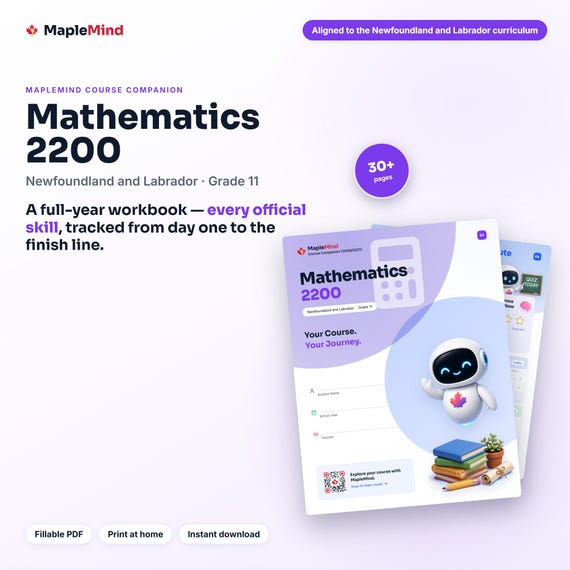
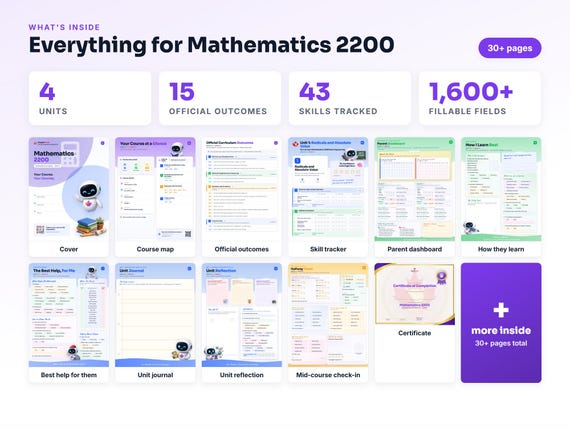

Printable workbook · A keepsake of the year
A Mathematics 2200 workbook worth keeping
Built from the same official curriculum as this page. Before and after each skill above, your student colours in how sure they feel — so the two of you can see, on one page, what's clicking and what needs another look. It's a quiet way to follow how the year is really going.
By June it's full of their own handwriting: units worked through, confidence grown, a mid-year check-in, notes from parent-teacher night, and a certificate at the end. Less a worksheet, more a record of the year worth keeping on the shelf.
Instant download · see every page, reviews and the full description · five or more workbooks are $2.99 each
What it looks like in the app



Common questions
Can MapleMind help me with Mathematics 2200?
Yes. MapleMind's AI tutor covers all 43 skills in Newfoundland and Labrador's Mathematics 2200 — you pick the exact skill, and the tutor teaches it step by step: a short lesson, a worked example, solving together, then a skill check to show it stuck.
Is MapleMind aligned to Newfoundland and Labrador's official curriculum?
Yes. Every skill in this course maps to an official outcome code from Newfoundland and Labrador's Grade 11 Mathematics curriculum, and the ministry's own wording is quoted under each unit on this page — with the official government source linked so you can check it yourself.
What does MapleMind cost?
It's free to start — 5 tutoring chats and a practice quiz every day, no credit card. A Pro subscription ($9.99/month or $49.99/year CAD, 7-day free trial) unlocks unlimited tutoring, practice, and exam simulations.
What if I'm stuck on just one topic?
That's the point of skill-level tutoring: open Mathematics 2200 in the app, tap the exact skill from the list on this page, and the tutor teaches just that — no wading through lessons you don't need.
Does MapleMind work in French or other languages?
Yes — 14 languages, including French. Both the app and the tutor's explanations switch to the language you choose.
Where can I see the official Newfoundland and Labrador curriculum for Mathematics 2200?
The official source is linked on this page — Newfoundland and Labrador's official curriculum. The outline here follows it: every MapleMind skill carries its official outcome code, and the ministry's own wording is quoted under each unit.
Keep exploring
Ready when you are
Pick a skill from this page and see it taught properly — free, in the browser, in under a minute.