Get help with Mathematics 1201 (Academic)
Most tutoring makes you sit through material you already know. MapleMind flips that: pick the exact skill that's causing trouble — any of the 42 below — and the tutor teaches just that one, step by step, as many times as it takes. Ask questions in plain words, any time of day, in English, French, or 12 other languages.
The official Newfoundland and Labrador Mathematics 1201 (Academic) curriculum
Newfoundland and Labrador defines Mathematics 1201 (Academic) by strands and outcomes. MapleMind teaches the same curriculum reorganized for one-skill-at-a-time tutoring — the table shows exactly where every official strand lands, and the ministry's own wording is quoted under each unit below.
Official source Newfoundland and Labrador's official curriculumRead it on the government site — gov.nl.ca ↗| Official strand | Outcomes | Where MapleMind teaches it |
|---|---|---|
| Strand N | 10 | Roots and Powers |
| PAR | 23 | Factors and Products · Relations and Functions |
| SAS | 9 | Measurement · Trigonometry |
Every skill below, taught one on one.
 Try the first session free
How MapleMind teaches Mathematics 1201 (Academic) — every unit, lesson, and skill
Every skill below runs as a short session: a plain-words lesson, a worked example, solving it together, then a five-question skill check that earns up to three stars. Guided Mode keeps it teaching instead of answer-handing — turning it off needs a parent's password.
Unit 1Roots and PowersOfficial strand · Strand N
Radicals, rational exponents, exponent laws, perfect squares/cubes, prime factors, GCF/LCM, and the real-number subsets.
Radicals and Rational Exponents
- The meaning of a radical's indexN.1.1 — Explain what the index of a radical means, and connect the index to which root is being taken (square root, cube root, and beyond).
- Rational exponents as radicalsN.1.3 — Rewrite powers with rational exponents as radicals and radicals as powers with rational exponents, for integral bases and whole-number exponents; connect this to why a^(m/n) equals the n-th root of a^m.
- Applying the exponent lawsN.1.6 — Apply the product, quotient, power-of-a-power, and power-of-a-product/quotient exponent laws to expressions with rational and variable bases and integral and rational exponents, and explain the reasoning; understand why a^(-n) = 1/a^n and why a^0 = 1.
- Finding errors in power simplificationsN.1.7 — Identify and correct errors in the simplification of an expression that involves powers, and solve problems that involve exponent laws or radicals.
Perfect Squares, Cubes and Roots
- Perfect squares and perfect cubesN.1.8 — Determine concretely whether a whole number is a perfect square, a perfect cube, or neither, using models or factoring.
- Finding square roots and cube rootsN.1.9 — Determine the square root of a perfect square and the cube root of a perfect cube using a variety of strategies, and explain the process; solve problems that involve square roots or cube roots.
- Prime factors, GCF and LCMN.1.14 — Determine the greatest common factor or least common multiple of a set of whole numbers using a variety of strategies and explain the process; determine prime factors and explain why 0 and 1 have none; solve problems involving these ideas.
Mixed Radicals and the Real Numbers
- Mixed and entire radicalsN.1.16 — Express a radical as a mixed radical in simplest form and a mixed radical as an entire radical, limited to numerical radicands.
- Rational and irrational numbersN.1.18 — Sort a set of numbers into rational and irrational, and represent the relationship among the subsets of the real numbers (natural, whole, integer, rational, irrational) using a graphic organizer.
- Estimating and ordering irrational numbersN.1.20 — Determine an approximate value of an irrational number, approximate the locations of irrational numbers on a number line using a variety of strategies, and order a set of irrational numbers.
The official wording — 10 outcomes in this unit
- N.1.1
Explain, using examples, the meaning of an index of a radical
- N.1.3
Express powers with rational exponents as radicals and vice versa
- N.1.6
Apply the exponent laws
- N.1.7
Identify and correct errors in the simplification of an expression that involves powers
- N.1.8
Determine, concretely, whether a given whole number is a perfect square, a perfect cube or neither
- N.1.9
Determine, using a variety of strategies, the square root of a perfect square, and explain the process
- N.1.14
Determine, using a variety of strategies, the greatest common factor or least common multiple of a set of whole numbers, and explain the process
- N.1.16
Express a radical as a mixed radical in simplest form
- N.1.18
Sort a set of numbers into rational and irrational numbers
- N.1.20
Determine an approximate value of a given irrational number
Unit 2Factors and ProductsOfficial strand · PAR
Multiplying polynomials (monomials, binomials, trinomials) and factoring polynomials, including the difference of squares.
Multiplying Polynomials
- Binomials as an area modelPAR.3.2 — Model the multiplication of two binomials concretely or pictorially and record the process symbolically, relating it to an area model and to multiplying two-digit numbers.
- Multiplying polynomials symbolicallyPAR.3.4 — Multiply two polynomials symbolically and combine like terms in the product, then verify by substituting numbers for the variables; limited to monomials, binomials and trinomials.
- Explaining and checking multiplication strategiesPAR.3.6 — Generalize and explain a strategy for multiplying polynomials, and identify and explain errors in a polynomial-multiplication solution.
Factoring Polynomials
- Common factors and the factor-multiply linkPAR.3.10 — Determine the common factors in the terms of a polynomial and express it in factored form concretely, pictorially and symbolically; explain the relationship between multiplication and factoring and express a polynomial as a product of its factors.
- Factoring trinomialsPAR.3.12 — Model the factoring of a trinomial concretely or pictorially, record the process symbolically, factor a polynomial and verify by multiplying the factors, and identify and explain errors in a factorization.
- The difference of squaresPAR.3.14 — Factor a polynomial that is a difference of squares and explain why it is a special case of trinomial factoring where the middle coefficient is zero.
The official wording — 6 outcomes in this unit
- PAR.3.2
Model the multiplication of two given binomials, concretely or pictorially, and record the process symbolically
- PAR.3.4
Multiply two polynomials symbolically, and combine like terms in the product
- PAR.3.6
Generalize and explain a strategy for multiplication of polynomials
- PAR.3.10
Determine the common factors in the terms of a polynomial, and express the polynomial in factored form, concretely, pictorially and symbolically
- PAR.3.12
Model the factoring of a trinomial, concretely or pictorially, and record the process symbolically
- PAR.3.14
Factor a polynomial that is a difference of squares, and explain why it is a special case of trinomial factoring where
Unit 3Relations and FunctionsOfficial strand · PAR
Graphs and relations, functions and function notation, slope and linear relations, forms of linear equations, and systems of linear equations - functions used as data and modelling tools.
Graphs, Relations and Functions
- Situations and graphsPAR.4.2 — Describe a possible situation for a given graph, sketch a possible graph for a given situation, and explain why data points should or should not be connected for a given situation.
- Representing relationsPAR.4.4 — Represent a relation in a variety of ways (table, set of ordered pairs, graph, equation, mapping) and move among the representations.
- Deciding whether a relation is a functionPAR.4.5 — Determine whether a set of ordered pairs or a graph represents a function; explain why some relations are not functions but all functions are relations; sort graphs as functions or non-functions and generalize the rules.
- Domain and rangePAR.4.10 — Determine and express in a variety of ways the domain and range of a graph, a set of ordered pairs, or a table of values; graph a set of data and determine its domain and range; identify independent and dependent variables in a context.
Slope and Linear Relations
- Recognizing linear relationsPAR.4.13 — Determine whether a table of values, a set of ordered pairs, a graph, or an equation represents a linear relation and explain why or why not; draw a graph from ordered pairs and decide if it is linear; solve a problem using the equation of a linear relation.
- Slope as rise over runPAR.4.18 — Determine the slope of a line segment by measuring and calculating the rise and run, determine the rate of change of a linear graph, and explain why any two points on a line give the same slope.
- Interpreting slope and its signPAR.4.21 — Explain slope as a rate of change using examples, classify lines as having positive or negative slope, explain the slope of horizontal and vertical lines, and solve contextual problems involving slope.
- Drawing lines and parallel/perpendicularPAR.4.24 — Draw a line given its slope and a point, determine another point on the line from the slope and a point, and generalize and apply a rule for whether two lines are parallel or perpendicular.
Intercepts and Forms of Linear Equations
- Intercepts of a linear relationPAR.4.28 — Determine the intercepts of the graph of a linear relation and state them as ordered pairs; sketch relations with one, two, or infinitely many intercepts; solve contextual problems involving intercepts, rate of change, domain, or range.
- Graphing from slope-intercept, general, and slope-point formPAR.4.35 — Graph a linear relation given in slope-intercept, general, or slope-point form with and without technology and explain the strategy; match relations to graphs and generalize graphing strategies; graph linear data from a context and write the line's equation.
- Comparing and converting formsPAR.4.38 — Express a linear relation in different forms and compare their graphs, rewrite a relation in slope-intercept or general form, and identify equivalent linear relations from a set.
- Writing the equation of a linePAR.4.42 — Write the equation of a linear relation given its slope and a point, given two points, or given a point and a parallel or perpendicular line, and explain the reasoning; determine slope and y-intercept from a graph and write y = mx + b.
Linear Functions and Function Notation
- Linear functions in function notationPAR.4.45 — Express the equation of a linear function in two variables using function notation and express an equation given in function notation as a linear function in two variables.
- Evaluating linear functionsPAR.4.47 — Determine the range value given a domain value for a linear function, determine the domain value given a range value, and sketch the graph of a linear function expressed in function notation.
Systems of Linear Equations
- Modelling with a system of equationsPAR.4.50 — Model a situation using a system of linear equations, relate the system to the context of a problem, and explain the meaning of the point of intersection of the system.
- Solving systems graphicallyPAR.4.53 — Determine and verify the solution of a system of linear equations graphically, with and without technology, and solve a problem using the system.
- Solving systems algebraicallyPAR.4.55 — Determine and verify the solution of a system of linear equations algebraically (substitution and elimination), explain a strategy, and explain why a system may have no solution, one solution, or infinitely many solutions.
The official wording — 17 outcomes in this unit
- PAR.4.2
Sketch a possible graph for a given situation
- PAR.4.4
Represent a relation in a variety of ways
- PAR.4.5
Determine if a set of ordered pairs represents a function.
- PAR.4.10
Determine, and express in a variety of ways, the domain and range of a graph, a set of ordered pairs or a table of values
- PAR.4.13
Determine whether a table of values or a set of ordered pairs represents a linear relation, and explain why or why not
- PAR.4.18
Determine the slope of a line segment by measuring and calculating the rise and run
- PAR.4.21
Explain, using examples, slope as a rate of change
- PAR.4.24
Draw a line, given its slope and a point on the line
- PAR.4.28
Determine the intercepts of the graph of a linear relation, and state the intercepts as values of ordered pairs
- PAR.4.35
Graph, with and without technology, a linear relation given in slope-intercept, general or slope-point form, and explain the strategy used to create the graph
- PAR.4.38
Express a linear relation in different forms, and compare their graphs
- PAR.4.42
Write the equation of a linear relation, given its slope and the coordinates of a point on the line, and explain the reasoning
- PAR.4.45
Express the equation of a linear function in two variables, using function notation
- PAR.4.47
Determine the related range value, given a domain value for a linear function
- PAR.4.50
Model a situation, using a system of linear equations
- PAR.4.53
Determine and verify the solution of a system of linear equation graphically, with and without technology
- PAR.4.55
Determine and verify the solution of a system of linear equations algebraically
Unit 4MeasurementOfficial strand · SAS
Surface area and volume of 3-D objects, linear measurement with SI and imperial referents, and converting units within and between systems.
Surface Area and Volume
- Surface area of 3-D objectsSAS.5.2 — Determine the surface area of a right cone, cylinder, prism, or pyramid from the object or its labelled diagram, sketch a diagram for a surface-area or volume problem, and find a missing dimension given the surface area.
- Volume and volume relationshipsSAS.5.4 — Determine the volume of a right cone, cylinder, prism, or pyramid, describe the relationship between the volumes of cones and cylinders (and pyramids and prisms) with the same base and height, and find a missing dimension given the volume.
- Spheres and composite objectsSAS.5.7 — Determine the surface area and volume of a sphere from the object or its diagram, find a missing dimension of a sphere given its surface area, and solve surface-area or volume problems for composite 3-D objects.
Linear Measure and Unit Conversion
- Referents and estimating linear measureSAS.5.10 — Provide referents for linear measurements in SI and imperial units and explain the choices, estimate a linear measure using a referent, compare SI and imperial units using referents, and justify the choice of units.
- Measuring and personal strategiesSAS.5.14 — Solve problems involving linear measure using instruments such as rulers, calipers, or tape measures, justify the choice of units in a problem-solving context, and describe a personal strategy for a linear measurement such as the circumference of a bottle.
- Converting within and between SI and imperialSAS.6.1 — Convert a measurement within or between SI and imperial systems using proportional reasoning, solve conversion problems, verify a conversion using unit analysis, and judge the reasonableness of a conversion with mental mathematics.
The official wording — 6 outcomes in this unit
- SAS.5.2
Determine the surface area of a right cone, right cylinder, right prism, or a right pyramid, using an object or its labelled diagram
- SAS.5.4
Determine the volume of a right cone, right cylinder, right prism, or right pyramid using an object or its labelled diagram
- SAS.5.7
Determine the surface area and volume of a sphere, using an object or its labelled diagram
- SAS.5.10
Provide referents for linear measurements, including millimetre, centimetre, metre, kilometre, inch, foot, yard and mile, and explain the choices
- SAS.5.14
Solve problems that involve linear measure, using instruments such as rulers, calipers or tape measures
- SAS.6.1
Using proportional reasoning, convert a measurement within or between SI and imperial systems
Unit 5TrigonometryOfficial strand · SAS
Right-triangle trigonometry: the primary trigonometric ratios and the Pythagorean theorem used to solve right triangles and real measurement problems.
Right-Triangle Trigonometry
- The primary trigonometric ratiosSAS.7.2 — Identify the hypotenuse and the opposite and adjacent sides for an acute angle in a right triangle, and explain the relationships between similar right triangles and the definitions of the primary trigonometric ratios.
- Finding missing sides and anglesSAS.7.3 — Use the primary trigonometric ratios to determine the measure of a missing angle and the length of a missing side in a right triangle, and solve right triangles.
- Solving problems with trig and PythagorasSAS.7.5 — Solve problems involving indirect and direct measurement using the trigonometric ratios, the Pythagorean theorem, and measurement instruments such as a clinometer, including problems with one or more right triangles.
The official wording — 3 outcomes in this unit
- SAS.7.2
Explain the relationships between similar right triangles and the definitions of the primary trigonometric ratios
- SAS.7.3
Use the primary trigonometric ratios to determine the measure of a missing angle in a right triangle
- SAS.7.5
Solve a problem that involves indirect and direct measurements, using the trigonometric ratios, the Pythagorean theorem and measurement instruments such as a clinometer or metre stick

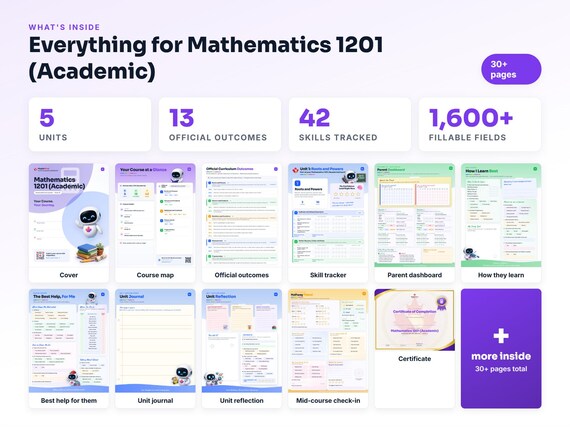


Printable workbook · A keepsake of the year
A Mathematics 1201 (Academic) workbook worth keeping
Built from the same official curriculum as this page. Before and after each skill above, your student colours in how sure they feel — so the two of you can see, on one page, what's clicking and what needs another look. It's a quiet way to follow how the year is really going.
By June it's full of their own handwriting: units worked through, confidence grown, a mid-year check-in, notes from parent-teacher night, and a certificate at the end. Less a worksheet, more a record of the year worth keeping on the shelf.
Instant download · see every page, reviews and the full description · five or more workbooks are $2.99 each
What it looks like in the app


Common questions
Can MapleMind help me with Mathematics 1201 (Academic)?
Yes. MapleMind's AI tutor covers all 42 skills in Newfoundland and Labrador's Mathematics 1201 (Academic) — you pick the exact skill, and the tutor teaches it step by step: a short lesson, a worked example, solving together, then a skill check to show it stuck.
Is MapleMind aligned to Newfoundland and Labrador's official curriculum?
Yes. Every skill in this course maps to an official outcome code from Newfoundland and Labrador's Grade 10 Mathematics curriculum, and the ministry's own wording is quoted under each unit on this page — with the official government source linked so you can check it yourself.
What does MapleMind cost?
It's free to start — 5 tutoring chats and a practice quiz every day, no credit card. A Pro subscription ($9.99/month or $49.99/year CAD, 7-day free trial) unlocks unlimited tutoring, practice, and exam simulations.
What if I'm stuck on just one topic?
That's the point of skill-level tutoring: open Mathematics 1201 (Academic) in the app, tap the exact skill from the list on this page, and the tutor teaches just that — no wading through lessons you don't need.
Does MapleMind work in French or other languages?
Yes — 14 languages, including French. Both the app and the tutor's explanations switch to the language you choose.
Where can I see the official Newfoundland and Labrador curriculum for Mathematics 1201 (Academic)?
The official source is linked on this page — Newfoundland and Labrador's official curriculum. The outline here follows it: every MapleMind skill carries its official outcome code, and the ministry's own wording is quoted under each unit.
Keep exploring
Ready when you are
Pick a skill from this page and see it taught properly — free, in the browser, in under a minute.