Get help with Principles of Mathematics, Grade 10 (Academic)
Most tutoring makes you sit through material you already know. MapleMind flips that: pick the exact skill that's causing trouble — any of the 45 below — and the tutor teaches just that one, step by step, as many times as it takes. Ask questions in plain words, any time of day, in English, French, or 12 other languages.
The official Ontario Principles of Mathematics, Grade 10 (Academic) curriculum
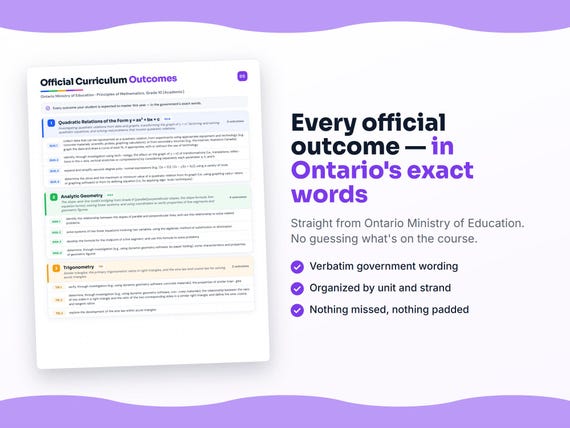
Ontario defines Principles of Mathematics, Grade 10 (Academic) by strands and outcomes. MapleMind teaches the same curriculum reorganized for one-skill-at-a-time tutoring — the table shows exactly where every official strand lands, and the ministry's own wording is quoted under each unit below.
Official source Ontario's official mathematics curriculumRead it on the government site — dcp.edu.gov.on.ca ↗| Official strand | Outcomes | Where MapleMind teaches it |
|---|---|---|
| Strand 1 | 21 | Quadratic Relations of the Form y = ax² + bx + c |
| Strand 2 | 14 | Analytic Geometry |
| Strand 3 | 10 | Trigonometry |
Every skill below, taught one on one.
 Try the first session free
How MapleMind teaches Principles of Mathematics, Grade 10 (Academic) — every unit, lesson, and skill
Every skill below runs as a short session: a plain-words lesson, a worked example, solving it together, then a five-question skill check that earns up to three stars. Guided Mode keeps it teaching instead of answer-handing — turning it off needs a parent's password.
Unit 1Quadratic Relations of the Form y = ax² + bx + cOfficial strand · Strand 1
Investigating quadratic relations from data and graphs, transforming the graph of y = x², factoring and solving quadratic equations, and solving real problems that involve quadratic relations.
Investigating the Basic Properties of Quadratic Relations
- Collecting and graphing quadratic datampm2d.1.1.1 — Collect data that forms a quadratic relation from an experiment or a secondary source, graph it, and draw a curve of best fit.
- Recognizing a parabola from a table of second differencesmpm2d.1.1.2 — Show that a quadratic relation y = ax² + bx + c graphs as a parabola and that its table of values has a constant second difference.
- Identifying the key features of a parabolampm2d.1.1.3 — Identify a parabola's axis of symmetry, vertex, y-intercept, zeros, and maximum or minimum value, using the correct terminology.
- Comparing y = x² with y = 2ˣ and meaning zero and negative exponentsmpm2d.1.1.4 — Compare the graphs of y = x² and y = 2ˣ, and determine what a negative exponent and an exponent of zero mean.
Relating the Graph of y = x² and Its Transformations
- Effect of a, h, and k on the graph of y = x²mpm2d.1.2.1 — Investigate, one parameter at a time, how a, h, and k transform the graph of y = x² (translations, reflections, stretches, and compressions).
- Roles of a, h, and k in vertex formmpm2d.1.2.2 — Explain what a, h, and k do in y = a(x − h)² + k, and identify the vertex and axis of symmetry from the equation.
- Sketching y = a(x − h)² + k by handmpm2d.1.2.3 — Sketch a parabola given in vertex form by applying transformations to the graph of y = x².
- Finding the vertex-form equation from a graphmpm2d.1.2.4 — Determine the equation, in the form y = a(x − h)² + k, of a parabola shown in a graph.
Solving Quadratic Equations
- Expanding and simplifying second-degree polynomialsmpm2d.1.3.1 — Expand and simplify second-degree polynomial expressions using tools like algebra tiles or a computer algebra system.
- Factoring common factors and simple trinomialsmpm2d.1.3.2.a — Factor polynomial expressions that involve common factors and simple trinomials (a = 1), such as 2x² + 4x or x² − x − 6.
- Factoring complex trinomials (a ≠ 1)mpm2d.1.3.2.b — Factor trinomials where the leading coefficient is not 1, such as 2a² + 11a + 5, using decomposition or another method.
- Factoring differences of squaresmpm2d.1.3.2.c — Recognize and factor differences-of-squares expressions such as 4x² − 25.
- Connecting factors of a quadratic to its x-interceptsmpm2d.1.3.3 — Describe how the factors of a quadratic expression relate to the x-intercepts (zeros) of its graph, in the form y = a(x − r)(x − s).
- Interpreting real and non-real rootsmpm2d.1.3.4 — Interpret whether a quadratic equation's roots are real or non-real, using graphing technology, and relate the roots to the x-intercepts.
- Completing the squarempm2d.1.3.5 — Rewrite y = ax² + bx + c in the form y = a(x − h)² + k by completing the square, in cases without fractions.
- Sketching or graphing from standard formmpm2d.1.3.6 — Sketch or graph a quadratic relation given in standard form, using intercepts and symmetry, completing the square, or technology.
- Exploring the algebraic development of the quadratic formulampm2d.1.3.7 — Follow the algebraic development of the quadratic formula, connecting its steps to a numerical example.
- Solving quadratic equations by factoringmpm2d.1.3.8.a — Solve quadratic equations that have real roots by factoring, and verify the solution algebraically.
- Solving quadratic equations with the quadratic formulampm2d.1.3.8.b — Solve quadratic equations that have real roots using the quadratic formula, and verify graphically using technology.
Solving Problems Involving Quadratic Relations
- Finding the zeros and the maximum or minimum valuempm2d.1.4.1 — Determine the zeros and the maximum or minimum value of a quadratic relation from its graph or from its equation.
- Solving realistic problems with a quadratic graph or equationmpm2d.1.4.2 — Solve problems from a realistic situation represented by a quadratic graph or equation, such as the height of a ball over time.
The official wording — 21 outcomes in this unit
- mpm2d.1.1.1
collect data that can be represented as a quadratic relation, from experiments using appropriate equipment and technology (e.g., concrete materials, scientific probes, graphing calculators), or from secondary sources (e.g., the Internet, Statistics Canada); graph the data and draw a curve of best fit, if appropriate, with or without the use of technology
- mpm2d.1.1.2
determine, through investigation with and without the use of technology, that a quadratic relation of the form y = ax2 + bx + c (a ≠ 0) can be graphically represented as a parabola, and that the table of values yields a constant second difference
- mpm2d.1.1.3
identify the key features of a graph of a parabola (i.e., the equation of the axis of symmetry, the coordinates of the vertex, the y-intercept, the zeros, and the maxi- mum or minimum value), and use the appropriate terminology to describe them
- mpm2d.1.1.4
compare, through investigation using tech- nology, the features of the graph of y = x2 and the graph of y = 2x, and determine the meaning of a negative exponent and of zero as an exponent
- mpm2d.1.2.1
identify, through investigation using tech- nology, the effect on the graph of y = x2 of transformations (i.e., translations, reflec- tions in the x-axis, vertical stretches or compressions) by considering separately each parameter a, h, and k
- mpm2d.1.2.2
explain the roles of a, h, and k in y = a(x – h )2 + k, using the appropriate terminology to describe the transforma- tions, and identify the vertex and the equa- tion of the axis of symmetry
- mpm2d.1.2.3
sketch, by hand, the graph of y = a(x – h )2 + k by applying transforma- tions to the graph of y = x2
- mpm2d.1.2.4
determine the equation, in the form y = a(x – h)2 + k, of a given graph of a parabola.
- mpm2d.1.3.1
expand and simplify second-degree poly- nomial expressions [e.g., (2x + 5)2, (2x – y)(x + 3y)], using a variety of tools
- mpm2d.1.3.2.a
factor polynomial expressions involving common factors, trinomials, and differ- ences of squares [e.g., 2x2 + 4x, 2x – 2y + ax – ay, x2 – x – 6, 2a2 + 11a + 5, 4x2 – 25], using a variety of tools
- mpm2d.1.3.2.b
factor polynomial expressions involving common factors, trinomials, and differ- ences of squares [e.g., 2x2 + 4x, 2x – 2y + ax – ay, x2 – x – 6, 2a2 + 11a + 5, 4x2 – 25], using a variety of tools
- mpm2d.1.3.2.c
factor polynomial expressions involving common factors, trinomials, and differ- ences of squares [e.g., 2x2 + 4x, 2x – 2y + ax – ay, x2 – x – 6, 2a2 + 11a + 5, 4x2 – 25], using a variety of tools
- mpm2d.1.3.3
determine, through investigation, and describe the connection between the factors of a quadratic expression and the x-intercepts (i.e., the zeros) of the graph of the corresponding quadratic relation, expressed in the form y = a(x – r)(x – s)
- mpm2d.1.3.4
interpret real and non-real roots of qua- dratic equations, through investigation using graphing technology, and relate the roots to the x-intercepts of the corre- sponding relations
- mpm2d.1.3.5
express y = ax2 + bx + c in the form y = a(x – h)2 + k by completing the square in situations involving no fractions, using a variety of tools
- mpm2d.1.3.6
sketch or graph a quadratic relation whose equation is given in the form
- mpm2d.1.3.7
explore the algebraic development of the quadratic formula (e.g., given the algebraic development, connect the steps to a numerical example; follow a demonstra- tion of the algebraic development
- mpm2d.1.3.8.a
solve quadratic equations that have real roots, using a variety of methods (i.e., factoring, using the quadratic formula, graphing)
- mpm2d.1.3.8.b
solve quadratic equations that have real roots, using a variety of methods (i.e., factoring, using the quadratic formula, graphing)
- mpm2d.1.4.1
determine the zeros and the maximum or minimum value of a quadratic relation from its graph (i.e., using graphing calcu- lators or graphing software) or from its defining equation (i.e., by applying alge- braic techniques)
- mpm2d.1.4.2
solve problems arising from a realistic situ- ation represented by a graph or an equa- tion of a quadratic relation, with and without the use of technology
Unit 2Analytic GeometryOfficial strand · Strand 2
The slope-and-line toolkit bridging from Grade 9 (parallel/perpendicular slopes, the slope formula, line-equation forms), solving linear systems, and using coordinates to verify properties of line segments and geometric figures.
The Slope-and-Line Toolkit (2022 Addendum)
- Slopes of parallel and perpendicular linesmpm2d.AG.ADD1 — Identify how the slopes of parallel lines relate to each other, and how the slopes of perpendicular lines relate to each other, and use this to solve problems.
- Developing and using the slope formulampm2d.AG.ADD2.a — Develop the slope formula (slope = rise/run = Δy/Δx) for a line.
- Determining a line's equation from a graph, table, or two pointsmpm2d.AG.ADD2.b — Use the slope formula to determine the equation of a line from a graph, a table of values, or the coordinates of two points.
- Translating between forms of a line's equationmpm2d.AG.ADD3 — Represent the equation of a line in different forms (y = mx + b, Ax + By + C = 0, Ax + By = D) and translate between them.
Solving Systems of Linear Equations
- Solving linear systems by substitution or eliminationmpm2d.2.1.1 — Solve a system of two linear equations in two variables algebraically, using substitution or elimination, and verify the solution.
- Solving realistic problems with linear systemsmpm2d.2.1.2 — Solve realistic problems described in words or represented by a linear system of two equations, choosing an appropriate algebraic or graphical method.
Solving Problems Involving Properties of Line Segments
- Developing and using the midpoint formulampm2d.2.2.1 — Develop the formula for the midpoint of a line segment, and use it to solve problems such as finding the midpoints of a triangle's sides.
- Developing and using the length-of-a-segment formulampm2d.2.2.2 — Develop the formula for the length of a line segment, and use it to solve problems such as finding lengths of segments joining triangle midpoints.
- Developing the equation of a circle centred at the originmpm2d.2.2.3 — Develop the equation for a circle centred at (0, 0) with radius r, using the length-of-a-line-segment formula.
- Finding a circle's radius, equation, and sketchmpm2d.2.2.4 — Determine a circle's radius from its equation, write the equation given the radius, and sketch the circle from x² + y² = r².
- Solving problems with slope, length, and midpoint togethermpm2d.2.2.5 — Solve problems involving the slope, length, and midpoint of a line segment, such as finding the equation of a right bisector.
Using Analytic Geometry to Verify Geometric Properties
- Investigating properties of geometric figuresmpm2d.2.3.1 — Investigate characteristics and properties of geometric figures, such as medians in a triangle, using dynamic geometry software or paper folding.
- Verifying geometric properties using algebra and analytic geometrympm2d.2.3.2 — Use algebraic techniques and analytic geometry to verify properties of geometric figures, such as showing two lines are perpendicular or a triangle is equilateral.
- Planning a multi-step proof of a geometric propertympm2d.2.3.3 — Plan and carry out a multi-step strategy that uses analytic geometry and algebra to verify a geometric property, such as that a triangle's midsegment is parallel to and half the length of the third side.
The official wording — 14 outcomes in this unit
- mpm2d.AG.ADD1
identify the relationship between the slopes of parallel and perpendicular lines, and use this relationship to solve related problems;
- mpm2d.AG.ADD2.a
develop the formula for the slope of a line
- mpm2d.AG.ADD2.b
use this formula to determine the equations of lines, given information about the lines (e.g., a graph of a line, a table of values, the coordinates of two points)
- mpm2d.AG.ADD3
represent the equations of lines in different forms (e.g., y = mx + b, Ax + By + C = 0, Ax + By = D) and translate between these forms, as appropriate for the context.
- mpm2d.2.1.1
solve systems of two linear equations involving two variables, using the algebraic method of substitution or elimination
- mpm2d.2.1.2
solve problems that arise from realistic sit- uations described in words or represented by linear systems of two equations involv- ing two variables, by choosing an appro- priate algebraic or graphical method
- mpm2d.2.2.1
develop the formula for the midpoint of a line segment, and use this formula to solve problems
- mpm2d.2.2.2
develop the formula for the length of a line segment, and use this formula to solve problems
- mpm2d.2.2.3
develop the equation for a circle with centre (0, 0) and radius r, by applying the formula for the length of a line segment
- mpm2d.2.2.4
determine the radius of a circle with cen- tre (0, 0), given its equation; write the equation of a circle with centre (0, 0), given the radius; and sketch the circle, given the equation in the form x2 + y2 = r2
- mpm2d.2.2.5
solve problems involving the slope, length, and midpoint of a line segment
- mpm2d.2.3.1
determine, through investigation (e.g., using dynamic geometry software, by paper folding), some characteristics and properties of geometric figures
- mpm2d.2.3.2
verify, using algebraic techniques and analytic geometry, some characteristics of geometric figures
- mpm2d.2.3.3
plan and implement a multi-step strategy that uses analytic geometry and algebraic techniques to verify a geometric property
Unit 3TrigonometryOfficial strand · Strand 3
Similar triangles, the primary trigonometric ratios in right triangles, and the sine law and cosine law for solving acute triangles.
Solving Problems Involving the Trigonometry of Right Triangles
- Verifying properties of similar trianglesmpm2d.3.1.1 — Verify, using dynamic geometry software or concrete materials, that similar triangles have equal corresponding angles and proportional corresponding sides.
- Comparing similarity and congruencempm2d.3.1.2 — Describe and compare what it means for two figures to be similar versus congruent.
- Solving real problems with similar trianglesmpm2d.3.1.3 — Solve realistic problems involving similar triangles, such as finding a tree's height using shadows and a metre stick.
Right-Triangle Trigonometry
- Defining the sine, cosine, and tangent ratiosmpm2d.3.2.1 — Investigate the relationship between side ratios in similar right triangles, and use it to define the sine, cosine, and tangent ratios.
- Finding sides and angles in right trianglesmpm2d.3.2.2 — Determine unknown side lengths and angle measures in right triangles using the primary trigonometric ratios and the Pythagorean theorem.
- Solving real-life right-triangle problemsmpm2d.3.2.3 — Solve real-life right-triangle problems, such as surveying, navigating, or finding the height of an inaccessible object, using trig ratios and the Pythagorean theorem.
Solving Problems Involving the Trigonometry of Acute Triangles
- Exploring the development of the sine lawmpm2d.3.3.1 — Explore how the sine law is developed for acute triangles, using dynamic geometry software or following the algebraic development.
- Exploring the development of the cosine lawmpm2d.3.3.2 — Explore how the cosine law is developed for acute triangles, and relate it to the Pythagorean theorem and the cosine ratio.
- Using the sine law and cosine law to find sides and anglesmpm2d.3.3.3 — Determine unknown side lengths and angle measures in acute triangles using the sine law and the cosine law.
- Solving real problems with acute trianglesmpm2d.3.3.4 — Solve real problems involving the measures of sides and angles in acute triangles.
The official wording — 10 outcomes in this unit
- mpm2d.3.1.1
verify, through investigation (e.g., using dynamic geometry software, concrete materials), the properties of similar trian- gles
- mpm2d.3.1.2
describe and compare the concepts of similarity and congruence;
- mpm2d.3.1.3
solve problems involving similar triangles in realistic situations (e.g., shadows, reflec- tions, scale models, surveying)
- mpm2d.3.2.1
determine, through investigation (e.g., using dynamic geometry software, con- crete materials), the relationship between the ratio of two sides in a right triangle and the ratio of the two corresponding sides in a similar right triangle, and define the sine, cosine, and tangent ratios
- mpm2d.3.2.2
determine the measures of the sides and angles in right triangles, using the primary trigonometric ratios and the Pythagorean theorem
- mpm2d.3.2.3
solve problems involving the measures of sides and angles in right triangles in real- life applications
- mpm2d.3.3.1
explore the development of the sine law within acute triangles
- mpm2d.3.3.2
explore the development of the cosine law within acute triangles
- mpm2d.3.3.3
determine the measures of sides and angles in acute triangles, using the sine law and the cosine law
- mpm2d.3.3.4
solve problems involving the measures of sides and angles in acute triangles.


Printable workbook · A keepsake of the year
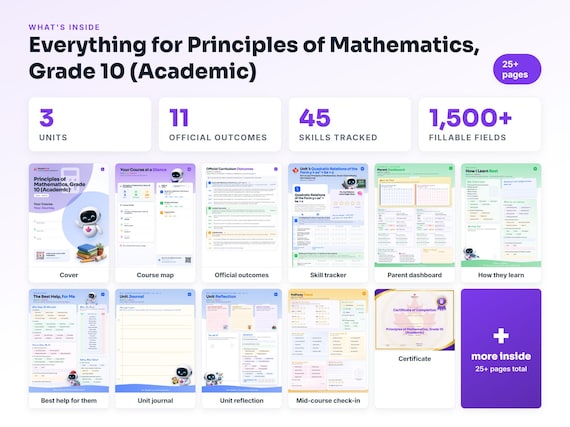
A Principles of Mathematics, Grade 10 (Academic) workbook worth keeping
Built from the same official curriculum as this page. Before and after each skill above, your student colours in how sure they feel — so the two of you can see, on one page, what's clicking and what needs another look. It's a quiet way to follow how the year is really going.
By June it's full of their own handwriting: units worked through, confidence grown, a mid-year check-in, notes from parent-teacher night, and a certificate at the end. Less a worksheet, more a record of the year worth keeping on the shelf.
Instant download · see every page, reviews and the full description · five or more workbooks are $2.99 each
What it looks like in the app



Common questions
Can MapleMind help me with Principles of Mathematics, Grade 10 (Academic)?
Yes. MapleMind's AI tutor covers all 45 skills in Ontario's Principles of Mathematics, Grade 10 (Academic) — you pick the exact skill, and the tutor teaches it step by step: a short lesson, a worked example, solving together, then a skill check to show it stuck.
Is MapleMind aligned to Ontario's official curriculum?
Yes. Every skill in this course maps to an official outcome code from Ontario's Grade 10 Mathematics curriculum, and the ministry's own wording is quoted under each unit on this page — with the official government source linked so you can check it yourself.
What does MapleMind cost?
It's free to start — 5 tutoring chats and a practice quiz every day, no credit card. A Pro subscription ($9.99/month or $49.99/year CAD, 7-day free trial) unlocks unlimited tutoring, practice, and exam simulations.
What if I'm stuck on just one topic?
That's the point of skill-level tutoring: open Principles of Mathematics, Grade 10 (Academic) in the app, tap the exact skill from the list on this page, and the tutor teaches just that — no wading through lessons you don't need.
Does MapleMind work in French or other languages?
Yes — 14 languages, including French. Both the app and the tutor's explanations switch to the language you choose.
Where can I see the official Ontario curriculum for Principles of Mathematics, Grade 10 (Academic)?
The official source is linked on this page — Ontario's official mathematics curriculum. The outline here follows it: every MapleMind skill carries its official outcome code, and the ministry's own wording is quoted under each unit.
Keep exploring
Ready when you are
Pick a skill from this page and see it taught properly — free, in the browser, in under a minute.