Ontario · For parents

What your child learns in Grade 10 in Ontario

Every subject, unit by unit, from Ontario’s curriculum: 519 skills in plain words.

Subjects
5
Skills
519
Provincial exams
2
Official curriculum
dcp.edu.gov.on.ca

Math in Grade 10

2 courses. Choose the one your child takes.

Foundations of Mathematics, Grade 10 (Applied)

MFM2P · 3 units · 34 skills

  1. Unit 1

    Measurement and Trigonometry

    Similar triangles have exactly the same angles, just possibly at a different size.

    • Verifying properties of similar triangles
    • Finding side lengths in similar triangles
    • Solving real problems with similar triangles
    9 more skills
    • Defining the sine, cosine, and tangent ratios
    • Finding sides and angles in right triangles
    • Solving real-life right-triangle problems
    • Exploring how an occupation uses trigonometry
    • Using the imperial system to solve measurement problems
    • Converting between imperial and metric measurements
    • Finding the surface area of a pyramid
    • Solving surface area and volume problems
    • Developing the volume formula for a sphere
  2. Unit 2

    Modelling Linear Relations

    Whatever you do to one side of an equation, you must do to the other side, to keep it balanced.

    • Solving first-degree equations, including fractional coefficients
    • Finding the value of a variable using a formula
    • Rewriting a line's equation in y = mx + b form
    9 more skills
    • Connecting rate of change to slope
    • Recognizing y = mx + b and the special cases x = a, y = b
    • The geometric meaning of m and b
    • Exploring properties of slope
    • Graphing lines by hand
    • Determining a line's equation from a graph, slope-intercept, slope-point, or two points
    • Finding the point of intersection graphically
    • Solving linear systems algebraically
    • Solving realistic problems with linear systems
  3. Unit 3

    Quadratic Relations

    Expanding (2x + 3)(x + 4) means multiplying every term in the first bracket by every term in the second.

    • Expanding and simplifying products and squares of binomials
    • Factoring binomials and trinomials using a common factor
    • Factoring simple trinomials x² + bx + c
    7 more skills
    • Factoring the difference of squares
    • Collecting and graphing quadratic data
    • Recognizing a parabola from a table of second differences
    • Identifying the key features of a parabola
    • Comparing standard-form and factored-form graphs
    • Solving quadratic problems by interpreting a graph
    • Interpreting key features from an experimental quadratic graph
Principles of Mathematics, Grade 10 (Academic)

MPM2D · 3 units · 45 skills

  1. Unit 1

    Quadratic Relations of the Form y = ax² + bx + c

    Real experiments (like a ball rolling or falling) or secondary sources (like Statistics Canada data) can produce data that follows a quadratic pattern.

    • Collecting and graphing quadratic data
    • Recognizing a parabola from a table of second differences
    • Identifying the key features of a parabola
    18 more skills
    • Comparing y = x² with y = 2ˣ and meaning zero and negative exponents
    • Effect of a, h, and k on the graph of y = x²
    • Roles of a, h, and k in vertex form
    • Sketching y = a(x − h)² + k by hand
    • Finding the vertex-form equation from a graph
    • Expanding and simplifying second-degree polynomials
    • Factoring common factors and simple trinomials
    • Factoring complex trinomials (a ≠ 1)
    • Factoring differences of squares
    • Connecting factors of a quadratic to its x-intercepts
    • Interpreting real and non-real roots
    • Completing the square
    • Sketching or graphing from standard form
    • Exploring the algebraic development of the quadratic formula
    • Solving quadratic equations by factoring
    • Solving quadratic equations with the quadratic formula
    • Finding the zeros and the maximum or minimum value
    • Solving realistic problems with a quadratic graph or equation
  2. Unit 2

    Analytic Geometry

    Parallel lines always have the SAME slope.

    • Slopes of parallel and perpendicular lines
    • Developing and using the slope formula
    • Determining a line's equation from a graph, table, or two points
    11 more skills
    • Translating between forms of a line's equation
    • Solving linear systems by substitution or elimination
    • Solving realistic problems with linear systems
    • Developing and using the midpoint formula
    • Developing and using the length-of-a-segment formula
    • Developing the equation of a circle centred at the origin
    • Finding a circle's radius, equation, and sketch
    • Solving problems with slope, length, and midpoint together
    • Investigating properties of geometric figures
    • Verifying geometric properties using algebra and analytic geometry
    • Planning a multi-step proof of a geometric property
  3. Unit 3

    Trigonometry

    Similar triangles have equal corresponding angles.

    • Verifying properties of similar triangles
    • Comparing similarity and congruence
    • Solving real problems with similar triangles
    7 more skills
    • Defining the sine, cosine, and tangent ratios
    • Finding sides and angles in right triangles
    • Solving real-life right-triangle problems
    • Exploring the development of the sine law
    • Exploring the development of the cosine law
    • Using the sine law and cosine law to find sides and angles
    • Solving real problems with acute triangles

Science in Grade 10

2 courses. Choose the one your child takes.

Science, Grade 10, Academic

SNC2D · 5 units · 70 skills

  1. Unit 1

    Investigation Skills and Careers

    The biology, chemistry, earth-science, and physics in this course connect to real careers.

    • Careers in the sciences
    • Scientists who contributed to these fields
  2. Unit 2

    Biology: Tissues, Organs, and Systems of Living Things

    Technologies such as cloning, stem-cell research, and transgenic transplants raise ethical issues.

    • Ethical issues in systems-biology technology
    • Medical imaging technologies
    • Public-health strategies in systems biology
    13 more skills
    • Impact of public-health strategies on society
    • Cell and system terminology
    • Stages of mitosis under the microscope
    • Comparing plant and animal cells
    • Investigating specialized cells
    • Rate of cell division in cancerous cells
    • Dissecting organ systems
    • Researching a disease of tissues or systems
    • The cell cycle and mitosis
    • Cell division and specialization
    • From cells to systems
    • Functions of animal systems
    • Interaction of systems in an organism
  3. Unit 3

    Chemistry: Chemical Reactions

    Reactions and their reactants/products raise safety and environmental issues — cyanide in gold mining, metal corrosion, pool disinfectants.

    • Safety and environmental issues of reactions
    • Chemistry solving environmental challenges
    • Chemical-reaction terminology
    13 more skills
    • Molecular models of reactions
    • Investigating reaction types
    • Conservation of mass inquiry
    • Evidence of chemical change
    • Classifying acids and bases
    • Formulae, composition, and names
    • Why we balance equations
    • Evidence that indicates chemical change
    • Writing balanced equations
    • Reactants and products of reaction types
    • Acid-base neutralization
    • The pH scale
    • Identifying compounds and writing formulae
  4. Unit 4

    Earth and Space Science: Climate Change

    Climate change affects human activity and natural systems — habitat loss, desertification, flooding, but also longer growing seasons in some regions.

    • Effects of climate change
    • Assessing climate initiatives
    • Proposing a course of action
    17 more skills
    • Climate-change terminology
    • Modelling the greenhouse effect
    • Evidence of climate change from data
    • Testing a climate hypothesis
    • Heat transfer in the hydrosphere and atmosphere
    • Water's states and climate
    • Ocean currents and heat transfer
    • Classifying local climate
    • Perspectives and bias in climate discussion
    • Earth's climate system
    • Heat transfer and currents
    • Natural vs anthropogenic greenhouse effect
    • Natural and human factors in climate
    • Greenhouse-gas sources and sinks
    • How gases trap heat
    • Anthropogenic effects and ozone
    • Indicators of climate change
  5. Unit 5

    Physics: Light and Geometric Optics

    Devices like eyeglasses, contact lenses, and laser eye surgery correct or extend human vision.

    • Devices for human perception of light
    • Devices that use light
    • Light and optics terminology
    13 more skills
    • Investigating the laws of reflection
    • Predicting images in mirrors
    • Investigating refraction
    • Predicting images with a converging lens
    • Calculating light velocity from refractive index
    • Types of light emission
    • The electromagnetic spectrum
    • Images in plane and curved mirrors
    • Total internal reflection
    • Images from converging lenses
    • Mirrors and lenses in instruments
    • Factors affecting refraction
    • Explaining optical phenomena

Science, Grade 10, Applied

SNC2P · 5 units · 64 skills

  1. Unit 1

    Investigation Skills and Careers

    The biology, chemistry, climate, and optics in this course connect to real jobs.

    • Careers in the sciences
    • Scientists who contributed to these fields
  2. Unit 2

    Biology: Tissues, Organs, and Systems

    Imaging technologies (ultrasound, X-rays, CT/CAT scan, MRI) let doctors see inside the body.

    • Medical imaging technologies
    • Effects of technologies and substances on the body
    • Human cell and system terminology
    10 more skills
    • Stages of mitosis in animal cells
    • Investigating human cell specialization
    • Cancerous vs non-cancerous cell division
    • Dissecting an animal's organ system
    • Researching a human health problem
    • The cell cycle and its importance
    • Specialized cells and tissues
    • Cell organization in the body
    • Functions of human body systems
    • Interaction of body systems
  3. Unit 3

    Chemistry: Chemical Reactions and Their Practical Applications

    Chemical reactions make products and drive processes — carbonating soft drinks, rust-proofing metal.

    • Reactions in products and processes
    • Reactions in a profession
    • Assessing chemical hazards
    12 more skills
    • Chemical-reaction terminology
    • Molecular models of reactions
    • Investigating reaction types
    • Conservation of mass inquiry
    • Investigating neutralization
    • Classifying acids and bases
    • Acid-base reactions in products
    • Formulae, composition, and names
    • Naming and writing formulae
    • Writing balanced equations
    • Neutralization reactions
    • The pH scale
  4. Unit 4

    Earth and Space Science: Earth's Dynamic Climate

    Climate change affects living things and natural systems — permafrost loss, longer growing seasons, warming oceans harming coral.

    • Effects of climate change on living things
    • Human actions and greenhouse gases
    • Climate terminology
    13 more skills
    • Investigating the greenhouse effect
    • Investigating a greenhouse-gas source
    • Factors affecting global warming
    • Your carbon footprint and a plan
    • Tools for climate decisions
    • Perspectives and bias in climate media
    • Earth's climate system
    • Natural vs anthropogenic greenhouse effect
    • Heat sinks
    • Naturally produced greenhouse gases
    • Human-produced greenhouse gases
    • Causes of climate change and Canada's role
    • Indicators of climate change
  5. Unit 5

    Physics: Light and Applications of Optics

    Additive colour mixes light (screens, spotlights); subtractive colour mixes pigments/filters.

    • Colour theory in technology
    • Optical technologies and information
    • Societal impact of optical technologies
    15 more skills
    • Light and optics terminology
    • Investigating reflection in mirrors
    • Investigating refraction
    • Predicting converging-lens images
    • How objects reflect, transmit, or absorb light
    • Coloured light on coloured objects
    • Building an optical device
    • Types of light emission
    • The electromagnetic spectrum and white light
    • Laws of reflection and mirrors
    • Refraction between media
    • Additive colour theory
    • Subtractive colour theory
    • Why objects have colour
    • Light and colour in optical devices

English in Grade 10

2 courses. Choose the one your child takes.

English, Grade 10, Academic

ENG2D · 4 units · 63 skills

  1. Unit 1

    Oral Communication

    Listening with a purpose (to analyze, to synthesize, to critique) shapes how closely and for what you listen.

    • Setting a purpose and goals for listening
    • Using active listening strategies
    • Listening comprehension strategies for complex texts
    13 more skills
    • Identifying the important ideas in oral texts
    • Interpreting oral texts with evidence
    • Extending understanding by making connections
    • Analyzing how oral texts communicate
    • Identifying perspectives and bias in oral texts
    • Evaluating presentation strategies
    • Communicating orally for a purpose and audience
    • Adapting interpersonal speaking strategies
    • Communicating a clear, structured argument
    • Word choice and stylistic devices in speaking
    • Using vocal strategies effectively
    • Using non-verbal cues
    • Using audio-visual aids to support a presentation
  2. Unit 2

    Reading and Literature Studies

    Reading with a specific purpose focuses attention and makes reading more efficient.

    • Reading diverse texts with a purpose
    • Using reading comprehension strategies
    • Identifying important ideas and supporting details
    11 more skills
    • Making and explaining inferences
    • Extending understanding by making connections
    • Analyzing how texts develop ideas and themes
    • Evaluating the effectiveness of texts with evidence
    • Identifying perspectives and bias in texts
    • Characteristics of text forms
    • Text features and how they communicate
    • Elements of style and their effects
    • Understanding words automatically in context
    • Decoding unfamiliar words
    • Strategies to expand vocabulary
  3. Unit 3

    Writing

    Topic, purpose, and audience are settled first — they steer every later writing choice.

    • Identifying topic, purpose, and audience
    • Generating and focusing ideas
    • Locating and selecting supporting information
    18 more skills
    • Organizing ideas with suitable patterns
    • Checking that ideas are relevant, accurate, and complete
    • Writing in a variety of forms for purposes and audiences
    • Establishing voice in writing
    • Choosing vivid, precise words
    • Varying sentences and making smooth transitions
    • Recognizing beliefs and values in your writing
    • Revising drafts to improve content and style
    • Producing revised drafts to criteria
    • Spelling correctly using rules and resources
    • Building and refining word choice for writing
    • Punctuation for clauses and lists (semicolons)
    • Punctuation for titles (italics and quotation marks)
    • Grammar: writing correct sentence types
    • Grammar: agreement and verb tense
    • Proofreading and correcting writing
    • Using presentation features to publish
    • Producing published work to criteria
  4. Unit 4

    Media Studies

    Media texts are built for specific audiences — content, images, and placement are all targeted choices.

    • How media texts suit purposes and audiences
    • Interpreting overt and implied media messages
    • Evaluating how effectively media texts communicate
    9 more skills
    • Why media texts prompt different responses
    • Identifying perspectives and bias in media texts
    • How production factors shape the media industry
    • Characteristics of media forms
    • Conventions and techniques in media forms
    • Planning a media text: topic, purpose, audience
    • Selecting an appropriate media form
    • Planning conventions and techniques for a media text
    • Producing media texts

English, Grade 10, Applied

ENG2P · 4 units · 62 skills

  1. Unit 1

    Oral Communication

    Knowing why you are listening (to follow instructions, to get the main idea) helps you focus on what matters.

    • Setting a purpose and goals for listening
    • Using active listening strategies
    • Listening comprehension strategies for complex texts
    13 more skills
    • Identifying the important ideas in oral texts
    • Interpreting oral texts with evidence
    • Extending understanding by making connections
    • Analyzing how oral texts communicate
    • Identifying perspectives and bias in oral texts
    • Evaluating presentation strategies
    • Communicating orally for a purpose and audience
    • Adapting interpersonal speaking strategies
    • Communicating a clear, structured argument
    • Word choice and stylistic devices in speaking
    • Using vocal strategies effectively
    • Using non-verbal cues
    • Using audio-visual aids to support a presentation
  2. Unit 2

    Reading and Literature Studies

    Reading with a specific purpose focuses attention and makes reading more efficient.

    • Reading diverse texts with a purpose
    • Using reading comprehension strategies
    • Identifying important ideas and supporting details
    11 more skills
    • Making and explaining inferences
    • Extending understanding by making connections
    • Analyzing how texts develop ideas and themes
    • Evaluating the effectiveness of texts with evidence
    • Identifying perspectives and bias in texts
    • Characteristics of text forms
    • Text features and how they communicate
    • Elements of style and their effects
    • Understanding words automatically in context
    • Decoding unfamiliar words
    • Strategies to expand vocabulary
  3. Unit 3

    Writing

    Topic, purpose, and audience are settled first — they steer every later writing choice.

    • Identifying topic, purpose, and audience
    • Generating and focusing ideas
    • Locating and selecting supporting information
    17 more skills
    • Organizing ideas with suitable patterns
    • Checking that ideas are relevant, accurate, and complete
    • Writing in a variety of forms for purposes and audiences
    • Establishing voice in writing
    • Choosing vivid, precise words
    • Varying sentences and making smooth transitions
    • Recognizing beliefs and values in your writing
    • Revising drafts to improve content and style
    • Producing revised drafts to criteria
    • Spelling correctly using rules and resources
    • Building and refining word choice for writing
    • Punctuation for clear meaning (commas)
    • Grammar: writing correct sentence types
    • Grammar: agreement and verb tense
    • Proofreading and correcting writing
    • Using presentation features to publish
    • Producing published work to criteria
  4. Unit 4

    Media Studies

    Media texts are built for specific audiences — content, images, and placement are all targeted choices.

    • How media texts suit purposes and audiences
    • Interpreting overt and implied media messages
    • Evaluating how effectively media texts communicate
    9 more skills
    • Why media texts prompt different responses
    • Identifying perspectives and bias in media texts
    • How production factors shape the media industry
    • Characteristics of media forms
    • Conventions and techniques in media forms
    • Planning a media text: topic, purpose, audience
    • Selecting an appropriate media form
    • Planning conventions and techniques for a media text
    • Producing media texts

French in Grade 10

Core French, Grade 10, Academic

FSF2D · 4 units · 35 skills

  1. Unit 1

    Listening

    The same before/during/after strategies now support longer, more academic listening - a report, an interview, a documentary segment - where ideas are developed over several minutes.

    • Using listening strategies
    • Showing you understood
    • Interactive listening strategies
    4 more skills
    • Responding in interactions
    • Reflecting on my listening
    • Hearing about French-speaking communities worldwide
    • Conventions you hear
  2. Unit 2

    Speaking

    Reflecting on speaking now weighs how well you sustained a longer exchange on an academic topic with decreasing support.

    • Using speaking strategies
    • Producing spoken messages
    • Speaking with fluency
    6 more skills
    • Applying language structures
    • Speaking-interaction strategies
    • Taking part in spoken exchanges
    • Reflecting on my speaking
    • Speaking about French-speaking communities worldwide
    • Conventions when you speak
  3. Unit 3

    Reading

    Reflecting on reading means judging which strategies helped you handle longer, more academic French texts.

    • Using reading strategies
    • Reading for meaning
    • Reading with fluency
    6 more skills
    • Developing vocabulary
    • Purpose of text forms
    • Features and style
    • Reflecting on my reading
    • Reading about French-speaking communities worldwide
    • Conventions in French texts
  4. Unit 4

    Writing

    At this grade, clear writing draws on the subjonctif present after expressions like 'il faut que', and two different past tenses.

    • Identifying purpose and audience
    • Writing in different forms
    • Past tenses and the subjonctif
    7 more skills
    • Complex sentences and object pronouns
    • Pre-writing: gathering ideas
    • Drafting and revising
    • Producing finished work
    • Reflecting on my writing
    • Writing about French-speaking communities worldwide
    • Conventions in my writing

Social studies in Grade 10

3 courses. Choose the one your child takes.

Canadian History since World War I, Grade 10 (Academic)

CHC2D · 5 units · 61 skills

  1. Unit 1

    Historical Skills and Careers

    Historical investigation builds essential skills — reading text, writing, document use, numeracy.

    • Skills history builds
    • Applying historical work habits
    • History and current issues
    1 more skill
    • Careers using history
  2. Unit 2

    Canada, 1914–1929

    Demographic trends included immigration, urban migration, and women entering the labour force.

    • Demographic trends, 1914–29
    • Science and technology, 1914–29
    • Economic trends, 1914–29
    11 more skills
    • WWI's impact on society and politics
    • Causes and consequences of WWI
    • Canada in international relations
    • Social and political conflict
    • Cooperation and movements
    • Government policy and Indigenous communities
    • Discrimination against ethnocultural groups
    • Individuals and organizations
    • Arts and popular culture
    • Rights and lives of women
    • Immigration and heritage
  3. Unit 3

    Canada, 1929–1945

    Social changes included Depression unemployment and the dustbowl, and new left- and right-wing movements.

    • Social changes, 1929–45
    • Science and technology, 1929–45
    • Economic trends, 1929–45
    10 more skills
    • Policy affecting Indigenous peoples
    • Political developments and policy
    • Cooperation and conflict
    • Relations with Britain and the US
    • Causes and contribution to WWII
    • WWII and Indigenous communities
    • WWII and non-Indigenous Canadians
    • Individuals and organizations
    • Responses to international events
    • The Holocaust and human rights
  4. Unit 4

    Canada, 1945–1982

    Trends included postwar immigration, war brides, suburbanization, and High Arctic settlement.

    • Demographic trends, 1945–82
    • Science and technology, 1945–82
    • Economic trends, 1945–82
    13 more skills
    • Policy affecting Indigenous peoples
    • Political developments and policy
    • Social welfare programs
    • Social conflict and inequality
    • Social movements and cooperation
    • Life for women, 1945–82
    • Canada and the Cold War
    • Relations with the United States
    • Individuals and organizations
    • Arts and popular culture
    • Events affecting Indigenous communities
    • The Quiet Revolution and Quebec
    • Immigration and heritage
  5. Unit 5

    Canada, 1982 to the Present

    Trends included demographic change, multiculturalism, and the growth of urban Inuit populations.

    • Social and cultural trends
    • Science and technology since 1982
    • Economic trends since 1982
    11 more skills
    • Policy affecting Indigenous peoples
    • Political developments and policy
    • Cooperation and conflict since 1982
    • Regionalism since 1982
    • Federal–Indigenous relations
    • Quebec and the federal government
    • Canada in the international community
    • Individuals and organizations
    • Arts and popular culture
    • Acknowledgement and commemoration
    • Relations with the United States

Canadian History since World War I, Grade 10 (Applied)

CHC2P · 5 units · 53 skills

  1. Unit 1

    Historical Skills and Careers

    Historical investigation builds essential skills — reading, writing, document use, numeracy.

    • Skills history builds
    • Applying historical work habits
    • History and current issues
    1 more skill
    • Careers using history
  2. Unit 2

    Canada, 1914–1929

    Social developments included changes in immigration, broader citizenship rights for many women, and the treatment of 'enemy aliens'.

    • Social developments, 1914–29
    • Science and technology, 1914–29
    • Economic trends, 1914–29
    9 more skills
    • WWI and everyday life
    • Causes and consequences of WWI
    • Cooperation and conflict at home
    • Challenges facing Indigenous communities
    • Challenges facing immigrants and minorities
    • French and English Canada
    • Individuals and organizations
    • Rights and lives of women
    • Canada on the world stage
  3. Unit 3

    Canada, 1929–1945

    Developments included rising poverty, the dislocation of Prairie farm families, and growing American cultural influence.

    • Social developments, 1929–45
    • Science and technology, 1929–45
    • Economic trends, 1929–45
    9 more skills
    • Policy affecting Indigenous peoples
    • Political developments and policy
    • Cooperation and conflict
    • Relations with Britain and the US
    • WWII and Indigenous communities
    • WWII and non-Indigenous groups
    • Individuals, organizations, and symbols
    • Responses to international events
    • The significance of the Holocaust
  4. Unit 4

    Canada, 1945–1982

    Trends included postwar immigration, war brides, the baby boom, and the growth of suburbs.

    • Demographic trends, 1945–82
    • Science and technology, 1945–82
    • Economic trends, 1945–82
    10 more skills
    • Policy affecting Indigenous peoples
    • Political developments and policy
    • French and English Canada
    • Social movements
    • Canada and the Cold War
    • Relations with the United States
    • Individuals, symbols, and events
    • Developments affecting Indigenous communities
    • Social welfare programs
    • Immigration and heritage
  5. Unit 5

    Canada, 1982 to the Present

    Trends included changes in families, rising multiculturalism, and the growth of urban Inuit populations.

    • Social trends since 1982
    • Science and technology since 1982
    • Economic trends since 1982
    9 more skills
    • Policy affecting Indigenous peoples
    • Political developments and policy
    • Quebec and the federal government
    • Federal–Indigenous relations
    • Relations with the United States
    • Individuals and organizations
    • Arts and popular culture
    • Responses to international events
    • Acknowledgement and commemoration

Civics and Citizenship, Grade 10

CHV2O · 3 units · 32 skills

  1. Unit 1

    Civic Skills and Careers

    Political inquiry builds transferable skills — research, argument, critical thinking.

    • Skills civics builds
    • Discussing civic issues
    • Politics in the news
    1 more skill
    • Careers in civics
  2. Unit 2

    Civic Awareness

    Civic issues arise at local, national, and global levels.

    • Civic issues and perspectives
    • Fundamental democratic values
    • Foreign influence on democracy
    17 more skills
    • Why civic action matters
    • Taking a civic position
    • Canada's political parties
    • How party values shape perspectives
    • The levels of government
    • Indigenous governance and treaties
    • The three branches of government
    • Revenue and budgets
    • How laws are made
    • How groups influence policy
    • Elections and forming government
    • The Charter and constitutional documents
    • Responsibilities of citizenship
    • Exercising rights for change
    • The judicial system and rights
    • Global citizenship
    • Human rights violations and responses
  3. Unit 3

    Civic Engagement and Action

    Individuals and organizations make civic contributions that matter in Canada and internationally.

    • The significance of civic contributions
    • Actions for the common good
    • Representation in communities
    5 more skills
    • National pride and commemoration
    • Accessing civic information
    • Youth service opportunities
    • Analysing a civic issue you care about
    • Proposing and assessing action

Provincial exams in Grade 10

MapleMind

See Grade 10 in MapleMind

Real screens from the app your child would use.

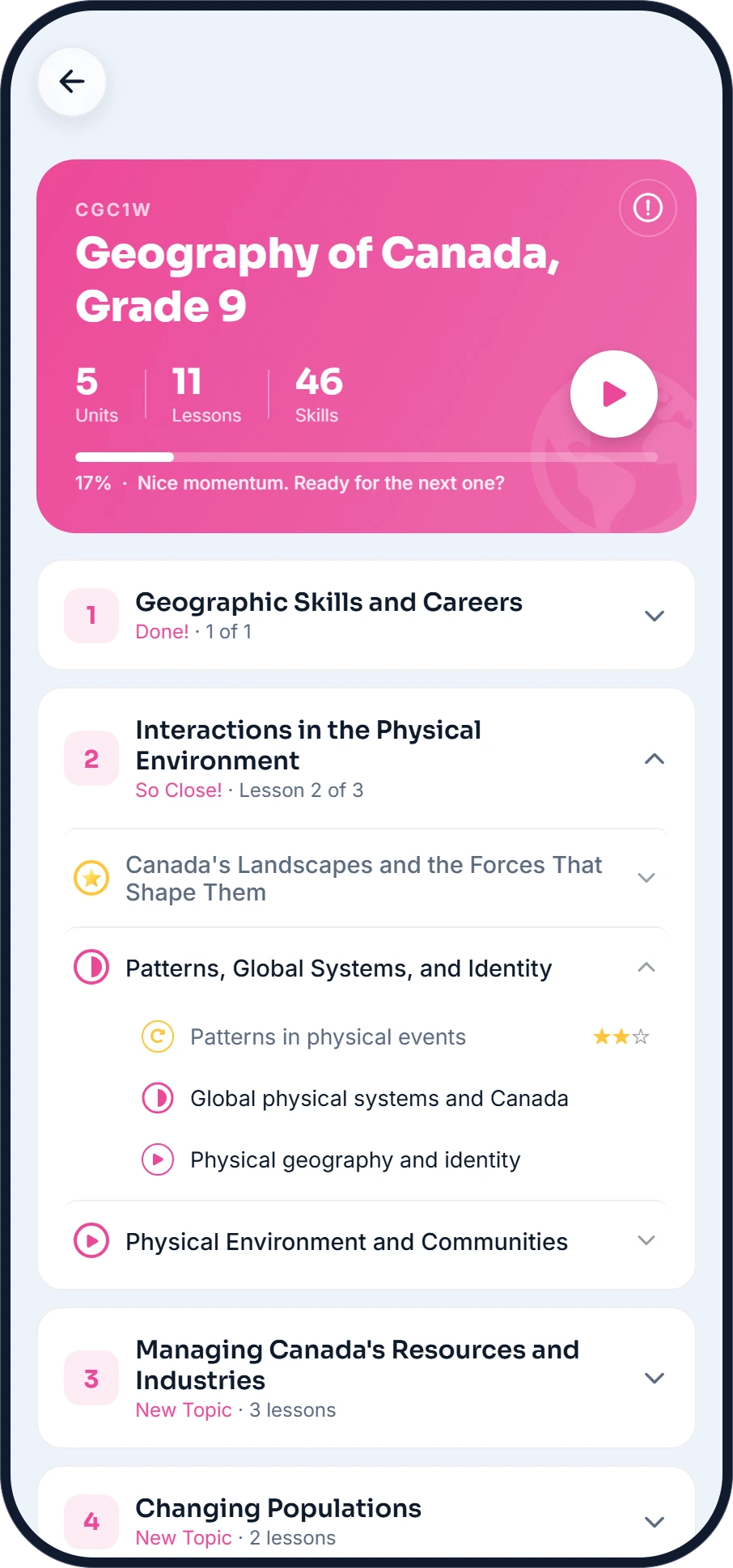
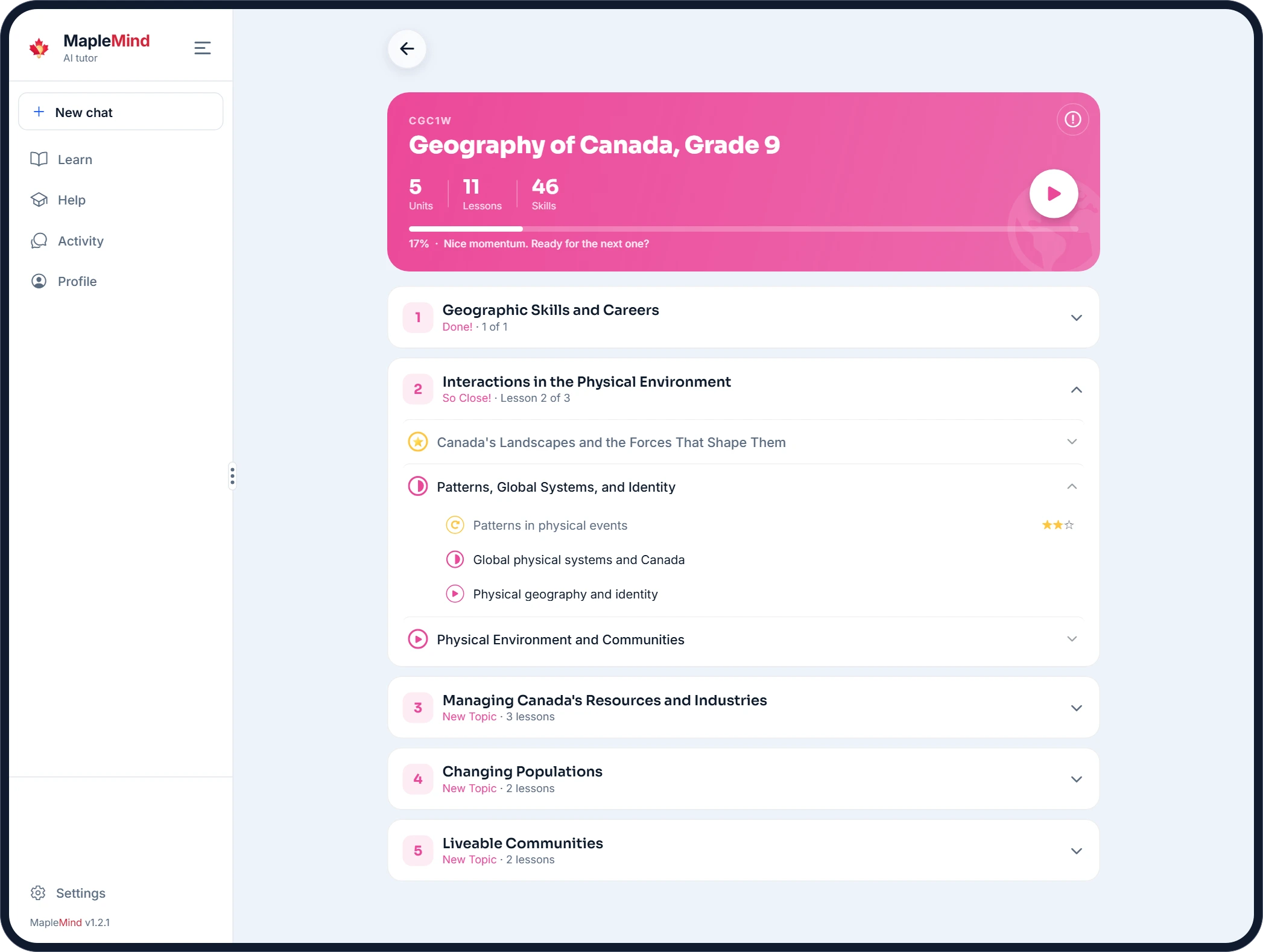
Geography of Canada, Grade 9 in MapleMind on a tablet: its units and lessons in order, a student partway through.Geography of Canada, Grade 9 in MapleMind on a phone: its units and lessons in order, a student partway through.
Their course, unit by unit, the way Ontario teaches it.Shown: Geography of Canada, Grade 9
Homework Help on a tablet: a photo of a worksheet, the tutor’s worked example of a two-step equation, and a question back to the student.Homework Help on a phone: a photo of a worksheet, the tutor’s worked example of a two-step equation, and a question back to the student.
Homework Help: they take a photo of the question, and the tutor works through it with them.
The Parent Dashboard on a tablet: a student’s days studied, streak, lessons, quiz average and recent activity.The Parent Dashboard on a phone: a student’s days studied, streak, lessons, quiz average and recent activity.
The Parent Dashboard: how each child’s week went, in lessons, quizzes and days studied.
A Grade 9 provincial mathematics exam on a tablet: a readiness score, the exam’s time and its next sitting.A Grade 9 provincial mathematics exam on a phone: a readiness score, the exam’s time and its next sitting.
A provincial exam: a practice sitting under the real time, and how ready they are.
The Learn tab on a tablet: a four-day streak, the week’s days, Homework Help, the next lesson and a review.The Learn tab on a phone: a four-day streak, the week’s days, Homework Help, the next lesson and a review.
The Learn tab: their week so far, and the next thing to do.

Help at home

Questions parents ask

What will my child learn in Grade 10 in Ontario?

Math: Foundations of Mathematics, Grade 10 (Applied) and Principles of Mathematics, Grade 10 (Academic). Science: Science, Grade 10, Academic and Science, Grade 10, Applied. English: English, Grade 10, Academic and English, Grade 10, Applied. French: Core French, Grade 10, Academic. Social studies: Canadian History since World War I, Grade 10 (Academic), Canadian History since World War I, Grade 10 (Applied) and Civics and Citizenship, Grade 10. That’s 519 skills in all, from Ontario’s curriculum.

When is the Ontario Secondary School Literacy Test?

It’s written November 3, 2026 to November 30, 2026, and March 30, 2027 to April 19, 2027.

Where does this list come from?

From Ontario’s official curriculum, the documents its education ministry publishes for each course. Each skill here is one of their expectations, written in plain words.

Can MapleMind help my child in Grade 10?

Yes. Every course on this page is in MapleMind, with lessons, practice and a tutor that works through each step with them. A free account gets 30 messages and 4 activities a day.

Help with Grade 10, one skill at a time.

Every course on this page is in MapleMind, free with daily limits.