Ontario · For parents

What your child learns in Grade 2 in Ontario

Every subject, unit by unit, from Ontario’s curriculum: 167 skills in plain words.

Subjects
4
Skills
167
Provincial exams
None
Official curriculum
dcp.edu.gov.on.ca

Math in Grade 2

Mathematics, Grade 2

5 units · 44 skills

  1. Unit 1

    Number

    A number up to 200 is read by its hundreds and then its tens and ones: 156 is 1 hundred, 5 tens and 6 ones, read one hundred fifty-six.

    • Reading and showing numbers to 200
    • Building and breaking apart numbers to 200
    • Comparing and ordering numbers to 200
    13 more skills
    • Estimating and checking by counting to 200
    • Counting to 200 by 20s, 25s, and 50s
    • What makes a number even or odd
    • Sharing fairly among 2, 3, 4, and 6 friends
    • One third is the same as two sixths
    • Properties of addition and subtraction
    • Addition and subtraction facts to 20
    • Mental math to add and subtract within 50
    • Adding-to and taking-away stories to 100
    • Putting-together and comparing stories to 100
    • Multiplication as repeated equal groups
    • Division as sharing up to 12 items equally
    • Repeated addition and subtraction for multiplying and dividing
  2. Unit 2

    Algebra

    A design has a pattern when something repeats or changes by a rule you can say: square, square, triangle, again and again, is a pattern, but a pile of mixed shapes is not.

    • Spotting patterns in geometric designs
    • Making and re-showing patterns with shapes and numbers
    • Finding the pattern rule to extend and predict with shapes and numbers
    6 more skills
    • Using patterns to show how numbers to 100 relate
    • Noticing when a symbol is a variable
    • Making addition and subtraction expressions equal
    • Finding equal ways to make the same number to 100
    • Writing and running code with things happening at the same time
    • Reading and changing code with things happening at the same time
  3. Unit 3

    Data

    A Venn diagram sorts by two features with two circles that overlap: the overlap holds buttons that are red and big, each outer part holds one feature, and buttons with neither go outside both circles.

    • Sorting data by two features with Venn and Carroll diagrams
    • Collecting data about two things and using two-way tally tables
    • Showing data with line plots and bar graphs
    4 more skills
    • Finding the mode of a data set
    • Asking and answering questions about data in logic diagrams, line plots, and bar graphs
    • Describing likelihood, including events that cannot both happen
    • Predicting if the mode will match in a different group
  4. Unit 4

    Spatial Sense

    Colour and size are not geometric properties: a small red square and a big blue square belong in the same group, because both have 4 equal sides and 4 square corners.

    • Sorting 2D shapes by sides and angles
    • Lines of symmetry in 2D shapes
    • Building and breaking apart shapes without changing their area
    7 more skills
    • Checking if shapes match exactly (congruent)
    • Making and reading simple maps
    • Describing where several things are and how to move between them
    • Measuring length with non-standard units
    • Centimetres and metres, with benchmarks to estimate
    • Measuring and drawing lengths in centimetres and metres
    • Describing how long something takes using units of time
  5. Unit 5

    Financial Literacy

    The same amount can be made with different coins: 25 cents is one quarter, or two dimes and a nickel, or one dime and three nickels, or five nickels.

    • Making the same amount of cents with different coins
    • Making the same dollar amount with coins and bills
Science in Grade 2

Science and Technology, Grade 2

5 units · 37 skills

  1. Unit 1

    STEM Skills and Connections

    Big problems are easier to code when broken into small steps.

    • Breaking coding problems into smaller steps
    • Noticing how coding and new technology affect everyday life
    • Finding science and technology at home and in the community
    1 more skill
    • Learning about contributions from many communities
  2. Unit 2

    Growth and Changes in Animals

    Animals affect people and the environment in helpful ways, like bees pollinating flowers.

    • How animals affect people and nature
    • Reducing harm from animals' impacts
    • How people affect animals and their homes
    5 more skills
    • Animal features that stay the same or change
    • How animals move
    • The life cycle of animals
    • How animals change as they grow
    • Adaptations that help animals survive
  3. Unit 3

    Properties of Liquids and Solids

    Some liquids and solids at home can be harmful if not used, stored, or thrown away safely.

    • Using, storing, and disposing of liquids and solids safely
    • How changes of state affect us
    • Sorting matter into liquids and solids
    6 more skills
    • Properties of liquids and solids
    • Liquid water and solid water
    • When states stay the same and when they change
    • Making useful mixtures
    • Floating, sinking, and soaking up water
    • Safety symbols on substances
  4. Unit 4

    Movement and Simple Machines

    Simple machines make everyday jobs easier for people.

    • Simple machines in daily life
    • Simple machines and the environment
    • Ways an object can move
    4 more skills
    • Changing an object's position
    • The six simple machines
    • How each simple machine is used
    • Comparing force with and without a machine
  5. Unit 5

    Air and Water in the Environment

    Human activities can affect the quality of air and water.

    • How human activities affect air and water
    • A plan to protect local air or water
    • Using water responsibly at home
    6 more skills
    • Fresh water around the world
    • Properties of air and water
    • Where water comes from
    • The stages of the water cycle
    • The three states of water
    • How living things depend on air and water

English in Grade 2

Language, Grade 2

4 units · 64 skills

  1. Unit 1

    Literacy Connections and Applications

    Media texts like videos and picture books have features - pictures, sounds, layout, word choice - that work together.

    • My rights and choices online
    • Staying safe and private online
    • Finding out and checking what we learn
    6 more skills
    • Noticing how videos and pictures are made
    • Who made this and who is it for?
    • Using digital tools to make something new
    • Working together kindly online
    • Seeing identity and belonging in stories
    • Learning from First Nations, Métis, and Inuit stories
  2. Unit 2

    Foundations of Language

    Good listening means looking at the speaker, staying quiet, and thinking about what they're saying.

    • Listening, asking questions, and restating
    • Using tricks to understand and notice confusion
    • Taking turns and staying on topic
    16 more skills
    • Using gestures and expression to share meaning
    • Choosing good words and full sentences
    • Reading and spelling longer words
    • Choosing the right spelling using position clues
    • Word parts that change meaning
    • Learning and using new words
    • Reading smoothly and with expression
    • Building all four kinds of sentences, plus compound sentences
    • Nouns for feelings and groups
    • Using pronouns like he, her, and mine
    • Using am, is, are, was, and were
    • Comparing with -er and -est
    • Joining words and words that describe actions
    • Showing ownership with an apostrophe
    • Showing someone talking with quotation marks
    • Capital letters for names and commas in lists
  3. Unit 3

    Comprehension: Understanding and Responding to Texts

    A story text, like a fairy tale, tells about made-up characters and events.

    • Reading and understanding short texts
    • Describing story books and information books
    • Using tables of contents, charts, and icons
    19 more skills
    • How pictures and design create meaning
    • Noticing how a story sounds and feels
    • Whose voice is telling the story?
    • Reading and viewing First Nations, Métis, and Inuit stories
    • Using what I already know to make connections
    • Why are we reading this?
    • Guessing what happens next
    • Fixing up a confusing part
    • Connecting a story to my life and other stories
    • Finding the main idea and important details
    • Naming which trick helped me understand
    • Consonance and simile in stories
    • Figuring out clues the story doesn't say
    • Comparing and sequencing story parts
    • Noticing symbols, language, and values in stories
    • Whose perspective is being shown?
    • Sharing my own thoughts and feelings about a story
    • Connecting First Nations, Métis, and Inuit stories to today
    • Naming the thinking skill that helped me
  4. Unit 4

    Composition: Expressing Ideas and Creating Texts

    Before making a text, you identify its topic, purpose, and audience.

    • Choosing a topic, purpose, and audience
    • Coming up with and building on ideas
    • Finding facts from more than one source
    11 more skills
    • Putting my ideas in order
    • Naming the trick that helped me plan
    • Writing a first try of my text
    • Printing letters neatly and smoothly
    • Showing my own feelings with descriptive words
    • Writing as "I"
    • Improving my writing with feedback
    • Fixing up my writing
    • Making a final copy of my text
    • Reading my text aloud with expression
    • Naming what helped me present well

Social studies in Grade 2

Social Studies, Grade 2

2 units · 22 skills

  1. Unit 1

    Heritage and Identity: Changing Family and Community Traditions

    Traditions are passed down through generations and can change over time.

    • How traditions change over generations
    • Comparing families and their traditions
    • Community traditions, past and present
    8 more skills
    • Reclaiming traditions and customs
    • Different types of families
    • Groups and diversity in my community
    • Places of significance on a map
    • Traditions and celebrations across communities
    • Family events across generations
    • How community celebrations pass on heritage
    • How family practices pass on heritage
  2. Unit 2

    People and Environment: Global Communities

    Communities around the world have different lifestyles.

    • Comparing how communities meet their needs
    • Adapting to location and climate
    • Sustainability and our environment
    8 more skills
    • Showing the world on maps and globes
    • Continents, oceans, and hemispheres
    • Cardinal directions
    • How location affects climate
    • Reading location and climate from maps
    • Meeting basic human needs around the world
    • Describing communities around the world
    • Comparing my community with a distant one

MapleMind

See Grade 2 in MapleMind

Real screens from the app your child would use.

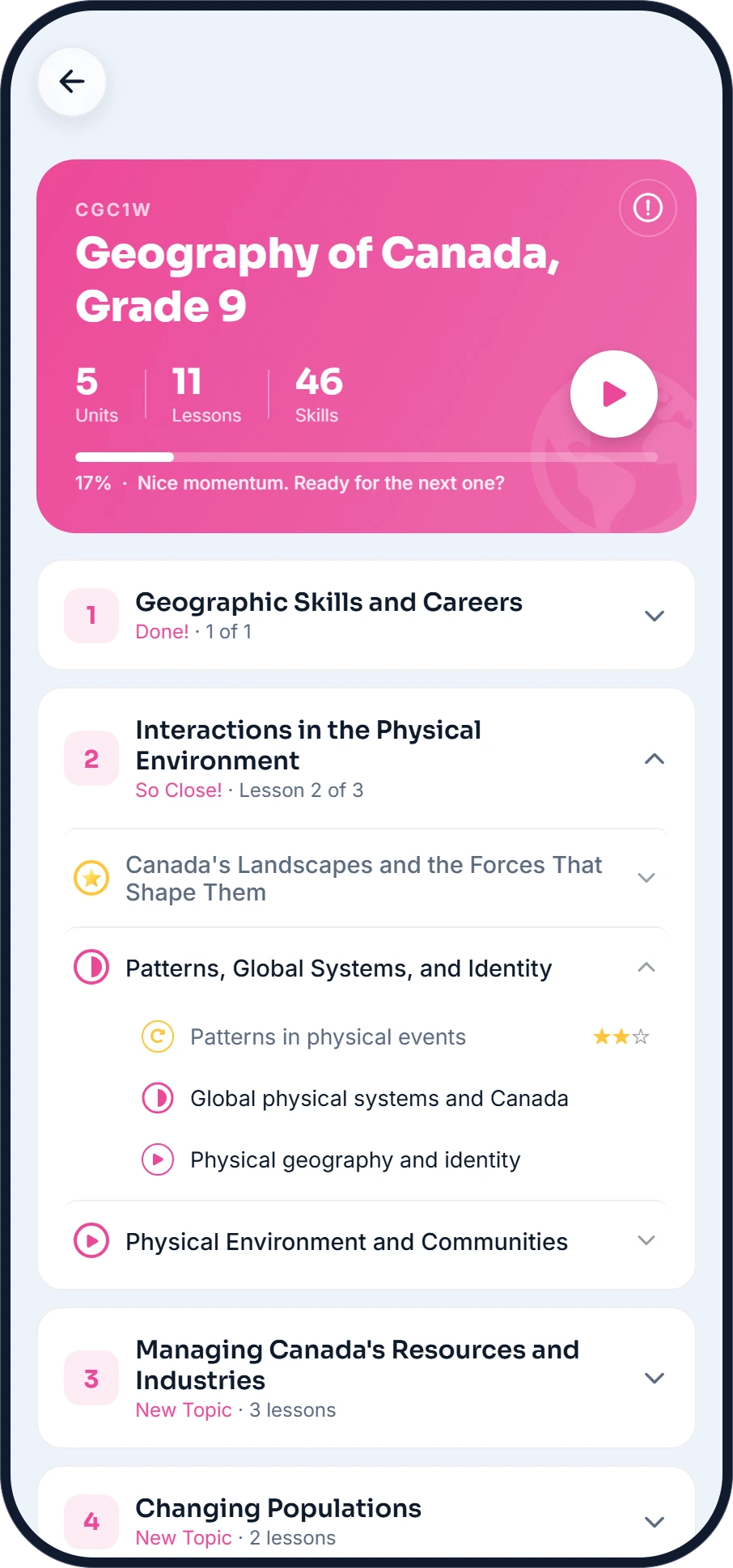
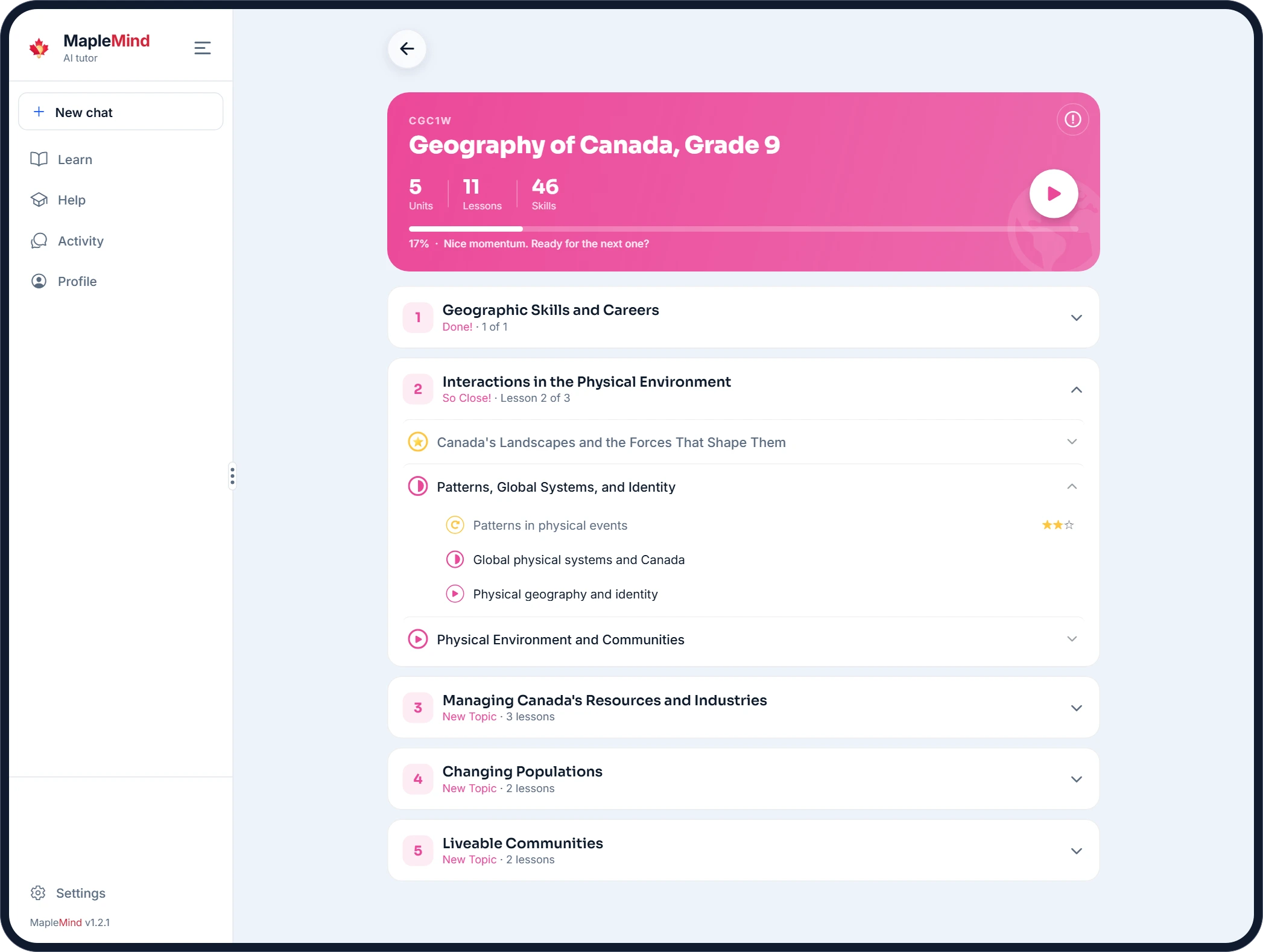
Geography of Canada, Grade 9 in MapleMind on a tablet: its units and lessons in order, a student partway through.Geography of Canada, Grade 9 in MapleMind on a phone: its units and lessons in order, a student partway through.
Their course, unit by unit, the way Ontario teaches it.Shown: Geography of Canada, Grade 9
Homework Help on a tablet: a photo of a worksheet, the tutor’s worked example of a two-step equation, and a question back to the student.Homework Help on a phone: a photo of a worksheet, the tutor’s worked example of a two-step equation, and a question back to the student.
Homework Help: they take a photo of the question, and the tutor works through it with them.
The Parent Dashboard on a tablet: a student’s days studied, streak, lessons, quiz average and recent activity.The Parent Dashboard on a phone: a student’s days studied, streak, lessons, quiz average and recent activity.
The Parent Dashboard: how each child’s week went, in lessons, quizzes and days studied.
A Grade 9 provincial mathematics exam on a tablet: a readiness score, the exam’s time and its next sitting.A Grade 9 provincial mathematics exam on a phone: a readiness score, the exam’s time and its next sitting.
A provincial exam: a practice sitting under the real time, and how ready they are.
The Learn tab on a tablet: a four-day streak, the week’s days, Homework Help, the next lesson and a review.The Learn tab on a phone: a four-day streak, the week’s days, Homework Help, the next lesson and a review.
The Learn tab: their week so far, and the next thing to do.

Help at home

Questions parents ask

What will my child learn in Grade 2 in Ontario?

Math: Mathematics, Grade 2. Science: Science and Technology, Grade 2. English: Language, Grade 2. Social studies: Social Studies, Grade 2. That’s 167 skills in all, from Ontario’s curriculum.

Does my child write a provincial exam in Grade 2?

No. Ontario has no provincial exam in Grade 2.

Where does this list come from?

From Ontario’s official curriculum, the documents its education ministry publishes for each course. Each skill here is one of their expectations, written in plain words.

Can MapleMind help my child in Grade 2?

Yes. Every course on this page is in MapleMind, with lessons, practice and a tutor that works through each step with them. A free account gets 30 messages and 4 activities a day.

Help with Grade 2, one skill at a time.

Every course on this page is in MapleMind, free with daily limits.