Get help with Science and Technology, Grade 2
Most tutoring makes your child sit through material your child already knows. MapleMind flips that: pick the exact skill that's causing trouble — any of the 37 below — and the tutor teaches just that one, step by step, as many times as it takes. Ask questions in plain words, any time of day, in English, French, or 12 other languages.
The official Ontario Science and Technology, Grade 2 curriculum
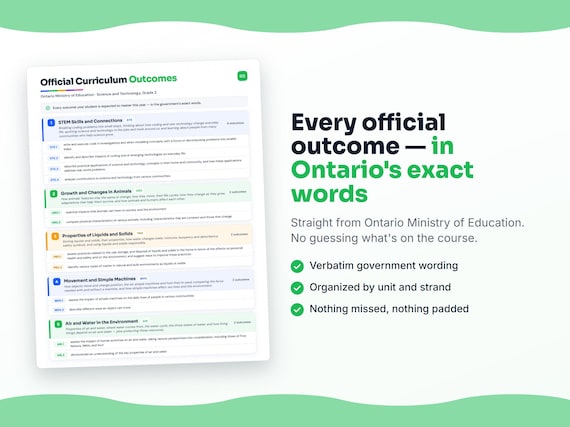
Ontario defines Science and Technology, Grade 2 by strands and outcomes. MapleMind teaches the same curriculum reorganized for one-skill-at-a-time tutoring — the table shows exactly where every official strand lands, and the ministry's own wording is quoted under each unit below.
Official source Ontario's official science curriculumRead it on the government site — dcp.edu.gov.on.ca ↗| Official strand | Outcomes | Where MapleMind teaches it |
|---|---|---|
| Strand A | 4 | STEM Skills and Connections |
| Strand B | 7 | Growth and Changes in Animals |
| Strand C | 9 | Properties of Liquids and Solids |
| Strand D | 7 | Movement and Simple Machines |
| Strand E | 8 | Air and Water in the Environment |
Every skill below, taught one on one.
 Try the first session free
How MapleMind teaches Science and Technology, Grade 2 — every unit, lesson, and skill
Every skill below runs as a short session: a plain-words lesson, a worked example, solving it together, then a five-question skill check that earns up to three stars. Guided Mode keeps it teaching instead of answer-handing — turning it off needs a parent's password.
Unit 1STEM Skills and ConnectionsOfficial strand · Strand A
Breaking coding problems into small steps, thinking about how coding and new technology change everyday life, spotting science and technology in the jobs and tools around us, and learning about people from many communities who help science grow.
Coding: Breaking a Big Job into Small Steps
- Breaking coding problems into smaller stepsA2.1 — Write and run code, focusing on breaking a problem into smaller, easier steps.
How Coding and New Technology Change Our Day
- Noticing how coding and new technology affect everyday lifeA2.2 — Notice and describe ways that coding and new kinds of technology change everyday life.
Science and Technology Around Us
- Finding science and technology at home and in the communityA3.1 — Describe real uses of science and technology at home and in the neighbourhood, and how they help solve everyday problems.
People Who Help Science Grow
- Learning about contributions from many communitiesA3.3 — Learn about and describe how people from many different communities have contributed to science and technology.
The official wording — 4 outcomes in this unit
- A2.1
write and execute code in investigations and when modelling concepts, with a focus on decomposing problems into smaller steps
- A2.2
identify and describe impacts of coding and of emerging technologies on everyday life
- A3.1
describe practical applications of science and technology concepts in their home and community, and how these applications address real-world problems
- A3.3
analyse contributions to science and technology from various communities
Unit 2Growth and Changes in AnimalsOfficial strand · Strand B
How animals' features stay the same or change, how they move, their life cycles, how they change as they grow, adaptations that help them survive, and how animals and humans affect each other.
Animals and People
- How animals affect people and natureB1.1 — Examine ways animals affect people and the environment, both helpful and harmful.
- Reducing harm from animals' impactsB1.1 — Describe ways that any negative impacts animals have can be reduced.
- How people affect animals and their homesB1.2 — Assess how various human activities affect animals and the places they live, and describe practices that reduce harmful effects.
Animal Features and Life Cycles
- Animal features that stay the same or changeB2.1 — Compare physical features of different animals, including features that stay the same and those that change.
- How animals moveB2.2 — Describe the different ways various animals move.
- The life cycle of animalsB2.3 — Describe the life cycle of a variety of animals, including insects, amphibians, birds, and mammals.
- How animals change as they growB2.4 — Compare how various animals look and behave differently as they go through a complete life cycle.
- Adaptations that help animals surviveB2.5 — Describe physical and behavioural adaptations that help various animals survive in their natural environment.
The official wording — 7 outcomes in this unit
- B1.1
examine impacts that animals can have on society and the environment
- B1.2
assess impacts of various human activities on animals and the places where they live, and describe practices that can minimize negative impacts
- B2.1
compare physical characteristics of various animals, including characteristics that are constant and those that change
- B2.2
describe the locomotion of various animals
- B2.3
describe the life cycle of a variety of animals, including insects, amphibians, birds, and mammals
- B2.4
compare changes in the appearance and behaviour of various animals as they go through a complete life cycle
- B2.5
describe adaptations, including physical and/or behavioural characteristics, that allow various animals to survive in their natural environment
Unit 3Properties of Liquids and SolidsOfficial strand · Strand C
Sorting liquids and solids, their properties, how water changes state, mixtures, buoyancy and absorbency, safety symbols, and using liquids and solids responsibly.
Using Liquids and Solids Safely
- Using, storing, and disposing of liquids and solids safelyC1.1 — Assess how we use, store, and throw away liquids and solids at home in terms of health, safety, and the environment, and suggest better ways.
- How changes of state affect usC1.2 — Assess how changes of state of liquids and solids affect humans and the environment.
Exploring Liquids and Solids
- Sorting matter into liquids and solidsC2.1 — Identify various types of matter in natural and built environments as liquids or solids.
- Properties of liquids and solidsC2.2 — Describe the properties of liquids and solids.
- Liquid water and solid waterC2.3 — Describe the properties of liquid water and solid water (ice), and the conditions that change one into the other.
- When states stay the same and when they changeC2.4 — Identify conditions where liquids and solids keep their state, and conditions that can cause them to change state.
- Making useful mixturesC2.5 — Describe ways liquids and solids can be combined to make useful mixtures.
- Floating, sinking, and soaking up waterC2.6 — Classify solid objects and materials by whether they float or sink, and whether they soak up or repel water.
- Safety symbols on substancesC2.7 — Explain the meaning of international symbols that give us safety information about substances.
The official wording — 9 outcomes in this unit
- C1.1
assess practices related to the use, storage, and disposal of liquids and solids in the home in terms of the effects on personal health and safety and on the environment, and suggest ways to improve these practices
- C1.2
assess the impacts of changes of state of liquids and solids on humans and on environments
- C2.1
identify various types of matter in natural and built environments as liquids or solids
- C2.2
describe the properties of liquids and solids
- C2.3
describe properties of liquid water and solid water, and identify the conditions that cause changes from one state to the other
- C2.4
identify conditions in which the states of liquids and solids remain constant and conditions that can cause their states to change
- C2.5
describe some ways in which liquids and solids can be combined to make useful mixtures
- C2.6
classify solid objects and materials in terms of their buoyancy and in terms of their ability to absorb or repel water
- C2.7
explain the meaning of international symbols that give us information on the safety of substances
Unit 4Movement and Simple MachinesOfficial strand · Strand D
How objects move and change position, the six simple machines and how they're used, comparing the force needed with and without a machine, and how simple machines affect our lives and the environment.
How Simple Machines Change Our World
- Simple machines in daily lifeD1.1 — Assess how simple machines affect the daily lives of people in various communities.
- Simple machines and the environmentD1.2 — Assess how technologies that use simple machines to help movement affect the environment.
Movement and the Six Simple Machines
- Ways an object can moveD2.1 — Describe different ways an object can move.
- Changing an object's positionD2.2 — Identify ways the position of an object can be changed.
- The six simple machinesD2.3 — Identify the six basic types of simple machines: lever, inclined plane, wedge, pulley, wheel and axle, and screw.
- How each simple machine is usedD2.4 — Describe ways each type of simple machine is used in daily life to make tasks easier.
- Comparing force with and without a machineD2.5 — Compare the force needed to move an object using various simple machines to the force needed without one.
The official wording — 7 outcomes in this unit
- D1.1
assess the impact of simple machines on the daily lives of people in various communities
- D1.2
assess the impact on the environment of technologies that use simple machines to facilitate movement
- D2.1
describe different ways an object can move
- D2.2
identify ways in which the position of an object can be changed
- D2.3
identify the six basic types of simple machines: lever, inclined plane, wedge, pulley, wheel and axle, and screw
- D2.4
describe ways in which each type of simple machine is used in daily life to make tasks easier
- D2.5
compare, qualitatively or quantitatively, the force required to move an object using various simple machines to the force required to move the object without using a simple machine
Unit 5Air and Water in the EnvironmentOfficial strand · Strand E
Properties of air and water, where water comes from, the water cycle, the three states of water, and how living things depend on air and water — plus protecting these resources.
Protecting Air and Water
- How human activities affect air and waterE1.1 — Assess how human activities affect air and water, considering different perspectives including those of First Nations, Métis, and Inuit.
- A plan to protect local air or waterE1.1 — Plan a course of action to protect the quality of air and/or water in the local community.
- Using water responsibly at homeE1.2 — Assess personal and household uses of water, and make a plan to use water responsibly.
- Fresh water around the worldE1.3 — Examine how much fresh water and drinking water are available around the world, and describe the impact on communities.
Air, Water, and the Water Cycle
- Properties of air and waterE2.1 — Show an understanding of the key properties of air and water.
- Where water comes fromE2.2 — Identify sources of water in the natural and built environments.
- The stages of the water cycleE2.3 — Describe the stages of the water cycle: evaporation, condensation, precipitation, and collection.
- The three states of waterE2.4 — Identify the three states of water in the environment, and describe how temperature changes affect the state of water in the water cycle.
- How living things depend on air and waterE2.5 — Describe ways living things, including humans, depend on air and water.
The official wording — 8 outcomes in this unit
- E1.1
assess the impact of human activities on air and water, taking various perspectives into consideration, including those of First Nations, Métis, and Inuit
- E1.2
assess their personal and household uses of water, and create a plan to use water responsibly
- E1.3
examine the availability of fresh water and drinking water around the world, and describe the impact on communities
- E2.1
demonstrate an understanding of the key properties of air and water
- E2.2
identify sources of water in the natural and built environments
- E2.3
describe the stages of the water cycle, including evaporation, condensation, precipitation, and collection
- E2.4
identify the three states of water in the environment, and describe how temperature changes affect the state of water within the water cycle
- E2.5
describe ways in which living things, including humans, depend on air and water
Printable workbook · A keepsake of the year
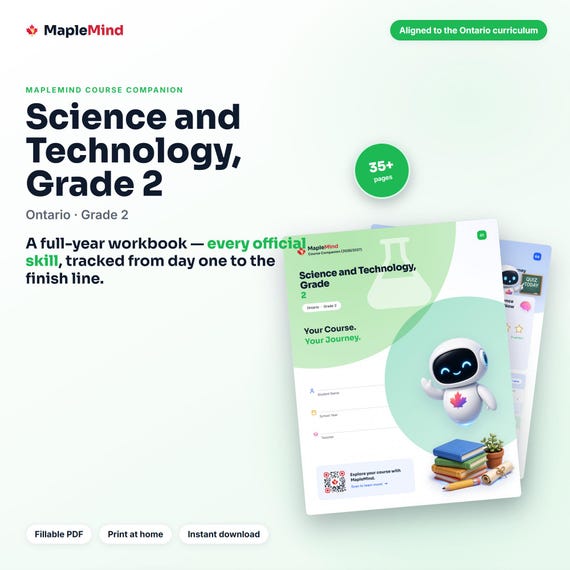
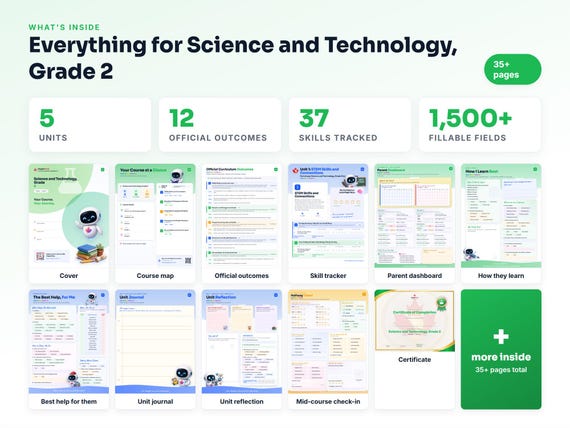
A Science and Technology, Grade 2 workbook worth keeping
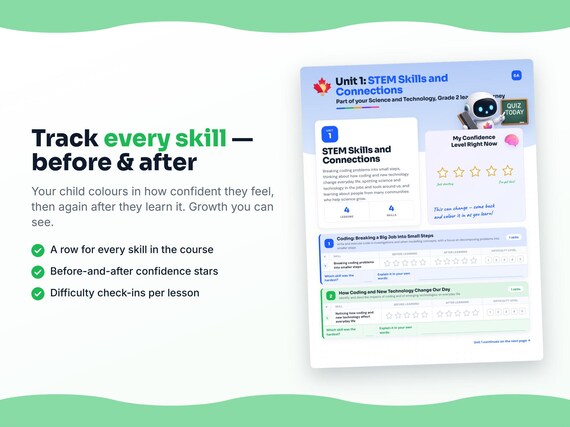
Built from the same official curriculum as this page. Before and after each skill above, your student colours in how sure they feel — so the two of you can see, on one page, what's clicking and what needs another look. It's a quiet way to follow how the year is really going.
By June it's full of their own handwriting: units worked through, confidence grown, a mid-year check-in, notes from parent-teacher night, and a certificate at the end. Less a worksheet, more a record of the year worth keeping on the shelf.
Instant download · see every page, reviews and the full description · five or more workbooks are $2.99 each
What it looks like in the app



Common questions
Can MapleMind help my child with Science and Technology, Grade 2?
Yes. MapleMind's AI tutor covers all 37 skills in Ontario's Science and Technology, Grade 2 — your child picks the exact skill, and the tutor teaches it step by step: a short lesson, a worked example, solving together, then a skill check to show it stuck.
Is MapleMind aligned to Ontario's official curriculum?
Yes. Every skill in this course maps to an official outcome code from Ontario's Grade 2 Science curriculum, and the ministry's own wording is quoted under each unit on this page — with the official government source linked so you can check it yourself.
What does MapleMind cost?
It's free to start — 5 tutoring chats and a practice quiz every day, no credit card. A Pro subscription ($9.99/month or $49.99/year CAD, 7-day free trial) unlocks unlimited tutoring, practice, and exam simulations.
What if my child is stuck on just one topic?
That's the point of skill-level tutoring: open Science and Technology, Grade 2 in the app, tap the exact skill from the list on this page, and the tutor teaches just that — no wading through lessons your child doesn't need.
Does MapleMind work in French or other languages?
Yes — 14 languages, including French. Both the app and the tutor's explanations switch to the language your child chooses.
Where can I see the official Ontario curriculum for Science and Technology, Grade 2?
The official source is linked on this page — Ontario's official science curriculum. The outline here follows it: every MapleMind skill carries its official outcome code, and the ministry's own wording is quoted under each unit.
Keep exploring
Ready when you are
Pick a skill from this page and see it taught properly — free, in the browser, in under a minute.