Get help with Science and Technology, Grade 3
Most tutoring makes your child sit through material your child already knows. MapleMind flips that: pick the exact skill that's causing trouble — any of the 40 below — and the tutor teaches just that one, step by step, as many times as it takes. Ask questions in plain words, any time of day, in English, French, or 12 other languages.
The official Ontario Science and Technology, Grade 3 curriculum
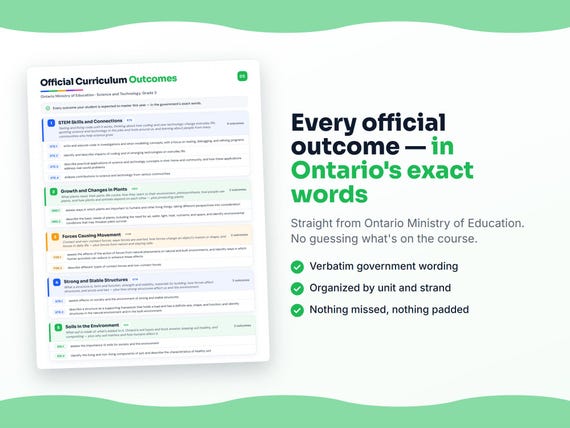
Ontario defines Science and Technology, Grade 3 by strands and outcomes. MapleMind teaches the same curriculum reorganized for one-skill-at-a-time tutoring — the table shows exactly where every official strand lands, and the ministry's own wording is quoted under each unit below.
Official source Ontario's official science curriculumRead it on the government site — dcp.edu.gov.on.ca ↗| Official strand | Outcomes | Where MapleMind teaches it |
|---|---|---|
| Strand A | 4 | STEM Skills and Connections |
| Strand B | 11 | Growth and Changes in Plants |
| Strand C | 6 | Forces Causing Movement |
| Strand D | 9 | Strong and Stable Structures |
| Strand E | 8 | Soils in the Environment |
Every skill below, taught one on one.
 Try the first session free
How MapleMind teaches Science and Technology, Grade 3 — every unit, lesson, and skill
Every skill below runs as a short session: a plain-words lesson, a worked example, solving it together, then a five-question skill check that earns up to three stars. Guided Mode keeps it teaching instead of answer-handing — turning it off needs a parent's password.
Unit 1STEM Skills and ConnectionsOfficial strand · Strand A
Testing and fixing code until it works, thinking about how coding and new technology change everyday life, spotting science and technology in the jobs and tools around us, and learning about people from many communities who help science grow.
Coding: Test, Fix, and Improve
- Testing, debugging, and refining codeA2.1 — Write and run code, focusing on testing it, finding and fixing mistakes (bugs), and improving it.
How Coding and New Technology Change Our Day
- Noticing how coding and new technology affect everyday lifeA2.2 — Notice and describe ways that coding and new kinds of technology change everyday life.
Science and Technology Around Us
- Finding science and technology at home and in the communityA3.1 — Describe real uses of science and technology at home and in the neighbourhood, and how they help solve everyday problems.
People Who Help Science Grow
- Learning about contributions from many communitiesA3.3 — Learn about and describe how people from many different communities have contributed to science and technology.
The official wording — 4 outcomes in this unit
- A2.1
write and execute code in investigations and when modelling concepts, with a focus on testing, debugging, and refining programs
- A2.2
identify and describe impacts of coding and of emerging technologies on everyday life
- A3.1
describe practical applications of science and technology concepts in their home and community, and how these applications address real-world problems
- A3.3
analyse contributions to science and technology from various communities
Unit 2Growth and Changes in PlantsOfficial strand · Strand B
What plants need, their parts, life cycles, how they react to their environment, photosynthesis, how people use plants, and how plants and animals depend on each other — plus protecting plants.
Plants and People
- Why plants are importantB1.1 — Assess the ways plants are important to humans and other living things, considering different perspectives.
- Protecting native plantsB1.1 — Identify ways humans can protect native plant species and their habitats.
- How people affect plants and their habitatsB1.2 — Assess how human activities affect plants and plant habitats, and identify personal actions to reduce harm and help.
- The good and hard parts of local foodB1.3 — Assess the benefits and limitations of locally grown food.
How Plants Grow
- What plants need to growB2.1 — Describe the basic needs of plants (air, water, light, heat, nutrients, space) and identify conditions that threaten plant survival.
- The parts of a plantB2.2 — Identify the parts of plants (root, stem, flower, stamen, pistil, leaf, seed, cone, fruit) and describe how each helps the plant survive.
- Plant life cyclesB2.3 — Describe the changes different plants go through in their life cycles.
- How plants react to their environmentB2.4 — Describe ways a variety of plants adapt or react to their environment and to changes in it.
- How plants make their own foodB2.5 — Show an understanding that most plants get energy from the Sun through photosynthesis, taking in carbon dioxide and releasing oxygen.
- How people around the world use plantsB2.6 — Describe ways that people, including Indigenous peoples, use plants for food, shelter, medicine, and clothing.
- Plants grown for foodB2.7 — Describe various plants used for food, including those grown by First Nations, Métis, and Inuit, and identify local places where they grow.
- How plants and animals depend on each otherB2.8 — Describe ways that plants and animals, including humans, depend on each other.
The official wording — 11 outcomes in this unit
- B1.1
assess ways in which plants are important to humans and other living things, taking different perspectives into consideration
- B1.2
assess ways in which human activities have an impact on plants and plant habitats, and identify personal actions that they could take to minimize harmful effects and enhance positive ones
- B1.3
assess the benefits and limitations of locally grown food
- B2.1
describe the basic needs of plants, including the need for air, water, light, heat, nutrients, and space, and identify environmental conditions that may threaten plant survival
- B2.2
identify different parts of plants, including the root, stem, flower, stamen, pistil, leaf, seed, cone, and fruit, and describe how each part contributes to plants’ survival within their environment
- B2.3
describe changes that different plants undergo in their life cycles
- B2.4
describe ways in which a variety of plants adapt and/or react to their environment and to changes in their environment
- B2.5
demonstrate an understanding that most plants get energy directly from the Sun through the process of photosynthesis, which involves the absorption of carbon dioxide and the release of oxygen
- B2.6
describe ways in which people, including Indigenous peoples, from various cultures around the world use plants for food, shelter, medicine, and clothing
- B2.7
describe various plants used for food, including those grown by First Nations, Métis, and Inuit, and identify local settings where these plants are grown or found
- B2.8
describe ways in which plants and animals, including humans, depend on each other
Unit 3Forces Causing MovementOfficial strand · Strand C
Contact and non-contact forces, ways forces are exerted, how forces change an object's motion or shape, and forces in daily life — plus forces from nature and staying safe.
Forces, Nature, and Safety
- Forces from natureC1.1 — Assess the effects of forces from natural phenomena on natural and built environments, and identify ways human activities can reduce or increase these effects.
- Harmful forces and safety devicesC1.2 — Assess harmful effects of forces from human activities, and describe how health and safety devices reduce them.
Exploring Forces and Movement
- Contact and non-contact forcesC2.1 — Describe different types of contact forces and non-contact forces.
- Different ways a force is exertedC2.2 — Describe different ways a force can be exerted on an object.
- How forces change motion and shapeC2.3 — Describe how forces of different strengths can make an object start, stop, or change its direction, speed, or shape.
- Forces in daily lifeC2.4 — Identify ways forces are used in daily life.
The official wording — 6 outcomes in this unit
- C1.1
assess the effects of the action of forces from natural phenomena on natural and built environments, and identify ways in which human activities can reduce or enhance these effects
- C1.2
assess harmful effects of forces that may result from various human activities, and describe how health and safety devices can minimize these effects
- C2.1
describe different types of contact forces and non-contact forces
- C2.2
describe different ways a force can be exerted on an object
- C2.3
describe how different forces applied to an object, including forces of varying magnitude, can cause the object to start, stop, or change its direction, speed, or shape
- C2.4
identify ways in which forces are used in their daily lives
Unit 4Strong and Stable StructuresOfficial strand · Strand D
What a structure is, form and function, strength and stability, materials for building, how forces affect structures, and struts and ties — plus how strong structures affect us and the environment.
Why Strong Structures Matter
- Effects of strong and stable structuresD1.1 — Assess the effects on society and the environment of strong and stable structures.
- Structures built by animalsD1.2 — Assess the environmental impact of structures built by various animals, including humans.
Building Strong, Stable Structures
- What a structure isD2.1 — Describe a structure as a supporting framework that holds a load and has a definite size, shape, and function, and identify structures in nature and the built environment.
- Form and function of structuresD2.2 — Show an understanding of the relationship between form and function for various structures.
- The strength of structuresD2.3 — Identify the strength of a structure as its ability to support a load, and describe ways to make structures and materials stronger.
- The stability of structuresD2.4 — Describe the stability of a structure as its ability to keep its shape, balance, float, or stay put when a force is applied, and describe ways to improve stability.
- Choosing materials for structuresD2.5 — Identify properties of materials that need to be considered when building structures.
- How forces affect structuresD2.6 — Describe ways different forces can affect the shape, balance, or position of structures.
- Struts and tiesD2.7 — Explain the role of struts and ties in structures under load.
The official wording — 9 outcomes in this unit
- D1.1
assess effects on society and the environment of strong and stable structures
- D1.2
assess the environmental impact of structures built by various animals, including structures built by humans
- D2.1
describe a structure as a supporting framework that holds a load and has a definite size, shape, and function, and identify structures in the natural environment and in the built environment
- D2.2
demonstrate an understanding of the relationship between form and function for various structures
- D2.3
identify the strength of a structure as its ability to support a load and describe ways to increase the strength of structures, including ways to increase the strength of different materials used to build them
- D2.4
describe the stability of a structure as its ability to keep its shape, maintain balance, float, and/or stay fixed in one spot when a force is applied to the structure, and describe ways to improve a structure’s stability
- D2.5
identify properties of materials that need to be considered when building structures
- D2.6
describe ways in which different forces can affect the shape, balance, or position of structures
- D2.7
explain the role of struts and ties in structures under load
Unit 5Soils in the EnvironmentOfficial strand · Strand E
What soil is made of, what's added to it, Ontario's soil types and food, erosion, keeping soil healthy, and composting — plus why soil matters and how humans affect it.
Why Soil Matters
- The importance of soilsE1.1 — Assess the importance of soils for society and the environment.
- How people affect soilsE1.2 — Assess the impact of human activity on soils.
- Improving and protecting soilE1.2 — Describe ways humans can improve the quality of soils and lessen or prevent harmful effects on them.
Exploring Soil
- What soil is made ofE2.1 — Identify the living and non-living parts of soil, and describe what makes soil healthy.
- What gets added to soilE2.2 — Identify substances commonly added to or absorbed by soil, and describe their effects on soil health.
- Ontario soils and the food they growE2.3 — Examine different types of soils found in Ontario, and describe how different soils suit growing different foods, including crops.
- ErosionE2.4 — Explain the process of erosion, including its causes and its impact on soils.
- Keeping Ontario's soil healthyE2.5 — Identify strategies used to maintain and improve soil health in Ontario.
- CompostingE2.6 — Describe the process of composting and explain some of its benefits.
The official wording — 8 outcomes in this unit
- E1.1
assess the importance of soils for society and the environment
- E1.2
assess the impact of human activity on soils
- E2.1
identify the living and non-living components of soil, and describe the characteristics of healthy soil
- E2.2
identify different substances that are commonly added to, or absorbed by, the soil, and describe their effects on soil health
- E2.3
examine different types of soils found in Ontario, and describe how different soils are suited to growing different types of food, including crops
- E2.4
explain the process of erosion, including its causes and its impact on soils
- E2.5
identify various strategies used to maintain and improve soil health in Ontario
- E2.6
describe the process of composting, and explain some benefits of composting

Printable workbook · A keepsake of the year
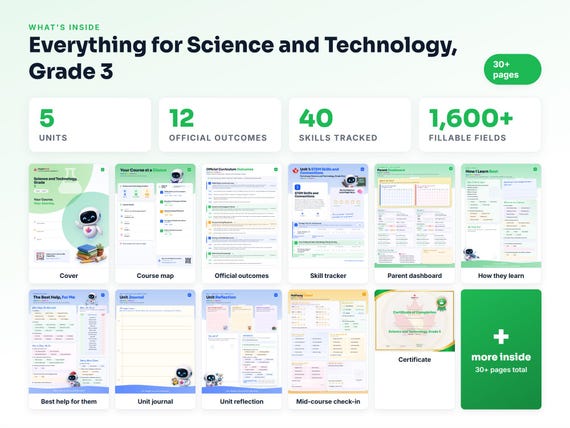
A Science and Technology, Grade 3 workbook worth keeping
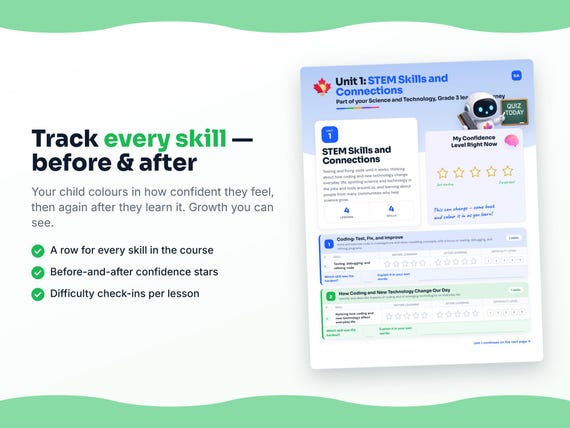
Built from the same official curriculum as this page. Before and after each skill above, your student colours in how sure they feel — so the two of you can see, on one page, what's clicking and what needs another look. It's a quiet way to follow how the year is really going.
By June it's full of their own handwriting: units worked through, confidence grown, a mid-year check-in, notes from parent-teacher night, and a certificate at the end. Less a worksheet, more a record of the year worth keeping on the shelf.
Instant download · see every page, reviews and the full description · five or more workbooks are $2.99 each
What it looks like in the app



Common questions
Can MapleMind help my child with Science and Technology, Grade 3?
Yes. MapleMind's AI tutor covers all 40 skills in Ontario's Science and Technology, Grade 3 — your child picks the exact skill, and the tutor teaches it step by step: a short lesson, a worked example, solving together, then a skill check to show it stuck.
Is MapleMind aligned to Ontario's official curriculum?
Yes. Every skill in this course maps to an official outcome code from Ontario's Grade 3 Science curriculum, and the ministry's own wording is quoted under each unit on this page — with the official government source linked so you can check it yourself.
What does MapleMind cost?
It's free to start — 5 tutoring chats and a practice quiz every day, no credit card. A Pro subscription ($9.99/month or $49.99/year CAD, 7-day free trial) unlocks unlimited tutoring, practice, and exam simulations.
What if my child is stuck on just one topic?
That's the point of skill-level tutoring: open Science and Technology, Grade 3 in the app, tap the exact skill from the list on this page, and the tutor teaches just that — no wading through lessons your child doesn't need.
Does MapleMind work in French or other languages?
Yes — 14 languages, including French. Both the app and the tutor's explanations switch to the language your child chooses.
Where can I see the official Ontario curriculum for Science and Technology, Grade 3?
The official source is linked on this page — Ontario's official science curriculum. The outline here follows it: every MapleMind skill carries its official outcome code, and the ministry's own wording is quoted under each unit.
Keep exploring
Ready when you are
Pick a skill from this page and see it taught properly — free, in the browser, in under a minute.