Ontario · For parents

What your child learns in Grade 8 in Ontario

Every subject, unit by unit, from Ontario’s curriculum: 225 skills in plain words.

Subjects
5
Skills
225
Provincial exams
None
Official curriculum
dcp.edu.gov.on.ca

Math in Grade 8

Mathematics, Grade 8

5 units · 45 skills

  1. Unit 1

    Number

    In scientific notation, there is exactly one non-zero digit to the left of the decimal point (e.g., 3.624 × 10^13, not 36.24 × 10^12).

    • Representing and comparing numbers with scientific notation
    • Describing, comparing, and ordering rational and irrational numbers
    • Estimating and calculating square roots
    9 more skills
    • Recalling commonly used square numbers and their square roots
    • Using fractions, decimals, and percents flexibly, including over 100% and under 1%
    • Using order of operations to solve multi-step problems with rational numbers, ratios, rates, and percents
    • Using mental math to multiply and divide by powers of ten
    • Adding and subtracting integers using appropriate strategies
    • Adding and subtracting fractions using appropriate strategies
    • Multiplying and dividing fractions by fractions, whole numbers, and mixed numbers
    • Multiplying and dividing integers using appropriate strategies
    • Comparing proportional situations and finding unknown values
  2. Unit 2

    Algebra

    A constant rate means the change between terms is always the same amount — like an hourly wage of $15 per hour.

    • Comparing patterns using rate and initial value
    • Creating and translating patterns using algebraic expressions and equations
    • Using pattern rules to extend patterns and solve for unknown values
    8 more skills
    • Creating patterns that show relationships among rational numbers
    • Adding and subtracting monomials with a degree of 1
    • Adding binomials with a degree of 1 that involve integers
    • Evaluating algebraic expressions with rational numbers
    • Solving and verifying equations with multiple terms, integers, and decimal numbers
    • Solving, verifying, and graphing inequalities with integers
    • Writing and running code that analyses data to inform decisions
    • Reading and changing code that analyses data
  3. Unit 3

    Data

    A variable is any attribute, number, or quantity that can be measured or counted.

    • Telling one-variable and two-variable data situations apart
    • Collecting continuous two-variable data and organizing it in a table of values
    • Choosing and justifying the best graph, including scatter plots
    5 more skills
    • Creating an infographic using tables and scatter plots
    • Using correlation language to describe two-variable relationships
    • Analysing data in scatter plots and misleading graphs to draw conclusions
    • Solving probability problems using Venn and tree diagrams
    • Comparing theoretical and experimental probabilities of multiple independent and dependent events
  4. Unit 4

    Spatial Sense

    A tessellation covers an area with tiles leaving no gaps or overlaps; the angles where tiles meet always add up to 360°.

    • Identifying properties of tessellating shapes and their transformations
    • Making objects and models from views using appropriate scales
    • Using scale drawings to calculate actual lengths and areas
    5 more skills
    • Performing and predicting translations, reflections, rotations, and dilations
    • Representing very large and very small metric units with exponential notation
    • Solving angle problems with intersecting and parallel lines and polygons
    • Solving perimeter, area, volume, and surface area problems for composite shapes and objects
    • Describing and applying the Pythagorean relationship to find an unknown side length
  5. Unit 5

    Financial Literacy

    There are different ways to pay in a foreign currency (cash exchange, credit card, prepaid travel card), each with its own advantages and disadvantages.

    • Weighing methods of payment across currencies and exchange rates
    • Creating a financial plan that accounts for income, expenses, and taxes
    • Identifying ways to keep a balanced budget and track income and spending
    3 more skills
    • Determining the growth of simple and compound interest and its long-term impact
    • Comparing ways consumers can get more value for their money
    • Comparing credit card interest rates, fees, and rewards to find the best value
Science in Grade 8

Science and Technology, Grade 8

5 units · 47 skills

  1. Unit 1

    STEM Skills and Connections

    Automating means having code run steps by itself, without a person doing each one.

    • Automating large systems with code
    • How coding and AI affect life and skilled trades
    • Science and technology in occupations and skilled trades
    1 more skill
    • Analysing contributions from many communities
  2. Unit 2

    Cells

    Technologies like the microscope and staining let us see cells and cellular processes.

    • Technologies that reveal cells
    • Effects of developments in cell biology
    • Cell theory
    5 more skills
    • Organelles and their functions
    • Plant and animal cells
    • Diffusion and osmosis
    • Unicellular and multicellular organisms
    • From cells to systems
  3. Unit 3

    Fluids

    Many technologies rely on fluid properties — hydraulic lifts, brakes, and pipelines.

    • Impacts of fluid-based technologies
    • Impacts of fluid spills
    • Viscosity
    9 more skills
    • Mass, volume, and density
    • Density of solids, liquids, and gases
    • Compressibility of liquids and gases
    • Buoyancy
    • Pressure, volume, and temperature
    • Pascal's law and force transfer in fluids
    • Factors affecting fluid flow
    • Pneumatic and hydraulic systems
    • Fluids in living things and machines
  4. Unit 4

    Systems in Action

    Automating a system replaces human steps with automatic ones.

    • Impacts of automating systems
    • Alternative ways of meeting needs
    • Types of systems
    10 more skills
    • Inputs and outputs of systems
    • Efficient and safe operation
    • The science terms of work
    • Work, force, and displacement
    • Input and output forces
    • Calculating mechanical advantage
    • Energy dissipation and efficiency
    • Information for safe, efficient use
    • Innovations and productivity
    • Social factors and the evolution of systems
  5. Unit 5

    Water Systems

    Fresh water is limited, and scarcity has social and environmental impacts.

    • Fresh-water scarcity and a plan of action
    • First Nations, Métis, and Inuit water knowledges
    • Impact of discoveries on water systems
    7 more skills
    • States, distribution, and circulation of water
    • Watersheds
    • The water table
    • Glaciers, ice-caps, and climate change
    • Water bodies and the atmosphere
    • Water-quality indicators
    • Municipal water processing

English in Grade 8

English (Language), Grade 8

4 units · 56 skills

  1. Unit 1

    Literacy Connections and Applications

    At Grade 8 you navigate online safely and manage your privacy, personal data, and security with more independence.

    • Rights, responsibilities, and digital identity
    • Staying safe and protecting privacy online
    • Researching and spotting misinformation
    6 more skills
    • Reading and analyzing digital and media texts
    • How form, message, and audience connect
    • Using digital tools to solve real problems
    • Collaborating safely and respectfully online
    • Identity and belonging in diverse texts
    • Themes in First Nations, Métis, and Inuit cultures
  2. Unit 2

    Foundations of Language

    At Grade 8 you EVALUATE and use effective listening skills to enhance comprehension, including paraphrasing, asking open-ended questions, and making relevant responses.

    • Active listening in discussions
    • Listening strategies before, during, and after
    • Speaking for purpose and audience
    8 more skills
    • Non-verbal communication strategies
    • Precise word choice when speaking
    • Morphology: reading and spelling with word parts
    • Building and using vocabulary
    • Reading fluently with expression
    • Increasingly complex sentences
    • Refining grammar across parts of speech
    • Refining capitalization and punctuation
  3. Unit 3

    Comprehension: Understanding and Responding to Texts

    At Grade 8 you comprehend complex texts independently, combining all your knowledge of words, grammar, cohesive ties, sentence structures, and background knowledge.

    • Reading and comprehending texts
    • Analyzing text forms and genres
    • Analyzing text patterns and features
    19 more skills
    • Analyzing visuals and design
    • Elements of style in texts
    • Narrator's point of view
    • Indigenous Storywork through First Nations, Métis, and Inuit texts
    • Using prior knowledge
    • Purposes for reading and choosing texts
    • Making predictions and posing questions
    • Monitoring comprehension
    • Connecting text ideas to self, texts, and world
    • Summarizing and synthesizing
    • Reflecting on comprehension strategies
    • Literary devices
    • Making inferences
    • Analyzing texts for ideas and information
    • Cultural elements in texts
    • Perspectives and bias
    • Topics such as diversity, inclusion, and accessibility
    • Influences on First Nations, Métis, and Inuit texts
    • Reflecting on critical thinking skills
  4. Unit 4

    Composition: Expressing Ideas and Creating Texts

    At Grade 8 you identify topic, purpose, and audience, CHOOSE a form, genre, and medium to suit them, and JUSTIFY your choices.

    • Planning topic, purpose, and audience
    • Generating and developing ideas
    • Gathering information and citing sources
    11 more skills
    • Organizing and sequencing content
    • Reflecting on planning strategies
    • Drafting texts in various genres
    • Transcription: cursive and word processing
    • Establishing voice in writing
    • Point of view, perspective, and bias in own texts
    • Revising drafts
    • Editing drafts
    • Producing final texts
    • Publishing and presenting texts
    • Reflecting on publishing and presenting

French in Grade 8

Core French, Grade 8

4 units · 33 skills

  1. Unit 1

    Listening

    Grade 8 listening makes predictions about a narrative or presentation based on the presenter's opening remarks, and uses self-questioning to monitor understanding.

    • Using listening strategies
    • Showing you understood
    • Interactive listening strategies
    4 more skills
    • Responding in short exchanges
    • Reflecting on my listening
    • French-speaking communities in Ontario
    • Noticing sociolinguistic conventions
  2. Unit 2

    Speaking

    Adjust your volume and tone to suit the message and context when you speak.

    • Using speaking strategies
    • Producing short spoken messages
    • Speaking with fluency
    5 more skills
    • Speaking-interaction strategies
    • Taking part in spoken exchanges
    • Reflecting on my speaking
    • Speaking about French-speaking communities
    • Using sociolinguistic conventions
  3. Unit 3

    Reading

    You now use a VARIETY of strategies across modelled, shared, and guided reading of increasingly complex texts.

    • Using reading strategies
    • Reading for meaning
    • Reading with fluency
    6 more skills
    • Developing vocabulary
    • Purposes of text forms
    • Characteristics of text forms
    • Reflecting on my reading
    • Reading about French-speaking communities
    • Conventions in French texts
  4. Unit 4

    Writing

    Each form has a structure: an information poster or brochure has a title, illustrations, captions, and brief explanations.

    • Identifying purpose and audience
    • Writing in different forms
    • Applying language conventions
    6 more skills
    • Pre-writing: gathering ideas
    • Drafting and revising
    • Producing finished work: conventions
    • Reflecting on my writing
    • Writing about French-speaking communities
    • Conventions in my writing

Social studies in Grade 8

History and Geography, Grade 8

4 units · 44 skills

  1. Unit 1

    Creating Canada (1850-1890)

    Internal factors included the Red River and North-West Resistances, the transcontinental railway, and the Manitoba Act of 1870.

    • Factors in the creation of the Dominion
    • Legal status and Indigenous peoples
    • Legal status and settler groups
    8 more skills
    • Actions people took to improve their lives
    • Key events and their significance
    • Treaties, the Indian Act, and Indigenous peoples
    • The residential school system
    • Political and legal changes for other groups
    • Social and economic changes
    • Cooperation and conflict
    • Significant individuals and groups
  2. Unit 2

    Canada, 1890-1914: A Changing Society

    Between 1890 and 1914, groups such as workers, farmers, recent immigrants, and different Indigenous communities had distinct experiences.

    • Experiences then and now
    • Challenges to Indigenous families and communities
    • Challenges for other communities
    7 more skills
    • Actions people took to improve their lives
    • Developments affecting Indigenous peoples
    • Developments affecting other communities
    • Political and legal changes
    • Social and economic changes
    • Cooperation and conflict
    • Significant individuals and groups
  3. Unit 3

    Global Settlement: Patterns and Sustainability

    Climate, landforms, soil type, vegetation, and natural resources all influence where people settle.

    • How the environment shapes settlement
    • Future physical processes and settlement
    • Features of a sustainable community
    7 more skills
    • Global patterns in human settlement
    • How the environment influences where settlements form
    • Land-use issues and responses
    • Current trends in human settlement
    • How settlement affects the environment
    • Practices for more sustainable settlements
    • Analysing and constructing choropleth maps
  4. Unit 4

    Global Inequalities: Economic Development and Quality of Life

    Factors that shape quality of life are connected, not isolated.

    • Factors that shape quality of life
    • Factors affecting economies and quality of life
    • Programs to improve quality of life
    10 more skills
    • The role of media in quality of life
    • Quality-of-life indicators
    • Comparing quality of life across countries
    • Scatter graphs for development
    • Population pyramids
    • Groups working to improve quality of life
    • Types of economic systems
    • Economic sectors and development
    • Factors in economic development
    • The spatial distribution of wealth

MapleMind

See Grade 8 in MapleMind

Real screens from the app your child would use.

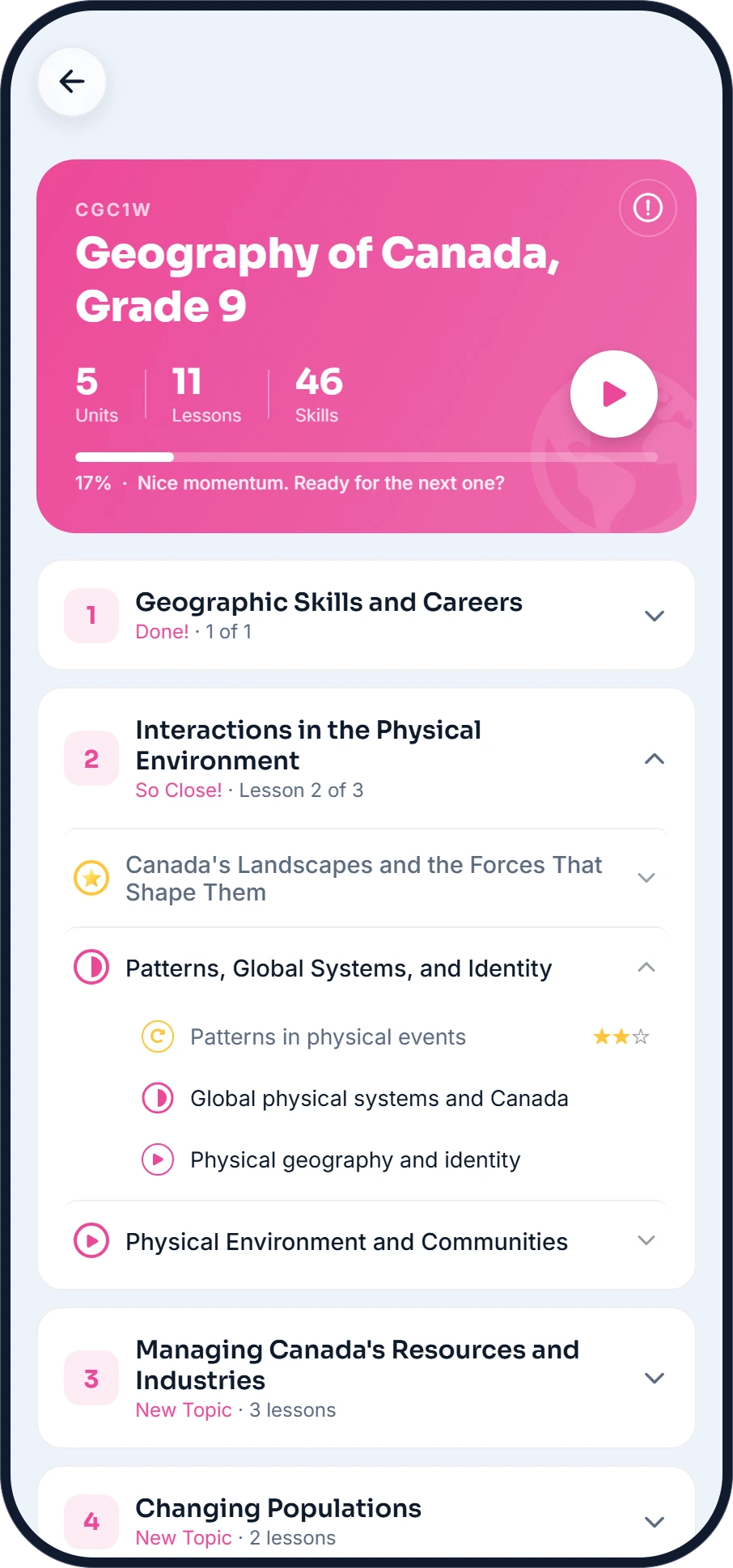
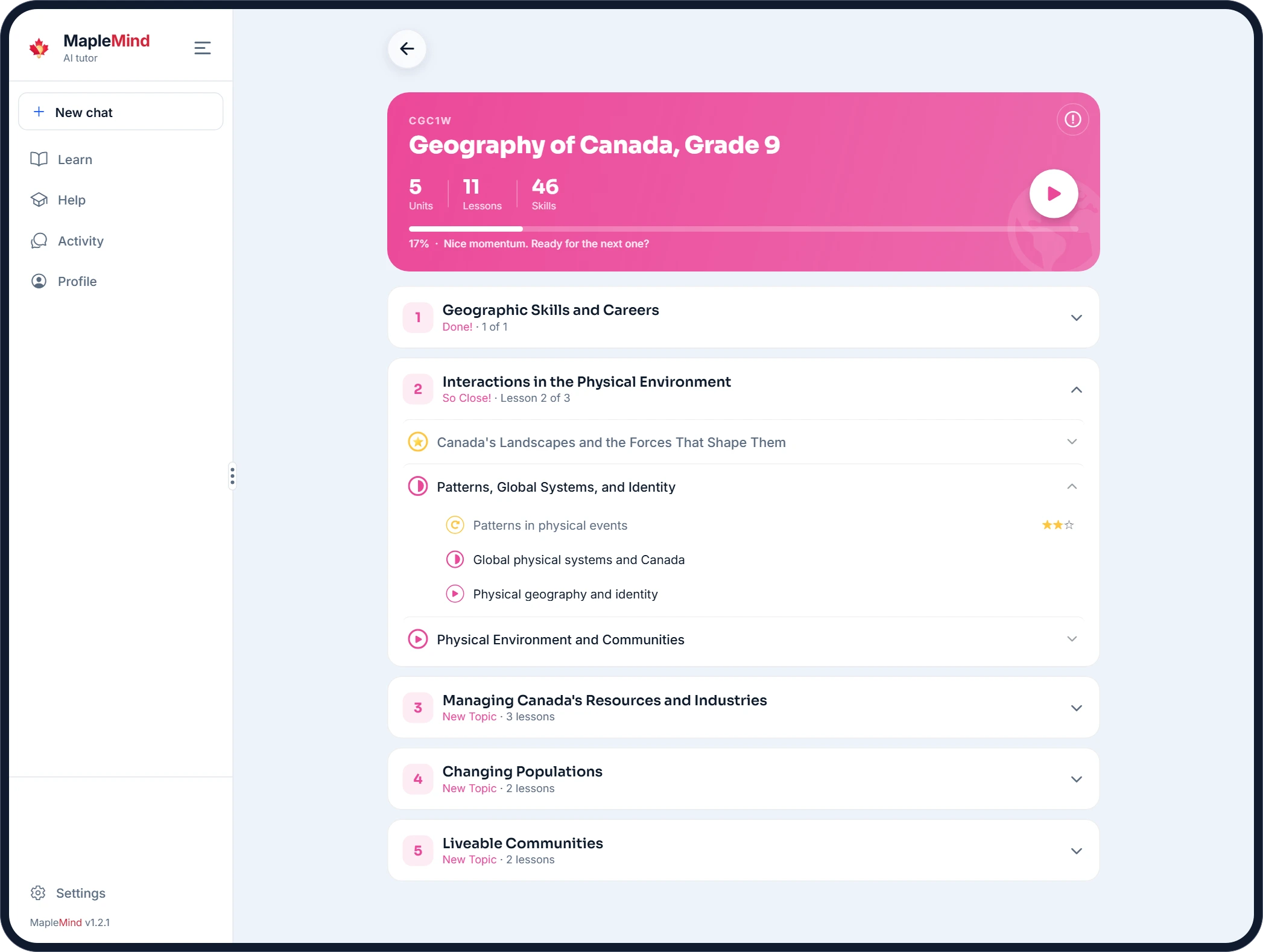
Geography of Canada, Grade 9 in MapleMind on a tablet: its units and lessons in order, a student partway through.Geography of Canada, Grade 9 in MapleMind on a phone: its units and lessons in order, a student partway through.
Their course, unit by unit, the way Ontario teaches it.Shown: Geography of Canada, Grade 9
Homework Help on a tablet: a photo of a worksheet, the tutor’s worked example of a two-step equation, and a question back to the student.Homework Help on a phone: a photo of a worksheet, the tutor’s worked example of a two-step equation, and a question back to the student.
Homework Help: they take a photo of the question, and the tutor works through it with them.
The Parent Dashboard on a tablet: a student’s days studied, streak, lessons, quiz average and recent activity.The Parent Dashboard on a phone: a student’s days studied, streak, lessons, quiz average and recent activity.
The Parent Dashboard: how each child’s week went, in lessons, quizzes and days studied.
A Grade 9 provincial mathematics exam on a tablet: a readiness score, the exam’s time and its next sitting.A Grade 9 provincial mathematics exam on a phone: a readiness score, the exam’s time and its next sitting.
A provincial exam: a practice sitting under the real time, and how ready they are.
The Learn tab on a tablet: a four-day streak, the week’s days, Homework Help, the next lesson and a review.The Learn tab on a phone: a four-day streak, the week’s days, Homework Help, the next lesson and a review.
The Learn tab: their week so far, and the next thing to do.

Help at home

Questions parents ask

What will my child learn in Grade 8 in Ontario?

Math: Mathematics, Grade 8. Science: Science and Technology, Grade 8. English: English (Language), Grade 8. French: Core French, Grade 8. Social studies: History and Geography, Grade 8. That’s 225 skills in all, from Ontario’s curriculum.

Does my child write a provincial exam in Grade 8?

No. Ontario has no provincial exam in Grade 8.

Where does this list come from?

From Ontario’s official curriculum, the documents its education ministry publishes for each course. Each skill here is one of their expectations, written in plain words.

Can MapleMind help my child in Grade 8?

Yes. Every course on this page is in MapleMind, with lessons, practice and a tutor that works through each step with them. A free account gets 30 messages and 4 activities a day.

Help with Grade 8, one skill at a time.

Every course on this page is in MapleMind, free with daily limits.