Get help with Mathematics, Grade 8
Most tutoring makes you sit through material you already know. MapleMind flips that: pick the exact skill that's causing trouble — any of the 45 below — and the tutor teaches just that one, step by step, as many times as it takes. Ask questions in plain words, any time of day, in English, French, or 12 other languages.
The official Ontario Mathematics, Grade 8 curriculum
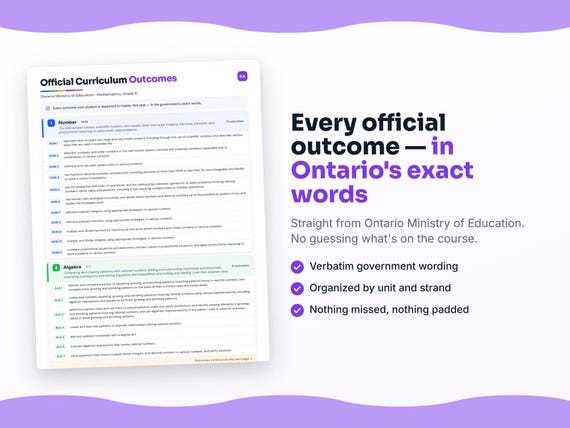
Ontario defines Mathematics, Grade 8 by strands and outcomes. MapleMind teaches the same curriculum reorganized for one-skill-at-a-time tutoring — the table shows exactly where every official strand lands, and the ministry's own wording is quoted under each unit below.
Official source Ontario's official mathematics curriculumRead it on the government site — dcp.edu.gov.on.ca ↗| Official strand | Outcomes | Where MapleMind teaches it |
|---|---|---|
| Strand B | 12 | Number |
| Strand C | 11 | Algebra |
| Strand D | 8 | Data |
| Strand E | 8 | Spatial Sense |
| Strand F | 6 | Financial Literacy |
Ontario also defines Strand A — Social-Emotional Learning Skills — which the ministry teaches through every other strand rather than as its own unit, so it doesn't get a row of its own.
Every skill below, taught one on one.
 Try the first session free
How MapleMind teaches Mathematics, Grade 8 — every unit, lesson, and skill
Every skill below runs as a short session: a plain-words lesson, a worked example, solving it together, then a five-question skill check that earns up to three stars. Guided Mode keeps it teaching instead of answer-handing — turning it off needs a parent's password.
Unit 1NumberOfficial strand · Strand B
The real number system, scientific notation, and square roots; and using integers, fractions, percents, and proportional reasoning to solve multi-step problems.
Very Large and Very Small Numbers
- Representing and comparing numbers with scientific notationB1.1 — Represent and compare very large and very small numbers, including by using scientific notation, and describe how they show up in everyday life.
The Real Number System
- Describing, comparing, and ordering rational and irrational numbersB1.2 — Describe, compare, and order numbers in the real number system — rational and irrational numbers — separately and together, in different situations.
Square Roots
- Estimating and calculating square rootsB1.3 — Estimate and calculate the square roots of numbers, including non-perfect squares, in different situations.
- Recalling commonly used square numbers and their square rootsB2.2 — Know and quickly use commonly used square numbers and their square roots.
Fractions, Decimals, and Percents — Flexibly
- Using fractions, decimals, and percents flexibly, including over 100% and under 1%B1.4 — Use fractions, decimal numbers, and percents — including percents of more than 100% or less than 1% — interchangeably and flexibly to solve a variety of problems.
Order of Operations in Multi-Step Problems
- Using order of operations to solve multi-step problems with rational numbers, ratios, rates, and percentsB2.1 — Use the properties and order of operations, and how operations relate to each other, to solve problems involving rational numbers, ratios, rates, and percents, including problems needing multiple steps or operations.
Mental Math with Powers of Ten
- Using mental math to multiply and divide by powers of tenB2.3 — Use mental math strategies to multiply and divide whole numbers and decimal numbers up to thousandths by powers of ten, and explain the strategy used.
Adding and Subtracting Integers
- Adding and subtracting integers using appropriate strategiesB2.4 — Add and subtract integers, using appropriate strategies, in different situations, paying close attention to what each sign in a statement means.
Adding and Subtracting Fractions
- Adding and subtracting fractions using appropriate strategiesB2.5 — Add and subtract fractions, using appropriate strategies, in different situations, including fractions with unlike denominators and mixed numbers.
Multiplying and Dividing Fractions
- Multiplying and dividing fractions by fractions, whole numbers, and mixed numbersB2.6 — Multiply and divide fractions by other fractions, as well as by whole numbers and mixed numbers, in different situations.
Multiplying and Dividing Integers
- Multiplying and dividing integers using appropriate strategiesB2.7 — Multiply and divide integers, using appropriate strategies, in different situations, applying the sign rules for each operation.
Proportional Reasoning
- Comparing proportional situations and finding unknown valuesB2.8 — Compare proportional situations and determine unknown values within them, applying proportional reasoning to solve problems in different contexts.
The official wording — 12 outcomes in this unit
- B1.1
represent and compare very large and very small numbers, including through the use of scientific notation, and describe various ways they are used in everyday life
- B1.2
describe, compare, and order numbers in the real number system (rational and irrational numbers), separately and in combination, in various contexts
- B1.3
estimate and calculate square roots, in various contexts
- B2.2
understand and recall commonly used square numbers and their square roots
- B1.4
use fractions, decimal numbers, and percents, including percents of more than 100% or less than 1%, interchangeably and flexibly to solve a variety of problems
- B2.1
use the properties and order of operations, and the relationships between operations, to solve problems involving rational numbers, ratios, rates, and percents, including those requiring multiple steps or multiple operations
- B2.3
use mental math strategies to multiply and divide whole numbers and decimal numbers up to thousandths by powers of ten, and explain the strategies used
- B2.4
add and subtract integers, using appropriate strategies, in various contexts
- B2.5
add and subtract fractions, using appropriate strategies, in various contexts
- B2.6
multiply and divide fractions by fractions, as well as by whole numbers and mixed numbers, in various contexts
- B2.7
multiply and divide integers, using appropriate strategies, in various contexts
- B2.8
compare proportional situations and determine unknown values in proportional situations, and apply proportional reasoning to solve problems in various contexts
Unit 2AlgebraOfficial strand · Strand C
Comparing and creating patterns with rational numbers; adding and subtracting monomials and binomials; evaluating expressions and solving equations and inequalities; and writing and reading code that analyses data.
Comparing Growing and Shrinking Patterns
- Comparing patterns using rate and initial valueC1.1 — Identify and compare repeating, growing, and shrinking patterns, including real-life ones, and compare linear growing and shrinking patterns by their constant rate and initial value.
Creating and Translating Patterns with Algebra
- Creating and translating patterns using algebraic expressions and equationsC1.2 — Create and translate repeating, growing, and shrinking patterns involving rational numbers, using various representations, including algebraic expressions and equations for linear patterns.
Pattern Rules and Solving for Unknowns
- Using pattern rules to extend patterns and solve for unknown valuesC1.3 — Determine pattern rules and use them to extend patterns, make and justify predictions, and identify missing elements in growing and shrinking patterns involving rational numbers, and use algebraic representations to solve for unknown values in linear patterns.
Patterns Showing Relationships Among Rational Numbers
- Creating patterns that show relationships among rational numbersC1.4 — Create and describe patterns to illustrate relationships among rational numbers.
Monomials and Binomials
- Adding and subtracting monomials with a degree of 1C2.1a — Add and subtract monomials with a degree of 1, combining like terms.
- Adding binomials with a degree of 1 that involve integersC2.1b — Add binomials with a degree of 1 that involve integers, using tools.
Evaluating Algebraic Expressions
- Evaluating algebraic expressions with rational numbersC2.2 — Evaluate algebraic expressions that involve rational numbers, substituting values in and following the order of operations.
Solving Multi-Term Equations
- Solving and verifying equations with multiple terms, integers, and decimal numbersC2.3 — Solve equations that involve multiple terms, integers, and decimal numbers in different situations, and check the solution.
Solving and Graphing Inequalities
- Solving, verifying, and graphing inequalities with integersC2.4 — Solve inequalities that involve integers, verify the solutions, and graph them on a number line.
Coding to Analyse Data
- Writing and running code that analyses data to inform decisionsC3.1 — Solve problems and create computational representations of math situations by writing and running code, including code that analyses data to inform and communicate decisions.
- Reading and changing code that analyses dataC3.2 — Read and alter existing code involving the analysis of data to inform and communicate decisions, and describe how changes affect both the outcomes and the efficiency of the code.
The official wording — 11 outcomes in this unit
- C1.1
identify and compare a variety of repeating, growing, and shrinking patterns, including patterns found in real-life contexts, and compare linear growing and shrinking patterns on the basis of their constant rates and initial values
- C1.2
create and translate repeating, growing, and shrinking patterns involving rational numbers using various representations, including algebraic expressions and equations for linear growing and shrinking patterns
- C1.3
determine pattern rules and use them to extend patterns, make and justify predictions, and identify missing elements in growing and shrinking patterns involving rational numbers, and use algebraic representations of the pattern rules to solve for unknown values in linear growing and shrinking patterns
- C1.4
create and describe patterns to illustrate relationships among rational numbers
- C2.1a
add and subtract monomials with a degree of 1
- C2.1b
and add binomials with a degree of 1 that involve integers, using tools
- C2.2
evaluate algebraic expressions that involve rational numbers
- C2.3
solve equations that involve multiple terms, integers, and decimal numbers in various contexts, and verify solutions
- C2.4
solve inequalities that involve integers, and verify and graph the solutions
- C3.1
solve problems and create computational representations of mathematical situations by writing and executing code, including code that involves the analysis of data in order to inform and communicate decisions
- C3.2
read and alter existing code involving the analysis of data in order to inform and communicate decisions, and describe how changes to the code affect the outcomes and the efficiency of the code
Unit 3DataOfficial strand · Strand D
Telling one-variable from two-variable data; collecting, graphing (including scatter plots), and analysing data, including with infographics and correlation language; and solving probability problems with Venn and tree diagrams.
One-Variable and Two-Variable Data
- Telling one-variable and two-variable data situations apartD1.1 — Identify situations involving one-variable data and situations involving two-variable data, and explain when each type is needed.
Collecting Continuous Two-Variable Data
- Collecting continuous two-variable data and organizing it in a table of valuesD1.2 — Collect continuous data to answer questions of interest involving two variables, and organize the data as appropriate in a table of values.
Choosing Graphs, Including Scatter Plots
- Choosing and justifying the best graph, including scatter plotsD1.3 — Select from a variety of graphs, including scatter plots, the type best suited to a data set, display the data with a proper source, title, labels, and scale, and justify the choice.
Building an Infographic with Tables and Scatter Plots
- Creating an infographic using tables and scatter plotsD1.4 — Create an infographic about a data set, representing the data in appropriate ways including tables and scatter plots, and adding other relevant information that tells the story of the data.
Describing Relationships Between Two Variables
- Using correlation language to describe two-variable relationshipsD1.5 — Use mathematical language, including "strong," "weak," "none," "positive," and "negative," to describe the relationship between two variables for data sets with and without outliers.
Analysing Data in Scatter Plots and Misleading Graphs
- Analysing data in scatter plots and misleading graphs to draw conclusionsD1.6 — Analyse different sets of data presented in various ways, including scatter plots and misleading graphs, by asking and answering questions, challenging preconceived notions, and drawing conclusions to make convincing arguments and informed decisions.
Solving Probability Problems with Diagrams
- Solving probability problems using Venn and tree diagramsD2.1 — Solve various problems that involve probability, using appropriate tools and strategies, including Venn and tree diagrams.
Comparing Probabilities of Multiple Events
- Comparing theoretical and experimental probabilities of multiple independent and dependent eventsD2.2 — Determine and compare the theoretical and experimental probabilities of multiple independent events happening and of multiple dependent events happening.
The official wording — 8 outcomes in this unit
- D1.1
identify situations involving one-variable data and situations involving two-variable data, and explain when each type of data is needed
- D1.2
collect continuous data to answer questions of interest involving two variables, and organize the data sets as appropriate in a table of values
- D1.3
select from among a variety of graphs, including scatter plots, the type of graph best suited to represent various sets of data; display the data in the graphs with proper sources, titles, and labels, and appropriate scales; and justify their choice of graphs
- D1.4
create an infographic about a data set, representing the data in appropriate ways, including in tables and scatter plots, and incorporating any other relevant information that helps to tell a story about the data
- D1.5
use mathematical language, including the terms “strong”, “weak”, “none”, “positive”, and “negative”, to describe the relationship between two variables for various data sets with and without outliers
- D1.6
analyse different sets of data presented in various ways, including in scatter plots and in misleading graphs, by asking and answering questions about the data, challenging preconceived notions, and drawing conclusions, then make convincing arguments and informed decisions
- D2.1
solve various problems that involve probability, using appropriate tools and strategies, including Venn and tree diagrams
- D2.2
determine and compare the theoretical and experimental probabilities of multiple independent events happening and of multiple dependent events happening
Unit 4Spatial SenseOfficial strand · Strand E
Tessellations, scale drawings and models, and transformations (including dilations) on the Cartesian plane; and measurement — metric prefixes, angle properties, composite shape formulas, and the Pythagorean relationship.
Tessellations
- Identifying properties of tessellating shapes and their transformationsE1.1 — Identify geometric properties of tessellating shapes and identify the transformations that occur in the tessellations.
Scale Models and Scale Drawings
- Making objects and models from views using appropriate scalesE1.2 — Make objects and models using appropriate scales, given their top, front, and side views or their perspective views.
- Using scale drawings to calculate actual lengths and areasE1.3 — Use scale drawings to calculate actual lengths and areas, and reproduce scale drawings at different ratios.
Transformations on the Cartesian Plane
- Performing and predicting translations, reflections, rotations, and dilationsE1.4 — Describe and perform translations, reflections, rotations, and dilations on a Cartesian plane, and predict the results of these transformations.
Very Large and Very Small Metric Units
- Representing very large and very small metric units with exponential notationE2.1 — Represent very large (mega, giga, tera) and very small (micro, nano, pico) metric units using models, base ten relationships, and exponential notation.
Angle Properties
- Solving angle problems with intersecting and parallel lines and polygonsE2.2 — Solve problems involving angle properties, including the properties of intersecting and parallel lines and of polygons.
Composite Shapes and Objects
- Solving perimeter, area, volume, and surface area problems for composite shapes and objectsE2.3 — Solve problems involving the perimeter, circumference, area, volume, and surface area of composite two-dimensional shapes and three-dimensional objects, using appropriate formulas.
The Pythagorean Relationship
- Describing and applying the Pythagorean relationship to find an unknown side lengthE2.4 — Describe the Pythagorean relationship using various geometric models, and apply the theorem to solve problems involving an unknown side length for a given right triangle.
The official wording — 8 outcomes in this unit
- E1.1
identify geometric properties of tessellating shapes and identify the transformations that occur in the tessellations
- E1.2
make objects and models using appropriate scales, given their top, front, and side views or their perspective views
- E1.3
use scale drawings to calculate actual lengths and areas, and reproduce scale drawings at different ratios
- E1.4
describe and perform translations, reflections, rotations, and dilations on a Cartesian plane, and predict the results of these transformations
- E2.1
represent very large (mega, giga, tera) and very small (micro, nano, pico) metric units using models, base ten relationships, and exponential notation
- E2.2
solve problems involving angle properties, including the properties of intersecting and parallel lines and of polygons
- E2.3
solve problems involving the perimeter, circumference, area, volume, and surface area of composite two-dimensional shapes and three-dimensional objects, using appropriate formulas
- E2.4
describe the Pythagorean relationship using various geometric models, and apply the theorem to solve problems involving an unknown side length for a given right triangle
Unit 5Financial LiteracyOfficial strand · Strand F
Multiple-currency payments and exchange rates; building a long-term financial plan and a balanced budget; simple and compound interest; and comparing consumer offers, including credit cards.
Payment Methods, Currencies, and Exchange Rates
- Weighing methods of payment across currencies and exchange ratesF1.1 — Describe some advantages and disadvantages of various methods of payment used when dealing with multiple currencies and exchange rates.
Creating a Long-Term Financial Plan
- Creating a financial plan that accounts for income, expenses, and taxesF1.2 — Create a financial plan to reach a long-term financial goal, accounting for income, expenses, and tax implications.
Maintaining a Balanced Budget
- Identifying ways to keep a balanced budget and track income and spendingF1.3 — Identify different ways to maintain a balanced budget, and use appropriate tools to track income and spending for several different scenarios.
Simple and Compound Interest
- Determining the growth of simple and compound interest and its long-term impactF1.4 — Determine the growth of simple and compound interest at various rates using digital tools, and explain the impact interest has on long-term financial planning.
Getting More Value for Your Money
- Comparing ways consumers can get more value for their moneyF1.5 — Compare various ways for consumers to get more value for their money when spending, including sales and customer loyalty and incentive programs, and determine the best choice for different scenarios.
Comparing Credit Cards and Consumer Contracts
- Comparing credit card interest rates, fees, and rewards to find the best valueF1.6 — Compare interest rates, annual fees, and rewards and other incentives offered by various credit card companies and consumer contracts to determine the best value and choice for different scenarios.
The official wording — 6 outcomes in this unit
- F1.1
describe some advantages and disadvantages of various methods of payment that can be used when dealing with multiple currencies and exchange rates
- F1.2
create a financial plan to reach a long-term financial goal, accounting for income, expenses, and tax implications
- F1.3
identify different ways to maintain a balanced budget, and use appropriate tools to track all income and spending, for several different scenarios
- F1.4
determine the growth of simple and compound interest at various rates using digital tools, and explain the impact interest has on long-term financial planning
- F1.5
compare various ways for consumers to get more value for their money when spending, including taking advantage of sales and customer loyalty and incentive programs, and determine the best choice for different scenarios
- F1.6
compare interest rates, annual fees, and rewards and other incentives offered by various credit card companies and consumer contracts to determine the best value and the best choice for different scenarios
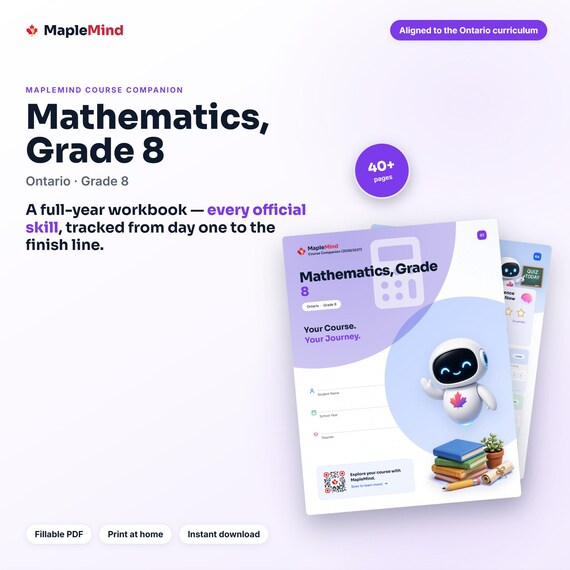
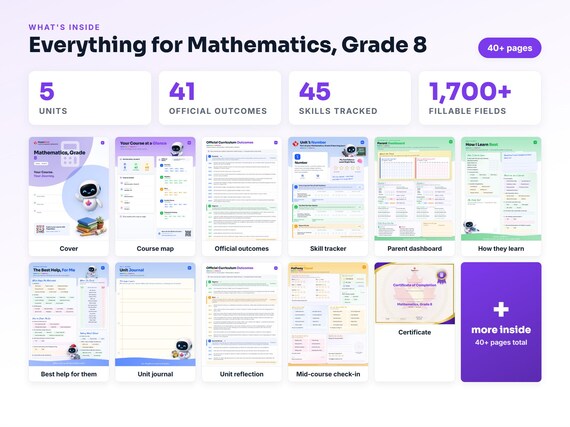

Printable workbook · A keepsake of the year
A Mathematics, Grade 8 workbook worth keeping
Built from the same official curriculum as this page. Before and after each skill above, your student colours in how sure they feel — so the two of you can see, on one page, what's clicking and what needs another look. It's a quiet way to follow how the year is really going.
By June it's full of their own handwriting: units worked through, confidence grown, a mid-year check-in, notes from parent-teacher night, and a certificate at the end. Less a worksheet, more a record of the year worth keeping on the shelf.
Instant download · see every page, reviews and the full description · five or more workbooks are $2.99 each
What it looks like in the app



Common questions
Can MapleMind help me with Mathematics, Grade 8?
Yes. MapleMind's AI tutor covers all 45 skills in Ontario's Mathematics, Grade 8 — you pick the exact skill, and the tutor teaches it step by step: a short lesson, a worked example, solving together, then a skill check to show it stuck.
Is MapleMind aligned to Ontario's official curriculum?
Yes. Every skill in this course maps to an official outcome code from Ontario's Grade 8 Mathematics curriculum, and the ministry's own wording is quoted under each unit on this page — with the official government source linked so you can check it yourself.
What does MapleMind cost?
It's free to start — 5 tutoring chats and a practice quiz every day, no credit card. A Pro subscription ($9.99/month or $49.99/year CAD, 7-day free trial) unlocks unlimited tutoring, practice, and exam simulations.
What if I'm stuck on just one topic?
That's the point of skill-level tutoring: open Mathematics, Grade 8 in the app, tap the exact skill from the list on this page, and the tutor teaches just that — no wading through lessons you don't need.
Does MapleMind work in French or other languages?
Yes — 14 languages, including French. Both the app and the tutor's explanations switch to the language you choose.
Where can I see the official Ontario curriculum for Mathematics, Grade 8?
The official source is linked on this page — Ontario's official mathematics curriculum. The outline here follows it: every MapleMind skill carries its official outcome code, and the ministry's own wording is quoted under each unit.
Keep exploring
Ready when you are
Pick a skill from this page and see it taught properly — free, in the browser, in under a minute.