Get help with Mathematics 8
Most tutoring makes you sit through material you already know. MapleMind flips that: pick the exact skill that's causing trouble — any of the 14 below — and the tutor teaches just that one, step by step, as many times as it takes. Ask questions in plain words, any time of day, in English, French, or 12 other languages.
The official British Columbia Mathematics 8 curriculum
British Columbia defines Mathematics 8 by strands and outcomes. MapleMind teaches the same curriculum reorganized for one-skill-at-a-time tutoring — the table shows exactly where every official strand lands, and the ministry's own wording is quoted under each unit below.
Official source BC's official mathematics curriculumRead it on the government site — curriculum.gov.bc.ca ↗| Official strand | Outcomes | Where MapleMind teaches it |
|---|---|---|
| Number | 5 | Number |
| Patterns | 3 | Patterns and Algebra |
| Geometry | 3 | Geometry and Measurement |
| Data | 2 | Data and Probability |
| Financial Literacy | 1 | Financial Literacy |
Every skill below, taught one on one.
 Try the first session free
How MapleMind teaches Mathematics 8 — every unit, lesson, and skill
Every skill below runs as a short session: a plain-words lesson, a worked example, solving it together, then a five-question skill check that earns up to three stars. Guided Mode keeps it teaching instead of answer-handing — turning it off needs a parent's password.
Unit 1NumberOfficial strand · Number
Big Idea: number represents and describes quantity. Squares, cubes and their roots, percents beyond the usual 0–100 range, proportional reasoning with rates and ratios, and all four operations with fractions.
Perfect Squares, Perfect Cubes, and Their Roots
- Perfect squares and perfect cubes8.C.1 — Recognize perfect squares (1, 4, 9, 16, 25…) and perfect cubes (1, 8, 27, 64…) as the result of multiplying a whole number by itself twice or three times, and connect them to square/cube area and volume models.
- Square roots and cube roots8.C.2 — Find the square root of a perfect square and the cube root of a perfect cube, and connect the root to "what side length makes this area/volume."
Percents Less Than 1% and Greater Than 100%
- Percents below 1% and above 100%8.C.3 — Interpret and calculate with percents outside the familiar 1–100 range — decimal percents like 0.5% and fractional percents like 150% or 250%, tying them back to their decimal and fraction equivalents.
Rates, Ratios, and Proportions
- Rates, ratios, proportions, and percent8.C.4 — Solve real problems involving rates (like km/h), ratios (comparing two quantities), proportions (equal ratios), and percent, moving fluently between these related representations.
All Four Operations with Fractions
- Adding, subtracting, multiplying, and dividing fractions8.C.5 — Add, subtract, multiply, and divide fractions (proper, improper, and mixed numbers) and apply the correct order of operations when a problem mixes more than one operation.
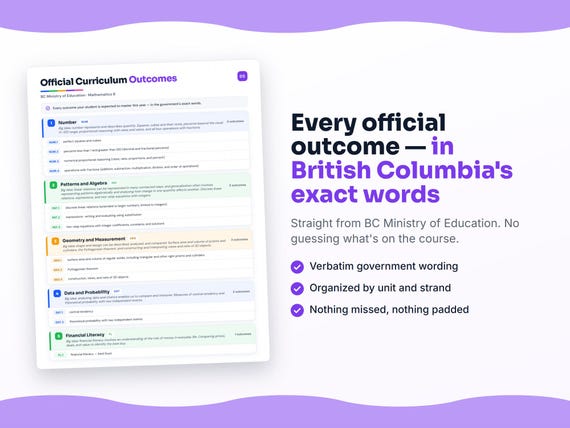
The official wording — 5 outcomes in this unit
- 8.C.1
perfect squares and cubes
- 8.C.2
square and cube roots
- 8.C.3
percents less than 1 and greater than 100 (decimal and fractional percents)
- 8.C.4
numerical proportional reasoning (rates, ratio, proportions, and percent)
- 8.C.5
operations with fractions (addition, subtraction, multiplication, division, and order of operations)
Unit 2Patterns and AlgebraOfficial strand · Patterns
Big Idea: linear relations can be represented in many connected ways, and generalization often involves representing patterns algebraically and analyzing how change in one quantity affects another. Discrete linear relations, expressions, and two-step equations with integers.
Discrete Linear Relations with Integers
- Linear relations with integers8.C.6 — Represent and extend a discrete linear relation (a pattern with a constant rate of change) using tables, graphs, and rules, now including negative numbers and larger values.
Writing and Evaluating Expressions
- Writing and evaluating expressions8.C.7 — Write an algebraic expression to represent a situation, and evaluate an expression by substituting given values for the variable(s), following order of operations.
Two-Step Equations with Integers
- Solving two-step equations with integers8.C.8 — Solve two-step linear equations where the coefficients, constants, and solutions can be integers (positive or negative), using inverse operations in the correct order.
The official wording — 3 outcomes in this unit
- 8.C.6
discrete linear relations (extended to larger numbers, limited to integers)
- 8.C.7
expressions- writing and evaluating using substitution
- 8.C.8
two-step equations with integer coefficients, constants, and solutions
Unit 3Geometry and MeasurementOfficial strand · Geometry
Big Idea: shape and design can be described, analyzed, and compared. Surface area and volume of prisms and cylinders, the Pythagorean theorem, and constructing and interpreting views and nets of 3D objects.
Surface Area and Volume of Prisms and Cylinders
- Surface area and volume of regular solids8.C.9 — Calculate the surface area and volume of regular solids, including triangular and other right prisms and cylinders, by decomposing them into their flat faces and cross-sections.
The Pythagorean Theorem
- The Pythagorean theorem8.C.10 — Use the Pythagorean theorem (a² + b² = c²) to find an unknown side length of a right triangle, and recognize that it only applies to right triangles.
Construction, Views, and Nets of 3D Objects
- Building and viewing 3D objects, and their nets8.C.11 — Build 3D objects from given views (top, front, side), sketch the views of a given 3D object, and identify or construct the net (unfolded flat pattern) that folds into a given solid.
The official wording — 3 outcomes in this unit
- 8.C.9
surface area and volume of regular solids, including triangular and other right prisms and cylinders
- 8.C.10
Pythagorean theorem
- 8.C.11
construction, views, and nets of 3D objects
Unit 4Data and ProbabilityOfficial strand · Data
Big Idea: analyzing data and chance enables us to compare and interpret. Measures of central tendency and theoretical probability with two independent events.
Mean, Median, and Mode
- Central tendency8.C.12 — Calculate and interpret the mean, median, and mode of a data set, and decide which measure best describes the data in a given situation.
Theoretical Probability of Two Independent Events
- Theoretical probability with two independent events8.C.13 — Calculate the theoretical probability of two independent events (where one event does not affect the other) by reasoning about all possible outcomes, such as with a table or tree diagram.
The official wording — 2 outcomes in this unit
- 8.C.12
central tendency
- 8.C.13
theoretical probability with two independent events
Unit 5Financial LiteracyOfficial strand · Financial Literacy
Big Idea: financial literacy involves an understanding of the role of money in everyday life. Comparing prices, deals, and value to identify the best buy.
Finding the Best Buy
- Best buys8.C.14 — Compare unit prices, sale prices, and package sizes to determine which option is the "best buy" — the best value for money — using proportional reasoning.
The official wording — 1 outcome in this unit
- 8.C.14
financial literacy — best buys
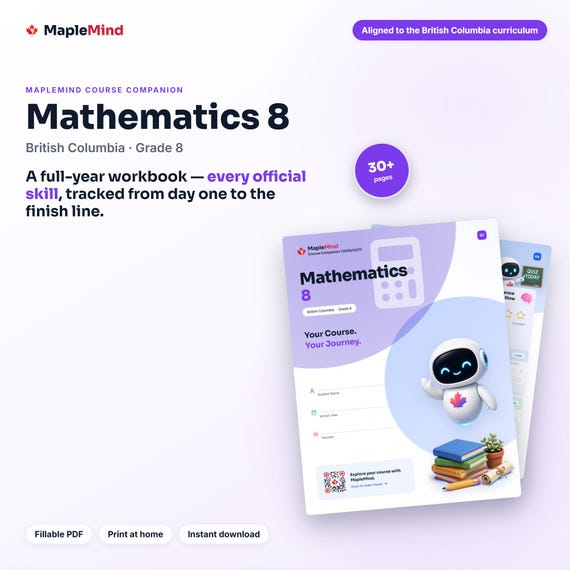
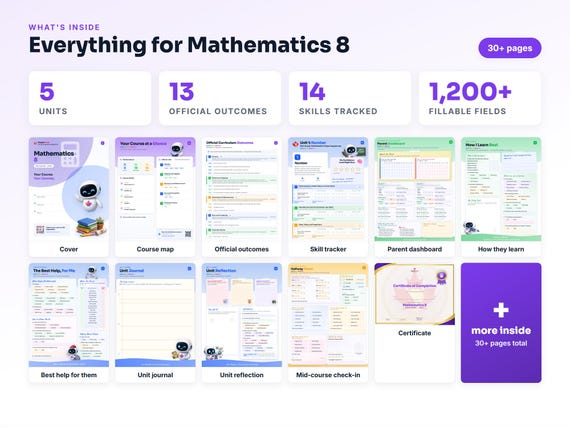
Printable workbook · A keepsake of the year
A Mathematics 8 workbook worth keeping
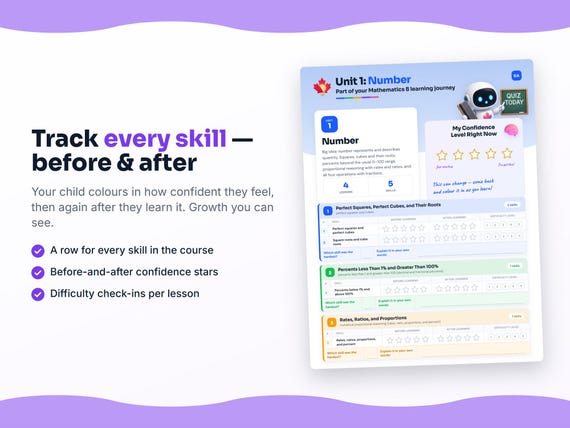
Built from the same official curriculum as this page. Before and after each skill above, your student colours in how sure they feel — so the two of you can see, on one page, what's clicking and what needs another look. It's a quiet way to follow how the year is really going.
By June it's full of their own handwriting: units worked through, confidence grown, a mid-year check-in, notes from parent-teacher night, and a certificate at the end. Less a worksheet, more a record of the year worth keeping on the shelf.
Instant download · see every page, reviews and the full description · five or more workbooks are $2.99 each
What it looks like in the app



Common questions
Can MapleMind help me with Mathematics 8?
Yes. MapleMind's AI tutor covers all 14 skills in British Columbia's Mathematics 8 — you pick the exact skill, and the tutor teaches it step by step: a short lesson, a worked example, solving together, then a skill check to show it stuck.
Is MapleMind aligned to British Columbia's official curriculum?
Yes. Every skill in this course maps to an official outcome code from British Columbia's Grade 8 Mathematics curriculum, and the ministry's own wording is quoted under each unit on this page — with the official government source linked so you can check it yourself.
What does MapleMind cost?
It's free to start — 5 tutoring chats and a practice quiz every day, no credit card. A Pro subscription ($9.99/month or $49.99/year CAD, 7-day free trial) unlocks unlimited tutoring, practice, and exam simulations.
What if I'm stuck on just one topic?
That's the point of skill-level tutoring: open Mathematics 8 in the app, tap the exact skill from the list on this page, and the tutor teaches just that — no wading through lessons you don't need.
Does MapleMind work in French or other languages?
Yes — 14 languages, including French. Both the app and the tutor's explanations switch to the language you choose.
Where can I see the official British Columbia curriculum for Mathematics 8?
The official source is linked on this page — BC's official mathematics curriculum. The outline here follows it: every MapleMind skill carries its official outcome code, and the ministry's own wording is quoted under each unit.
Keep exploring
Ready when you are
Pick a skill from this page and see it taught properly — free, in the browser, in under a minute.