Get help with Mathematics 9
Most tutoring makes you sit through material you already know. MapleMind flips that: pick the exact skill that's causing trouble — any of the 22 below — and the tutor teaches just that one, step by step, as many times as it takes. Ask questions in plain words, any time of day, in English, French, or 12 other languages.
The official British Columbia Mathematics 9 curriculum
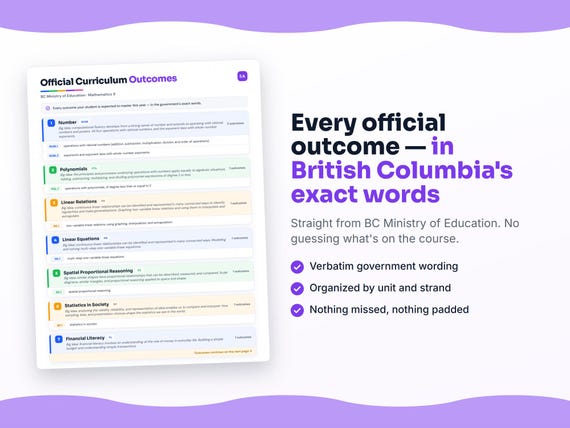
British Columbia defines Mathematics 9 by strands and outcomes. MapleMind teaches the same curriculum reorganized for one-skill-at-a-time tutoring — the table shows exactly where every official strand lands, and the ministry's own wording is quoted under each unit below.
Official source BC's official mathematics curriculumRead it on the government site — curriculum.gov.bc.ca ↗| Official strand | Outcomes | Where MapleMind teaches it |
|---|---|---|
| Number | 2 | Number |
| Algebra | 1 | Polynomials |
| Patterns and Relations | 2 | Linear Relations · Linear Equations |
| Shape and Space | 1 | Spatial Proportional Reasoning |
| Statistics and Probability | 1 | Statistics in Society |
| Financial Literacy | 1 | Financial Literacy |
Every skill below, taught one on one.
 Try the first session free
How MapleMind teaches Mathematics 9 — every unit, lesson, and skill
Every skill below runs as a short session: a plain-words lesson, a worked example, solving it together, then a five-question skill check that earns up to three stars. Guided Mode keeps it teaching instead of answer-handing — turning it off needs a parent's password.
Unit 1NumberOfficial strand · Number
Big Idea: computational fluency develops from a strong sense of number and extends to operating with rational numbers and powers. All four operations with rational numbers, and the exponent laws with whole-number exponents.
Operations with Rational Numbers
- Adding and subtracting rational numbers9.C.1 — Add and subtract positive and negative rational numbers — fractions, decimals, and mixed numbers — using a number line or the rule for combining signs.
- Multiplying and dividing rational numbers9.C.1 — Multiply and divide positive and negative rational numbers, and predict the sign of the result before calculating.
- Order of operations with rational numbers9.C.1 — Apply the order of operations to multi-step expressions that combine rational numbers, brackets, and more than one operation.
Exponents and the Exponent Laws
- What a whole-number exponent means9.C.2 — Read and write powers with whole-number exponents, connect a power to repeated multiplication, and evaluate powers with rational bases.
- The product and quotient laws9.C.2 — Multiply powers with the same base by adding exponents, and divide powers with the same base by subtracting exponents.
- The power-of-a-power law9.C.2 — Simplify an expression like (a^m)^n by multiplying the exponents, and combine two or more exponent laws in one problem.
The official wording — 2 outcomes in this unit
- 9.C.1
operations with rational numbers (addition, subtraction, multiplication, division, and order of operations)
- 9.C.2
exponents and exponent laws with whole-number exponents
Unit 2PolynomialsOfficial strand · Algebra
Big Idea: the principles and processes underlying operations with numbers apply equally to algebraic situations. Adding, subtracting, multiplying, and dividing polynomial expressions of degree 2 or less.
Operations with Polynomials
- Adding and subtracting polynomials9.C.3 — Add and subtract polynomial expressions of degree 2 or less by combining like terms, using algebra tiles or symbols.
- Multiplying a polynomial by a monomial9.C.3 — Multiply a polynomial expression of degree 2 or less by a monomial, distributing the multiplication across every term.
- Dividing a polynomial by a monomial9.C.3 — Divide a polynomial expression of degree 2 or less by a monomial, dividing every term by the same monomial.
The official wording — 1 outcome in this unit
- 9.C.3
operations with polynomials, of degree less than or equal to 2
Unit 3Linear RelationsOfficial strand · Patterns and Relations
Big Idea: continuous linear relationships can be identified and represented in many connected ways to identify regularities and make generalizations. Graphing two-variable linear relations and using them to interpolate and extrapolate.
Graphing Two-Variable Linear Relations
- From a table of values to a graph9.C.4 — Build a table of values for a two-variable linear relation and plot the points to see the straight-line pattern.
- Interpolating between plotted points9.C.4 — Use a graphed linear relation to estimate a value between two plotted points (interpolation) and check it makes sense in context.
- Extrapolating beyond plotted points9.C.4 — Use a graphed linear relation to predict a value beyond the plotted points (extrapolation), and recognize when a prediction becomes unreliable.
The official wording — 1 outcome in this unit
- 9.C.4
two-variable linear relations, using graphing, interpolation, and extrapolation
Unit 4Linear EquationsOfficial strand · Patterns and Relations
Big Idea: continuous linear relationships can be identified and represented in many connected ways. Modelling and solving multi-step one-variable linear equations.
Solving Multi-Step Linear Equations
- Equations with the variable on both sides9.C.5 — Solve a multi-step one-variable linear equation where the variable appears on both sides, using inverse operations in a consistent order.
- Equations with brackets9.C.5 — Expand brackets in a one-variable linear equation before solving it in multiple steps.
- Modelling a real situation with an equation9.C.5 — Translate a real, multi-step problem situation into a one-variable linear equation, solve it, and check the answer against the original situation.
The official wording — 1 outcome in this unit
- 9.C.5
multi-step one-variable linear equations
Unit 5Spatial Proportional ReasoningOfficial strand · Shape and Space
Big Idea: similar shapes have proportional relationships that can be described, measured, and compared. Scale diagrams, similar triangles, and proportional reasoning applied to space and shape.
Scale Diagrams and Similar Shapes
- Scale factor in scale diagrams9.C.6 — Determine the scale factor of an enlargement or reduction from a scale diagram, and use it to find an unknown length.
- Similar triangles and proportional sides9.C.6 — Recognize similar triangles by their proportional corresponding sides and equal corresponding angles, and set up a proportion to solve for a missing side.
- Solving real problems with proportional reasoning9.C.6 — Apply scale factors and similar-shape proportions to real spatial problems, such as scale models, floor plans, or map distances.
The official wording — 1 outcome in this unit
- 9.C.6
spatial proportional reasoning
Unit 6Statistics in SocietyOfficial strand · Statistics and Probability
Big Idea: analyzing the validity, reliability, and representation of data enables us to compare and interpret. How sampling, bias, and presentation choices shape the statistics we see in the world.
Evaluating Statistics in Society
- Sampling methods and bias9.C.7 — Describe how a sample is chosen and identify sources of bias that can make a statistic unreliable, such as a non-representative sample or a leading survey question.
- Interpreting statistics reported in the media9.C.7 — Interpret statistics reported in news, advertising, or social media, questioning how the data was collected and whether the graph or claim fairly represents it.
The official wording — 1 outcome in this unit
- 9.C.7
statistics in society
Unit 7Financial LiteracyOfficial strand · Financial Literacy
Big Idea: financial literacy involves an understanding of the role of money in everyday life. Building a simple budget and understanding simple transactions.
Simple Budgets and Transactions
- Building a simple budget9.C.8 — Build a simple budget that tracks income against expenses over a period of time, and adjust it so spending does not exceed income.
- Simple transactions9.C.8 — Work through simple financial transactions — deposits, withdrawals, and purchases — and keep an accurate running balance.
The official wording — 1 outcome in this unit
- 9.C.8
financial literacy
Printable workbook · A keepsake of the year
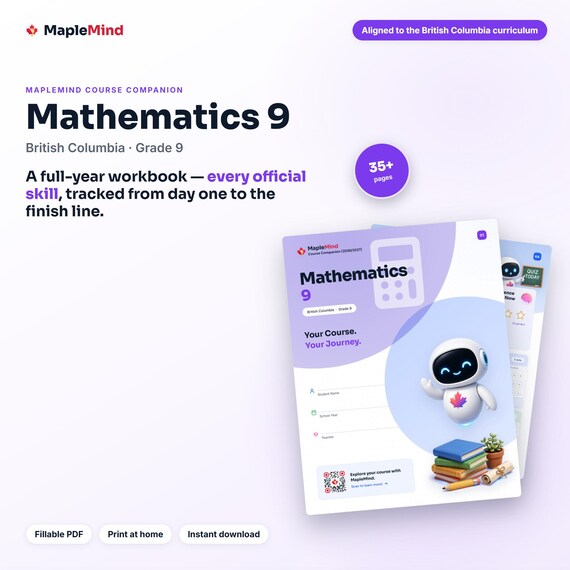
A Mathematics 9 workbook worth keeping
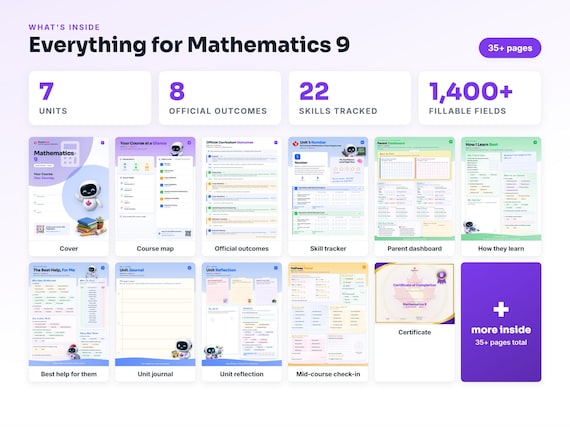
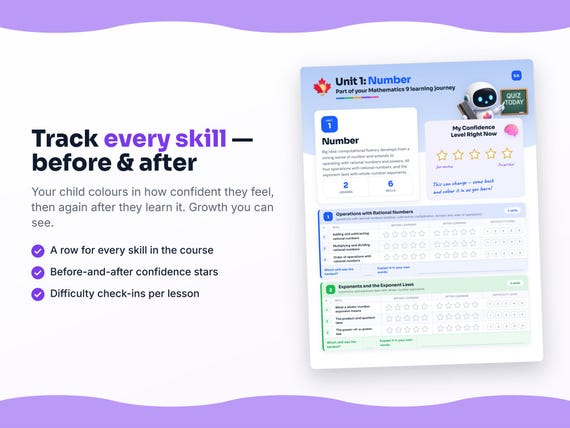
Built from the same official curriculum as this page. Before and after each skill above, your student colours in how sure they feel — so the two of you can see, on one page, what's clicking and what needs another look. It's a quiet way to follow how the year is really going.
By June it's full of their own handwriting: units worked through, confidence grown, a mid-year check-in, notes from parent-teacher night, and a certificate at the end. Less a worksheet, more a record of the year worth keeping on the shelf.
Instant download · see every page, reviews and the full description · five or more workbooks are $2.99 each
What it looks like in the app



Common questions
Can MapleMind help me with Mathematics 9?
Yes. MapleMind's AI tutor covers all 22 skills in British Columbia's Mathematics 9 — you pick the exact skill, and the tutor teaches it step by step: a short lesson, a worked example, solving together, then a skill check to show it stuck.
Is MapleMind aligned to British Columbia's official curriculum?
Yes. Every skill in this course maps to an official outcome code from British Columbia's Grade 9 Mathematics curriculum, and the ministry's own wording is quoted under each unit on this page — with the official government source linked so you can check it yourself.
What does MapleMind cost?
It's free to start — 5 tutoring chats and a practice quiz every day, no credit card. A Pro subscription ($9.99/month or $49.99/year CAD, 7-day free trial) unlocks unlimited tutoring, practice, and exam simulations.
What if I'm stuck on just one topic?
That's the point of skill-level tutoring: open Mathematics 9 in the app, tap the exact skill from the list on this page, and the tutor teaches just that — no wading through lessons you don't need.
Does MapleMind work in French or other languages?
Yes — 14 languages, including French. Both the app and the tutor's explanations switch to the language you choose.
Where can I see the official British Columbia curriculum for Mathematics 9?
The official source is linked on this page — BC's official mathematics curriculum. The outline here follows it: every MapleMind skill carries its official outcome code, and the ministry's own wording is quoted under each unit.
Keep exploring
Ready when you are
Pick a skill from this page and see it taught properly — free, in the browser, in under a minute.