Get help with Foundations of Mathematics and Pre-calculus 10
Most tutoring makes you sit through material you already know. MapleMind flips that: pick the exact skill that's causing trouble — any of the 23 below — and the tutor teaches just that one, step by step, as many times as it takes. Ask questions in plain words, any time of day, in English, French, or 12 other languages.
The official British Columbia Foundations of Mathematics and Pre-calculus 10 curriculum
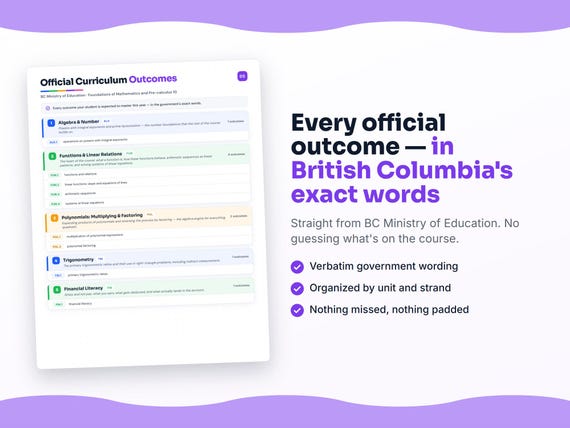
British Columbia defines Foundations of Mathematics and Pre-calculus 10 by strands and outcomes. MapleMind teaches the same curriculum reorganized for one-skill-at-a-time tutoring — the table shows exactly where every official strand lands, and the ministry's own wording is quoted under each unit below.
Official source BC's official mathematics curriculumRead it on the government site — curriculum.gov.bc.ca ↗| Official strand | Outcomes | Where MapleMind teaches it |
|---|---|---|
| Strand AN | 2 | Algebra & Number |
| Strand FR | 4 | Functions & Linear Relations |
| Strand P | 2 | Polynomials: Multiplying & Factoring |
| Strand T | 1 | Trigonometry |
| Strand FL | 1 | Financial Literacy |
Every skill below, taught one on one.
 Try the first session free
How MapleMind teaches Foundations of Mathematics and Pre-calculus 10 — every unit, lesson, and skill
Every skill below runs as a short session: a plain-words lesson, a worked example, solving it together, then a five-question skill check that earns up to three stars. Guided Mode keeps it teaching instead of answer-handing — turning it off needs a parent's password.
Unit 1Algebra & NumberOfficial strand · Strand AN
Powers with integral exponents and prime factorization — the number foundations that the rest of the course builds on.
Powers & the Exponent Laws
- Powers with positive and negative exponentsfpc10.10.C.1 — Evaluate powers with integral (positive, negative, and zero) exponents, using order of operations, with numerical bases.
- The exponent laws with numerical and variable basesfpc10.10.C.1 — Apply the exponent laws (product, quotient, power of a power) to expressions with numerical and variable bases.
- Prime factorization, GCF, and LCMfpc10.10.C.2 — Express the prime factorization of a number using powers, and use it to find greatest common factors and least common multiples.
The official wording — 2 outcomes in this unit
- fpc10.10.C.1
operations on powers with integral exponents
- fpc10.10.C.2
prime factorization
Unit 2Functions & Linear RelationsOfficial strand · Strand FR
The heart of the course: what a function is, how linear functions behave, arithmetic sequences as linear patterns, and solving systems of linear equations.
Relations, Functions & Function Notation
- Is it a function? Relations and the function ideafpc10.10.C.3 — Understand what makes a relation a function and identify functions from graphs, tables, and sets of ordered pairs.
- Function notation, domain, and rangefpc10.10.C.3 — Use f(x) notation to evaluate functions, and state domain and range in situational and non-situational contexts.
- Connecting graphs, data, and situationsfpc10.10.C.3 — Connect graphs with the situations and data they represent, interpreting features of a graph in context.
Linear Functions: Slope & Equations of Lines
- Slope: positive, negative, zero, and undefinedfpc10.10.C.4 — Determine the slope of a line from a graph or two points, including the special cases of horizontal and vertical lines.
- Equations of lines: slope-intercept, point-slope, and general formfpc10.10.C.4 — Write and convert between the slope-intercept, point-slope, and general forms of a linear equation, connecting graphs, tables, and equations.
- Parallel, perpendicular, horizontal, and vertical linesfpc10.10.C.4 — Write equations of lines parallel or perpendicular to a given line, and equations of horizontal and vertical lines.
Arithmetic Sequences
- Common difference and the general termfpc10.10.C.5 — Identify the first term and common difference of an arithmetic sequence and use the general term to find any term.
- Connecting sequences to linear functionsfpc10.10.C.5 — Connect arithmetic sequences to linear functions, seeing the common difference as slope and the sequence as a discrete line.
Systems of Linear Equations
- Solving systems graphically and reading the solutionfpc10.10.C.6 — Solve systems of two linear equations graphically and interpret the intersection point as the solution.
- Substitution and eliminationfpc10.10.C.6 — Solve systems of linear equations algebraically by inspection, substitution, and elimination.
- Systems in situational contextsfpc10.10.C.6 — Model situations with systems of linear equations and interpret the solution in the context.
The official wording — 4 outcomes in this unit
- fpc10.10.C.3
functions and relations
- fpc10.10.C.4
linear functions: slope and equations of lines
- fpc10.10.C.5
arithmetic sequences
- fpc10.10.C.6
systems of linear equations
Unit 3Polynomials: Multiplying & FactoringOfficial strand · Strand P
Expanding products of polynomials and reversing the process by factoring — the algebra engine for everything quadratic.
Multiplying Polynomial Expressions
- Multiplying binomials with the area modelfpc10.10.C.7 — Multiply two binomials using the distributive property, connected to the area model.
- Products with trinomialsfpc10.10.C.7 — Apply the distributive property to products involving trinomials and collect like terms.
Polynomial Factoring
- Greatest common factor of a polynomialfpc10.10.C.8 — Factor polynomials by removing the greatest common factor.
- Factoring trinomials and the difference of squaresfpc10.10.C.8 — Factor simple trinomials of the form x^2 + bx + c and differences of squares.
The official wording — 2 outcomes in this unit
- fpc10.10.C.7
multiplication of polynomial expressions
- fpc10.10.C.8
polynomial factoring
Unit 4TrigonometryOfficial strand · Strand T
The primary trigonometric ratios and their use in right-triangle problems, including indirect measurement.
The Primary Trigonometric Ratios
- Sine, cosine, and tangent in right trianglesfpc10.10.C.9 — Define and compute the sine, cosine, and tangent ratios for acute angles in right triangles.
- Finding missing sides and anglesfpc10.10.C.9 — Determine missing sides and angles of right triangles using trigonometric ratios and the Pythagorean theorem.
- Direct and indirect measurementfpc10.10.C.9 — Solve contextual problems using trigonometry for indirect measurement.
The official wording — 1 outcome in this unit
- fpc10.10.C.9
primary trigonometric ratios
Unit 5Financial LiteracyOfficial strand · Strand FL
Gross and net pay: what you earn, what gets deducted, and what actually lands in the account.
Gross Pay, Deductions & Net Pay
- Types of income and calculating gross payfpc10.10.C.10 — Calculate gross pay for different types of income, including hourly wages, salary, commission, and overtime.
- Deductions and net payfpc10.10.C.10 — Determine net pay by applying income tax and other deductions to gross pay.
The official wording — 1 outcome in this unit
- fpc10.10.C.10
financial literacy
Printable workbook · A keepsake of the year
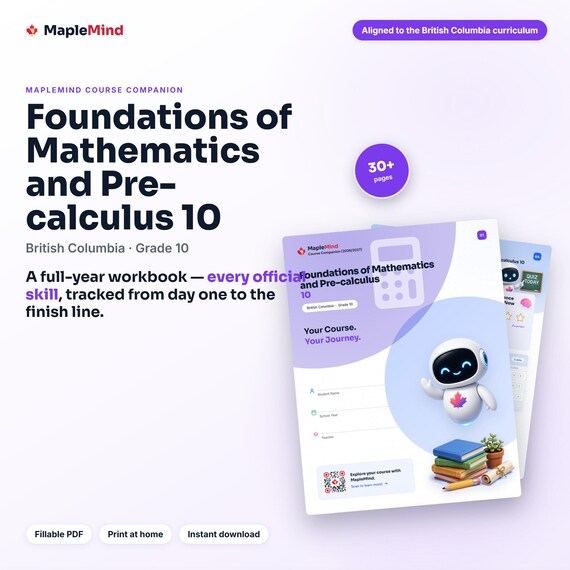
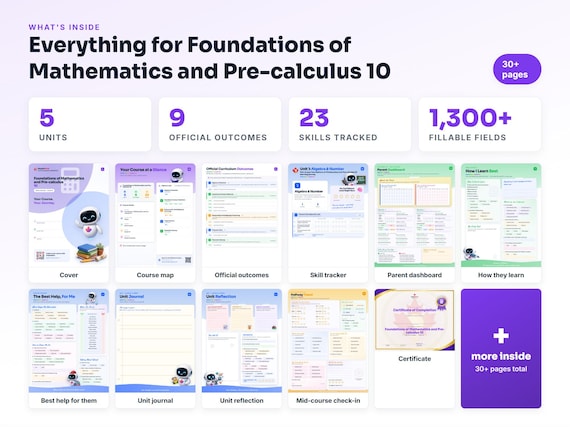
A Foundations of Mathematics and Pre-calculus 10 workbook worth keeping
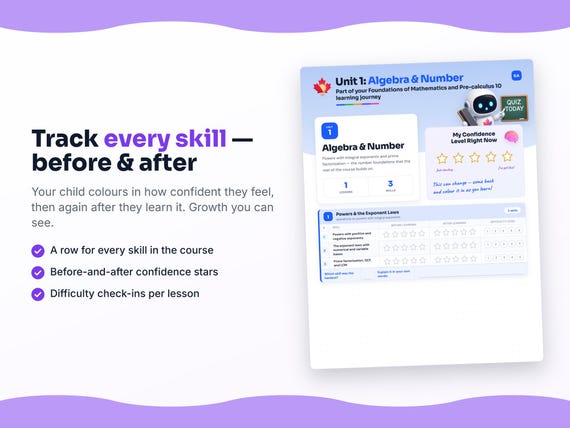
Built from the same official curriculum as this page. Before and after each skill above, your student colours in how sure they feel — so the two of you can see, on one page, what's clicking and what needs another look. It's a quiet way to follow how the year is really going.
By June it's full of their own handwriting: units worked through, confidence grown, a mid-year check-in, notes from parent-teacher night, and a certificate at the end. Less a worksheet, more a record of the year worth keeping on the shelf.
Instant download · see every page, reviews and the full description · five or more workbooks are $2.99 each
What it looks like in the app



Preparing for the Grade 10 Numeracy Assessment?
BC's Grade 10 Numeracy Assessment is a graduation requirement. MapleMind simulates it from this course and shows which skills need another pass.
Common questions
Can MapleMind help me with Foundations of Mathematics and Pre-calculus 10?
Yes. MapleMind's AI tutor covers all 23 skills in British Columbia's Foundations of Mathematics and Pre-calculus 10 — you pick the exact skill, and the tutor teaches it step by step: a short lesson, a worked example, solving together, then a skill check to show it stuck.
Is MapleMind aligned to British Columbia's official curriculum?
Yes. Every skill in this course maps to an official outcome code from British Columbia's Grade 10 Mathematics curriculum, and the ministry's own wording is quoted under each unit on this page — with the official government source linked so you can check it yourself.
What does MapleMind cost?
It's free to start — 5 tutoring chats and a practice quiz every day, no credit card. A Pro subscription ($9.99/month or $49.99/year CAD, 7-day free trial) unlocks unlimited tutoring, practice, and exam simulations.
What if I'm stuck on just one topic?
That's the point of skill-level tutoring: open Foundations of Mathematics and Pre-calculus 10 in the app, tap the exact skill from the list on this page, and the tutor teaches just that — no wading through lessons you don't need.
Does MapleMind work in French or other languages?
Yes — 14 languages, including French. Both the app and the tutor's explanations switch to the language you choose.
Where can I see the official British Columbia curriculum for Foundations of Mathematics and Pre-calculus 10?
The official source is linked on this page — BC's official mathematics curriculum. The outline here follows it: every MapleMind skill carries its official outcome code, and the ministry's own wording is quoted under each unit.
Does MapleMind help with the Grade 10 Numeracy Assessment?
Yes. BC's Grade 10 Numeracy Assessment is a graduation requirement. MapleMind simulates it from this course and shows which skills need another pass.
Keep exploring
Ready when you are
Pick a skill from this page and see it taught properly — free, in the browser, in under a minute.