Get help with Foundations of Mathematics 11
Most tutoring makes you sit through material you already know. MapleMind flips that: pick the exact skill that's causing trouble — any of the 14 below — and the tutor teaches just that one, step by step, as many times as it takes. Ask questions in plain words, any time of day, in English, French, or 12 other languages.
The official British Columbia Foundations of Mathematics 11 curriculum
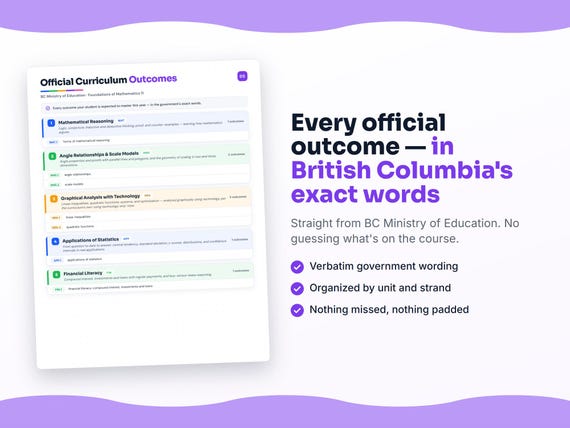
British Columbia defines Foundations of Mathematics 11 by strands and outcomes. MapleMind teaches the same curriculum reorganized for one-skill-at-a-time tutoring — the table shows exactly where every official strand lands, and the ministry's own wording is quoted under each unit below.
Official source BC's official mathematics curriculumRead it on the government site — curriculum.gov.bc.ca ↗| Official strand | Outcomes | Where MapleMind teaches it |
|---|---|---|
| Strand R | 1 | Mathematical Reasoning |
| Strand G | 2 | Angle Relationships & Scale Models |
| Strand GA | 4 | Graphical Analysis with Technology |
| Strand S | 1 | Applications of Statistics |
| Strand FL | 1 | Financial Literacy |
Every skill below, taught one on one.
 Try the first session free
How MapleMind teaches Foundations of Mathematics 11 — every unit, lesson, and skill
Every skill below runs as a short session: a plain-words lesson, a worked example, solving it together, then a five-question skill check that earns up to three stars. Guided Mode keeps it teaching instead of answer-handing — turning it off needs a parent's password.
Unit 1Mathematical ReasoningOfficial strand · Strand R
Logic, conjecture, inductive and deductive thinking, proof, and counter-examples — learning how mathematics argues.
Inductive & Deductive Reasoning, Conjectures & Proof
- Inductive reasoning, conjectures, and counter-examplesfm11.11.C.1 — Use inductive reasoning to form conjectures from patterns and test them, using counter-examples to disprove.
- Deductive reasoning and prooffm11.11.C.1 — Use deductive reasoning to prove conjectures, including simple algebraic and logical proofs and puzzle analysis.
The official wording — 1 outcome in this unit
- fm11.11.C.1
forms of mathematical reasoning
Unit 2Angle Relationships & Scale ModelsOfficial strand · Strand G
Angle properties and proofs with parallel lines and polygons, and the geometry of scaling in two and three dimensions.
Angle Relationships & Proofs
- Angles with parallel linesfm11.11.C.2 — Apply and prove angle properties formed by parallel lines and transversals.
- Angles in triangles and polygonsfm11.11.C.2 — Apply and prove angle properties in triangles and other polygons, including interior and exterior angle sums.
Scale Models & the Square-Cube Law
- Enlargements, reductions, and similar objectsfm11.11.C.8 — Create and analyze enlargements and reductions of 2-D shapes and 3-D objects, comparing lengths, areas, and volumes of similar objects.
- The square-cube law in the real worldfm11.11.C.8 — Apply the square-cube law to explain real phenomena where area-dependent and volume-dependent quantities scale differently.
The official wording — 2 outcomes in this unit
- fm11.11.C.2
angle relationships
- fm11.11.C.8
scale models
Unit 3Graphical Analysis with TechnologyOfficial strand · Strand GA
Linear inequalities, quadratic functions, systems, and optimization — analyzed graphically using technology, per the curriculum's own 'using technology only' note.
Graphing Linear Inequalities
- Solution regions of linear inequalitiesfm11.11.C.3 — Graph linear inequalities with technology, interpreting solution regions, boundary lines, and intersection points.
Quadratic Functions & Systems (Technology)
- Analyzing quadratic function graphsfm11.11.C.4 — Analyze characteristics of quadratic function graphs using technology: vertex, intercepts, symmetry, maximum/minimum, and end behaviour.
- Systems: linear-quadratic and quadratic-quadraticfm11.11.C.5 — Solve systems of equations graphically with technology, including linear-linear, linear-quadratic, and quadratic-quadratic systems.
- Optimization with feasible regionsfm11.11.C.6 — Optimize an objective function over a feasible region defined by constraints, in profit/cost and area/perimeter contexts.
The official wording — 4 outcomes in this unit
- fm11.11.C.3
linear inequalities
- fm11.11.C.4
quadratic functions
- fm11.11.C.5
systems of equations
- fm11.11.C.6
optimization
Unit 4Applications of StatisticsOfficial strand · Strand S
From question to data to answer: central tendency, standard deviation, z-scores, distributions, and confidence intervals in real applications.
Standard Deviation, Distributions & Confidence
- Measuring spread: standard deviationfm11.11.C.7 — Interpret and compare data sets using measures of central tendency and standard deviation.
- Z-scores, the normal distribution, and confidence intervalsfm11.11.C.7 — Use z-scores and normal distributions to interpret data, and understand confidence intervals in reported statistics.
The official wording — 1 outcome in this unit
- fm11.11.C.7
applications of statistics
Unit 5Financial LiteracyOfficial strand · Strand FL
Compound interest, investments and loans with regular payments, and buy-versus-lease reasoning.
Compound Interest, Investments, Loans & Buy-vs-Lease
- Compound interestfm11.11.C.9 — Calculate compound interest with A = P(1 + i)^n across compounding frequencies.
- Regular payments and buy-vs-leasefm11.11.C.9 — Analyze investments and loans with regular payments using technology, and compare buying versus leasing.
The official wording — 1 outcome in this unit
- fm11.11.C.9
financial literacy: compound interest, investments and loans
Printable workbook · A keepsake of the year
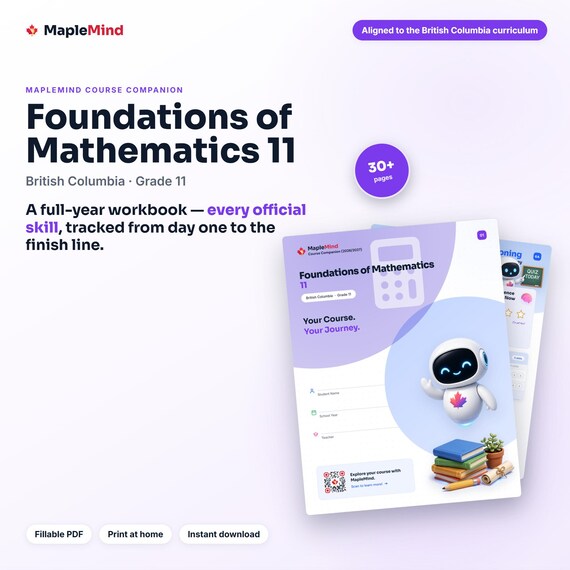
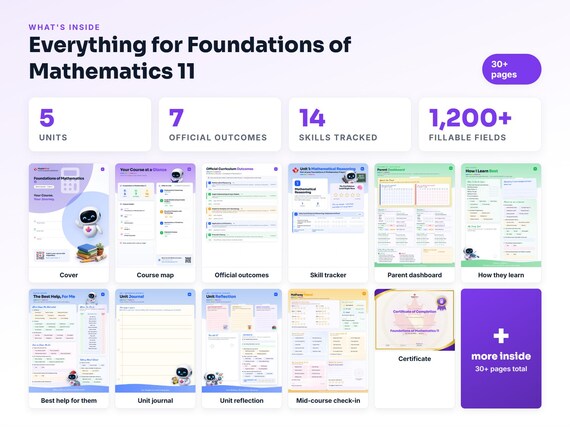
A Foundations of Mathematics 11 workbook worth keeping
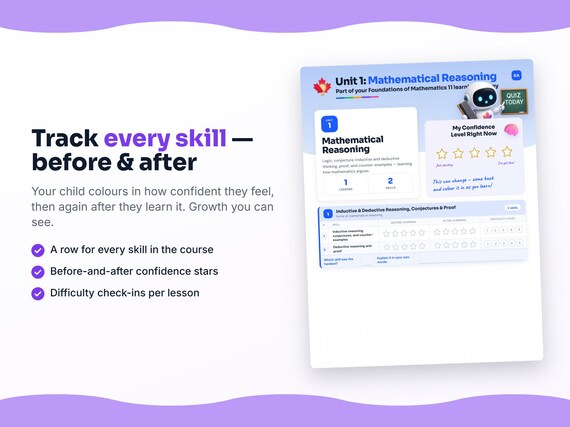
Built from the same official curriculum as this page. Before and after each skill above, your student colours in how sure they feel — so the two of you can see, on one page, what's clicking and what needs another look. It's a quiet way to follow how the year is really going.
By June it's full of their own handwriting: units worked through, confidence grown, a mid-year check-in, notes from parent-teacher night, and a certificate at the end. Less a worksheet, more a record of the year worth keeping on the shelf.
Instant download · see every page, reviews and the full description · five or more workbooks are $2.99 each
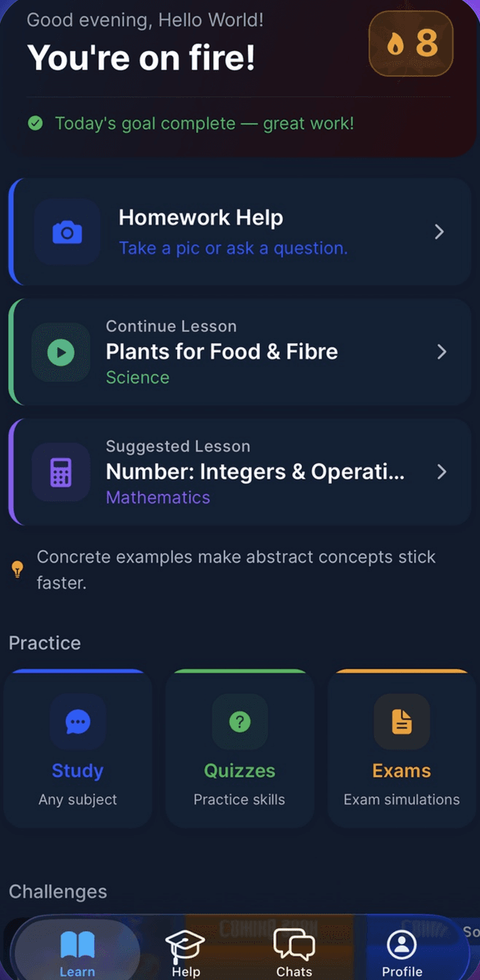
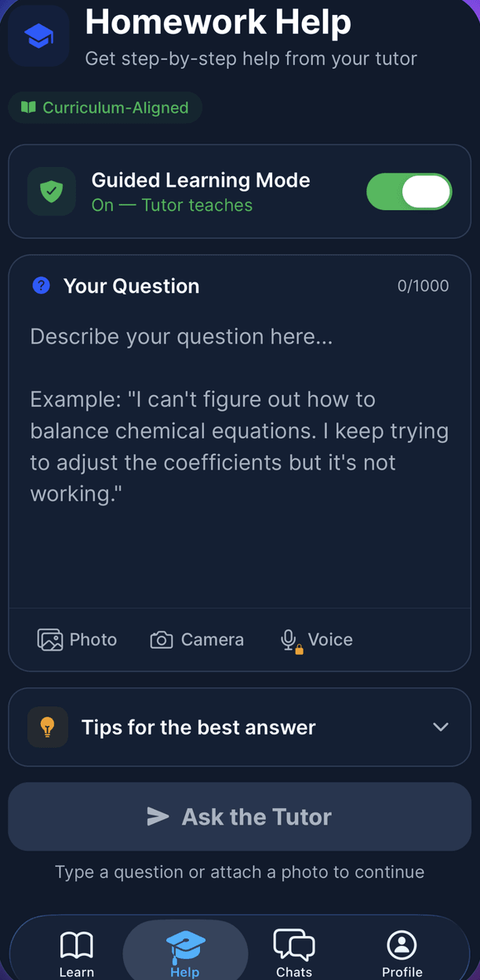
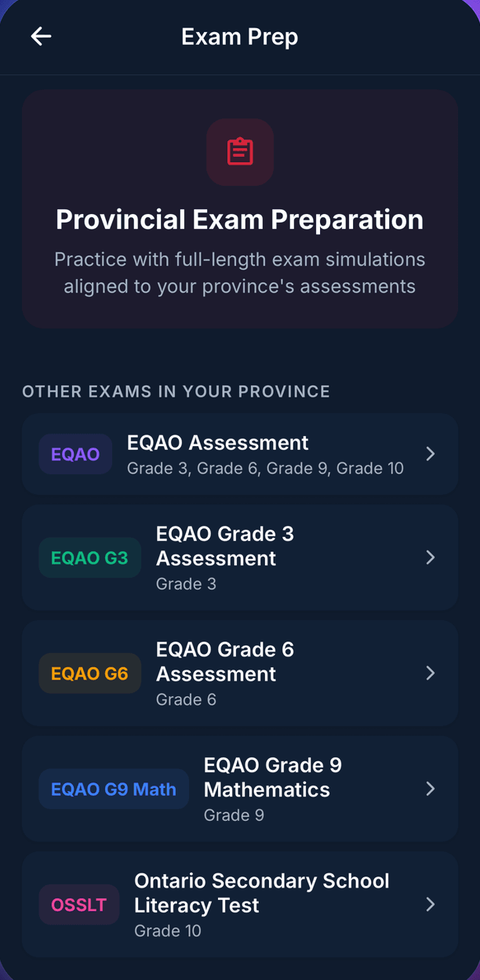
What it looks like in the app
Common questions
Can MapleMind help me with Foundations of Mathematics 11?
Yes. MapleMind's AI tutor covers all 14 skills in British Columbia's Foundations of Mathematics 11 — you pick the exact skill, and the tutor teaches it step by step: a short lesson, a worked example, solving together, then a skill check to show it stuck.
Is MapleMind aligned to British Columbia's official curriculum?
Yes. Every skill in this course maps to an official outcome code from British Columbia's Grade 11 Mathematics curriculum, and the ministry's own wording is quoted under each unit on this page — with the official government source linked so you can check it yourself.
What does MapleMind cost?
It's free to start — 5 tutoring chats and a practice quiz every day, no credit card. A Pro subscription ($9.99/month or $49.99/year CAD, 7-day free trial) unlocks unlimited tutoring, practice, and exam simulations.
What if I'm stuck on just one topic?
That's the point of skill-level tutoring: open Foundations of Mathematics 11 in the app, tap the exact skill from the list on this page, and the tutor teaches just that — no wading through lessons you don't need.
Does MapleMind work in French or other languages?
Yes — 14 languages, including French. Both the app and the tutor's explanations switch to the language you choose.
Where can I see the official British Columbia curriculum for Foundations of Mathematics 11?
The official source is linked on this page — BC's official mathematics curriculum. The outline here follows it: every MapleMind skill carries its official outcome code, and the ministry's own wording is quoted under each unit.
Keep exploring
Ready when you are
Pick a skill from this page and see it taught properly — free, in the browser, in under a minute.