Get help with Mathematics 8
Most tutoring makes you sit through material you already know. MapleMind flips that: pick the exact skill that's causing trouble — any of the 44 below — and the tutor teaches just that one, step by step, as many times as it takes. Ask questions in plain words, any time of day, in English, French, or 12 other languages.
The official Alberta Mathematics 8 curriculum
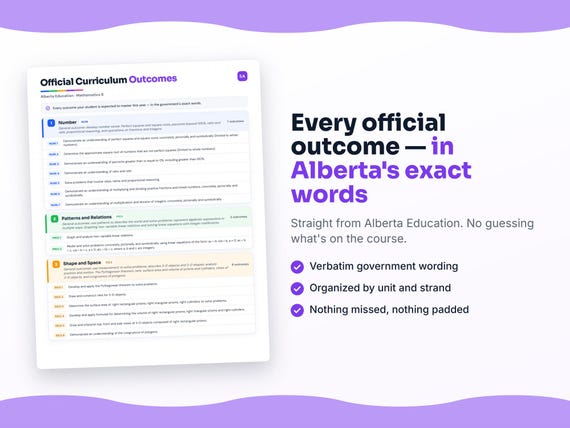
Alberta defines Mathematics 8 by strands and outcomes. MapleMind teaches the same curriculum reorganized for one-skill-at-a-time tutoring — the table shows exactly where every official strand lands, and the ministry's own wording is quoted under each unit below.
Official source Alberta's official programs of studyRead it on the government site — alberta.ca ↗| Official strand | Outcomes | Where MapleMind teaches it |
|---|---|---|
| Number | 7 | Number |
| Patterns and Relations (Patterns; Variables and Equations) | 2 | Patterns and Relations |
| Shape and Space (Measurement; 3-D Objects and 2-D Shapes; Transformations) | 6 | Shape and Space |
| Statistics and Probability (Data Analysis; Chance and Uncertainty) | 2 | Statistics and Probability |
Every skill below, taught one on one.
 Try the first session free
How MapleMind teaches Mathematics 8 — every unit, lesson, and skill
Every skill below runs as a short session: a plain-words lesson, a worked example, solving it together, then a five-question skill check that earns up to three stars. Guided Mode keeps it teaching instead of answer-handing — turning it off needs a parent's password.
Unit 1NumberOfficial strand · Number
General outcome: develop number sense. Perfect squares and square roots, percents beyond 100%, ratio and rate, proportional reasoning, and operations on fractions and integers.
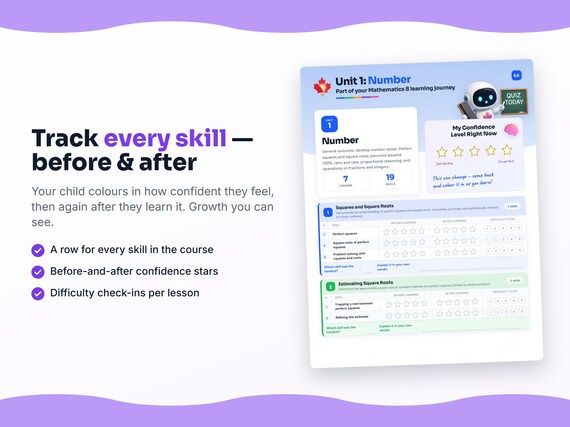
Squares and Square Roots
- Perfect squares8.N.1 — Recognize perfect squares and model them concretely and pictorially as square areas (whole numbers).
- Square roots of perfect squares8.N.1 — Determine the square root of a perfect square and connect it to the side length of a square with that area.
- Problem solving with squares and roots8.N.1 — Solve problems using perfect squares and their square roots, symbolically and in area contexts.
Estimating Square Roots
- Trapping a root between perfect squares8.N.2 — Estimate the square root of a non-perfect square by finding the two nearest perfect squares it lies between.
- Refining the estimate8.N.2 — Refine an approximate square root to a closer decimal estimate, with and without technology, and check reasonableness.
Percents Beyond 100
- Percents of all sizes8.N.3 — Understand percents from fractional percents through percents greater than 100%, and represent them concretely and pictorially.
- Percent–fraction–decimal8.N.3 — Convert among percents (including >100% and fractional percents), fractions and decimals.
- Solving percent problems8.N.3 — Solve real-context problems with percents greater than 100% (markups, growth, combined taxes).
Ratio and Rate
- What a ratio is8.N.4 — Understand ratios as a comparison of quantities, express part-to-part and part-to-whole ratios, and find equivalent ratios.
- What a rate is8.N.4 — Understand rates as a comparison of two quantities with different units, and find unit rates.
Proportional Reasoning
- Solving proportions8.N.5 — Solve for a missing value in a proportion using equivalent ratios and cross-multiplication.
- Comparing with unit rates8.N.5 — Use unit rates to compare options and make best-buy decisions.
- Proportional problem solving8.N.5 — Solve multi-step real-context problems involving rates, ratios and proportional reasoning (scaling recipes, maps, currency).
Multiplying and Dividing Fractions
- Multiplying fractions8.N.6 — Multiply positive fractions and mixed numbers, modelled concretely/pictorially (area model) and symbolically.
- Dividing fractions8.N.6 — Divide positive fractions and mixed numbers, and explain why multiplying by the reciprocal works.
- Fraction problem solving8.N.6 — Solve real-context problems that multiply or divide positive fractions and mixed numbers.
Multiplying and Dividing Integers
- Multiplying integers8.N.7 — Multiply integers, modelled concretely/pictorially, and use the sign rules (same signs → positive, different → negative).
- Dividing integers8.N.7 — Divide integers and connect the sign rules to the inverse relationship with multiplication.
- Integer problem solving8.N.7 — Solve real-context problems (temperature change, elevation, finance) using integer multiplication and division.
The official wording — 7 outcomes in this unit
- 8.N.1
Demonstrate an understanding of perfect squares and square roots, concretely, pictorially and symbolically (limited to whole numbers).
- 8.N.2
Determine the approximate square root of numbers that are not perfect squares (limited to whole numbers).
- 8.N.3
Demonstrate an understanding of percents greater than or equal to 0%, including greater than 100%.
- 8.N.4
Demonstrate an understanding of ratio and rate.
- 8.N.5
Solve problems that involve rates, ratios and proportional reasoning.
- 8.N.6
Demonstrate an understanding of multiplying and dividing positive fractions and mixed numbers, concretely, pictorially and symbolically.
- 8.N.7
Demonstrate an understanding of multiplication and division of integers, concretely, pictorially and symbolically.
Unit 2Patterns and RelationsOfficial strand · Patterns and Relations (Patterns; Variables and Equations)
General outcomes: use patterns to describe the world and solve problems; represent algebraic expressions in multiple ways. Graphing two-variable linear relations and solving linear equations with integer coefficients.
Graphing Linear Relations
- From table to graph8.PR.1 — Build a table of values for a two-variable linear relation and plot it as a straight line.
- Analyzing the relation8.PR.1 — Analyze a two-variable linear graph: describe the pattern, and read values from it.
- Linear relations in context8.PR.1 — Interpret a two-variable linear relation in a real context and use the graph to answer questions.
Solving Linear Equations
- One-step equations (ax = b, x/a = b)8.PR.2 — Model and solve one-step linear equations of the form ax = b and x/a = b (a ≠ 0) with integer coefficients, and verify.
- Two-step equations (ax + b = c)8.PR.2 — Model and solve two-step linear equations of the form ax + b = c and x/a + b = c (a ≠ 0) with integer coefficients.
- Equations with brackets (a(x + b) = c)8.PR.2 — Solve linear equations of the form a(x + b) = c by expanding first, and verify the solution in context.
The official wording — 2 outcomes in this unit
- 8.PR.1
Graph and analyze two-variable linear relations.
- 8.PR.2
Model and solve problems concretely, pictorially and symbolically, using linear equations of the form: ax = b; x/a = b, a ≠ 0; ax + b = c; x/a + b = c, a ≠ 0; a(x + b) = c; where a, b and c are integers.
Unit 3Shape and SpaceOfficial strand · Shape and Space (Measurement; 3-D Objects and 2-D Shapes; Transformations)
General outcomes: use measurement to solve problems; describe 3-D objects and 2-D shapes; analyze position and motion. The Pythagorean theorem, nets, surface area and volume of prisms and cylinders, views of 3-D objects, and congruence of polygons.
The Pythagorean Theorem
- Understanding the theorem8.SS.1 — Develop the Pythagorean relationship a² + b² = c² using the areas of squares on a right triangle’s sides.
- Finding the hypotenuse8.SS.1 — Apply the Pythagorean theorem to find the hypotenuse of a right triangle.
- Finding a leg and solving problems8.SS.1 — Find a missing leg with the Pythagorean theorem and solve real-context problems (ladders, distances, is-it-a-right-triangle checks).
Nets of 3-D Objects
- Drawing nets8.SS.2 — Draw nets for right rectangular prisms, right triangular prisms and right cylinders.
- Matching and building from nets8.SS.2 — Match a net to its 3-D object and identify which nets do and do not fold into a given solid.
Surface Area
- Surface area of rectangular prisms8.SS.3 — Determine the surface area of a right rectangular prism by summing the areas of its faces (via the net).
- Surface area of triangular prisms8.SS.3 — Determine the surface area of a right triangular prism, accounting for the two triangular and three rectangular faces.
- Surface area of cylinders8.SS.3 — Determine the surface area of a right cylinder (two circles plus the rolled rectangle, 2πr·h), and solve problems.
Volume
- Volume of rectangular prisms8.SS.4 — Develop and apply V = area of base × height for right rectangular prisms.
- Volume of triangular prisms8.SS.4 — Apply V = area of triangular base × height to right triangular prisms.
- Volume of cylinders8.SS.4 — Apply V = πr²·h to right cylinders and solve capacity problems.
Views of 3-D Objects
- Drawing top, front and side views8.SS.5 — Draw the top, front and side views of a 3-D object composed of right rectangular prisms.
- Building from views8.SS.5 — Interpret a set of top/front/side views and build or identify the 3-D object they describe.
Congruence of Polygons
- What makes polygons congruent8.SS.6 — Identify congruent polygons by equal corresponding sides and equal corresponding angles.
- Reasoning with congruence8.SS.6 — Use congruence of polygons to find unknown side lengths and angles, and justify the reasoning.
The official wording — 6 outcomes in this unit
- 8.SS.1
Develop and apply the Pythagorean theorem to solve problems.
- 8.SS.2
Draw and construct nets for 3-D objects.
- 8.SS.3
Determine the surface area of: right rectangular prisms; right triangular prisms; right cylinders; to solve problems.
- 8.SS.4
Develop and apply formulas for determining the volume of right rectangular prisms, right triangular prisms and right cylinders.
- 8.SS.5
Draw and interpret top, front and side views of 3-D objects composed of right rectangular prisms.
- 8.SS.6
Demonstrate an understanding of the congruence of polygons.
Unit 4Statistics and ProbabilityOfficial strand · Statistics and Probability (Data Analysis; Chance and Uncertainty)
General outcomes: collect, display and analyze data to solve problems; use experimental or theoretical probabilities to solve problems. Critiquing data displays and the probability of independent events.
Critiquing Data Displays
- Reading the four displays8.SP.1 — Read and interpret circle graphs, line graphs, bar graphs and pictographs, and match each display type to the data it suits.
- Spotting misleading displays8.SP.1 — Critique how a display can mislead (truncated axes, uneven scales, distorted pictograph symbols) and describe the honest fix.
Probability of Independent Events
- What independent events are8.SP.2 — Understand independent events (one outcome does not affect another) and distinguish them from dependent situations.
- Probability of two independent events8.SP.2 — Determine the probability of two independent events by multiplying their individual probabilities, and solve problems.
The official wording — 2 outcomes in this unit
- 8.SP.1
Critique ways in which data is presented in circle graphs, line graphs, bar graphs and pictographs.
- 8.SP.2
Solve problems involving the probability of independent events.
Printable workbook · A keepsake of the year
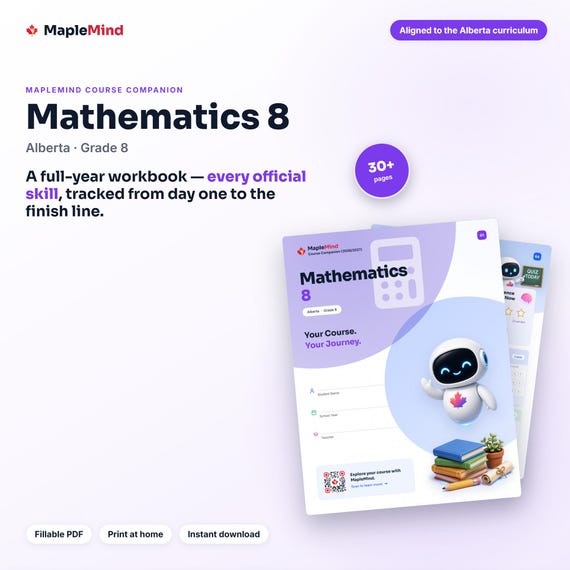
A Mathematics 8 workbook worth keeping
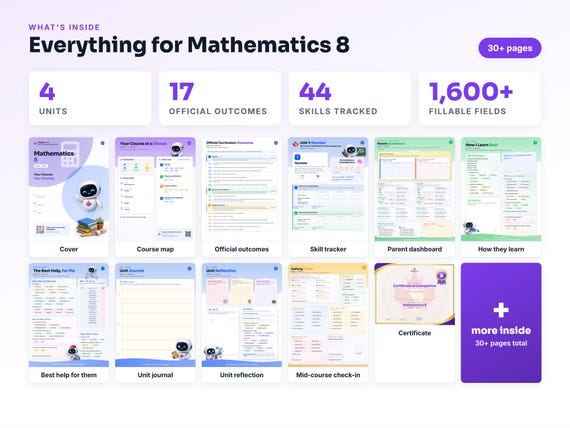
Built from the same official curriculum as this page. Before and after each skill above, your student colours in how sure they feel — so the two of you can see, on one page, what's clicking and what needs another look. It's a quiet way to follow how the year is really going.
By June it's full of their own handwriting: units worked through, confidence grown, a mid-year check-in, notes from parent-teacher night, and a certificate at the end. Less a worksheet, more a record of the year worth keeping on the shelf.
Instant download · see every page, reviews and the full description · five or more workbooks are $2.99 each
What it looks like in the app



Common questions
Can MapleMind help me with Mathematics 8?
Yes. MapleMind's AI tutor covers all 44 skills in Alberta's Mathematics 8 — you pick the exact skill, and the tutor teaches it step by step: a short lesson, a worked example, solving together, then a skill check to show it stuck.
Is MapleMind aligned to Alberta's official curriculum?
Yes. Every skill in this course maps to an official outcome code from Alberta's Grade 8 Mathematics curriculum, and the ministry's own wording is quoted under each unit on this page — with the official government source linked so you can check it yourself.
What does MapleMind cost?
It's free to start — 5 tutoring chats and a practice quiz every day, no credit card. A Pro subscription ($9.99/month or $49.99/year CAD, 7-day free trial) unlocks unlimited tutoring, practice, and exam simulations.
What if I'm stuck on just one topic?
That's the point of skill-level tutoring: open Mathematics 8 in the app, tap the exact skill from the list on this page, and the tutor teaches just that — no wading through lessons you don't need.
Does MapleMind work in French or other languages?
Yes — 14 languages, including French. Both the app and the tutor's explanations switch to the language you choose.
Where can I see the official Alberta curriculum for Mathematics 8?
The official source is linked on this page — Alberta's official programs of study. The outline here follows it: every MapleMind skill carries its official outcome code, and the ministry's own wording is quoted under each unit.
Keep exploring
Ready when you are
Pick a skill from this page and see it taught properly — free, in the browser, in under a minute.