Alberta · For parents

What your child learns in Grade 8 in Alberta

Every subject, unit by unit, from Alberta’s curriculum: 163 skills in plain words.

Subjects
5
Skills
163
Provincial exams
None
Official curriculum
alberta.ca

Math in Grade 8

Mathematics 8

4 units · 44 skills

  1. Unit 1

    Number

    A perfect square is a whole number you get by multiplying a whole number by itself: 1, 4, 9, 16, 25, …

    • Perfect squares
    • Square roots of perfect squares
    • Problem solving with squares and roots
    16 more skills
    • Trapping a root between perfect squares
    • Refining the estimate
    • Percents of all sizes
    • Percent–fraction–decimal
    • Solving percent problems
    • What a ratio is
    • What a rate is
    • Solving proportions
    • Comparing with unit rates
    • Proportional problem solving
    • Multiplying fractions
    • Dividing fractions
    • Fraction problem solving
    • Multiplying integers
    • Dividing integers
    • Integer problem solving
  2. Unit 2

    Patterns and Relations

    Pick input values, apply the rule to get each output, and write the (x, y) pairs in a table.

    • From table to graph
    • Analyzing the relation
    • Linear relations in context
    3 more skills
    • One-step equations (ax = b, x/a = b)
    • Two-step equations (ax + b = c)
    • Equations with brackets (a(x + b) = c)
  3. Unit 3

    Shape and Space

    In a right triangle, the squares built on the two legs add up to the square on the hypotenuse: a² + b² = c².

    • Understanding the theorem
    • Finding the hypotenuse
    • Finding a leg and solving problems
    12 more skills
    • Drawing nets
    • Matching and building from nets
    • Surface area of rectangular prisms
    • Surface area of triangular prisms
    • Surface area of cylinders
    • Volume of rectangular prisms
    • Volume of triangular prisms
    • Volume of cylinders
    • Drawing top, front and side views
    • Building from views
    • What makes polygons congruent
    • Reasoning with congruence
  4. Unit 4

    Statistics and Probability

    Circle graph → parts of one whole; bar graph → comparing categories; line graph → change over time; pictograph → counts with symbols.

    • Reading the four displays
    • Spotting misleading displays
    • What independent events are
    1 more skill
    • Probability of two independent events
Science in Grade 8

Science 8

5 units · 39 skills

  1. Unit 1

    Mix and Flow of Matter

    A fluid is any material that flows and takes the shape of its container — this includes BOTH liquids and gases, not just liquids.

    • What is a fluid?
    • Fluids in technological devices
    • Mixtures and solutions
    6 more skills
    • Concentration and solubility
    • Viscosity and flow rate
    • Density and buoyancy
    • Compressibility and the particle model
    • Pressure and force in fluids
    • Hydraulic and pneumatic systems
  2. Unit 2

    Cells and Systems

    Living things share characteristics such as being made of cells, needing energy, growing, responding to their environment, and reproducing.

    • Living things and their organization
    • Seeing cells with the microscope
    • Cell structures and functions
    5 more skills
    • Diffusion and osmosis
    • Digestive, circulatory and respiratory systems
    • Responding to stimuli
    • Investigating body systems
    • Medical technologies and applications
  3. Unit 3

    Light and Optical Systems

    Luminous objects make their own light (the Sun, a bulb, a flame); illuminated objects only reflect light from a source (the Moon, this page).

    • Sources and nature of light
    • How we see objects
    • Reflection and the ray model
    3 more skills
    • Refraction: bending light
    • Lenses and image formation
    • Optical technologies
  4. Unit 4

    Mechanical Systems

    The simple machines are the lever, wheel and axle, pulley, inclined plane, wedge, and screw.

    • Simple machines
    • How machines improved over time
    • Systems, subsystems and parts
    5 more skills
    • Mechanical advantage
    • Transmitting force and motion
    • Energy and efficiency
    • Machines and society
    • Environmental impact of machines
  5. Unit 5

    Freshwater and Saltwater Systems

    Most of Earth’s water is salt water in oceans; only a small fraction is fresh water, and much of that is frozen in ice and glaciers.

    • Distribution of water
    • Water supply and quality
    • Water shaping the land
    5 more skills
    • Water and climate
    • Factors affecting productivity
    • Species distribution in water
    • Human impacts on aquatic systems
    • Science and water issues
See the course: Science 8

English in Grade 8

2 courses. Choose the one your child takes.

English as an Additional Language (Grades 7–9)

6 units · 28 skills

  1. Unit 1

    Emerging Literacy (Levels A–B)

    You do not need every word — catching one key word (with a picture or action) is enough to understand.

    • Level A — Listening
    • Level A — Speaking
    • Level A — Reading
    5 more skills
    • Level A — Writing
    • Level B — Listening
    • Level B — Speaking
    • Level B — Reading
    • Level B — Writing
  2. Unit 2

    Level 1 — Beginning

    One-step instructions (open, close, write, look) tell you exactly one thing to do.

    • Level 1 — Listening
    • Level 1 — Speaking
    • Level 1 — Reading
    1 more skill
    • Level 1 — Writing
  3. Unit 3

    Level 2 — Developing

    Listen for the key words that carry the meaning of a short message.

    • Level 2 — Listening
    • Level 2 — Speaking
    • Level 2 — Reading
    1 more skill
    • Level 2 — Writing
  4. Unit 4

    Level 3 — Expanding

    Beyond the main idea, listen for details: who, when, how many.

    • Level 3 — Listening
    • Level 3 — Speaking
    • Level 3 — Reading
    1 more skill
    • Level 3 — Writing
  5. Unit 5

    Level 4 — Bridging

    You can now handle a new situation, not only familiar ones, using context clues.

    • Level 4 — Listening
    • Level 4 — Speaking
    • Level 4 — Reading
    1 more skill
    • Level 4 — Writing
  6. Unit 6

    Level 5 — Extending

    You can now follow new social and subject-area situations with less support.

    • Level 5 — Listening
    • Level 5 — Speaking
    • Level 5 — Reading
    1 more skill
    • Level 5 — Writing

English Language Arts 8

5 units · 20 skills

  1. Unit 1

    Reading and Comprehension

    Paraphrasing means restating an idea in your own words while keeping its meaning — it proves you understood, not just copied.

    • Paraphrasing main ideas and details
    • Using reference cues
    • Using prior knowledge to interpret
    1 more skill
    • Exchanging ideas to broaden perspective
  2. Unit 2

    Responding to and Analyzing Texts

    A motive is the reason behind a choice; interpreting it means asking "why would they do that?" and finding evidence.

    • Interpreting character choices and motives
    • How techniques create effect
    • Matching form to purpose
    2 more skills
    • Telling theme from topic
    • How texts reflect cultures and periods
  3. Unit 3

    Creating Texts

    Strong writing ideas often come from real issues — a problem or question raised by a text or by your own experience.

    • Generating ideas from issues
    • Structuring with main and minor characters
  4. Unit 4

    Research and Information

    Focusing a topic means narrowing it to something specific enough to research and matching it to a form and audience.

    • Focusing a topic and tracing arguments
    • Evaluating sources
    • Organizing to show relationships
    1 more skill
    • Note-making and referencing sources
  5. Unit 5

    Writing Craft and Conventions

    Revising can ADD words and phrases that emphasize key ideas or create a dominant impression.

    • Revising for emphasis and variety
    • How language changes
    • Modifiers and sentence variety
    2 more skills
    • Hyphens, semicolons and dashes
    • A system for spelling

French in Grade 8

French as a Second Language 8 (Nine-Year Program)

6 units · 20 skills

  1. Unit 1

    La boîte à outils — Grade 8 Expansion

    Three ending sets: –er (parle), –ir (finit — je finis, nous finissons), –re (attend — j'attends, il attend, no ending).

    • Present tense of –er, –ir and –re verbs
    • The imperative
    • Demonstrative and exclamatory adjectives
    5 more skills
    • Plural possessives: notre, votre, leur
    • The partitive: du, de la, des
    • Quantities and avoir expressions
    • The four adverb families
    • Stronger ways to say no
  2. Unit 2

    Les animaux

    Animal kit: un chien, un chat, un oiseau, un poisson, un cheval; wild ones: un lion, un éléphant, une girafe.

    • Understanding French about animals
    • Directions at the zoo
  3. Unit 3

    Les vêtements

    Clothing kit: une chemise, un pantalon, une robe, des chaussures, un manteau; care words: laver, sécher.

    • Reading French about clothing
    • Describing your wardrobe
  4. Unit 4

    La nourriture

    Food kit + partitive: du pain, des fruits, de la viande; meals: le petit déjeuner, le dîner, le souper.

    • Understanding French about food and nutrition
    • Reading recipes and food texts
    • Writing a recipe
    1 more skill
    • Expressing food preferences in writing
  5. Unit 5

    Fêtes et célébrations

    Celebration texts follow origin → traditions → foods — use the pattern to find details fast.

    • Reading about celebrations and their foods
    • Describing a celebration
  6. Unit 6

    Une langue vivante

    Living languages borrow: le week-end, le sandwich, un email (un courriel in Canada) — le rôle des emprunts et des anglicismes.

    • How French evolves
    • Regional variations and idioms

Social studies in Grade 8

Social Studies 8

3 units · 12 skills

  1. Unit 1

    From Isolation to Adaptation: Japan

    During the Edo period, the Tokugawa shogunate cut off most contact with the outside world (the sakoku policy), limiting trade and foreign influence.

    • How and why Japan isolated itself
    • Geography and Japan’s worldview
    • The shogun and the social order
    2 more skills
    • Why Japan changed course
    • From feudal to modern
  2. Unit 2

    Origins of a Western Worldview: Renaissance Europe

    The Renaissance ("rebirth", roughly 1300s–1600s) revived ancient Greek and Roman learning and sparked new ideas in art, science, and thought.

    • What the Renaissance was
    • Trade and the city-states
    • Thinkers and the humanist worldview
    1 more skill
    • The Age of Discovery and the expansionist worldview
  3. Unit 3

    Worldviews in Conflict: The Spanish and the Aztecs

    The Aztec civilization had a rich worldview — a powerful empire centred on Tenochtitlan, a complex religion, and beliefs that shaped daily life and decisions.

    • The Aztec worldview
    • Spain’s drive for empire
    • Why the Spanish prevailed

MapleMind

See Grade 8 in MapleMind

Real screens from the app your child would use.

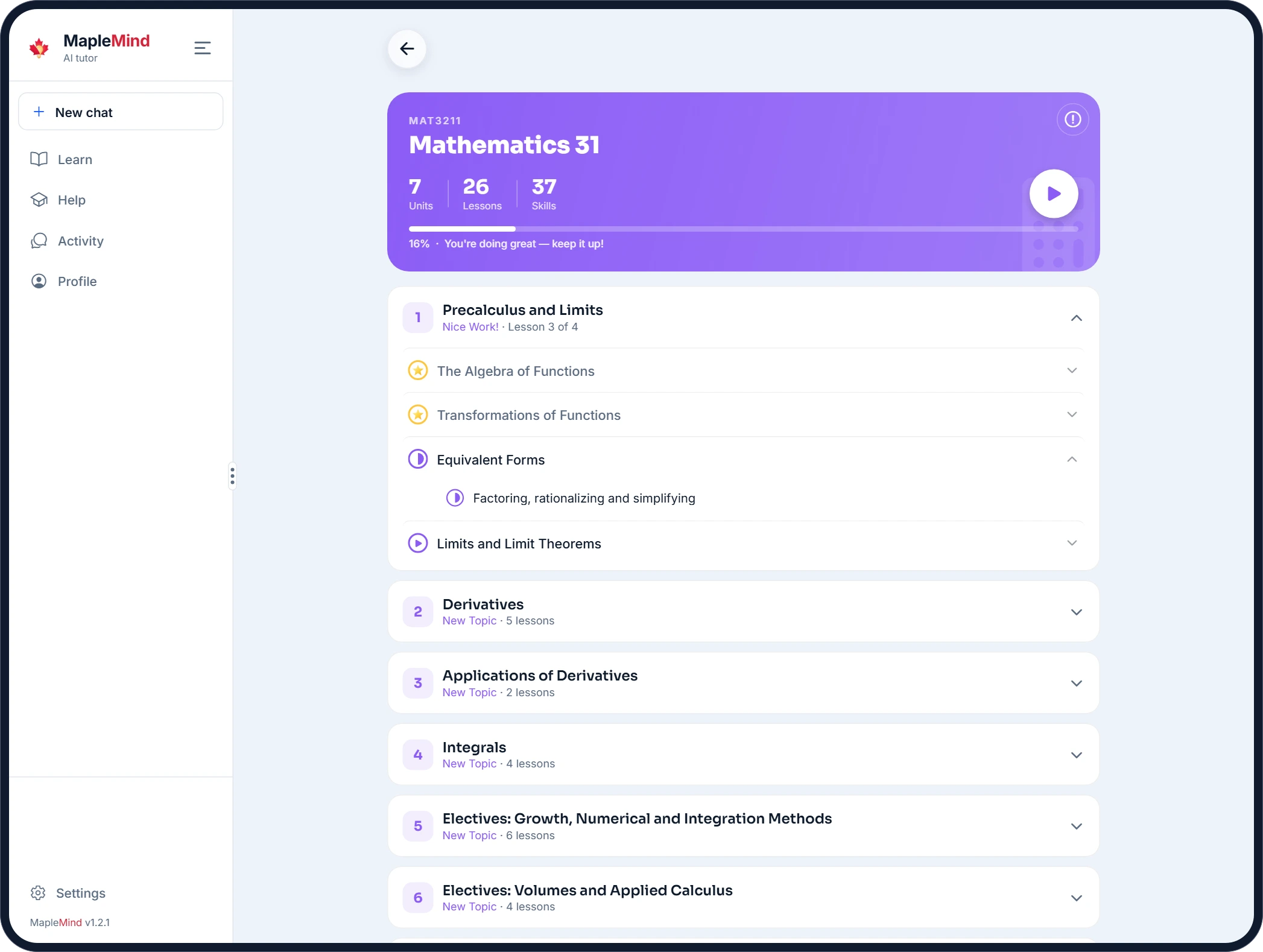
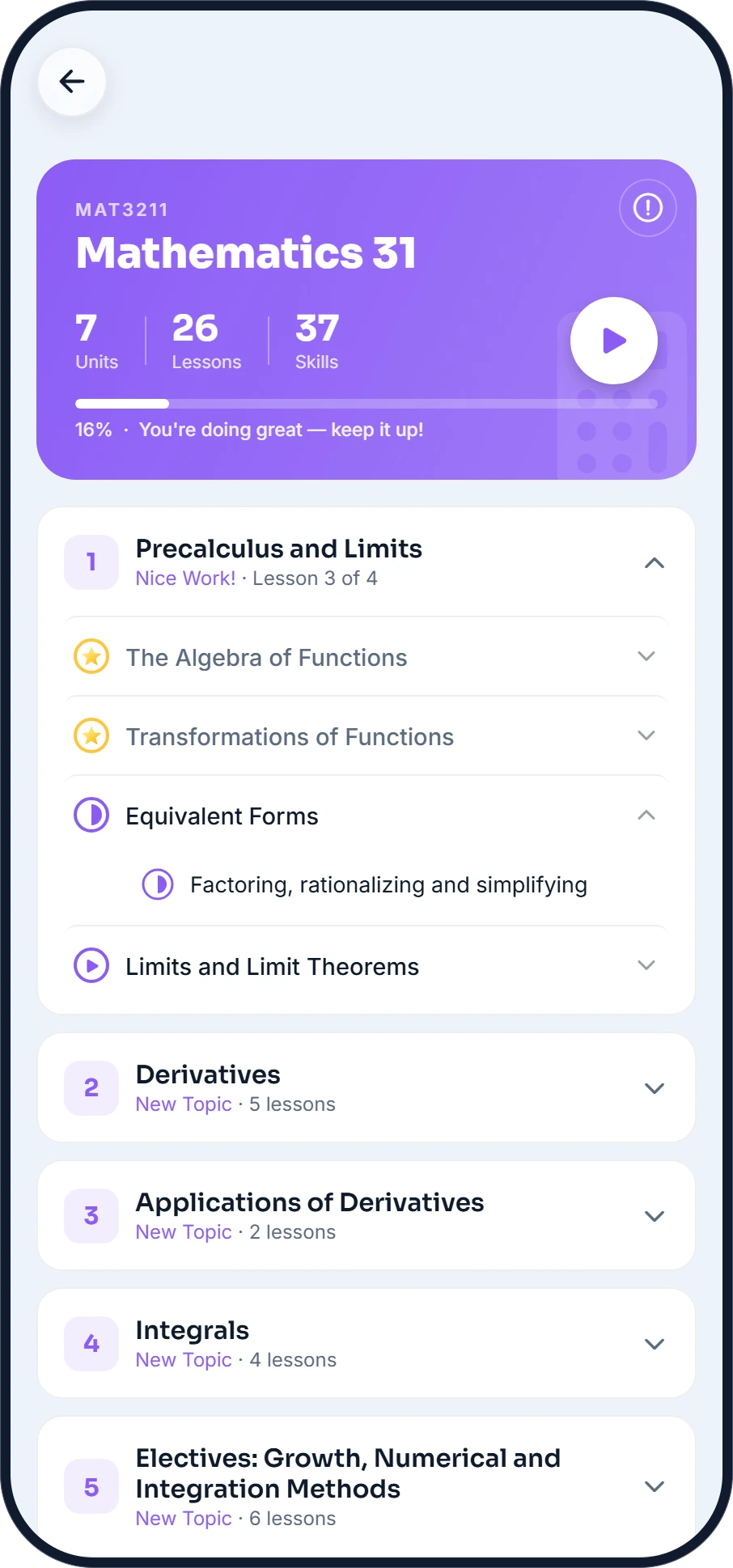
Mathematics 31 in MapleMind on a tablet: its units and lessons in order, a student partway through.Mathematics 31 in MapleMind on a phone: its units and lessons in order, a student partway through.
Their course, unit by unit, the way Alberta teaches it.Shown: Mathematics 31
Homework Help on a tablet: a photo of a worksheet, the tutor’s worked example of a two-step equation, and a question back to the student.Homework Help on a phone: a photo of a worksheet, the tutor’s worked example of a two-step equation, and a question back to the student.
Homework Help: they take a photo of the question, and the tutor works through it with them.
The Parent Dashboard on a tablet: a student’s days studied, streak, lessons, quiz average and recent activity.The Parent Dashboard on a phone: a student’s days studied, streak, lessons, quiz average and recent activity.
The Parent Dashboard: how each child’s week went, in lessons, quizzes and days studied.
A Grade 9 provincial mathematics exam on a tablet: a readiness score, the exam’s time and its next sitting.A Grade 9 provincial mathematics exam on a phone: a readiness score, the exam’s time and its next sitting.
A provincial exam: a practice sitting under the real time, and how ready they are.
The Learn tab on a tablet: a four-day streak, the week’s days, Homework Help, the next lesson and a review.The Learn tab on a phone: a four-day streak, the week’s days, Homework Help, the next lesson and a review.
The Learn tab: their week so far, and the next thing to do.

Help at home

Questions parents ask

What will my child learn in Grade 8 in Alberta?

Math: Mathematics 8. Science: Science 8. English: English as an Additional Language (Grades 7–9) and English Language Arts 8. French: French as a Second Language 8 (Nine-Year Program). Social studies: Social Studies 8. That’s 163 skills in all, from Alberta’s curriculum.

Does my child write a provincial exam in Grade 8?

No. Alberta has no provincial exam in Grade 8.

Where does this list come from?

From Alberta’s official curriculum, the documents its education ministry publishes for each course. Each skill here is one of their expectations, written in plain words.

Can MapleMind help my child in Grade 8?

Yes. Every course on this page is in MapleMind, with lessons, practice and a tutor that works through each step with them. A free account gets 30 messages and 4 activities a day.

Help with Grade 8, one skill at a time.

Every course on this page is in MapleMind, free with daily limits.