Get help with English Language Arts 8
Most tutoring makes you sit through material you already know. MapleMind flips that: pick the exact skill that's causing trouble — any of the 20 below — and the tutor teaches just that one, step by step, as many times as it takes. Ask questions in plain words, any time of day, in English, French, or 12 other languages.
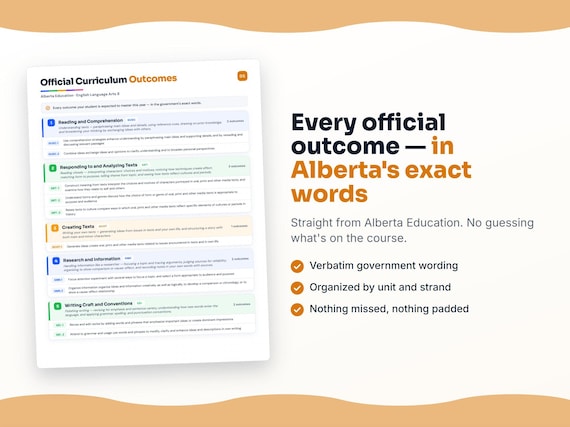
The official Alberta English Language Arts 8 curriculum
Alberta defines English Language Arts 8 by strands and outcomes. MapleMind teaches the same curriculum reorganized for one-skill-at-a-time tutoring — the table shows exactly where every official strand lands, and the ministry's own wording is quoted under each unit below.
Official source Alberta's official programs of studyRead it on the government site — alberta.ca ↗| Official strand | Outcomes | Where MapleMind teaches it |
|---|---|---|
| GO2.1 Use Strategies and Cues · GO1.2 Clarify and Extend | 4 | Reading and Comprehension |
| GO2.2 Respond to Texts · GO2.3 Understand Forms, Elements and Techniques · GO5.1 | 5 | Responding to and Analyzing Texts |
| GO2.4 Create Original Text | 2 | Creating Texts |
| GO3 Manage Ideas and Information | 4 | Research and Information |
| GO4.1 Enhance and Improve · GO4.2 Attend to Conventions | 5 | Writing Craft and Conventions |
Every skill below, taught one on one.
 Try the first session free
How MapleMind teaches English Language Arts 8 — every unit, lesson, and skill
Every skill below runs as a short session: a plain-words lesson, a worked example, solving it together, then a five-question skill check that earns up to three stars. Guided Mode keeps it teaching instead of answer-handing — turning it off needs a parent's password.
Unit 1Reading and ComprehensionOfficial strand · GO2.1 Use Strategies and Cues · GO1.2 Clarify and Extend
Understanding texts — paraphrasing main ideas and details, using reference cues, drawing on prior knowledge, and broadening your thinking by exchanging ideas with others.
Reading Strategies
- Paraphrasing main ideas and details8.2.1.2 — Enhance understanding by paraphrasing main ideas and supporting details, and by rereading key passages.
- Using reference cues8.2.1.3 — Identify and use visual and textual cues in reference materials (catalogues, databases, web sites) to find information.
- Using prior knowledge to interpret8.2.1.1 — Use strategies to supplement and extend your prior knowledge and experience when interpreting new ideas.
Extending Your Thinking
- Exchanging ideas to broaden perspective8.1.2.2 — Exchange ideas and opinions with others to clarify understanding and broaden your perspective.
The official wording — 4 outcomes in this unit
- 8.2.1.2
Use comprehension strategies enhance understanding by paraphrasing main ideas and supporting details, and by rereading and discussing relevant passages
- 8.2.1.3
Use textual cues identify and use visual and textual cues in reference materials, such as catalogues, databases, web sites
- 8.2.1.1
Use prior knowledge use strategies to supplement and extend prior knowledge and experiences when interpreting new ideas and information
- 8.1.2.2
Combine ideas exchange ideas and opinions to clarify understanding and to broaden personal perspectives
Unit 2Responding to and Analyzing TextsOfficial strand · GO2.2 Respond to Texts · GO2.3 Understand Forms, Elements and Techniques · GO5.1
Reading closely — interpreting characters’ choices and motives, noticing how techniques create effect, matching form to purpose, telling theme from topic, and seeing how texts reflect cultures and periods.
Responding to Texts
- Interpreting character choices and motives8.2.2.2 — Interpret the choices and motives of characters and examine how they relate to yourself and others.
- How techniques create effect8.2.2.3 — Discuss how techniques such as word choice, balance and camera angles communicate meaning and enhance effect.
Forms and Literary Elements
- Matching form to purpose8.2.3.1 — Discuss how the choice of form or genre is appropriate to a text’s purpose and audience.
- Telling theme from topic8.2.3.2 — Distinguish theme from topic or main idea, and explain characters’ qualities and motivations.
Texts and Culture
- How texts reflect cultures and periods8.5.1.2 — Compare ways that texts reflect specific elements of cultures or periods in history.
The official wording — 5 outcomes in this unit
- 8.2.2.2
Construct meaning from texts interpret the choices and motives of characters portrayed in oral, print and other media texts, and examine how they relate to self and others
- 8.2.2.3
Appreciate the artistry of texts discuss how techniques, such as word choice, balance, camera angles, line and framing, communicate meaning and enhance effects
- 8.2.3.1
Understand forms and genres discuss how the choice of form or genre of oral, print and other media texts is appropriate to purpose and audience
- 8.2.3.2
Understand techniques and elements distinguish theme from topic or main idea in oral, print and other media texts
- 8.5.1.2
Relate texts to culture compare ways in which oral, print and other media texts reflect specific elements of cultures or periods in history
Unit 3Creating TextsOfficial strand · GO2.4 Create Original Text
Writing your own texts — generating ideas from issues in texts and your own life, and structuring a story with both main and minor characters.
Writing Original Texts
- Generating ideas from issues8.2.4.1 — Generate ideas for texts related to issues you encounter in texts and in your own life.
- Structuring with main and minor characters8.2.4.3 — Structure a text with both main and minor characters, choosing a form that fits your purpose.
The official wording — 2 outcomes in this unit
- 8.2.4.1
Generate ideas create oral, print and other media texts related to issues encountered in texts and in own life
- 8.2.4.3
Structure texts create oral, print and other media texts with both main and minor characters
Unit 4Research and InformationOfficial strand · GO3 Manage Ideas and Information
Handling information like a researcher — focusing a topic and tracing arguments, judging sources for reliability, organizing to show comparison or cause-effect, and recording notes in your own words with sources.
Planning and Finding Information
- Focusing a topic and tracing arguments8.3.1.1 — Experiment with ways to focus a topic, select a fitting form, and trace the development of arguments and opinions.
- Evaluating sources8.3.2.3 — Develop and use criteria to evaluate the usefulness, currency and reliability of information.
Organizing and Citing
- Organizing to show relationships8.3.3.1 — Organize ideas creatively and logically to develop a comparison, chronology or cause-effect relationship.
- Note-making and referencing sources8.3.3.2 — Make point-form notes summarizing major ideas and supporting details, and reference your sources.
The official wording — 4 outcomes in this unit
- 8.3.1.1
Focus attention experiment with several ways to focus a topic, and select a form appropriate to audience and purpose
- 8.3.2.3
Evaluate sources develop and use criteria for evaluating the usefulness, currency and reliability of information
- 8.3.3.1
Organize information organize ideas and information creatively, as well as logically, to develop a comparison or chronology, or to show a cause-effect relationship
- 8.3.3.2
Record information make notes in point form, summarizing major ideas and supporting details; reference sources
Unit 5Writing Craft and ConventionsOfficial strand · GO4.1 Enhance and Improve · GO4.2 Attend to Conventions
Polishing writing — revising for emphasis and sentence variety, understanding how new words enter the language, and applying grammar, spelling, and punctuation conventions.
Revising and Word Choice
- Revising for emphasis and variety8.4.1.2 — Revise by adding words and phrases that emphasize important ideas, and to enhance sentence variety and word choice.
- How language changes8.4.1.4 — Explore and explain how new words and expressions enter the language through culture, technology and other factors.
Grammar and Punctuation
- Modifiers and sentence variety8.4.2.1 — Use words and phrases to modify and clarify ideas, and use simple, compound and complex sentence structures.
- Hyphens, semicolons and dashes8.4.2.3 — Use hyphens to break or join words, and recognize semicolons and dashes.
- A system for spelling8.4.2.2 — Develop a systematic, effective approach to studying and remembering the spelling of key words.
The official wording — 5 outcomes in this unit
- 8.4.1.2
Revise and edit revise by adding words and phrases that emphasize important ideas or create dominant impressions
- 8.4.1.4
Expand knowledge of language explore and explain ways that new words, phrases and manners of expression enter the language
- 8.4.2.1
Attend to grammar and usage use words and phrases to modify, clarify and enhance ideas and descriptions in own writing
- 8.4.2.3
Attend to capitalization and punctuation use hyphens to break words at the end of lines, and to make a new word from two related words
- 8.4.2.2
Attend to spelling develop a systematic and effective approach to studying and remembering the correct spelling of key words
Printable workbook · A keepsake of the year
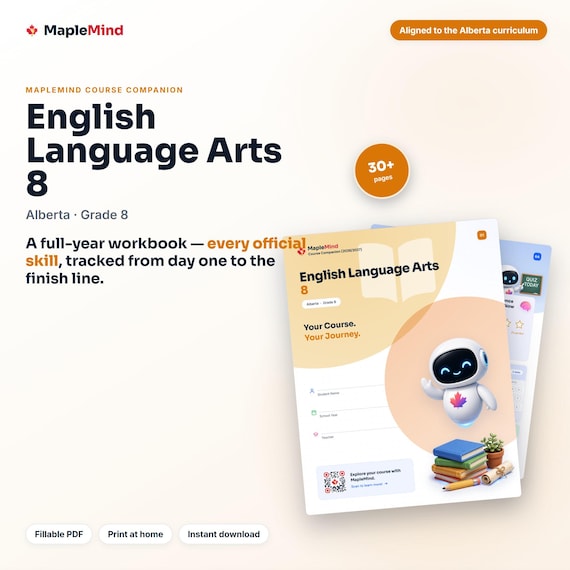
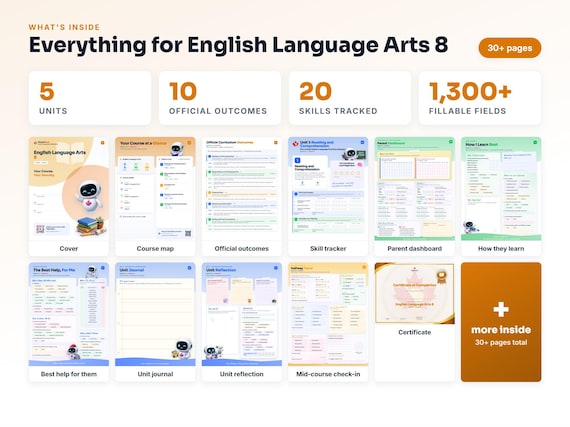
A English Language Arts 8 workbook worth keeping
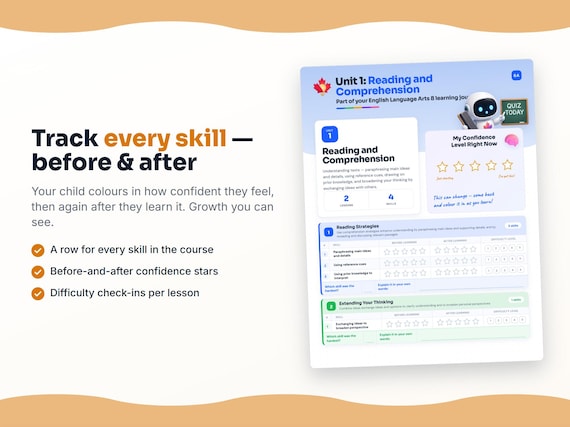
Built from the same official curriculum as this page. Before and after each skill above, your student colours in how sure they feel — so the two of you can see, on one page, what's clicking and what needs another look. It's a quiet way to follow how the year is really going.
By June it's full of their own handwriting: units worked through, confidence grown, a mid-year check-in, notes from parent-teacher night, and a certificate at the end. Less a worksheet, more a record of the year worth keeping on the shelf.
Instant download · see every page, reviews and the full description · five or more workbooks are $2.99 each
What it looks like in the app



Common questions
Can MapleMind help me with English Language Arts 8?
Yes. MapleMind's AI tutor covers all 20 skills in Alberta's English Language Arts 8 — you pick the exact skill, and the tutor teaches it step by step: a short lesson, a worked example, solving together, then a skill check to show it stuck.
Is MapleMind aligned to Alberta's official curriculum?
Yes. Every skill in this course maps to an official outcome code from Alberta's Grade 8 English Language Arts curriculum, and the ministry's own wording is quoted under each unit on this page — with the official government source linked so you can check it yourself.
What does MapleMind cost?
It's free to start — 5 tutoring chats and a practice quiz every day, no credit card. A Pro subscription ($9.99/month or $49.99/year CAD, 7-day free trial) unlocks unlimited tutoring, practice, and exam simulations.
What if I'm stuck on just one topic?
That's the point of skill-level tutoring: open English Language Arts 8 in the app, tap the exact skill from the list on this page, and the tutor teaches just that — no wading through lessons you don't need.
Does MapleMind work in French or other languages?
Yes — 14 languages, including French. Both the app and the tutor's explanations switch to the language you choose.
Where can I see the official Alberta curriculum for English Language Arts 8?
The official source is linked on this page — Alberta's official programs of study. The outline here follows it: every MapleMind skill carries its official outcome code, and the ministry's own wording is quoted under each unit.
Keep exploring
Ready when you are
Pick a skill from this page and see it taught properly — free, in the browser, in under a minute.