Get help with English Language Arts 7
Most tutoring makes you sit through material you already know. MapleMind flips that: pick the exact skill that's causing trouble — any of the 20 below — and the tutor teaches just that one, step by step, as many times as it takes. Ask questions in plain words, any time of day, in English, French, or 12 other languages.
The official Alberta English Language Arts 7 curriculum
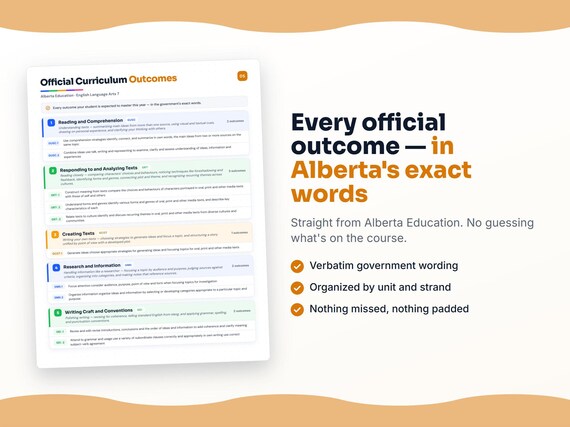
Alberta defines English Language Arts 7 by strands and outcomes. MapleMind teaches the same curriculum reorganized for one-skill-at-a-time tutoring — the table shows exactly where every official strand lands, and the ministry's own wording is quoted under each unit below.
Official source Alberta's official programs of studyRead it on the government site — alberta.ca ↗| Official strand | Outcomes | Where MapleMind teaches it |
|---|---|---|
| GO2.1 Use Strategies and Cues · GO1.2 Clarify and Extend | 4 | Reading and Comprehension |
| GO2.2 Respond to Texts · GO2.3 Understand Forms, Elements and Techniques · GO5.1 | 5 | Responding to and Analyzing Texts |
| GO2.4 Create Original Text | 2 | Creating Texts |
| GO3 Manage Ideas and Information | 4 | Research and Information |
| GO4.1 Enhance and Improve · GO4.2 Attend to Conventions | 5 | Writing Craft and Conventions |
Every skill below, taught one on one.
 Try the first session free
How MapleMind teaches English Language Arts 7 — every unit, lesson, and skill
Every skill below runs as a short session: a plain-words lesson, a worked example, solving it together, then a five-question skill check that earns up to three stars. Guided Mode keeps it teaching instead of answer-handing — turning it off needs a parent's password.
Unit 1Reading and ComprehensionOfficial strand · GO2.1 Use Strategies and Cues · GO1.2 Clarify and Extend
Understanding texts — summarizing main ideas from more than one source, using visual and textual cues, drawing on personal experience, and clarifying your thinking with others.
Reading Strategies
- Summarizing main ideas7.2.1.2 — Identify, connect and summarize in your own words the main ideas from two or more sources on the same topic.
- Using visual and textual cues7.2.1.3 — Identify and use visual and textual cues such as numbers, bullets, and signal words (first/then/next).
- Using prior experience to understand7.2.1.1 — Select and focus relevant ideas from your own experience and prior knowledge to understand new information.
Extending Your Thinking
- Clarifying and assessing your ideas7.1.2.2 — Use talk, writing and representing to examine, clarify and assess your understanding of ideas and information.
The official wording — 4 outcomes in this unit
- 7.2.1.2
Use comprehension strategies identify, connect, and summarize in own words, the main ideas from two or more sources on the same topic
- 7.2.1.3
Use textual cues identify and use visual and textual cues, such as numbers, bullets and words
- 7.2.1.1
Use prior knowledge select and focus relevant ideas from personal experiences and prior knowledge to understand new ideas and information
- 7.1.2.2
Combine ideas use talk, writing and representing to examine, clarify and assess understanding of ideas, information and experiences
Unit 2Responding to and Analyzing TextsOfficial strand · GO2.2 Respond to Texts · GO2.3 Understand Forms, Elements and Techniques · GO5.1
Reading closely — comparing characters’ choices and behaviours, noticing techniques like foreshadowing and flashback, identifying forms and genres, connecting plot and theme, and recognizing recurring themes across cultures.
Responding to Texts
- Comparing character choices and behaviours7.2.2.2 — Compare the choices and behaviours of characters with those of yourself and others.
- Techniques like suspense and foreshadowing7.2.2.3 — Discuss how techniques such as suspense, foreshadowing and flashback communicate meaning and enhance a text.
Forms and Literary Elements
- Forms and genres7.2.3.1 — Identify various forms and genres of texts and describe the key characteristics of each.
- Connecting plot, character and theme7.2.3.2 — Discuss connections among plot and subplot, main and supporting characters, and main idea and theme.
Texts and Culture
- Recurring themes across cultures7.5.1.2 — Identify and discuss recurring themes in texts from diverse cultures and communities.
The official wording — 5 outcomes in this unit
- 7.2.2.2
Construct meaning from texts compare the choices and behaviours of characters portrayed in oral, print and other media texts with those of self and others
- 7.2.2.3
Appreciate the artistry of texts discuss how techniques, such as colour, shape, composition, suspense, foreshadowing and flashback, are used to communicate meaning
- 7.2.3.1
Understand forms and genres identify various forms and genres of oral, print and other media texts, and describe key characteristics of each
- 7.2.3.2
Understand techniques and elements discuss connections among plot and subplot, main and supporting characters, main idea and theme
- 7.5.1.2
Relate texts to culture identify and discuss recurring themes in oral, print and other media texts from diverse cultures and communities
Unit 3Creating TextsOfficial strand · GO2.4 Create Original Text
Writing your own texts — choosing strategies to generate ideas and focus a topic, and structuring a story unified by point of view with a developed plot.
Writing Original Texts
- Generating and focusing ideas7.2.4.1 — Choose appropriate strategies for generating ideas and focusing topics for your texts.
- Structuring with point of view and plot7.2.4.3 — Structure a text unified by point of view, with a carefully developed plot and an ending consistent with events.
The official wording — 2 outcomes in this unit
- 7.2.4.1
Generate ideas choose appropriate strategies for generating ideas and focusing topics for oral, print and other media texts
- 7.2.4.3
Structure texts create oral, print and other media texts that are unified by point of view, carefully developed plot and endings consistent with previous events
Unit 4Research and InformationOfficial strand · GO3 Manage Ideas and Information
Handling information like a researcher — focusing a topic by audience and purpose, judging sources against criteria, organizing into categories, and making notes that reference sources.
Planning and Finding Information
- Focusing a topic for audience and purpose7.3.1.1 — Consider audience, purpose, point of view and form when focusing a topic for investigation.
- Evaluating sources against criteria7.3.2.3 — Use pre-established criteria to evaluate the usefulness of information sources by their structure and purpose.
Organizing and Citing
- Organizing into categories7.3.3.1 — Organize ideas and information by selecting or developing categories appropriate to your topic and purpose.
- Making notes and referencing sources7.3.3.2 — Make notes using headings, subheadings or graphic organizers, and reference your sources.
The official wording — 4 outcomes in this unit
- 7.3.1.1
Focus attention consider audience, purpose, point of view and form when focusing topics for investigation
- 7.3.2.3
Evaluate sources use pre-established criteria to evaluate the usefulness of a variety of information sources
- 7.3.3.1
Organize information organize ideas and information by selecting or developing categories appropriate to a particular topic and purpose
- 7.3.3.2
Record information make notes, using headings and subheadings or graphic organizers appropriate to a topic; reference sources
Unit 5Writing Craft and ConventionsOfficial strand · GO4.1 Enhance and Improve · GO4.2 Attend to Conventions
Polishing writing — revising for coherence, telling standard English from slang, and applying grammar, spelling, and punctuation conventions.
Revising and Word Choice
- Revising for coherence7.4.1.2 — Revise introductions, conclusions and the order of ideas to add coherence and clarify meaning.
- Standard English vs. slang7.4.1.4 — Identify differences between standard English and slang, colloquialism or jargon, and how these affect meaning.
Grammar and Punctuation
- Subordinate clauses and agreement7.4.2.1 — Use a variety of subordinate clauses correctly, and use correct subject–verb agreement.
- Punctuating direct speech7.4.2.3 — Use periods and commas with quotation marks for direct speech, and commas to separate phrases and clauses.
- Solving spelling problems7.4.2.2 — Use reference materials to confirm spellings and to solve spelling problems when editing and proofreading.
The official wording — 5 outcomes in this unit
- 7.4.1.2
Revise and edit revise introductions, conclusions and the order of ideas and information to add coherence and clarify meaning
- 7.4.1.4
Expand knowledge of language identify differences between standard English and slang, colloquialism or jargon, and explain how these differences affect meaning
- 7.4.2.1
Attend to grammar and usage use a variety of subordinate clauses correctly and appropriately in own writing use correct subject-verb agreement
- 7.4.2.3
Attend to capitalization and punctuation use periods and commas with quotation marks that indicate direct speech in own writing
- 7.4.2.2
Attend to spelling use reference materials to confirm spellings and to solve spelling problems when editing and proofreading
Printable workbook · A keepsake of the year
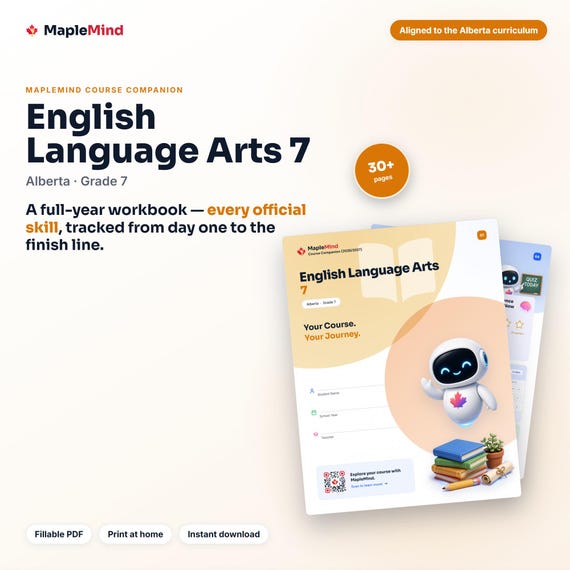
A English Language Arts 7 workbook worth keeping
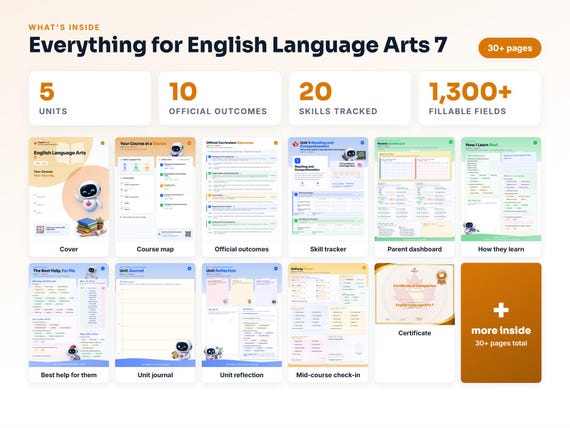
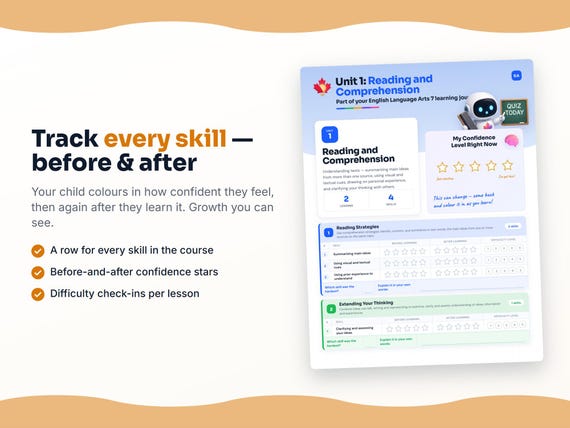
Built from the same official curriculum as this page. Before and after each skill above, your student colours in how sure they feel — so the two of you can see, on one page, what's clicking and what needs another look. It's a quiet way to follow how the year is really going.
By June it's full of their own handwriting: units worked through, confidence grown, a mid-year check-in, notes from parent-teacher night, and a certificate at the end. Less a worksheet, more a record of the year worth keeping on the shelf.
Instant download · see every page, reviews and the full description · five or more workbooks are $2.99 each
What it looks like in the app



Common questions
Can MapleMind help me with English Language Arts 7?
Yes. MapleMind's AI tutor covers all 20 skills in Alberta's English Language Arts 7 — you pick the exact skill, and the tutor teaches it step by step: a short lesson, a worked example, solving together, then a skill check to show it stuck.
Is MapleMind aligned to Alberta's official curriculum?
Yes. Every skill in this course maps to an official outcome code from Alberta's Grade 7 English Language Arts curriculum, and the ministry's own wording is quoted under each unit on this page — with the official government source linked so you can check it yourself.
What does MapleMind cost?
It's free to start — 5 tutoring chats and a practice quiz every day, no credit card. A Pro subscription ($9.99/month or $49.99/year CAD, 7-day free trial) unlocks unlimited tutoring, practice, and exam simulations.
What if I'm stuck on just one topic?
That's the point of skill-level tutoring: open English Language Arts 7 in the app, tap the exact skill from the list on this page, and the tutor teaches just that — no wading through lessons you don't need.
Does MapleMind work in French or other languages?
Yes — 14 languages, including French. Both the app and the tutor's explanations switch to the language you choose.
Where can I see the official Alberta curriculum for English Language Arts 7?
The official source is linked on this page — Alberta's official programs of study. The outline here follows it: every MapleMind skill carries its official outcome code, and the ministry's own wording is quoted under each unit.
Keep exploring
Ready when you are
Pick a skill from this page and see it taught properly — free, in the browser, in under a minute.