Get help with English Language Arts 6
Most tutoring makes your child sit through material your child already knows. MapleMind flips that: pick the exact skill that's causing trouble — any of the 21 below — and the tutor teaches just that one, step by step, as many times as it takes. Ask questions in plain words, any time of day, in English, French, or 12 other languages.
The official Alberta English Language Arts 6 curriculum
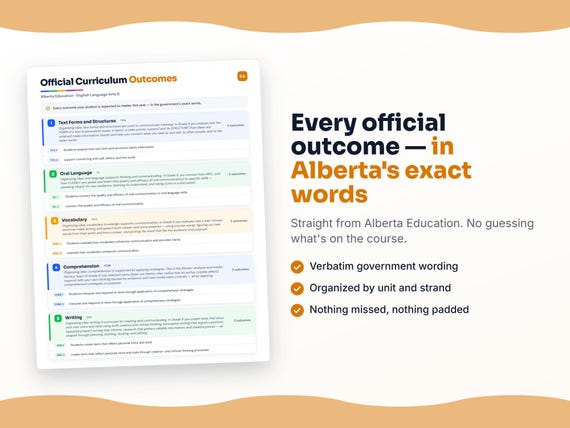
Alberta defines English Language Arts 6 by strands and outcomes. MapleMind teaches the same curriculum reorganized for one-skill-at-a-time tutoring — the table shows exactly where every official strand lands, and the ministry's own wording is quoted under each unit below.
Official source Alberta's official programs of studyRead it on the government site — alberta.ca ↗| Official strand | Outcomes | Where MapleMind teaches it |
|---|---|---|
| Text Forms and Structures | 1 | Text Forms and Structures |
| Oral Language | 1 | Oral Language |
| Vocabulary | 1 | Vocabulary |
| Comprehension | 1 | Comprehension |
| Writing | 1 | Writing |
| Conventions | 1 | Conventions |
Every skill below, taught one on one.
 Try the first session free
How MapleMind teaches English Language Arts 6 — every unit, lesson, and skill
Every skill below runs as a short session: a plain-words lesson, a worked example, solving it together, then a five-question skill check that earns up to three stars. Guided Mode keeps it teaching instead of answer-handing — turning it off needs a parent's password.
Unit 1Text Forms and StructuresOfficial strand · Text Forms and Structures
Organizing idea: text forms and structures are used to communicate meaning. In Grade 6 you analyze how the FORM of a text (a persuasive essay, a report, a news article, a poem) and its STRUCTURE (how ideas are ordered) make information clearer and help you connect what you read to yourself, to other people, and to the wider world.
Form Follows Purpose
- Reading form as a clue to purpose6.TF.1 — Identify common text forms — persuasive, expository/report, narrative, news, poem — and explain how each form is built to do a particular job (persuade, inform, tell a story).
- How structure organizes ideas6.TF.1 — Recognize common organizational structures (chronological order, compare-and-contrast, cause-and-effect, problem-and-solution) and explain how the right structure makes information clearer for the reader.
Connecting Through Texts
- Text-to-self, text-to-others, text-to-world6.TF.1 — Make three kinds of connection to a text — to your own life (self), to other people (others), and to events and issues beyond you (the world) — and explain how the text’s form and structure helped you make each one.
The official wording — 1 outcome in this unit
- 6.TF.1
Students analyze how text form and structure clarify information
Unit 2Oral LanguageOfficial strand · Oral Language
Organizing idea: oral language supports thinking and communicating. In Grade 6 you connect how WELL and how CLEARLY you speak and listen (the quality and efficacy of oral communication) to specific skills — speaking clearly for your audience, listening to understand, and taking turns in a discussion.
Speaking So People Understand
- Oral skills that make speaking effective6.OL.1 — Connect effective speaking to concrete oral language skills — clear pronunciation, a pace and volume that fit the room, and choosing words that match your audience — so your listeners actually get your message.
Listening and Discussion
- Listening to understand, not just to reply6.OL.1 — Use active-listening moves — paying attention, asking clarifying questions, and paraphrasing what a speaker said — to show you understood, and connect these to the quality of the conversation.
- Taking part in a group discussion6.OL.1 — Contribute to a discussion by building on others’ ideas, disagreeing respectfully, and taking turns, so the group communicates effectively.
The official wording — 1 outcome in this unit
- 6.OL.1
Students connect the quality and efficacy of oral communication to oral language skills
Unit 3VocabularyOfficial strand · Vocabulary
Organizing idea: vocabulary knowledge supports communication. In Grade 6 you evaluate how a well-chosen word can make writing and speech both clearer and more powerful — using precise words, figuring out new words from their parts and from context, and picking the word that fits the audience and purpose.
Choosing the Precise Word
- Precise words add clarity6.V.1 — Choose specific, precise words over vague ones (“sprinted” instead of “went fast”) and explain how the sharper word makes the meaning clearer for the reader or listener.
- Shades of meaning and connotation6.V.1 — Compare words with similar meanings but different feelings (“thrifty” vs “cheap”) and choose the one whose connotation best fits your purpose and audience.
Building Word Meaning
- Working out new words6.V.1 — Figure out an unfamiliar word by breaking it into meaningful parts (prefix, root, suffix) and by using clues in the surrounding sentence, then check the meaning makes sense.
The official wording — 1 outcome in this unit
- 6.V.1
Students evaluate how vocabulary enhances communication and provides clarity
Unit 4ComprehensionOfficial strand · Comprehension
Organizing idea: comprehension is supported by applying strategies. This is the literary-analysis and media-literacy heart of Grade 6: you interpret texts (draw out theme, infer, notice how an author creates effect), respond with your own thinking backed by evidence, and read media texts critically — all by applying comprehension strategies on purpose.
Interpreting Texts
- Strategies that unlock meaning6.C.1 — Apply comprehension strategies on purpose — predicting, questioning, visualizing, summarizing, and inferring “between the lines” — to build meaning from a text.
Responding and Reading Media
- Responding with evidence6.C.1 — Respond to a text with your own opinion or interpretation and back it with specific evidence (a quotation or detail) rather than just “I liked it.”
- Reading media texts critically6.C.1 — Apply comprehension strategies to media texts (ads, videos, web pages): identify the message, its intended audience, and the techniques used to persuade or inform.
The official wording — 1 outcome in this unit
- 6.C.1
Students interpret and respond to texts through application of comprehension strategies
Unit 5WritingOfficial strand · Writing
Organizing idea: writing is a process for creating and communicating. In Grade 6 you create texts that show your own voice and style using both creative and critical thinking: persuasive writing that argues a position, expository/report writing that informs, research that gathers reliable information, and creative pieces — all shaped through planning, drafting, revising, and editing.
Persuasive and Expository Writing
- Building a persuasive argument6.W.1 — Write to persuade by stating a clear position and supporting it with reasons and evidence for a specific audience — an argument, not just a strongly stated opinion.
- Expository and report writing6.W.1 — Write an expository text or report that informs — organizing facts into an introduction, body paragraphs with one main idea each, and a conclusion.
Research and Personal Voice
- Researching and writing a report6.W.1 — Plan a short research report: choose a focused question, gather information from reliable sources, take notes in your own words, and organize the findings into a written report.
- Personal voice and creative expression6.W.1 — Create a piece that shows your personal voice and style — word choice, sentence rhythm, and point of view that sound like you — using creative and critical thinking to shape it.
The official wording — 1 outcome in this unit
- 6.W.1
Students create texts that reflect personal voice and style
Unit 6ConventionsOfficial strand · Conventions
Organizing idea: conventions support clear communication. In Grade 6 you apply and analyze the conventions of English — grammar, spelling, punctuation, and sentence structure — that keep writing accurate, and you edit your own work carefully. You also learn how conventions can be used on purpose for creative effect.
Grammar and Sentences
- Grammar that keeps writing accurate6.CV.1 — Apply grammar conventions — subject–verb agreement, consistent verb tense, and correct pronoun use — and explain how each supports accurate, clear communication.
- Sentence variety for effect6.CV.1 — Combine simple, compound, and complex sentences, and analyze how varying sentence length and type can be used on purpose to enhance creative expression.
Editing and Punctuation
- Punctuation and spelling conventions6.CV.1 — Apply punctuation (commas in a series, apostrophes, quotation marks for dialogue) and spelling conventions accurately, using a strategy to check tricky words.
- Editing your own work6.CV.1 — Edit a draft for convention errors (grammar, spelling, punctuation) as a separate step from revising — understanding that editing fixes correctness while revising changes the ideas and wording.
The official wording — 1 outcome in this unit
- 6.CV.1
Students apply and analyze conventions that support accuracy
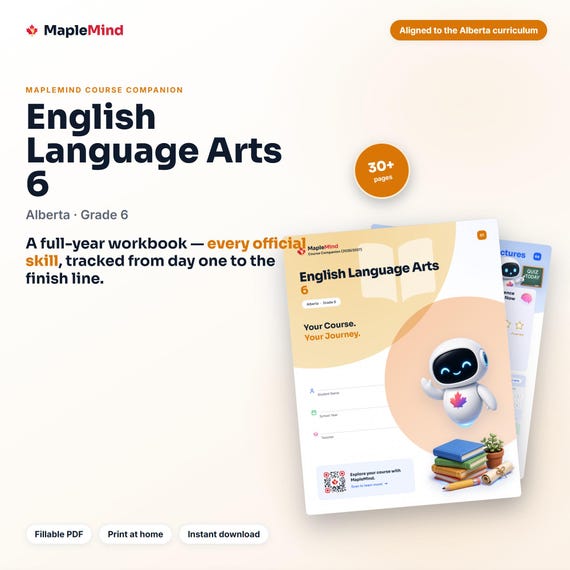
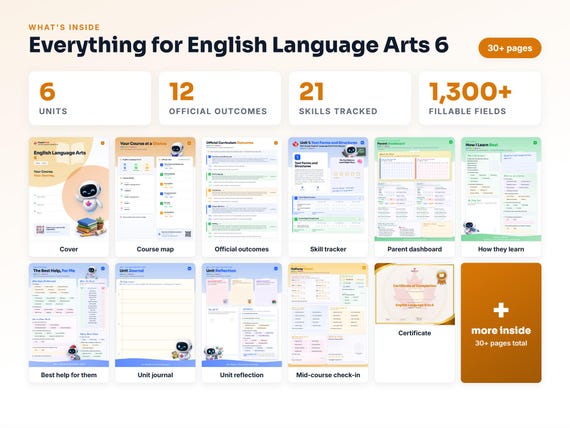
Printable workbook · A keepsake of the year
A English Language Arts 6 workbook worth keeping
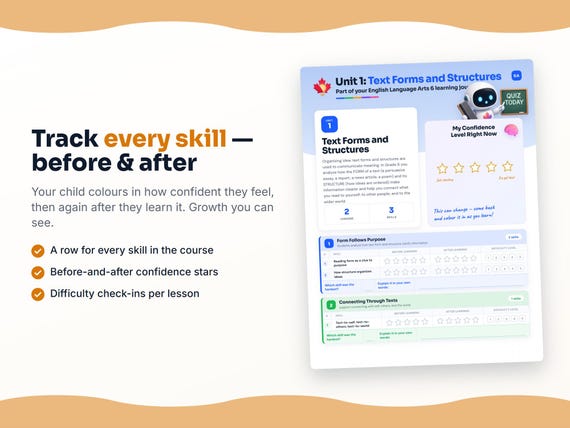
Built from the same official curriculum as this page. Before and after each skill above, your student colours in how sure they feel — so the two of you can see, on one page, what's clicking and what needs another look. It's a quiet way to follow how the year is really going.
By June it's full of their own handwriting: units worked through, confidence grown, a mid-year check-in, notes from parent-teacher night, and a certificate at the end. Less a worksheet, more a record of the year worth keeping on the shelf.
Instant download · see every page, reviews and the full description · five or more workbooks are $2.99 each
What it looks like in the app



Preparing for the Grade 6 Provincial Achievement Test (PAT)?
Alberta students write a Provincial Achievement Test in Grade 6. MapleMind's exam mode simulates it from this course's skills, then shows exactly which ones to shore up.
Common questions
Can MapleMind help my child with English Language Arts 6?
Yes. MapleMind's AI tutor covers all 21 skills in Alberta's English Language Arts 6 — your child picks the exact skill, and the tutor teaches it step by step: a short lesson, a worked example, solving together, then a skill check to show it stuck.
Is MapleMind aligned to Alberta's official curriculum?
Yes. Every skill in this course maps to an official outcome code from Alberta's Grade 6 English Language Arts curriculum, and the ministry's own wording is quoted under each unit on this page — with the official government source linked so you can check it yourself.
What does MapleMind cost?
It's free to start — 5 tutoring chats and a practice quiz every day, no credit card. A Pro subscription ($9.99/month or $49.99/year CAD, 7-day free trial) unlocks unlimited tutoring, practice, and exam simulations.
What if my child is stuck on just one topic?
That's the point of skill-level tutoring: open English Language Arts 6 in the app, tap the exact skill from the list on this page, and the tutor teaches just that — no wading through lessons your child doesn't need.
Does MapleMind work in French or other languages?
Yes — 14 languages, including French. Both the app and the tutor's explanations switch to the language your child chooses.
Where can I see the official Alberta curriculum for English Language Arts 6?
The official source is linked on this page — Alberta's official programs of study. The outline here follows it: every MapleMind skill carries its official outcome code, and the ministry's own wording is quoted under each unit.
Does MapleMind help with the Grade 6 Provincial Achievement Test (PAT)?
Yes. Alberta students write a Provincial Achievement Test in Grade 6. MapleMind's exam mode simulates it from this course's skills, then shows exactly which ones to shore up.
Keep exploring
Ready when you are
Pick a skill from this page and see it taught properly — free, in the browser, in under a minute.