Get help with English Language Arts 9
Most tutoring makes you sit through material you already know. MapleMind flips that: pick the exact skill that's causing trouble — any of the 20 below — and the tutor teaches just that one, step by step, as many times as it takes. Ask questions in plain words, any time of day, in English, French, or 12 other languages.
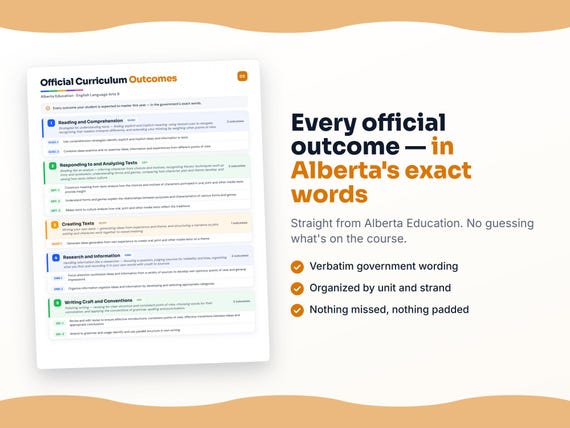
The official Alberta English Language Arts 9 curriculum
Alberta defines English Language Arts 9 by strands and outcomes. MapleMind teaches the same curriculum reorganized for one-skill-at-a-time tutoring — the table shows exactly where every official strand lands, and the ministry's own wording is quoted under each unit below.
Official source Alberta's official programs of studyRead it on the government site — alberta.ca ↗| Official strand | Outcomes | Where MapleMind teaches it |
|---|---|---|
| GO2.1 Use Strategies and Cues · GO1.2 Clarify and Extend | 4 | Reading and Comprehension |
| GO2.2 Respond to Texts · GO2.3 Understand Forms, Elements and Techniques · GO5.1 | 5 | Responding to and Analyzing Texts |
| GO2.4 Create Original Text | 2 | Creating Texts |
| GO3 Manage Ideas and Information | 4 | Research and Information |
| GO4.1 Enhance and Improve · GO4.2 Attend to Conventions | 5 | Writing Craft and Conventions |
Every skill below, taught one on one.
 Try the first session free
How MapleMind teaches English Language Arts 9 — every unit, lesson, and skill
Every skill below runs as a short session: a plain-words lesson, a worked example, solving it together, then a five-question skill check that earns up to three stars. Guided Mode keeps it teaching instead of answer-handing — turning it off needs a parent's password.
Unit 1Reading and ComprehensionOfficial strand · GO2.1 Use Strategies and Cues · GO1.2 Clarify and Extend
Strategies for understanding texts — finding explicit and implicit meaning, using textual cues to navigate, recognizing that readers interpret differently, and extending your thinking by weighing other points of view.
Reading Strategies
- Explicit and implicit meaning9.2.1.2 — Use comprehension strategies to identify both explicit (stated) and implicit (implied) ideas and information in a text.
- Textual cues, skimming and scanning9.2.1.3 — Use visual and textual cues and structural features to skim, scan and locate information efficiently.
- Why readers interpret differently9.2.1.1 — Discuss how interpretations of the same text vary according to readers’ prior knowledge and experiences.
Extending Your Thinking
- Weighing multiple points of view9.1.2.2 — Combine ideas by examining and re-examining information and experiences from different points of view.
The official wording — 4 outcomes in this unit
- 9.2.1.2
Use comprehension strategies identify explicit and implicit ideas and information in texts
- 9.2.1.3
Use textual cues use knowledge of visual and textual cues and structural features when skimming and scanning
- 9.2.1.1
Use prior knowledge discuss how interpretations of the same text might vary, according to the prior knowledge and experiences of various readers
- 9.1.2.2
Combine ideas examine and re-examine ideas, information and experiences from different points of view
Unit 2Responding to and Analyzing TextsOfficial strand · GO2.2 Respond to Texts · GO2.3 Understand Forms, Elements and Techniques · GO5.1
Reading like an analyst — inferring character from choices and motives, recognizing literary techniques such as irony and symbolism, understanding forms and genres, comparing how character, plot and theme develop, and seeing how texts reflect culture.
Responding to Texts
- Character choices and motives9.2.2.2 — Analyze how the choices and motives of characters give insight into people and situations.
- Irony, symbolism and other techniques9.2.2.3 — Discuss how techniques such as irony, symbolism and perspective communicate meaning and enhance effect.
Forms and Literary Elements
- Forms and genres9.2.3.1 — Explain the relationship between the purpose of a text and the characteristics of its form or genre.
- Comparing character, plot and theme9.2.3.2 — Compare how character, plot and theme develop across two texts.
Texts and Culture
- How texts reflect culture9.5.1.2 — Analyze how oral, print and other media texts reflect the traditions and beliefs of a culture.
The official wording — 5 outcomes in this unit
- 9.2.2.2
Construct meaning from texts analyze how the choices and motives of characters portrayed in oral, print and other media texts provide insight
- 9.2.2.3
Appreciate the artistry of texts discuss how techniques, such as irony, symbolism, perspective and proportion, communicate meaning and enhance effect
- 9.2.3.1
Understand forms and genres explain the relationships between purposes and characteristics of various forms and genres
- 9.2.3.2
Understand techniques and elements compare the development of character, plot and theme in two oral, print or other media texts
- 9.5.1.2
Relate texts to culture analyze how oral, print and other media texts reflect the traditions
Unit 3Creating TextsOfficial strand · GO2.4 Create Original Text
Writing your own texts — generating ideas from experience and theme, and structuring a narrative so plot, setting and character work together to reveal meaning.
Writing Original Texts
- Generating ideas from a theme9.2.4.1 — Generate ideas by generalizing from your own experience to create a text on a theme.
- Structuring a narrative9.2.4.3 — Structure a text so that plot, setting and character interrelate and reveal the significance of the action.
The official wording — 2 outcomes in this unit
- 9.2.4.1
Generate ideas generalize from own experience to create oral, print and other media texts on a theme
- 9.2.4.3
Structure texts create oral, print and other media texts that interrelate plot, setting and character, and reveal the significance of the action
Unit 4Research and InformationOfficial strand · GO3 Manage Ideas and Information
Handling information like a researcher — focusing a question, judging sources for reliability and bias, organizing what you find, and recording it in your own words with credit to sources.
Planning and Finding Information
- Focusing a research question9.3.1.1 — Focus attention by synthesizing ideas and information from several sources to develop your own opinion.
- Evaluating sources for bias9.3.2.3 — Evaluate sources for currency, reliability and possible bias before using their information.
Organizing and Citing
- Organizing information9.3.3.1 — Organize ideas and information by developing and selecting appropriate categories.
- Summarizing in your own words9.3.3.2 — Record information by using your own words to summarize, and give credit to sources (avoiding plagiarism).
The official wording — 4 outcomes in this unit
- 9.3.1.1
Focus attention synthesize ideas and information from a variety of sources to develop own opinions, points of view and general impressions
- 9.3.2.3
Evaluate sources evaluate sources for currency, reliability and possible bias of information
- 9.3.3.1
Organize information organize ideas and information by developing and selecting appropriate categories
- 9.3.3.2
Record information use own words to summarize and record information in a variety of forms
Unit 5Writing Craft and ConventionsOfficial strand · GO4.1 Enhance and Improve · GO4.2 Attend to Conventions
Polishing writing — revising for clear structure and consistent point of view, choosing words for their connotation, and applying the conventions of grammar, spelling and punctuation.
Revising and Word Choice
- Revising for structure and flow9.4.1.2 — Revise to ensure effective introductions, a consistent point of view, effective transitions and appropriate conclusions.
- Denotation and connotation9.4.1.4 — Distinguish the denotative from the connotative meaning of words and choose words for their effect.
Grammar and Punctuation
- Parallel structure9.4.2.1 — Identify and use parallel structure to make writing clearer and more balanced.
- Punctuation and quotation marks9.4.2.3 — Use quotation marks and other punctuation correctly, including to distinguish words being discussed or quoted.
- Spelling strategies9.4.2.2 — Apply a variety of spelling strategies deliberately and independently in your writing.
The official wording — 5 outcomes in this unit
- 9.4.1.2
Revise and edit revise to ensure effective introductions, consistent points of view, effective transitions between ideas and appropriate conclusions
- 9.4.1.4
Expand knowledge of language distinguish between the denotative and connotative meaning of words
- 9.4.2.1
Attend to grammar and usage identify and use parallel structure in own writing
- 9.4.2.3
Attend to capitalization and punctuation use quotation marks to distinguish words being discussed
- 9.4.2.2
Attend to spelling demonstrate the deliberate, conscientious and independent application of a variety
Printable workbook · A keepsake of the year
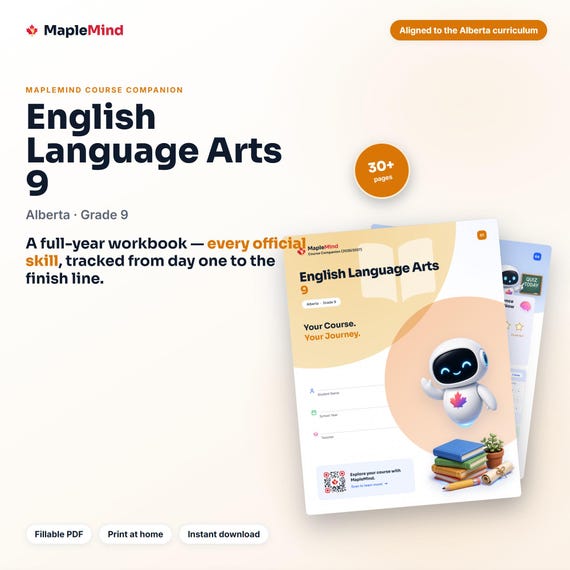
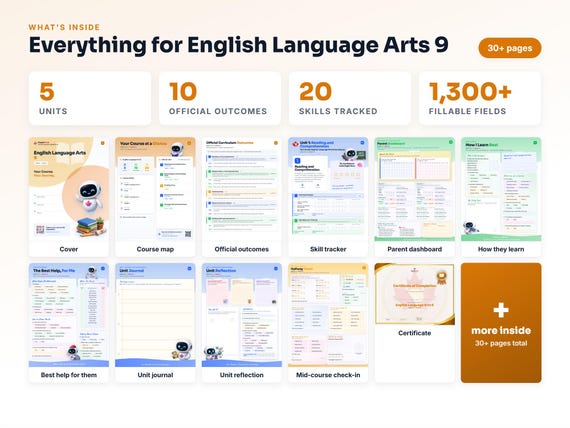
A English Language Arts 9 workbook worth keeping
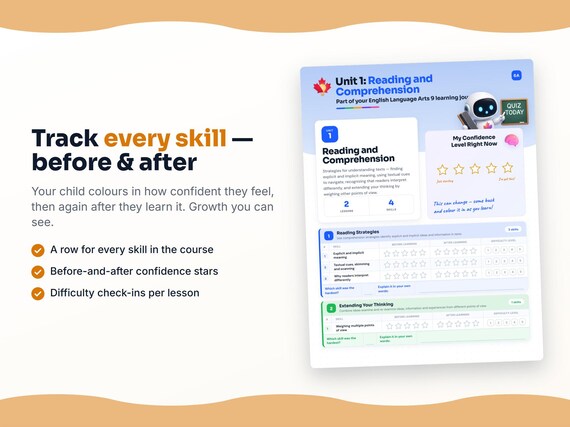
Built from the same official curriculum as this page. Before and after each skill above, your student colours in how sure they feel — so the two of you can see, on one page, what's clicking and what needs another look. It's a quiet way to follow how the year is really going.
By June it's full of their own handwriting: units worked through, confidence grown, a mid-year check-in, notes from parent-teacher night, and a certificate at the end. Less a worksheet, more a record of the year worth keeping on the shelf.
Instant download · see every page, reviews and the full description · five or more workbooks are $2.99 each
What it looks like in the app



Preparing for the Grade 9 Provincial Achievement Test (PAT)?
Alberta students write a Provincial Achievement Test in Grade 9. MapleMind's exam mode simulates it from this course's skills, then shows exactly which ones to shore up.
Common questions
Can MapleMind help me with English Language Arts 9?
Yes. MapleMind's AI tutor covers all 20 skills in Alberta's English Language Arts 9 — you pick the exact skill, and the tutor teaches it step by step: a short lesson, a worked example, solving together, then a skill check to show it stuck.
Is MapleMind aligned to Alberta's official curriculum?
Yes. Every skill in this course maps to an official outcome code from Alberta's Grade 9 English Language Arts curriculum, and the ministry's own wording is quoted under each unit on this page — with the official government source linked so you can check it yourself.
What does MapleMind cost?
It's free to start — 5 tutoring chats and a practice quiz every day, no credit card. A Pro subscription ($9.99/month or $49.99/year CAD, 7-day free trial) unlocks unlimited tutoring, practice, and exam simulations.
What if I'm stuck on just one topic?
That's the point of skill-level tutoring: open English Language Arts 9 in the app, tap the exact skill from the list on this page, and the tutor teaches just that — no wading through lessons you don't need.
Does MapleMind work in French or other languages?
Yes — 14 languages, including French. Both the app and the tutor's explanations switch to the language you choose.
Where can I see the official Alberta curriculum for English Language Arts 9?
The official source is linked on this page — Alberta's official programs of study. The outline here follows it: every MapleMind skill carries its official outcome code, and the ministry's own wording is quoted under each unit.
Does MapleMind help with the Grade 9 Provincial Achievement Test (PAT)?
Yes. Alberta students write a Provincial Achievement Test in Grade 9. MapleMind's exam mode simulates it from this course's skills, then shows exactly which ones to shore up.
Keep exploring
Ready when you are
Pick a skill from this page and see it taught properly — free, in the browser, in under a minute.