Get help with English Language Arts 10-2
Most tutoring makes you sit through material you already know. MapleMind flips that: pick the exact skill that's causing trouble — any of the 28 below — and the tutor teaches just that one, step by step, as many times as it takes. Ask questions in plain words, any time of day, in English, French, or 12 other languages.
The official Alberta English Language Arts 10-2 curriculum
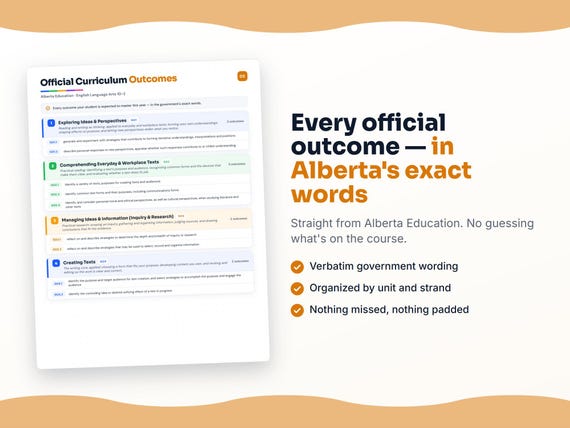
Alberta defines English Language Arts 10-2 by strands and outcomes. MapleMind teaches the same curriculum reorganized for one-skill-at-a-time tutoring — the table shows exactly where every official strand lands, and the ministry's own wording is quoted under each unit below.
Official source Alberta's official programs of studyRead it on the government site — alberta.ca ↗| Official strand | Outcomes | Where MapleMind teaches it |
|---|---|---|
| General Outcome 1 | 5 | Exploring Ideas & Perspectives |
| General Outcome 2 | 9 | Comprehending Everyday & Workplace Texts |
| General Outcome 3 | 6 | Managing Ideas & Information (Inquiry & Research) |
| General Outcome 4 | 8 | Creating Texts |
Every skill below, taught one on one.
 Try the first session free
How MapleMind teaches English Language Arts 10-2 — every unit, lesson, and skill
Every skill below runs as a short session: a plain-words lesson, a worked example, solving it together, then a five-question skill check that earns up to three stars. Guided Mode keeps it teaching instead of answer-handing — turning it off needs a parent's password.
Unit 1Exploring Ideas & PerspectivesOfficial strand · General Outcome 1
Reading and writing as thinking, applied to everyday and workplace texts: forming your own understandings, shaping effects on purpose, and letting new perspectives widen what you notice.
Discover Possibilities
- Forming tentative understandings1.1.1 — Use strategies like questioning and suspending judgement to form tentative understandings you can still revise.
- Experimenting with language, image and structure1.1.2 — Experiment with language, image and structure to create different effects for particular situations, purposes and audiences.
Extend Awareness
- Considering new perspectives1.2.1 — Describe your responses to new perspectives and judge whether they help or hinder your understanding.
- Expressing preferences and expanding interests1.2.2 — Reflect on your text preferences, identify what shaped them, and choose strategies to expand your interests.
- Setting personal goals for language growth1.2.3 — Appraise your strengths and weaknesses as a language user, pick and try strategies to build strengths and address weaknesses, and set growth goals for real communications like working in a group or club.
The official wording — 5 outcomes in this unit
- 1.1.1
generate and experiment with strategies that contribute to forming tentative understandings, interpretations and positions
- 1.1.2
experiment with language, image and structure to create different effects in particular situations and for particular purposes and audiences
- 1.2.1
describe personal responses to new perspectives, appraise whether such responses contribute to or inhibit understanding
- 1.2.2
reflect on personal text preferences, identify influences that have contributed to the formation of these preferences
- 1.2.3
appraise own strengths and weaknesses as a language user and language learner
Unit 2Comprehending Everyday & Workplace TextsOfficial strand · General Outcome 2
Practical reading: identifying a text's purpose and audience, recognizing common forms and the devices that make them clear, and evaluating whether a text does its job.
Meaning from Text & Context
- Discerning context2.1.1 — Identify a variety of texts, their purposes (to inform, persuade, entertain or inspire) and their audiences.
- Understanding and interpreting content2.1.2 — Use comprehension strategies — questioning, predicting, using context for meaning — to understand literature and other texts.
- Engaging prior knowledge2.1.3 — Activate what you already know — prior experiences with similar texts, and textual elements like plot, setting and character in texts you have studied — to help you make sense of a new text.
- Using reference strategies2.1.4 — Use reference strategies and technologies — refining questions, note-taking — to aid understanding.
Text Forms & Techniques
- Relating form to purpose2.2.1 — Identify common text forms and their purposes, including communications forms (letters, memoranda) and literary forms.
- Devices that create clarity and emphasis2.2.2 — Identify rhetorical devices (repetition) and stylistic techniques that create clarity, coherence and emphasis.
Responding to Texts
- Connecting self, text, culture and milieu2.3.1 — Bring your personal, moral, ethical and cultural perspectives to a text, respond both personally and analytically, and recognize Canadian content and the culture it reflects.
- Evaluating texts with criteria2.3.2 — Develop and apply criteria to evaluate whether a text is effective, appropriate and significant.
- Appreciating effectiveness and artistry2.3.3 — Recognize that texts can be effective and artistic, and use appropriate terminology to discuss them.
The official wording — 9 outcomes in this unit
- 2.1.1
identify a variety of texts, purposes for creating texts and audiences
- 2.1.2
use a variety of strategies to comprehend literature and other texts
- 2.1.3
reflect on and describe strategies used to engage prior knowledge as a means of assisting comprehension of new texts
- 2.1.4
use a variety of appropriate reference strategies and reference technologies to aid understanding
- 2.2.1
identify common text forms and their purposes, including communications forms
- 2.2.2
identify rhetorical devices
- 2.3.1
identify and consider personal moral and ethical perspectives, as well as cultural perspectives, when studying literature and other texts
- 2.3.2
identify criteria to evaluate the effectiveness of texts, monitor the effectiveness of the criteria, and modify the criteria as needed
- 2.3.3
recognize that texts can be effective and artistic, and use terminology appropriate to the forms studied
Unit 3Managing Ideas & Information (Inquiry & Research)Official strand · General Outcome 3
Practical research: scoping an inquiry, gathering and organizing information, judging sources, and drawing conclusions that fit the evidence.
Planning Inquiry or Research
- Focusing purpose and form3.1.1 — Determine the depth and breadth of an inquiry and identify its purpose, audience and form of presentation.
- Planning and identifying sources3.1.2 — Develop an inquiry plan and identify your information needs and sources.
Following the Plan of Inquiry
- Selecting, recording and organizing information3.2.1 — Use strategies to select, record and organize information relevant to your purpose.
- Evaluating sources and detecting bias3.2.2 — Evaluate sources for credibility, quality and bias.
- Forming generalizations and conclusions3.2.3 — Form generalizations from evidence and draw conclusions consistent with your findings.
- Reviewing the inquiry process and findings3.2.4 — Look back at how well your research strategies worked, check the accuracy and significance of your findings, keep a record of your references, and identify what to do differently next time.
The official wording — 6 outcomes in this unit
- 3.1.1
reflect on and describe strategies to determine the depth and breadth of inquiry or research
- 3.1.2
reflect on and describe strategies for developing an inquiry or research plan that will foster understanding
- 3.2.1
reflect on and describe strategies that may be used to select, record and organize information
- 3.2.2
reflect on and describe strategies to evaluate information sources for credibility and bias and for quality
- 3.2.3
form generalizations by integrating new information with prior knowledge
- 3.2.4
reflect on and assess the effectiveness of strategies used to guide inquiry or research
Unit 4Creating TextsOfficial strand · General Outcome 4
The writing core, applied: choosing a form that fits your purpose, developing content you own, and revising and editing so the work is clear and correct.
Developing & Presenting Texts
- Assessing the text-creation context4.1.1 — Before drafting, identify your purpose and target audience, select strategies to accomplish that purpose and engage that audience, and identify the expectations and constraints of the task.
- Choosing form, structure and medium4.1.2 — Select a text form appropriate to your purpose and consistent with your content.
- Developing content4.1.3 — Take ownership of text creation by crafting a topic that is personally meaningful and engaging.
- Producing and presenting the text4.1.4 — Meet the production, publication and presentation requirements for your form — layout, font and visuals for print; voice, nonverbal and visual factors for oral and multimedia — as appropriate to purpose, audience and situation.
Improving & Editing
- Enhancing thought, support and detail4.2.1 — Identify the controlling idea or unifying effect of a text in progress, and review its accuracy and specificity.
- Enhancing organization4.2.2 — Review and revise the beginning, organizational components and closing of a draft, and strengthen transitions so the parts hold together as clear units of thought.
- Addressing matters of stylistic choice4.2.3 — Choose effective words and use a variety of sentence patterns and structures on purpose — straightforward for clarity, short sentences for action — and describe the effects your choices create.
- Editing for correctness4.2.4 — Use handbooks and tools and apply capitalization, punctuation, spelling and grammar conventions to edit for correctness.
The official wording — 8 outcomes in this unit
- 4.1.1
identify the purpose and target audience for text creation, and select strategies to accomplish the purpose and engage the audience
- 4.1.2
select a text form appropriate to the purpose for text creation and consistent with the content to be presented in the text
- 4.1.3
take ownership of text creation, by selecting or crafting a topic, concept or idea that is personally meaningful and engaging
- 4.1.4
meet production, publication and display requirements for print texts as appropriate to purpose, audience and situation
- 4.2.1
identify the controlling idea or desired unifying effect of a text in progress
- 4.2.2
review the organizational components of a text in progress
- 4.2.3
use a variety of sentence patterns and structures appropriately
- 4.2.4
use handbooks and other tools, including electronic tools, as resources to assist with text creation
Printable workbook · A keepsake of the year
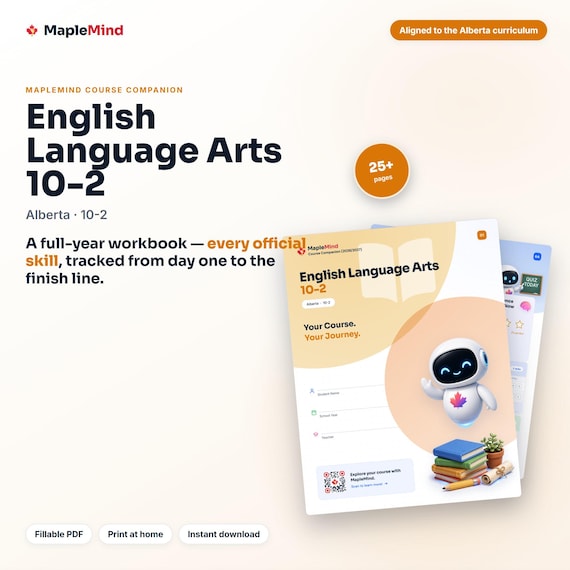
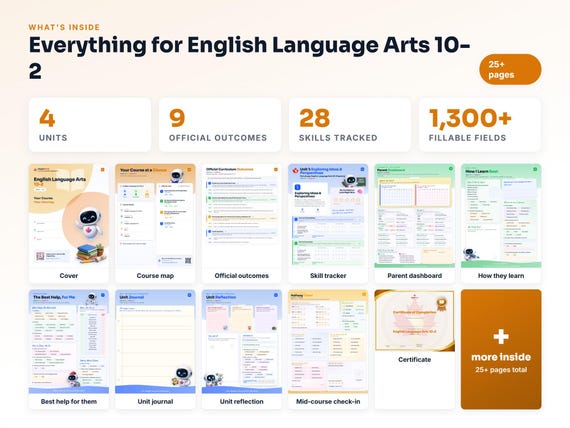
A English Language Arts 10-2 workbook worth keeping
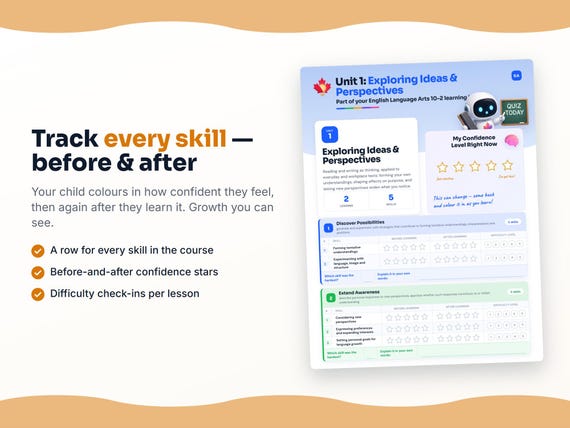
Built from the same official curriculum as this page. Before and after each skill above, your student colours in how sure they feel — so the two of you can see, on one page, what's clicking and what needs another look. It's a quiet way to follow how the year is really going.
By June it's full of their own handwriting: units worked through, confidence grown, a mid-year check-in, notes from parent-teacher night, and a certificate at the end. Less a worksheet, more a record of the year worth keeping on the shelf.
Instant download · see every page, reviews and the full description · five or more workbooks are $2.99 each
What it looks like in the app



Common questions
Can MapleMind help me with English Language Arts 10-2?
Yes. MapleMind's AI tutor covers all 28 skills in Alberta's English Language Arts 10-2 — you pick the exact skill, and the tutor teaches it step by step: a short lesson, a worked example, solving together, then a skill check to show it stuck.
Is MapleMind aligned to Alberta's official curriculum?
Yes. Every skill in this course maps to an official outcome code from Alberta's Grade 10 English Language Arts curriculum, and the ministry's own wording is quoted under each unit on this page — with the official government source linked so you can check it yourself.
What does MapleMind cost?
It's free to start — 5 tutoring chats and a practice quiz every day, no credit card. A Pro subscription ($9.99/month or $49.99/year CAD, 7-day free trial) unlocks unlimited tutoring, practice, and exam simulations.
What if I'm stuck on just one topic?
That's the point of skill-level tutoring: open English Language Arts 10-2 in the app, tap the exact skill from the list on this page, and the tutor teaches just that — no wading through lessons you don't need.
Does MapleMind work in French or other languages?
Yes — 14 languages, including French. Both the app and the tutor's explanations switch to the language you choose.
Where can I see the official Alberta curriculum for English Language Arts 10-2?
The official source is linked on this page — Alberta's official programs of study. The outline here follows it: every MapleMind skill carries its official outcome code, and the ministry's own wording is quoted under each unit.
Keep exploring
Ready when you are
Pick a skill from this page and see it taught properly — free, in the browser, in under a minute.