Get help with Science 8
Most tutoring makes you sit through material you already know. MapleMind flips that: pick the exact skill that's causing trouble — any of the 39 below — and the tutor teaches just that one, step by step, as many times as it takes. Ask questions in plain words, any time of day, in English, French, or 12 other languages.
The official Alberta Science 8 curriculum
Alberta defines Science 8 by strands and outcomes. MapleMind teaches the same curriculum reorganized for one-skill-at-a-time tutoring — the table shows exactly where every official strand lands, and the ministry's own wording is quoted under each unit below.
Official source Alberta's official programs of studyRead it on the government site — alberta.ca ↗| Official strand | Outcomes | Where MapleMind teaches it |
|---|---|---|
| Mix and Flow of Matter | 4 | Mix and Flow of Matter |
| Cells and Systems | 4 | Cells and Systems |
| Light and Optical Systems | 3 | Light and Optical Systems |
| Mechanical Systems | 4 | Mechanical Systems |
| Freshwater and Saltwater Systems | 4 | Freshwater and Saltwater Systems |
Every skill below, taught one on one.
 Try the first session free
How MapleMind teaches Science 8 — every unit, lesson, and skill
Every skill below runs as a short session: a plain-words lesson, a worked example, solving it together, then a five-question skill check that earns up to three stars. Guided Mode keeps it teaching instead of answer-handing — turning it off needs a parent's password.
Unit 1Mix and Flow of MatterOfficial strand · Mix and Flow of Matter
Fluids and their uses, the composition and behaviour of solutions, how the particle model explains fluid properties, and technologies built on those properties.
Fluids Around Us
- What is a fluid?8.A.1 — Identify fluids (liquids and gases) as materials that flow and take the shape of their container, and give examples in everyday materials and devices.
- Fluids in technological devices8.A.1 — Describe how fluids are used in familiar technologies (brakes, syringes, pumps) and why a fluid is the right material for the job.
Solutions and Mixtures
- Mixtures and solutions8.A.2 — Distinguish pure substances from mixtures, and mechanical mixtures from solutions, and describe the parts of a solution (solute and solvent).
- Concentration and solubility8.A.2 — Describe concentration qualitatively (dilute vs. concentrated) and identify factors that affect how much solute dissolves and how fast (temperature, stirring).
Properties of Fluids
- Viscosity and flow rate8.A.3 — Describe viscosity as resistance to flow, compare the flow rate of different fluids, and relate viscosity to temperature.
- Density and buoyancy8.A.3 — Explain density as mass per unit volume, predict floating vs. sinking from relative density, and describe buoyant force.
- Compressibility and the particle model8.A.3 — Use the particle model (spacing of particles) to explain why gases are compressible and liquids are nearly not, and to explain density and viscosity.
Technologies That Use Fluids
- Pressure and force in fluids8.A.4 — Describe pressure as force per unit area and how a confined fluid transmits pressure (the basis of hydraulic and pneumatic systems).
- Hydraulic and pneumatic systems8.A.4 — Explain how hydraulic (liquid) and pneumatic (gas) systems use fluid pressure to move and lift, and identify examples of each.
The official wording — 4 outcomes in this unit
- 8.A.1
Investigate and describe fluids used in technological devices and everyday materials.
- 8.A.2
Investigate and describe the composition of fluids, and interpret the behaviour of materials in solution.
- 8.A.3
Investigate and compare the properties of gases and liquids; and relate variations in their viscosity, density, buoyancy and compressibility to the particle model of matter.
- 8.A.4
Identify, interpret and apply technologies based on properties of fluids.
Unit 2Cells and SystemsOfficial strand · Cells and Systems
The characteristics and organization of living things, the role of cells, the healthy function of human body systems, and the science leading to new medical knowledge.
Characteristics of Living Things
- Living things and their organization8.B.1 — Identify the characteristics common to living things and describe how organisms are organized from cells to tissues, organs and systems.
- Seeing cells with the microscope8.B.1 — Describe how the microscope extended our view of living things and use magnification to estimate the size of what is seen.
Cells and Their Functions
- Cell structures and functions8.B.2 — Identify major cell structures (membrane, nucleus, cytoplasm; cell wall and chloroplasts in plants) and their functions, and compare plant and animal cells.
- Diffusion and osmosis8.B.2 — Describe how materials move into and out of cells by diffusion and osmosis across the cell membrane, and why cells stay small.
Human Body Systems
- Digestive, circulatory and respiratory systems8.B.3 — Describe how the digestive, circulatory and respiratory systems work and cooperate to supply cells with nutrients and oxygen.
- Responding to stimuli8.B.3 — Illustrate ways the body responds to internal and external stimuli (e.g., temperature, exercise) to maintain a stable internal state.
Science and Medical Advances
- Investigating body systems8.B.4 — Describe areas of scientific investigation that have led to new knowledge about how body systems work.
- Medical technologies and applications8.B.4 — Identify medical technologies that arose from this knowledge (imaging, transplants, diagnostics) and one issue each raises.
The official wording — 4 outcomes in this unit
- 8.B.1
Investigate living things; and identify and apply scientific ideas used to interpret their general structure, function and organization.
- 8.B.2
Investigate and describe the role of cells within living things.
- 8.B.3
Interpret the healthy function of human body systems, and illustrate ways the body reacts to internal and external stimuli.
- 8.B.4
Describe areas of scientific investigation leading to new knowledge about body systems and to new medical applications.
Unit 3Light and Optical SystemsOfficial strand · Light and Optical Systems
The nature of light and vision, how light travels described by the geometric ray model, and how images form in the eye and in optical technologies.
The Nature of Light and Vision
- Sources and nature of light8.C.1 — Distinguish luminous sources from illuminated objects, and describe how ideas about light have developed through invention and inquiry.
- How we see objects8.C.1 — Explain that we see objects because light travels from a source, reflects off the object, and enters the eye — not because the eye "sends out" rays.
Light and the Ray Model
- Reflection and the ray model8.C.2 — Use the geometric ray model and the law of reflection (angle of incidence equals angle of reflection) to predict how light bounces off surfaces and mirrors.
- Refraction: bending light8.C.2 — Describe refraction as the bending of light as it passes between materials (e.g., air to water) and give examples of its effects.
Images and Optical Technology
- Lenses and image formation8.C.3 — Describe how converging and diverging lenses bend light to form images, and how the eye forms an image on the retina.
- Optical technologies8.C.3 — Interpret how optical technologies (glasses, cameras, microscopes, telescopes) use lenses and mirrors to extend or correct human vision.
The official wording — 3 outcomes in this unit
- 8.C.1
Investigate the nature of light and vision; and describe the role of invention, explanation and inquiry in developing our current knowledge.
- 8.C.2
Investigate the transmission of light, and describe its behaviour using a geometric ray model.
- 8.C.3
Investigate and explain the science of image formation and vision, and interpret related technologies.
Unit 4Mechanical SystemsOfficial strand · Mechanical Systems
How mechanical devices have improved over time, how a machine breaks into systems and subsystems, how force and energy transmit through it, and the social and environmental contexts of machines.
Machines Through History
- Simple machines8.D.1 — Identify the simple machines (lever, wheel and axle, pulley, inclined plane, wedge, screw) and describe how each makes work easier.
- How machines improved over time8.D.1 — Compare an older and a newer version of a mechanical device and describe the scientific or design ideas behind the improvement.
Analyzing Mechanical Systems
- Systems, subsystems and parts8.D.2 — Analyze a machine by naming the overall system, its subsystems, and the component parts, and describe the function of each.
- Mechanical advantage8.D.2 — Describe mechanical advantage as the trade-off between force and distance, and estimate it for a simple machine.
Force and Energy in Machines
- Transmitting force and motion8.D.3 — Describe how force and motion transmit between parts (gears, belts, chains, hydraulics) and how direction and speed can change.
- Energy and efficiency8.D.3 — Explain that some input energy is always lost to friction as heat, so a machine is never 100% efficient.
Machines, Society and Environment
- Machines and society8.D.4 — Describe how the development of a mechanical device changed how people work or live, with benefits and drawbacks.
- Environmental impact of machines8.D.4 — Analyze an environmental impact of a machine (energy use, emissions, materials) and one way to reduce it.
The official wording — 4 outcomes in this unit
- 8.D.1
Illustrate the development of science and technology by describing, comparing and interpreting mechanical devices that have been improved over time.
- 8.D.2
Analyze machines by describing the structures and functions of the overall system, the subsystems and the component parts.
- 8.D.3
Investigate and describe the transmission of force and energy between parts of a mechanical system.
- 8.D.4
Analyze the social and environmental contexts of science and technology, as they apply to the development of mechanical devices.
Unit 5Freshwater and Saltwater SystemsOfficial strand · Freshwater and Saltwater Systems
The distribution and importance of water, the links among landforms, water and climate, what shapes productivity and species in aquatic environments, and human impacts on water.
Water on Earth
- Distribution of water8.E.1 — Describe where Earth’s water is found (oceans, ice, groundwater, freshwater) and the relative amounts, locally and globally.
- Water supply and quality8.E.1 — Explain why the supply and quality of fresh water matter to humans and other living things, and how quality is judged.
Water, Landforms and Climate
- Water shaping the land8.E.2 — Describe how moving water, ice and waves erode and deposit material to shape landforms over time.
- Water and climate8.E.2 — Explain how large bodies of water moderate climate and drive the water cycle, linking water, land and weather.
Life in Aquatic Systems
- Factors affecting productivity8.E.3 — Analyze how light, temperature, dissolved oxygen and nutrients affect the productivity of a marine or freshwater environment.
- Species distribution in water8.E.3 — Explain how conditions such as salinity, depth and temperature determine where different aquatic species live.
Human Impact on Water
- Human impacts on aquatic systems8.E.4 — Analyze human impacts on aquatic systems (pollution, overuse, habitat change) and their effects on water quality and life.
- Science and water issues8.E.4 — Identify roles of science and technology in monitoring and protecting water (treatment, testing, restoration).
The official wording — 4 outcomes in this unit
- 8.E.1
Describe the distribution and characteristics of water in local and global environments, and identify the significance of water supply and quality to the needs of humans and other living things.
- 8.E.2
Investigate and interpret linkages among landforms, water and climate.
- 8.E.3
Analyze factors affecting productivity and species distribution in marine and freshwater environments.
- 8.E.4
Analyze human impacts on aquatic systems; and identify the roles of science and technology in addressing related questions, problems and issues.
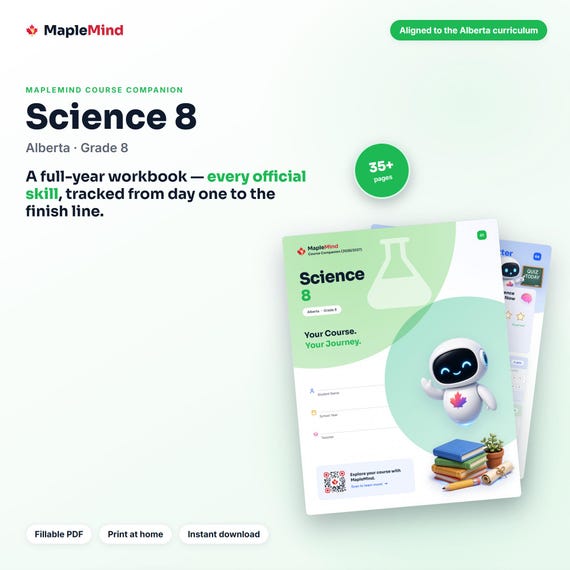
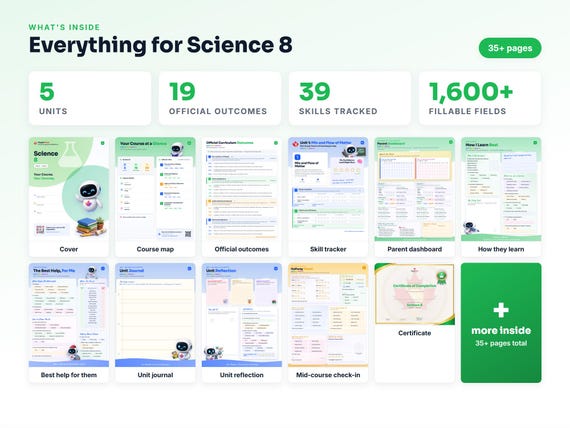


Printable workbook · A keepsake of the year
A Science 8 workbook worth keeping
Built from the same official curriculum as this page. Before and after each skill above, your student colours in how sure they feel — so the two of you can see, on one page, what's clicking and what needs another look. It's a quiet way to follow how the year is really going.
By June it's full of their own handwriting: units worked through, confidence grown, a mid-year check-in, notes from parent-teacher night, and a certificate at the end. Less a worksheet, more a record of the year worth keeping on the shelf.
Instant download · see every page, reviews and the full description · five or more workbooks are $2.99 each
What it looks like in the app



Common questions
Can MapleMind help me with Science 8?
Yes. MapleMind's AI tutor covers all 39 skills in Alberta's Science 8 — you pick the exact skill, and the tutor teaches it step by step: a short lesson, a worked example, solving together, then a skill check to show it stuck.
Is MapleMind aligned to Alberta's official curriculum?
Yes. Every skill in this course maps to an official outcome code from Alberta's Grade 8 Science curriculum, and the ministry's own wording is quoted under each unit on this page — with the official government source linked so you can check it yourself.
What does MapleMind cost?
It's free to start — 5 tutoring chats and a practice quiz every day, no credit card. A Pro subscription ($9.99/month or $49.99/year CAD, 7-day free trial) unlocks unlimited tutoring, practice, and exam simulations.
What if I'm stuck on just one topic?
That's the point of skill-level tutoring: open Science 8 in the app, tap the exact skill from the list on this page, and the tutor teaches just that — no wading through lessons you don't need.
Does MapleMind work in French or other languages?
Yes — 14 languages, including French. Both the app and the tutor's explanations switch to the language you choose.
Where can I see the official Alberta curriculum for Science 8?
The official source is linked on this page — Alberta's official programs of study. The outline here follows it: every MapleMind skill carries its official outcome code, and the ministry's own wording is quoted under each unit.
Keep exploring
Ready when you are
Pick a skill from this page and see it taught properly — free, in the browser, in under a minute.