Get help with Science 9
Most tutoring makes you sit through material you already know. MapleMind flips that: pick the exact skill that's causing trouble — any of the 42 below — and the tutor teaches just that one, step by step, as many times as it takes. Ask questions in plain words, any time of day, in English, French, or 12 other languages.
The official Alberta Science 9 curriculum
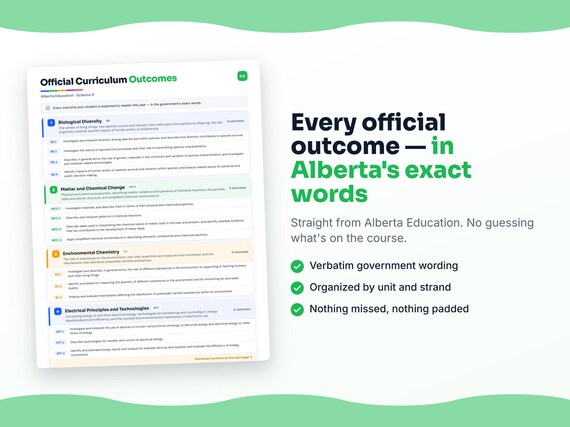
Alberta defines Science 9 by strands and outcomes. MapleMind teaches the same curriculum reorganized for one-skill-at-a-time tutoring — the table shows exactly where every official strand lands, and the ministry's own wording is quoted under each unit below.
Official source Alberta's official programs of studyRead it on the government site — alberta.ca ↗| Official strand | Outcomes | Where MapleMind teaches it |
|---|---|---|
| Biological Diversity | 4 | Biological Diversity |
| Matter and Chemical Change | 4 | Matter and Chemical Change |
| Environmental Chemistry | 3 | Environmental Chemistry |
| Electrical Principles and Technologies | 4 | Electrical Principles and Technologies |
| Space Exploration | 4 | Space Exploration |
Every skill below, taught one on one.
 Try the first session free
How MapleMind teaches Science 9 — every unit, lesson, and skill
Every skill below runs as a short session: a plain-words lesson, a worked example, solving it together, then a five-question skill check that earns up to three stars. Guided Mode keeps it teaching instead of answer-handing — turning it off needs a parent's password.
Unit 1Biological DiversityOfficial strand · Biological Diversity
The variety of living things, how species survive and interact, how traits pass from parents to offspring, the role of genetic material, and the impact of human action on biodiversity.
Diversity and Species Survival
- Variation within and among species9.A.1 — Observe and describe variation among species and within a species, and explain how variation helps species survive changing conditions.
- Niches and symbiotic relationships9.A.1 — Identify niches and the dependencies that link species, and classify symbiotic relationships as mutualism, commensalism or parasitism.
Reproduction and Inheritance of Traits
- Sexual vs. asexual reproduction9.A.2 — Distinguish sexual from asexual reproduction (binary fission, budding, spores vs. cross-fertilization) and describe zygote and embryo formation.
- Heritable traits and variation9.A.2 — Identify discrete vs. continuous variation, distinguish heritable from non-heritable traits, and recognize where heredity and environment both play a role.
- Dominant and recessive characteristics9.A.2 — Identify examples of dominant and recessive characteristics and recognize that dominance gives only a partial explanation of variation.
Genetic Material and Selection
- Chromosomes, genes and DNA9.A.3 — Describe the relationship of chromosomes, genes and DNA as repositories of genetic information, and distinguish cell division that copies cells from division that makes sex cells.
- Natural and artificial selection9.A.3 — Compare advantages of sexual vs. asexual reproduction, and distinguish natural from artificial selection with examples.
- Genetic technologies and their issues9.A.3 — Describe emerging technologies for recombining genetic material and identify questions and issues related to their use.
Biodiversity and Human Impact
- Extinction and changing diversity9.A.4 — Describe the relative abundance of species and ongoing changes through extinction and extirpation, investigating the environmental factors behind them.
- Conservation strategies and biotechnology9.A.4 — Evaluate strategies for minimizing species loss (seed banks, protected areas, treaties) and the impacts of biotechnology in resource management.
The official wording — 4 outcomes in this unit
- 9.A.1
Investigate and interpret diversity among species and within species, and describe how diversity contributes to species survival.
- 9.A.2
Investigate the nature of reproductive processes and their role in transmitting species characteristics.
- 9.A.3
Describe, in general terms, the role of genetic materials in the continuity and variation of species characteristics; and investigate and interpret related technologies.
- 9.A.4
Identify impacts of human action on species survival and variation within species, and analyze related issues for personal and public decision making.
Unit 2Matter and Chemical ChangeOfficial strand · Matter and Chemical Change
Physical and chemical properties, classifying matter, evidence and patterns of chemical reactions, the periodic table and atomic structure, and simplified chemical nomenclature.
Properties and Classifying Matter
- Physical and chemical properties9.B.1 — Investigate and describe materials by properties such as melting point, solubility and conductivity, and judge when a new substance has been produced.
- Classifying materials9.B.1 — Classify materials by composition: pure substances vs. solutions vs. mechanical mixtures, and metals vs. nonmetals.
Patterns in Chemical Reactions
- Evidence of chemical change9.B.2 — Observe and describe evidence of chemical change (combustion, corrosion, reactions with oxygen) and evaluate the dangers of caustic and explosive reactions.
- Reaction rates and energy9.B.2 — Identify exothermic vs. endothermic reactions and the conditions (heat, concentration, surface area) that affect reaction rates.
- Conservation of mass9.B.2 — Identify evidence for conservation of mass in chemical reactions and describe techniques for gathering that evidence.
The Periodic Table and Atoms
- Origins of the periodic table9.B.3 — Describe how the periodic table arose and relate patterns in element properties to position on the table (first 18 elements).
- Reading atomic structure from the table9.B.3 — Use the periodic table to find protons, electrons and other atomic information, and distinguish observation from theory in atomic models.
- Ionic vs. molecular compounds9.B.3 — Distinguish ionic from molecular compounds and describe the properties of common examples of each.
Naming Compounds and Reactions
- Reading and naming chemical formulas9.B.4 — Read and interpret formulas for two-element compounds and give their IUPAC and common names (NaCl, CO₂, MgO, FeCl₂/FeCl₃).
- Combining ratios and models9.B.4 — Use ion charges to predict combining ratios in ionic compounds and build simple models of molecular and ionic compounds.
- Word and formula equations9.B.4 — Represent familiar reactions (combustion, corrosion, replacement) with word equations and chemical formulas (not balancing at this level).
The official wording — 4 outcomes in this unit
- 9.B.1
Investigate materials, and describe them in terms of their physical and chemical properties.
- 9.B.2
Describe and interpret patterns in chemical reactions.
- 9.B.3
Describe ideas used in interpreting the chemical nature of matter, both in the past and present, and identify example evidence that has contributed to the development of these ideas.
- 9.B.4
Apply simplified chemical nomenclature in describing elements, compounds and chemical reactions.
Unit 3Environmental ChemistryOfficial strand · Environmental Chemistry
The role of substances in the environment, how their quantities are measured and monitored, and the mechanisms that distribute potentially harmful substances.
Substances in the Environment
- Helpful and harmful substances9.C.1 — Describe, in general terms, how different substances support or harm humans and other living things, including nutrients and toxins.
- Organisms and their chemical needs9.C.1 — Relate the needs of organisms to the substances they take from and return to the environment.
Measuring and Monitoring
- Measuring quantities of substances9.C.2 — Identify processes for measuring the quantity of substances, including concentration expressed as parts per million (ppm).
- Monitoring air and water quality9.C.2 — Describe methods and indicators used to monitor air and water quality over time.
Distribution of Harmful Substances
- Transport and bioaccumulation9.C.3 — Analyze mechanisms — including bioaccumulation through food chains — that affect how harmful substances spread through an environment.
- Factors affecting distribution9.C.3 — Evaluate how factors such as solubility, degradation and dilution change the distribution and impact of a substance.
The official wording — 3 outcomes in this unit
- 9.C.1
Investigate and describe, in general terms, the role of different substances in the environment in supporting or harming humans and other living things.
- 9.C.2
Identify processes for measuring the quantity of different substances in the environment and for monitoring air and water quality.
- 9.C.3
Analyze and evaluate mechanisms affecting the distribution of potentially harmful substances within an environment.
Unit 4Electrical Principles and TechnologiesOfficial strand · Electrical Principles and Technologies
Converting energy to and from electrical energy, technologies for transferring and controlling it, energy inputs/outputs and efficiency, and the societal and environmental implications of electricity use.
Converting Energy to Electricity
- Energy conversions9.D.1 — Investigate devices that convert other forms of energy to electrical energy and electrical energy to other forms (cells, generators, motors, lights).
- Static and current electricity9.D.1 — Distinguish static from current electricity and describe how charge builds and flows.
Transferring and Controlling Electricity
- Circuits and components9.D.2 — Describe technologies for transferring and controlling electrical energy, including series and parallel circuits and their components.
- Voltage, current and resistance9.D.2 — Relate voltage, current and resistance (Ohm’s law, V = IR) and assess the potential danger of electrical devices from their voltage and current.
Energy Inputs, Outputs and Efficiency
- Energy inputs and outputs9.D.3 — Identify and estimate the energy inputs and outputs of example devices and systems, including power in watts.
- Calculating efficiency9.D.3 — Evaluate the efficiency of energy conversions as useful output over total input, expressed as a percent.
Electricity, Society and Environment
- Generation and the environment9.D.4 — Describe how electrical energy is generated (renewable and non-renewable sources) and discuss the environmental implications of each.
- Conservation and everyday choices9.D.4 — Analyze personal and societal choices about electricity use and conservation, including reading energy consumption.
The official wording — 4 outcomes in this unit
- 9.D.1
Investigate and interpret the use of devices to convert various forms of energy to electrical energy and electrical energy to other forms of energy.
- 9.D.2
Describe technologies for transfer and control of electrical energy.
- 9.D.3
Identify and estimate energy inputs and outputs for example devices and systems, and evaluate the efficiency of energy conversions.
- 9.D.4
Describe and discuss the societal and environmental implications of the use of electrical energy.
Unit 5Space ExplorationOfficial strand · Space Exploration
How technology has shaped our understanding of Earth and space, the technologies developed for space exploration and life in space, optical/radio telescopes and probes, and the issues arising from space technology.
Understanding Earth and Space
- Changing ideas about Earth and space9.E.1 — Investigate how human understanding of Earth and space has depended on technological development, and how ideas have changed over time.
- Reference frames and celestial motion9.E.1 — Describe observed motions of celestial objects and how frames of reference explain day, night, seasons and phases.
Technologies for Space Exploration
- Challenges of space travel9.E.2 — Identify problems in developing space technologies and describe technologies developed for life in space (life support, propulsion, materials).
- Spin-off technologies9.E.2 — Describe everyday technologies that originated from or were advanced by space research.
Telescopes and Probes
- Optical and radio telescopes9.E.3 — Describe the science of optical and radio telescopes and how they gather information across the electromagnetic spectrum.
- Space probes and remote sensing9.E.3 — Interpret how space probes and remote sensing technologies collect and transmit data about distant objects and Earth.
Issues in Space Technology
- Opportunities and alternatives9.E.4 — Identify issues and opportunities from space technology, the alternatives involved, and analyze the implications for society.
The official wording — 4 outcomes in this unit
- 9.E.1
Investigate and describe ways that human understanding of Earth and space has depended on technological development.
- 9.E.2
Identify problems in developing technologies for space exploration, describe technologies developed for life in space, and explain the scientific principles involved.
- 9.E.3
Describe and interpret the science of optical and radio telescopes, space probes and remote sensing technologies.
- 9.E.4
Identify issues and opportunities arising from the application of space technology, identify alternatives involved, and analyze implications.
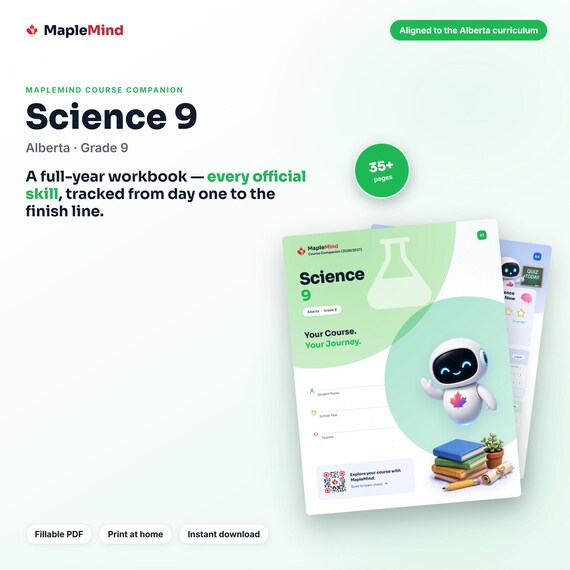
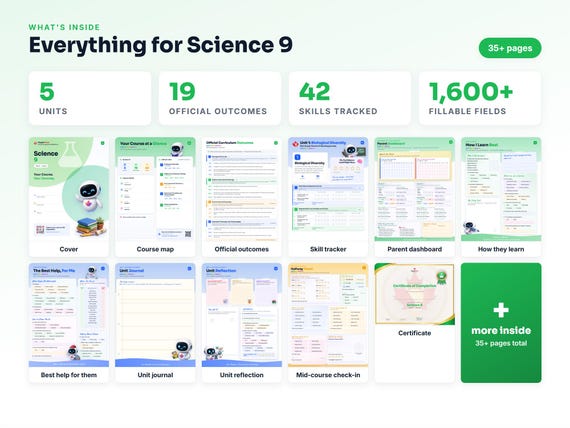

Printable workbook · A keepsake of the year
A Science 9 workbook worth keeping
Built from the same official curriculum as this page. Before and after each skill above, your student colours in how sure they feel — so the two of you can see, on one page, what's clicking and what needs another look. It's a quiet way to follow how the year is really going.
By June it's full of their own handwriting: units worked through, confidence grown, a mid-year check-in, notes from parent-teacher night, and a certificate at the end. Less a worksheet, more a record of the year worth keeping on the shelf.
Instant download · see every page, reviews and the full description · five or more workbooks are $2.99 each
What it looks like in the app



Preparing for the Grade 9 Provincial Achievement Test (PAT)?
Alberta students write a Provincial Achievement Test in Grade 9. MapleMind's exam mode simulates it from this course's skills, then shows exactly which ones to shore up.
Common questions
Can MapleMind help me with Science 9?
Yes. MapleMind's AI tutor covers all 42 skills in Alberta's Science 9 — you pick the exact skill, and the tutor teaches it step by step: a short lesson, a worked example, solving together, then a skill check to show it stuck.
Is MapleMind aligned to Alberta's official curriculum?
Yes. Every skill in this course maps to an official outcome code from Alberta's Grade 9 Science curriculum, and the ministry's own wording is quoted under each unit on this page — with the official government source linked so you can check it yourself.
What does MapleMind cost?
It's free to start — 5 tutoring chats and a practice quiz every day, no credit card. A Pro subscription ($9.99/month or $49.99/year CAD, 7-day free trial) unlocks unlimited tutoring, practice, and exam simulations.
What if I'm stuck on just one topic?
That's the point of skill-level tutoring: open Science 9 in the app, tap the exact skill from the list on this page, and the tutor teaches just that — no wading through lessons you don't need.
Does MapleMind work in French or other languages?
Yes — 14 languages, including French. Both the app and the tutor's explanations switch to the language you choose.
Where can I see the official Alberta curriculum for Science 9?
The official source is linked on this page — Alberta's official programs of study. The outline here follows it: every MapleMind skill carries its official outcome code, and the ministry's own wording is quoted under each unit.
Does MapleMind help with the Grade 9 Provincial Achievement Test (PAT)?
Yes. Alberta students write a Provincial Achievement Test in Grade 9. MapleMind's exam mode simulates it from this course's skills, then shows exactly which ones to shore up.
Keep exploring
Ready when you are
Pick a skill from this page and see it taught properly — free, in the browser, in under a minute.