Get help with Science 10
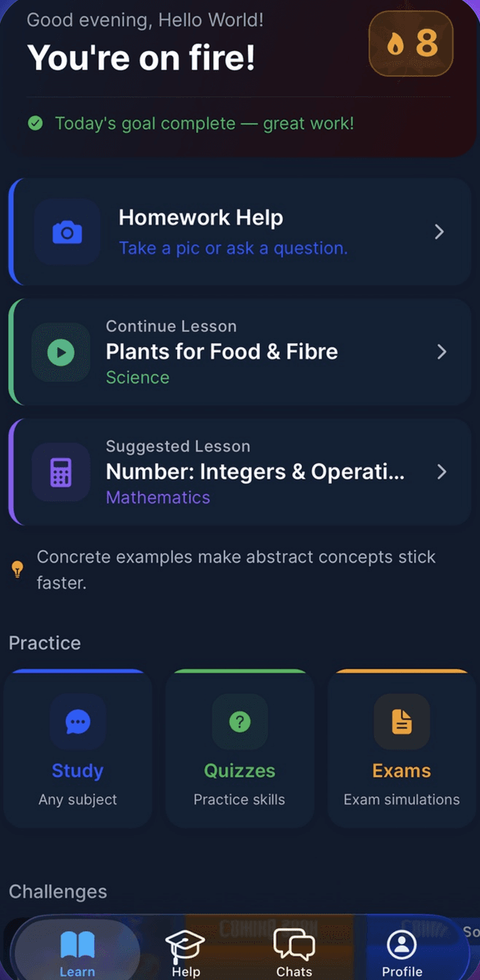
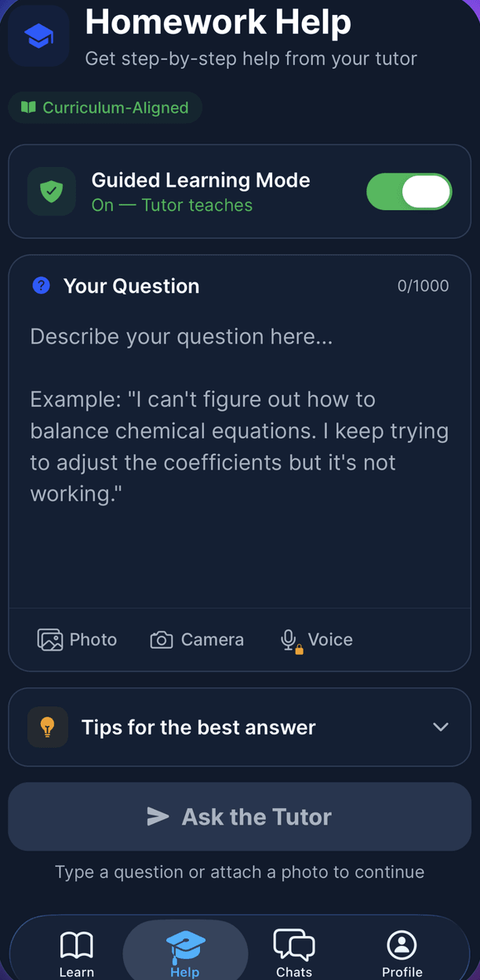
Most tutoring makes you sit through material you already know. MapleMind flips that: pick the exact skill that's causing trouble — any of the 18 below — and the tutor teaches just that one, step by step, as many times as it takes. Ask questions in plain words, any time of day, in English, French, or 12 other languages.
The official Alberta Science 10 curriculum
Alberta defines Science 10 by strands and outcomes. MapleMind teaches the same curriculum reorganized for one-skill-at-a-time tutoring — the table shows exactly where every official strand lands, and the ministry's own wording is quoted under each unit below.
Official source Alberta's official programs of studyRead it on the government site — alberta.ca ↗| Official strand | Outcomes | Where MapleMind teaches it |
|---|---|---|
| Unit A | 3 | Energy & Matter in Chemical Change |
| Unit B | 3 | Energy Flow in Technological Systems |
| Unit C | 3 | Cycling of Matter in Living Systems |
| Unit D | 4 | Energy Flow in Global Systems |
Every skill below, taught one on one.
 Try the first session free
How MapleMind teaches Science 10 — every unit, lesson, and skill
Every skill below runs as a short session: a plain-words lesson, a worked example, solving it together, then a five-question skill check that earns up to three stars. Guided Mode keeps it teaching instead of answer-handing — turning it off needs a parent's password.
Unit 1Energy & Matter in Chemical ChangeOfficial strand · Unit A
What matter is made of, how the periodic table lets elements combine into named compounds, and how chemical change conserves mass — the chemistry foundation for every science that follows.
The Structure of Matter
- Particles that make up matter10.A.1 — Describe the basic particles — protons, neutrons and electrons — that make up the underlying structure of matter, trace the evidence behind the atomic model (Dalton, Thomson, Rutherford, Bohr), and investigate related technologies.
Combining Elements & Naming Compounds
- How elements combine to form compounds10.A.2 — Explain, using the periodic table, how and why elements combine to form compounds in specific ratios — metals with non-metals (ionic), non-metals with non-metals (molecular).
- Naming ionic compounds (IUPAC)10.A.2 — Follow IUPAC guidelines to write formulas and names for ionic compounds, using a periodic table, a table of ions and charge balance ($\text{MgO}$ = magnesium oxide, $\text{CaCl}_2$ = calcium chloride).
- Naming simple molecular compounds (IUPAC)10.A.2 — Follow IUPAC guidelines to name simple molecular compounds using multiplying prefixes ($\text{CO}_2$ = carbon dioxide, $\text{N}_2\text{O}$ = dinitrogen monoxide).
Chemical Change & Conservation of Mass
- Identifying and classifying chemical changes10.A.3 — Recognize the evidence for a chemical change (energy/temperature change, colour or odour change, formation of a gas or precipitate) and classify reactions by type — synthesis, decomposition, single and double replacement, combustion — and as endothermic or exothermic.
- Writing balanced equations & conservation of mass10.A.3 — Translate word equations to balanced chemical equations (and back) for significant reactions, applying Lavoisier’s law of conservation of mass so atoms are neither created nor destroyed.
The official wording — 3 outcomes in this unit
- 10.A.1
Describe the basic particles that make up the underlying structure of matter, and investigate related technologies
- 10.A.2
Explain, using the periodic table, how elements combine to form compounds
- 10.A.3
Identify and classify chemical changes
Unit 2Energy Flow in Technological SystemsOfficial strand · Unit B
How steam engines and other machines were built before thermodynamics was understood, how we measure energy in mechanical systems, and why no energy transformation is ever perfectly efficient.
Machines Before the Laws of Thermodynamics
- Technology developed before the laws10.B.1 — Analyze and illustrate how technologies based on thermodynamic principles — such as the steam engine — were developed before the laws of thermodynamics were formulated, and how the concept of energy grew from observing heat and mechanical devices.
Concepts of Energy in Mechanical Systems
- Defining the measures of energy10.B.2 — Explain the concepts used to measure energy in mechanical systems: kinetic energy (energy of motion) and potential energy (energy of position or condition), chemical energy as stored potential energy, and the difference between scalar and vector quantities in describing motion.
- Calculating energy and work10.B.2 — Apply the practical measures of energy in mechanical systems: gravitational potential energy $E_p = mgh$, kinetic energy $E_k = \frac{1}{2}mv^2$, work $W = Fd$, and the joule as the SI unit of energy — with $g = 9.81\ \text{m/s}^2$.
Efficiency of Energy Transformations
- Energy conservation and efficiency of transformations10.B.3 — Apply the principles of energy conservation and the first and second laws of thermodynamics to investigate, describe and predict the efficiency of energy transformation in technological systems, and explain why efficiency is always below 100%.
The official wording — 3 outcomes in this unit
- 10.B.1
Analyze and illustrate how technologies based on thermodynamic principles were developed before the laws of thermodynamics were formulated
- 10.B.2
Explain concepts used in theoretical and practical measures of energy in mechanical systems
- 10.B.3
Apply the principles of energy conservation and thermodynamics to investigate, describe and predict efficiency of energy transformation in technological systems
Unit 3Cycling of Matter in Living SystemsOfficial strand · Unit C
How imaging technology built our picture of the cell, what each organelle does, how matter moves in and out of a cell, and how a plant scales that cell up into tissues and systems.
Imaging Technology & the Cell
- Imaging technology and understanding of the cell10.C.1 — Explain how developments in imaging technology — the light and electron microscope, and staining techniques — shaped the cell theory and the current understanding of the cell.
Cell Organelles & Transport
- Function of cell organelles and structures10.C.2 — Describe the function of the cell membrane, nucleus, mitochondrion, ribosomes, chloroplast, cell wall and other organelles in a cell, in terms of the life processes each carries out.
- Modelling transport across the cell10.C.2 — Use models to explain how matter moves across the cell — passive transport by diffusion and osmosis versus active transport, the role of the semi-permeable membrane in maintaining equilibrium, and the surface-area-to-volume ratio that limits cell size — and their applications.
Plants as a Multicellular Organism
- Specialized structures in plants10.C.3 — Analyze plants as an example of a multicellular organism with specialized structures at the cellular, tissue and system levels — leaf tissues for photosynthesis, xylem and phloem for transport, stomata for gas exchange.
The official wording — 3 outcomes in this unit
- 10.C.1
Explain the relationship between developments in imaging technology and the current understanding of the cell
- 10.C.2
Describe the function of cell organelles and structures in a cell, in terms of life processes
- 10.C.3
Analyze plants as an example of a multicellular organism with specialized structures at the cellular, tissue and system levels
Unit 4Energy Flow in Global SystemsOfficial strand · Unit D
How solar energy drives the biosphere, how global energy transfer shapes climate, why climate defines the world’s biomes, and how environmental factors are changing that climate.
Solar Energy, Global Transfer & Climate
- Solar energy, terrestrial energy and the biosphere10.D.1 — Describe how the relationships among input solar energy, output terrestrial energy (the net radiation budget) and energy flow within the biosphere — including the greenhouse effect — affect the lives of humans and other species.
- Net solar energy, global transfer and climate10.D.2 — Analyze the relationships among net solar energy, global energy transfer processes — primarily radiation, convection and the hydrologic cycle — and climate.
Biomes & Climate Change
- Climate and the world’s major biomes10.D.3 — Relate climate to the characteristics of the world’s major biomes, and compare biomes in different regions of the world.
- Environmental factors and climate change10.D.4 — Investigate and interpret the role of environmental factors on global energy transfer and climate change.
The official wording — 4 outcomes in this unit
- 10.D.1
Describe how the relationships among input solar energy, output terrestrial energy and energy flow within the biosphere affect the lives of humans and other species
- 10.D.2
Analyze the relationships among net solar energy, global energy transfer processes—primarily radiation, convection and hydrologic cycle—and climate
- 10.D.3
Relate climate to the characteristics of the world’s major biomes, and compare biomes in different regions of the world
- 10.D.4
Investigate and interpret the role of environmental factors on global energy transfer and climate change

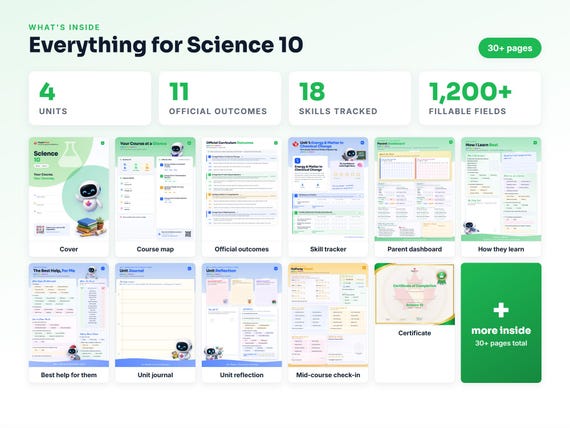


Printable workbook · A keepsake of the year
A Science 10 workbook worth keeping
Built from the same official curriculum as this page. Before and after each skill above, your student colours in how sure they feel — so the two of you can see, on one page, what's clicking and what needs another look. It's a quiet way to follow how the year is really going.
By June it's full of their own handwriting: units worked through, confidence grown, a mid-year check-in, notes from parent-teacher night, and a certificate at the end. Less a worksheet, more a record of the year worth keeping on the shelf.
Instant download · see every page, reviews and the full description · five or more workbooks are $2.99 each
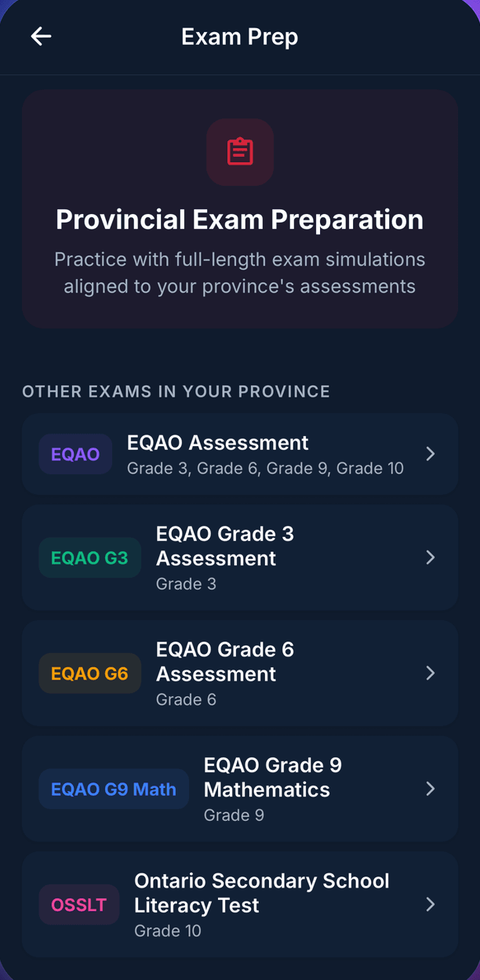
What it looks like in the app
Common questions
Can MapleMind help me with Science 10?
Yes. MapleMind's AI tutor covers all 18 skills in Alberta's Science 10 — you pick the exact skill, and the tutor teaches it step by step: a short lesson, a worked example, solving together, then a skill check to show it stuck.
Is MapleMind aligned to Alberta's official curriculum?
Yes. Every skill in this course maps to an official outcome code from Alberta's Grade 10 Science curriculum, and the ministry's own wording is quoted under each unit on this page — with the official government source linked so you can check it yourself.
What does MapleMind cost?
It's free to start — 5 tutoring chats and a practice quiz every day, no credit card. A Pro subscription ($9.99/month or $49.99/year CAD, 7-day free trial) unlocks unlimited tutoring, practice, and exam simulations.
What if I'm stuck on just one topic?
That's the point of skill-level tutoring: open Science 10 in the app, tap the exact skill from the list on this page, and the tutor teaches just that — no wading through lessons you don't need.
Does MapleMind work in French or other languages?
Yes — 14 languages, including French. Both the app and the tutor's explanations switch to the language you choose.
Where can I see the official Alberta curriculum for Science 10?
The official source is linked on this page — Alberta's official programs of study. The outline here follows it: every MapleMind skill carries its official outcome code, and the ministry's own wording is quoted under each unit.
Keep exploring
Ready when you are
Pick a skill from this page and see it taught properly — free, in the browser, in under a minute.