Get help with Chemistry 20
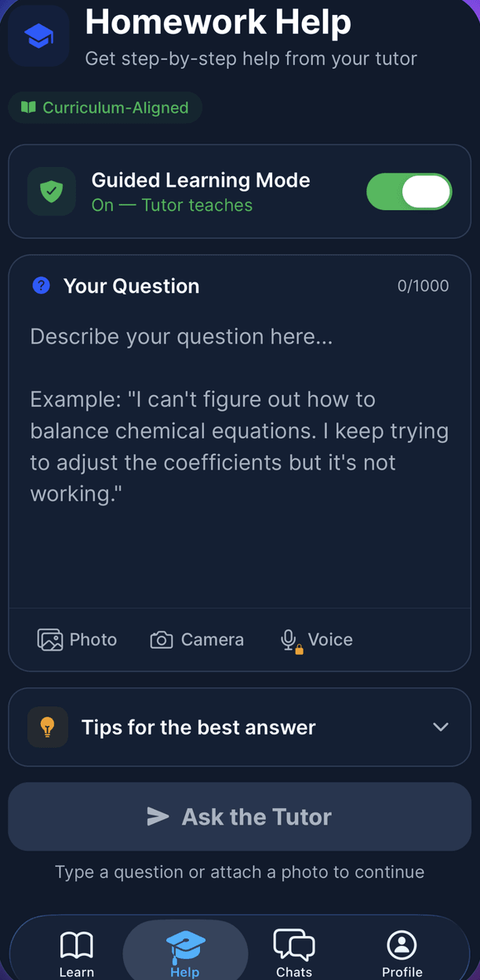
Most tutoring makes you sit through material you already know. MapleMind flips that: pick the exact skill that's causing trouble — any of the 54 below — and the tutor teaches just that one, step by step, as many times as it takes. Ask questions in plain words, any time of day, in English, French, or 12 other languages.
The official Alberta Chemistry 20 curriculum
Alberta defines Chemistry 20 by strands and outcomes. MapleMind teaches the same curriculum reorganized for one-skill-at-a-time tutoring — the table shows exactly where every official strand lands, and the ministry's own wording is quoted under each unit below.
Official source Alberta's official programs of studyRead it on the government site — alberta.ca ↗| Official strand | Outcomes | Where MapleMind teaches it |
|---|---|---|
| Unit A | 16 | Diversity of Matter & Chemical Bonding |
| Unit B | 4 | Forms of Matter: Gases |
| Unit C | 22 | Matter as Solutions, Acids & Bases |
| Unit D | 12 | Quantitative Relationships in Chemical Changes |
Every skill below, taught one on one.
 Try the first session free
How MapleMind teaches Chemistry 20 — every unit, lesson, and skill
Every skill below runs as a short session: a plain-words lesson, a worked example, solving it together, then a five-question skill check that earns up to three stars. Guided Mode keeps it teaching instead of answer-handing — turning it off needs a parent's password.
Unit 1Diversity of Matter & Chemical BondingOfficial strand · Unit A
Why atoms join at all — from the transfer of electrons that makes ionic compounds to the sharing that makes molecules — and how the bonding inside and between particles explains the properties we can see, feel and measure.
Naming Ionic Compounds & Why Charges Balance
- Naming ionic compounds20-A1.1k — Recall and apply the IUPAC principles for assigning names to ionic compounds, including multivalent metals and polyatomic ions.
- Ionic formulas as lowest whole-number ratios20-A1.2k — Explain why the formula of an ionic compound gives the simplest whole-number ratio of ions that produces a net charge of zero.
- Valence electrons, electronegativity and ionic bonds20-A1.3k — Define valence electron, electronegativity, ionic bond and intramolecular force, and use these terms precisely.
How Ionic Bonds Form & the Lattice
- Periodic table and electron dot diagrams for ionic bonding20-A1.4k — Use the periodic table and electron dot (Lewis) diagrams to support and explain ionic bonding theory — predicting the ions that form.
- Ionic bonds from attraction of opposite charges20-A1.5k — Explain how an ionic bond results from the simultaneous attraction of oppositely charged ions.
- Ionic lattices and properties20-A1.6k — Explain that ionic compounds form lattices and that these structures relate to properties such as melting point, solubility and reactivity.
Molecular Substances & Covalent Bonding
- Naming molecular substances20-A2.1k — Recall and apply the principles for assigning names to molecular substances, including prefixes for the number of atoms.
- Molecular formulas count atoms20-A2.2k — Explain why the formula of a molecular substance gives the actual number of atoms of each constituent element in the molecule.
- Electron pairing and covalent bonds20-A2.3k — Relate electron pairing to single, multiple and covalent bonds — sharing one, two or three pairs of electrons.
- Electron dot diagrams and Lewis structures20-A2.4k — Draw electron dot diagrams of atoms and molecules, write structural formulas, and use Lewis structures to predict bonding in simple molecules.
Molecular Shape & Polarity
- VSEPR theory and molecular shapes20-A2.5k — Apply VSEPR theory to predict molecular shapes: linear, angular (bent), tetrahedral, trigonal pyramidal and trigonal planar.
- Illustrating molecular structure20-A2.6k — Illustrate, by drawing or by building models, the structure of simple molecular substances.
- Polarity from shape and charge distribution20-A2.9k — Determine the polarity of a molecule based on its structural shape and any unequal distribution of charge.
Forces Between Molecules & the Bonding Continuum
- London, dipole-dipole and hydrogen bonding20-A2.7k — Explain the intermolecular forces: London (dispersion) forces, dipole-dipole forces and hydrogen bonding.
- Intermolecular forces and physical properties20-A2.8k — Relate properties of substances — melting and boiling points, enthalpies of fusion and vaporization — to the predicted intermolecular bonding.
- Bonding as a continuum20-A2.10k — Describe bonding as a continuum ranging from complete electron transfer (ionic) to equal sharing of electrons (nonpolar covalent).
The official wording — 16 outcomes in this unit
- 20-A1.1k
recall principles for assigning names to ionic compounds
- 20-A1.2k
explain why formulas for ionic compounds refer to the simplest whole-number ratio of ions that result in a net charge of zero
- 20-A1.3k
define valence electron, electronegativity, ionic bond and intramolecular force
- 20-A1.4k
use the periodic table and electron dot diagrams to support and explain ionic bonding theory
- 20-A1.5k
explain how an ionic bond results from the simultaneous attraction of oppositely charged ions
- 20-A1.6k
explain that ionic compounds form lattices and that these structures relate to the compounds' properties
- 20-A2.1k
recall principles for assigning names to molecular substances
- 20-A2.2k
explain why formulas for molecular substances refer to the number of atoms of each constituent element
- 20-A2.3k
relate electron pairing to multiple and covalent bonds
- 20-A2.4k
draw electron dot diagrams of atoms and molecules, writing structural formulas for molecular substances and using Lewis structures to predict bonding in simple molecules
- 20-A2.5k
apply VSEPR theory to predict molecular shapes for linear, angular (V-shaped, bent), tetrahedral, trigonal pyramidal and trigonal planar molecules
- 20-A2.6k
illustrate, by drawing or by building models, the structure of simple molecular substances
- 20-A2.9k
determine the polarity of a molecule based on simple structural shapes and unequal charge distribution
- 20-A2.7k
explain intermolecular forces, London (dispersion) forces, dipole-dipole forces and hydrogen bonding
- 20-A2.8k
relate properties of substances (e.g., melting and boiling points, enthalpies of fusion and vaporization) to the predicted intermolecular bonding in the substances
- 20-A2.10k
describe bonding as a continuum ranging from complete electron transfer to equal sharing of electrons
Unit 2Forms of Matter: GasesOfficial strand · Unit B
The state of matter that fills its container, presses on its walls and answers to a single tidy equation — how the motion of unseen particles produces the pressure, volume and temperature we can measure, and the gas laws that connect them.
Kinetic Molecular Theory & the Gas Laws
- Real and ideal gases20-B1.1k — Describe and compare the behaviour of real and ideal gases in terms of the kinetic molecular theory.
- Celsius and Kelvin temperature scales20-B1.2k — Convert between the Celsius and Kelvin temperature scales, and explain why Kelvin is required for gas-law calculations.
- Law of combining volumes20-B1.3k — Explain the law of combining volumes — that gases react in simple whole-number ratios of volumes at the same temperature and pressure.
- Boyle's, Charles's and the ideal gas law20-B1.4k — Show how Boyle's and Charles's laws relate to the ideal gas law ($\text{PV} = \text{nRT}$), express pressure in kPa, atm and mmHg, and perform gas-law calculations at STP, SATP and other conditions.
The official wording — 4 outcomes in this unit
- 20-B1.1k
describe and compare the behaviour of real and ideal gases in terms of kinetic molecular theory
- 20-B1.2k
convert between the Celsius and Kelvin temperature scales
- 20-B1.3k
explain the law of combining volumes
- 20-B1.4k
illustrate how Boyle's and Charles's laws, individually and combined, are related to the ideal gas law
Unit 3Matter as Solutions, Acids & BasesOfficial strand · Unit C
Most chemistry happens in water. This unit builds from what a solution is and how concentrated it is, through solubility and equilibrium, to the special solutions we call acids and bases — how strong they are, and how we measure them with pH.
Solutions, Dissolving & Electrolytes
- Pure substances, mixtures and homogeneous mixtures20-C1.1k — Recall the categories of pure substances and mixtures and explain the nature of homogeneous mixtures (solutions).
- Dissolving as a prerequisite for reactions20-C1.2k — Provide examples from living and nonliving systems showing how dissolving substances in water is often a prerequisite for chemical change.
- Dissolving as endothermic or exothermic20-C1.3k — Explain dissolving as an endothermic or exothermic process with respect to the breaking and forming of bonds.
- Electrolytes and nonelectrolytes20-C1.4k — Differentiate between electrolytes and nonelectrolytes based on whether the dissolved substance conducts electricity.
Concentration of Solutions
- Ways of expressing concentration20-C1.5k — Express concentration in various ways: moles per litre of solution, percent by mass and parts per million.
- Calculating molar concentration20-C1.6k — Calculate the concentration of solutions in moles per litre from empirical data, and determine mass or volume from a given concentration.
- Dilution calculations20-C1.7k — Calculate the concentrations and/or volumes of diluted solutions and the quantities of solution and water needed to dilute.
- Concentration of ions in solution20-C1.8k — Use data and ionization/dissociation equations to calculate the concentration of ions in a solution.
Solubility, Saturation & Preparing Solutions
- Solubility and its factors20-C1.9k — Define solubility and identify related factors: temperature, pressure and miscibility.
- Saturation as a dynamic equilibrium20-C1.10k — Explain a saturated solution in terms of equilibrium — equal rates of dissolving and crystallization.
- Preparing and diluting solutions20-C1.11k — Describe the procedures and calculations required for preparing and diluting solutions in the lab.
Acids, Bases & Neutralization
- IUPAC naming of acids and bases20-C2.1k — Recall the IUPAC nomenclature of acids and bases, naming and writing formulas for common examples.
- Empirical definitions of acidic, basic and neutral20-C2.2k — Recall the empirical definitions of acidic, basic and neutral solutions determined using indicators, pH and electrical conductivity.
- Arrhenius acids20-C2.7k — Define Arrhenius (modified) acids as substances that produce $\text{H}_3\text{O}^+(\text{aq})$ in aqueous solutions, and recognize that the definition is limited.
- Arrhenius bases20-C2.8k — Define Arrhenius (modified) bases as substances that produce $\text{OH}^-(\text{aq})$ in aqueous solutions, and recognize that the definition is limited.
- Neutralization20-C2.9k — Define neutralization as a reaction between hydronium and hydroxide ions to produce water.
pH, pOH & Measuring Acidity
- Calculating pH and pOH20-C2.3k — Calculate $\text{H}_3\text{O}^+(\text{aq})$ and $\text{OH}^-(\text{aq})$ concentrations and the pH and pOH of solutions using $\text{pH} = -\log[\text{H}_3\text{O}^+]$ and $\text{pOH} = -\log[\text{OH}^-]$.
- SI units and significant digits in pH20-C2.4k — Use appropriate SI units for concentration and express pH and concentration to the correct number of significant digits (decimal places in pH set the significant digits of concentration).
- How pH and pOH change with concentration20-C2.5k — Compare the magnitude of changes in pH and pOH with changes in concentration for acids and bases (the logarithmic scale).
- Indicators, pH paper and pH meters20-C2.6k — Explain how indicators, pH paper or pH meters can be used to measure $\text{H}_3\text{O}^+(\text{aq})$.
Strong vs Weak, Mono- vs Polyprotic
- Strong vs weak acids and bases20-C2.10k — Differentiate qualitatively between strong and weak acids, and strong and weak bases, on the basis of ionization/dissociation — pH, reaction rate and electrical conductivity.
- Monoprotic and polyprotic acids and bases20-C2.11k — Identify monoprotic and polyprotic acids and bases and compare their ionization/dissociation.
The official wording — 22 outcomes in this unit
- 20-C1.1k
recall the categories of pure substances and mixtures and explain the nature of homogeneous mixtures
- 20-C1.2k
provide examples from living and nonliving systems that illustrate how dissolving substances in water is often a prerequisite for chemical change
- 20-C1.3k
explain dissolving as an endothermic or exothermic process with respect to the breaking and forming of bonds
- 20-C1.4k
differentiate between electrolytes and nonelectrolytes
- 20-C1.5k
express concentration in various ways; i.e., moles per litre of solution, percent by mass and parts per million
- 20-C1.6k
calculate, from empirical data, the concentration of solutions in moles per litre of solution and determine mass or volume from such concentrations
- 20-C1.7k
calculate the concentrations and/or volumes of diluted solutions and the quantities of a solution and water to use when diluting
- 20-C1.8k
use data and ionization/dissociation equations to calculate the concentration of ions in a solution
- 20-C1.9k
define solubility and identify related factors; i.e., temperature, pressure and miscibility
- 20-C1.10k
explain a saturated solution in terms of equilibrium; i.e., equal rates of dissolving and crystallization
- 20-C1.11k
describe the procedures and calculations required for preparing and diluting solutions
- 20-C2.1k
recall International Union of Pure and Applied Chemistry (IUPAC) nomenclature of acids and bases
- 20-C2.2k
recall the empirical definitions of acidic, basic and neutral solutions determined by using indicators, pH and electrical conductivity
- 20-C2.7k
define Arrhenius (modified) acids as substances that produce
- 20-C2.8k
define Arrhenius (modified) bases as substances that produce
- 20-C2.9k
define neutralization as a reaction between hydronium and hydroxide ions
- 20-C2.3k
calculate H 3 O + (aq) and OH - (aq) concentrations and the pH and pOH of acidic and basic solutions based on logarithmic expressions
- 20-C2.4k
use appropriate Système international (SI) units to communicate the concentration of solutions and express pH and concentration answers to the correct number of significant digits
- 20-C2.5k
compare magnitude changes in pH and pOH with changes in concentration for acids and bases
- 20-C2.6k
explain how the use of indicators, pH paper or pH meters can be used to measure
- 20-C2.10k
differentiate, qualitatively, between strong and weak acids and between strong and weak bases on the basis of ionization and dissociation
- 20-C2.11k
identify monoprotic and polyprotic acids and bases and compare their ionization/dissociation
Unit 4Quantitative Relationships in Chemical ChangesOfficial strand · Unit D
Chemistry with numbers attached — predicting products, balancing equations, and using the mole to calculate exactly how much reacts and how much is made, then testing those predictions against real yields and titration data.
Predicting Products & Balancing Equations
- Predicting reaction products by type20-D1.1k — Predict the product(s) of a chemical reaction based upon its reaction type (synthesis, decomposition, single/double replacement, combustion).
- Balancing chemical equations20-D1.2k — Recall the balancing of chemical equations in terms of atoms, molecules and moles — conserving atoms on both sides.
- Quantitative vs qualitative analysis20-D1.3k — Contrast quantitative analysis (how much) with qualitative analysis (what is present).
- Ionic and net ionic equations20-D1.4k — Write balanced ionic and net ionic equations, including identifying spectator ions, for reactions in aqueous solution.
Stoichiometry & Limiting Reagents
- Gravimetric, solution and gas stoichiometry20-D1.5k — Calculate the quantities of reactants and/or products in chemical reactions using gravimetric, solution or gas stoichiometry.
- Conservation of mass in quantitative analysis20-D2.1k — Explain chemical principles such as conservation of mass in a chemical change, using quantitative analysis.
- Limiting and excess reagents20-D2.2k — Identify the limiting and excess reagents in chemical reactions and use them to determine how much product can form.
Theoretical vs Actual Yield
- Theoretical and actual yields20-D2.3k — Define theoretical yield (the calculated maximum) and actual yield (what is really recovered).
- Why actual yield differs from theoretical20-D2.4k — Explain the discrepancy between theoretical and actual yield (side reactions, incomplete reactions, losses in handling, impure reactants).
Titration & the Equivalence Point
- Drawing and interpreting titration curves20-D2.5k — Draw and interpret titration curves using data from titrations of strong monoprotic acids and strong monoprotic bases.
- Function and choice of indicators20-D2.6k — Describe the function of indicators in titrations and how an appropriate indicator is chosen.
- Equivalence point vs indicator end point20-D2.7k — Identify equivalence points on strong monoprotic acid–strong monoprotic base titration curves and differentiate the indicator end point from the equivalence point.
The official wording — 12 outcomes in this unit
- 20-D1.1k
predict the product(s) of a chemical reaction based upon the reaction type
- 20-D1.2k
recall the balancing of chemical equations in terms of atoms, molecules and moles
- 20-D1.3k
contrast quantitative and qualitative analysis
- 20-D1.4k
write balanced ionic and net ionic equations, including identification of spectator ions, for reactions taking place in aqueous solutions
- 20-D1.5k
calculate the quantities of reactants and/or products involved in chemical reactions, using gravimetric, solution or gas stoichiometry
- 20-D2.1k
explain chemical principles (i.e., conservation of mass in a chemical change), using quantitative analysis
- 20-D2.2k
identify limiting and excess reagents in chemical reactions
- 20-D2.3k
define theoretical yields and actual yields
- 20-D2.4k
explain the discrepancy between theoretical and actual yield
- 20-D2.5k
draw and interpret titration curves, using data from titration experiments involving strong monoprotic acids and strong monoprotic bases
- 20-D2.6k
describe the function and choice of indicators in titrations
- 20-D2.7k
identify equivalence points on strong monoprotic acid-strong monoprotic base titration curves and differentiate between the indicator end point and the equivalence point


Printable workbook · A keepsake of the year
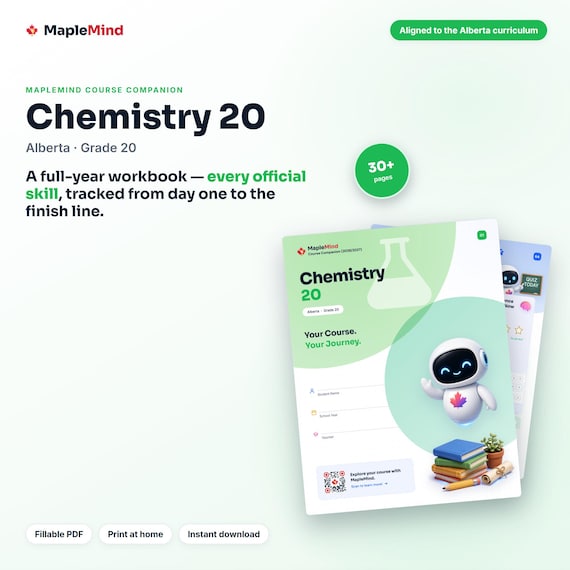
A Chemistry 20 workbook worth keeping
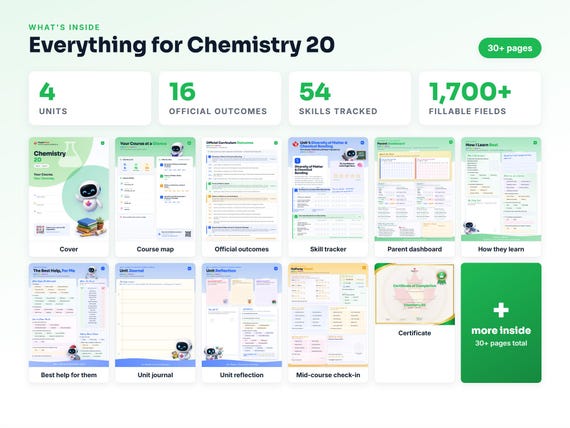
Built from the same official curriculum as this page. Before and after each skill above, your student colours in how sure they feel — so the two of you can see, on one page, what's clicking and what needs another look. It's a quiet way to follow how the year is really going.
By June it's full of their own handwriting: units worked through, confidence grown, a mid-year check-in, notes from parent-teacher night, and a certificate at the end. Less a worksheet, more a record of the year worth keeping on the shelf.
Instant download · see every page, reviews and the full description · five or more workbooks are $2.99 each
What it looks like in the app

Common questions
Can MapleMind help me with Chemistry 20?
Yes. MapleMind's AI tutor covers all 54 skills in Alberta's Chemistry 20 — you pick the exact skill, and the tutor teaches it step by step: a short lesson, a worked example, solving together, then a skill check to show it stuck.
Is MapleMind aligned to Alberta's official curriculum?
Yes. Every skill in this course maps to an official outcome code from Alberta's Grade 11 Science curriculum, and the ministry's own wording is quoted under each unit on this page — with the official government source linked so you can check it yourself.
What does MapleMind cost?
It's free to start — 5 tutoring chats and a practice quiz every day, no credit card. A Pro subscription ($9.99/month or $49.99/year CAD, 7-day free trial) unlocks unlimited tutoring, practice, and exam simulations.
What if I'm stuck on just one topic?
That's the point of skill-level tutoring: open Chemistry 20 in the app, tap the exact skill from the list on this page, and the tutor teaches just that — no wading through lessons you don't need.
Does MapleMind work in French or other languages?
Yes — 14 languages, including French. Both the app and the tutor's explanations switch to the language you choose.
Where can I see the official Alberta curriculum for Chemistry 20?
The official source is linked on this page — Alberta's official programs of study. The outline here follows it: every MapleMind skill carries its official outcome code, and the ministry's own wording is quoted under each unit.
Keep exploring
Ready when you are
Pick a skill from this page and see it taught properly — free, in the browser, in under a minute.