Get help with Biology 11
Most tutoring makes you sit through material you already know. MapleMind flips that: pick the exact skill that's causing trouble — any of the 26 below — and the tutor teaches just that one, step by step, as many times as it takes. Ask questions in plain words, any time of day, in English, French, or 12 other languages.
The official British Columbia Biology 11 curriculum
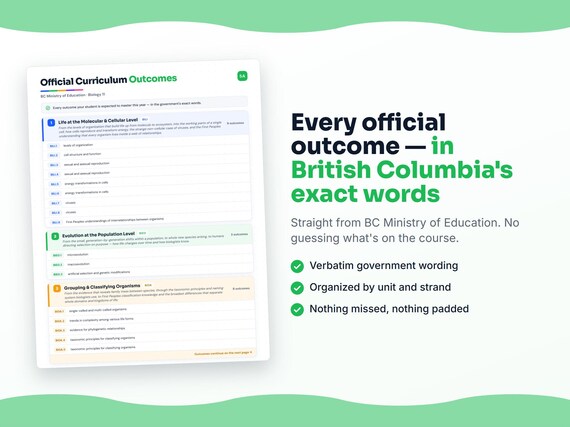
British Columbia defines Biology 11 by strands and outcomes. MapleMind teaches the same curriculum reorganized for one-skill-at-a-time tutoring — the table shows exactly where every official strand lands, and the ministry's own wording is quoted under each unit below.
Official source BC's official science curriculumRead it on the government site — curriculum.gov.bc.ca ↗| Official strand | Outcomes | Where MapleMind teaches it |
|---|---|---|
| Big Idea: Life is a result of interactions at the molecular and cellular levels. | 9 | Life at the Molecular & Cellular Level |
| Big Idea: Evolution occurs at the population level. | 6 | Evolution at the Population Level |
| Big Idea: Organisms are grouped based on common characteristics. | 8 | Grouping & Classifying Organisms |
| Curricular Competency 11.CC.7 (Planning and conducting) — the sciences' one CC-TEACH exception. | 3 | Lab Numeracy: Accuracy and Precision |
Every skill below, taught one on one.
 Try the first session free
How MapleMind teaches Biology 11 — every unit, lesson, and skill
Every skill below runs as a short session: a plain-words lesson, a worked example, solving it together, then a five-question skill check that earns up to three stars. Guided Mode keeps it teaching instead of answer-handing — turning it off needs a parent's password.
Unit 1Life at the Molecular & Cellular LevelOfficial strand · Big Idea: Life is a result of interactions at the molecular and cellular levels.
From the levels of organization that build life up from molecule to ecosystem, into the working parts of a single cell, how cells reproduce and transform energy, the strange non-cellular case of viruses, and the First Peoples understanding that every organism lives inside a web of relationships.
Levels of Biological Organization
- The levels of biological organization11.CELL.1 — Describe the levels of biological organization, from molecule through cell, tissue, organ, organ system, and organism, up to population, community, and ecosystem, and explain how each level is built from the ones below it.
Cell Structure and Function
- Cell structure and function11.CELL.2 — Compare prokaryotic and eukaryotic cell structure, identify the major organelles inside a cell and the job each one does, and explain cell specialization — why a muscle cell and a nerve cell look and work so differently despite sharing the same DNA.
Sexual Reproduction and Meiosis
- Sexual reproduction and meiosis11.CELL.3 — Explain sexual reproduction and the process of meiosis — how it halves chromosome number and shuffles genetic material through crossing-over and independent assortment — and why this produces offspring that are genetically varied rather than identical to either parent.
Asexual Reproduction
- Asexual reproduction11.CELL.4 — Compare the mechanisms of asexual reproduction — mitosis, budding, conjugation, and binary fission — and explain why offspring produced this way are genetically identical to their single parent, unlike sexual reproduction.
Cellular Respiration
- Cellular respiration11.CELL.5 — Explain cellular respiration — glucose broken down in the presence of oxygen to yield usable energy (ATP) and carbon dioxide — as the process most cells use to power the work of staying alive.
Photosynthesis
- Photosynthesis11.CELL.6 — Explain photosynthesis — a process that consumes carbon dioxide and water and produces oxygen and sugars — as the process that captures light energy and builds the sugars that fuel cellular respiration.
Viral Structure and Replication Cycles
Viral Disease, Immunity, and Vaccines
First Peoples Understandings of Interrelationships
- First Peoples understandings of interrelationships between organisms11.CELL.9 — Explain First Peoples understandings of interrelationships between organisms — for example, plants acting as timing indicators for other seasonal events, and decaying animals returning nutrients to plants — as a web of reciprocal relationship rather than a one-way food chain.
The official wording — 9 outcomes in this unit
- 11.CELL.1
levels of organization
- 11.CELL.2
cell structure and function
- 11.CELL.3
sexual and asexual reproduction
- 11.CELL.4
sexual and asexual reproduction
- 11.CELL.5
energy transformations in cells
- 11.CELL.6
energy transformations in cells
- 11.CELL.7
viruses
- 11.CELL.8
viruses
- 11.CELL.9
First Peoples understandings of interrelationships between organisms
Unit 2Evolution at the Population LevelOfficial strand · Big Idea: Evolution occurs at the population level.
From the small, generation-by-generation shifts within a population, to whole new species arising, to humans directing selection on purpose — how life changes over time and how biologists know.
Microevolution: Adaptation, DNA Change, and Natural Selection
- Adaptation to changing environments and changes in DNA11.EVO.1 — Explain microevolution as change within a species that occurs over time in a population, driven by adaptation to changing environments and by changes in DNA — mutations that create new genetic variation across a population.
- Natural selection11.EVO.2 — Explain natural selection as the mechanism of gradual change within a population — individuals whose traits fit the environment survive and reproduce more, shifting the population's traits over generations.
Macroevolution: Speciation and the Evidence
- Speciation mechanisms11.EVO.3 — Compare mechanisms of speciation — neo-Darwinism (gradualism), punctuated equilibrium, genetic drift, sexual selection, and adaptive radiation — as different routes by which one population becomes two or more separate species.
- Processes of macroevolution11.EVO.4 — Distinguish the processes of macroevolution — divergent evolution, convergent evolution, and co-evolution — as different patterns by which lineages change relative to one another over long timescales.
- Evidence for macroevolution11.EVO.5 — Evaluate the evidence for macroevolution — embryology, mitochondrial DNA, molecular evolution, and the fossil record — and explain how each independent line of evidence supports the same conclusion about shared ancestry.
Artificial Selection and Genetic Modification
- Artificial selection and genetic modifications11.EVO.6 — Explain artificial selection (humans choosing which organisms breed, as in dog breeds or canola varieties) and genetic modifications such as gene therapy and GMOs, and discuss the ethical considerations each raises.
The official wording — 6 outcomes in this unit
- 11.EVO.1
microevolution
- 11.EVO.2
microevolution
- 11.EVO.3
macroevolution
- 11.EVO.4
macroevolution
- 11.EVO.5
macroevolution
- 11.EVO.6
artificial selection and genetic modifications
Unit 3Grouping & Classifying OrganismsOfficial strand · Big Idea: Organisms are grouped based on common characteristics.
From the evidence that reveals family trees between species, through the taxonomic principles and naming system biologists use, to First Peoples classification knowledge and the broadest differences that separate whole domains and kingdoms of life.
Single-Celled and Multi-Celled Organisms
- Single-celled and multi-celled organisms11.CLASS.1 — Compare single-celled organisms, where one cell performs every life function, with multi-celled organisms, where cells specialize and depend on each other, and give real examples of each.
Trends in Complexity Among Life Forms
- Trends in complexity among various life forms11.CLASS.2 — Describe trends in complexity seen across life forms — symmetry, presence of a coelom, cephalization, and vascularization — while recognizing that "more complex" does not mean "more successful."
Evidence for Phylogenetic Relationships
- Evidence for phylogenetic relationships11.CLASS.3 — Evaluate the evidence used to build phylogenetic (family) trees between species — DNA sequence similarity, biochemistry, comparative anatomy, embryology, fossil evidence, and biogeography — and explain how it reveals shared ancestry.
The Taxonomic Hierarchy
- The taxonomic hierarchy11.CLASS.4 — Apply the taxonomic hierarchy of ranks — kingdom, phylum, class, order, family, genus, species — used to classify organisms into a nested system based on shared characteristics.
Building and Using Cladograms and Dichotomous Keys
- Building and using cladograms and dichotomous keys11.CLASS.5 — Build and interpret a phylogenetic tree (cladogram) showing shared ancestry among species, and use a dichotomous key to identify an unknown organism step by step.
Binomial Nomenclature
- Binomial nomenclature11.CLASS.6 — Use binomial nomenclature — the two-part genus-plus-species naming system, such as Homo sapiens — to write and interpret the scientific name of an organism precisely, avoiding the confusion of common names.
First Peoples Knowledge on Classification
- First Peoples knowledge on classification11.CLASS.7 — Explain First Peoples knowledge on classification — for example, classifying animals and BC plants based on their use, such as traditional clothing, food, hunting seasons, and medicine — as a distinct, valid classification system alongside Western taxonomy.
Domains and Kingdoms
- Similarities and differences between domains and kingdoms11.CLASS.8 — Compare the similarities and differences between the domains and kingdoms of life, describing the unifying criteria that separate them and how the classification models have changed as knowledge has grown.
The official wording — 8 outcomes in this unit
- 11.CLASS.1
single-celled and multi-celled organisms
- 11.CLASS.2
trends in complexity among various life forms
- 11.CLASS.3
evidence for phylogenetic relationships
- 11.CLASS.4
taxonomic principles for classifying organisms
- 11.CLASS.5
taxonomic principles for classifying organisms
- 11.CLASS.6
binomial nomenclature
- 11.CLASS.7
First Peoples knowledge on classification
- 11.CLASS.8
similarities and differences between domains and kingdoms
Unit 4Lab Numeracy: Accuracy and PrecisionOfficial strand · Curricular Competency 11.CC.7 (Planning and conducting) — the sciences' one CC-TEACH exception.
The sciences' one taught Curricular Competency: applying the concepts of accuracy and precision to experimental procedures and data. Three separately-quizzable lab-numeracy skills — significant figures, measurement uncertainty, and scientific notation — front-loaded here and applied throughout every lab in Units 1-3.
Significant Figures and Rounding Rules
- Significant figures and rounding rules in biological measurements11.LAB.1 — Apply the concept of accuracy to experimental data by identifying the number of significant figures in a measurement and rounding a calculated result to the correct number of significant figures.
Measurement Uncertainty and Accuracy vs. Precision
- Measurement uncertainty and accuracy vs. precision11.LAB.2 — Apply the concept of precision to experimental procedures by stating the uncertainty of a measurement, distinguishing accuracy from precision, and completing magnification calculations for a biological diagram, such as a protist viewed under a microscope.
Scientific Notation for Biological Quantities
- Scientific notation for very large and very small biological quantities11.LAB.3 — Apply scientific notation to express very large and very small biological quantities precisely — such as a cell's size in metres or a bacterial population count — as part of accurate experimental data reporting.
The official wording — 3 outcomes in this unit
- 11.LAB.1
Apply the concepts of accuracy and precision to experimental procedures and data
- 11.LAB.2
Apply the concepts of accuracy and precision to experimental procedures and data
- 11.LAB.3
Apply the concepts of accuracy and precision to experimental procedures and data
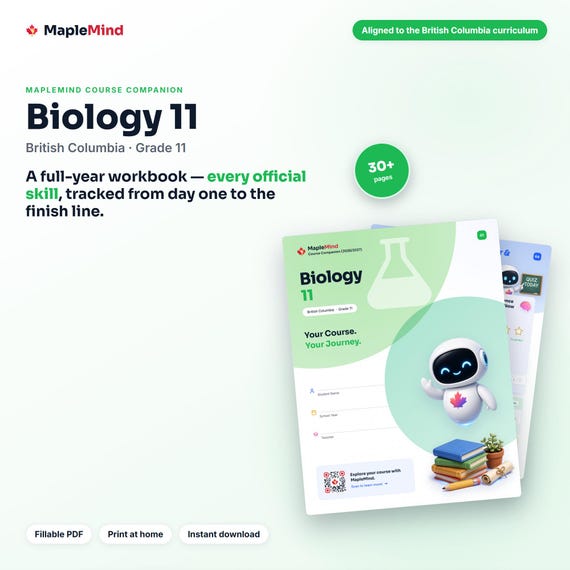
Printable workbook · A keepsake of the year
A Biology 11 workbook worth keeping
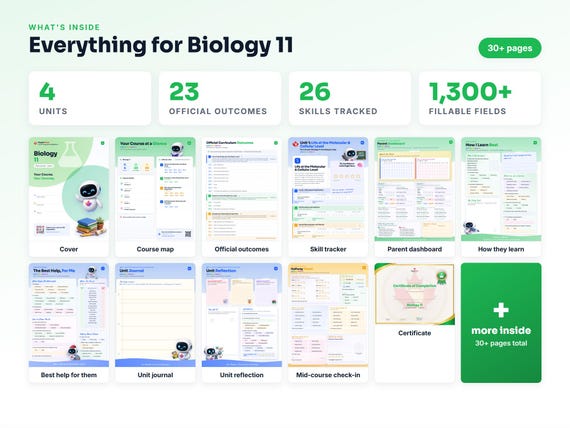
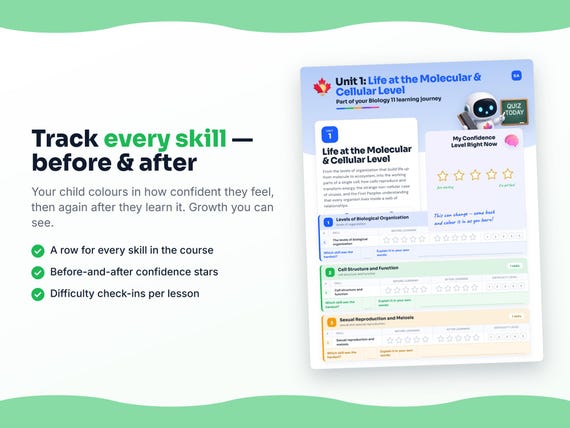
Built from the same official curriculum as this page. Before and after each skill above, your student colours in how sure they feel — so the two of you can see, on one page, what's clicking and what needs another look. It's a quiet way to follow how the year is really going.
By June it's full of their own handwriting: units worked through, confidence grown, a mid-year check-in, notes from parent-teacher night, and a certificate at the end. Less a worksheet, more a record of the year worth keeping on the shelf.
Instant download · see every page, reviews and the full description · five or more workbooks are $2.99 each
What it looks like in the app



Common questions
Can MapleMind help me with Biology 11?
Yes. MapleMind's AI tutor covers all 26 skills in British Columbia's Biology 11 — you pick the exact skill, and the tutor teaches it step by step: a short lesson, a worked example, solving together, then a skill check to show it stuck.
Is MapleMind aligned to British Columbia's official curriculum?
Yes. Every skill in this course maps to an official outcome code from British Columbia's Grade 11 Science curriculum, and the ministry's own wording is quoted under each unit on this page — with the official government source linked so you can check it yourself.
What does MapleMind cost?
It's free to start — 5 tutoring chats and a practice quiz every day, no credit card. A Pro subscription ($9.99/month or $49.99/year CAD, 7-day free trial) unlocks unlimited tutoring, practice, and exam simulations.
What if I'm stuck on just one topic?
That's the point of skill-level tutoring: open Biology 11 in the app, tap the exact skill from the list on this page, and the tutor teaches just that — no wading through lessons you don't need.
Does MapleMind work in French or other languages?
Yes — 14 languages, including French. Both the app and the tutor's explanations switch to the language you choose.
Where can I see the official British Columbia curriculum for Biology 11?
The official source is linked on this page — BC's official science curriculum. The outline here follows it: every MapleMind skill carries its official outcome code, and the ministry's own wording is quoted under each unit.
Keep exploring
Ready when you are
Pick a skill from this page and see it taught properly — free, in the browser, in under a minute.