Get help with Science 10
Most tutoring makes you sit through material you already know. MapleMind flips that: pick the exact skill that's causing trouble — any of the 25 below — and the tutor teaches just that one, step by step, as many times as it takes. Ask questions in plain words, any time of day, in English, French, or 12 other languages.
The official British Columbia Science 10 curriculum
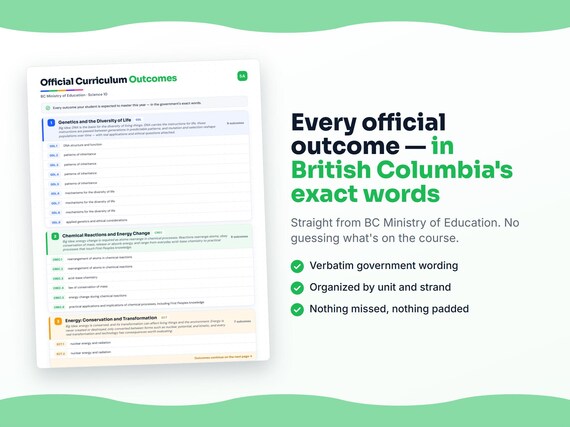
British Columbia defines Science 10 by strands and outcomes. MapleMind teaches the same curriculum reorganized for one-skill-at-a-time tutoring — the table shows exactly where every official strand lands, and the ministry's own wording is quoted under each unit below.
Official source BC's official science curriculumRead it on the government site — curriculum.gov.bc.ca ↗| Official strand | Outcomes | Where MapleMind teaches it |
|---|---|---|
| Genetics & the Diversity of Life | 9 | Genetics and the Diversity of Life |
| Chemical Reactions & Energy Change | 6 | Chemical Reactions and Energy Change |
| Energy: Conservation & Transformation | 7 | Energy: Conservation and Transformation |
| Formation of the Universe | 3 | Formation of the Universe |
Every skill below, taught one on one.
 Try the first session free
How MapleMind teaches Science 10 — every unit, lesson, and skill
Every skill below runs as a short session: a plain-words lesson, a worked example, solving it together, then a five-question skill check that earns up to three stars. Guided Mode keeps it teaching instead of answer-handing — turning it off needs a parent's password.
Unit 1Genetics and the Diversity of LifeOfficial strand · Genetics & the Diversity of Life
Big Idea: DNA is the basis for the diversity of living things. DNA carries the instructions for life, those instructions are passed between generations in predictable patterns, and mutation and selection reshape populations over time — with real applications and ethical questions attached.
DNA: The Code of Life
- DNA structure and function10.GEN.1 — Describe the double-helix structure of DNA — the sugar-phosphate backbone and the four complementary bases, organized into genes and chromosomes — and explain how that structure lets DNA store, express, and transmit the genetic instructions that build and run an organism.
Mendelian Genetics and Punnett Squares
- Mendelian genetics and Punnett squares (predicting single-trait crosses)10.GEN.2 — Use Mendelian patterns — dominant and recessive alleles — and a Punnett square to predict the genotype and phenotype ratios of a single-trait (monohybrid) cross between two parents.
Dominance Patterns
- Dominance patterns (complete dominance, co-dominance, incomplete dominance)10.GEN.3 — Distinguish complete dominance (one allele fully masks the other), co-dominance (both alleles are expressed together, unblended), and incomplete dominance (the phenotype blends between the two alleles), and predict the phenotype each pattern produces.
Sex-Linked Inheritance
- Sex-linked inheritance (traits carried on the X chromosome)10.GEN.4 — Explain how traits carried on the X chromosome are inherited differently in males and females, and set up and solve a Punnett square for a sex-linked cross.
Human Genetics and Pedigrees
- Human genetics (pedigrees and inherited human traits/conditions)10.GEN.5 — Read and interpret a human pedigree chart to trace an inherited trait or condition across generations, and determine the likely inheritance pattern it follows.
Mutation and Its Impact on Evolution
- Mutation and its impact on evolution (mutagens, carcinogens, positive/negative/neutral effects)10.DIV.1 — Explain how a mutation is a change in the DNA sequence that can arise from mutagens or carcinogens, why most mutations are neutral or harmful while a few are beneficial, and how mutation is the ultimate source of the genetic variation evolution acts on.
Natural Selection
- Natural selection (selection pressure, adaptation, adaptive radiation, extinction)10.DIV.2 — Explain how natural selection acts on existing variation through selection pressure and differential survival and reproduction, producing adaptations, adaptive radiation into new niches, or extinction when a population cannot adapt.
Artificial Selection
- Artificial selection (selective breeding in agriculture and of plants/animals)10.DIV.3 — Explain how humans direct artificial selection by deliberately choosing which plants or animals breed for desired traits, including selective breeding practices in agriculture, and compare this human-directed process to natural selection.
Applied Genetics and Ethics
- Applied genetics and its ethical considerations (GMOs, gene therapy, cloning, forensics; health/environmental/social implications)10.GEN.6 — Describe real applications of genetics — such as GMOs, gene therapy, cloning, or forensic DNA analysis — and weigh the health, environmental, and social implications they raise for individuals, families, and society.
The official wording — 9 outcomes in this unit
- 10.GEN.1
DNA structure and function
- 10.GEN.2
patterns of inheritance
- 10.GEN.3
patterns of inheritance
- 10.GEN.4
patterns of inheritance
- 10.GEN.5
patterns of inheritance
- 10.DIV.1
mechanisms for the diversity of life
- 10.DIV.2
mechanisms for the diversity of life
- 10.DIV.3
mechanisms for the diversity of life
- 10.GEN.6
applied genetics and ethical considerations
Unit 2Chemical Reactions and Energy ChangeOfficial strand · Chemical Reactions & Energy Change
Big Idea: energy change is required as atoms rearrange in chemical processes. Reactions rearrange atoms, obey conservation of mass, release or absorb energy, and range from everyday acid-base chemistry to practical processes that touch First Peoples knowledge.
How Atoms Rearrange and Balancing Equations
- How atoms rearrange in a reaction and how to balance a chemical equation10.CHEM.1 — Explain that a chemical reaction breaks bonds in the reactants and forms new bonds in the products, rearranging the same atoms into new substances, and represent this with a correctly balanced chemical equation.
Classifying Reaction Types
- Classifying reaction types (synthesis, decomposition, single/double replacement, combustion, neutralization)10.CHEM.2 — Classify a chemical reaction as synthesis, decomposition, single replacement, double replacement, combustion, or neutralization based on the pattern of how its reactants rearrange into products.
Acid-Base Chemistry
- Acid-base chemistry (the pH scale, acids and bases, neutralization)10.CHEM.3 — Identify the properties of acids and bases, use the pH scale to classify solutions, and describe what happens chemically when an acid and a base react (neutralization).
The Law of Conservation of Mass
- The law of conservation of mass in chemical reactions10.CHEM.4 — State the law of conservation of mass — matter is neither created nor destroyed in a chemical reaction — and use it to verify that a chemical equation is balanced and that total mass of reactants equals total mass of products.
Energy Change During Reactions
- Energy change during reactions (exothermic vs endothermic, activation energy)10.CHEM.5 — Distinguish exothermic reactions (release energy, often as heat) from endothermic reactions (absorb energy), and explain the role of activation energy in starting a reaction.
Chemistry in Practice
- Practical applications of chemical processes, including First Peoples knowledge (traditional medicines, food chemistry, remediation)10.CHEM.6 — Describe real-world chemical processes and their implications for society and the environment, including First Peoples knowledge of chemical processes such as traditional medicines, food chemistry, and environmental remediation.
The official wording — 6 outcomes in this unit
- 10.CHEM.1
rearrangement of atoms in chemical reactions
- 10.CHEM.2
rearrangement of atoms in chemical reactions
- 10.CHEM.3
acid-base chemistry
- 10.CHEM.4
law of conservation of mass
- 10.CHEM.5
energy change during chemical reactions
- 10.CHEM.6
practical applications and implications of chemical processes, including First Peoples knowledge
Unit 3Energy: Conservation and TransformationOfficial strand · Energy: Conservation & Transformation
Big Idea: energy is conserved, and its transformation can affect living things and the environment. Energy is never created or destroyed, only converted between forms such as nuclear, potential, and kinetic, and every real transformation and technology has consequences worth evaluating.
Nuclear Energy
- Nuclear energy (fission vs fusion; nuclear technologies and their impacts)10.EN.1 — Distinguish nuclear fission (splitting a large nucleus) from nuclear fusion (combining small nuclei), and evaluate the applications and impacts of nuclear technologies such as power generation and medical isotopes.
Radiation
- Radiation (ionizing vs non-ionizing; alpha, beta, gamma)10.EN.2 — Distinguish ionizing radiation from non-ionizing radiation, and describe the properties of alpha, beta, and gamma radiation, including their relative penetrating power and shielding.
The Law of Conservation of Energy
- The law of conservation of energy10.EN.3 — State the law of conservation of energy — energy cannot be created or destroyed, only transformed from one form to another or transferred between objects — and use it to track energy through a system.
Gravitational Potential Energy
- Gravitational potential energy and calculating PE = mgh10.EN.4 — Define gravitational potential energy as stored energy due to an object's height, and calculate it using PE = mgh.
Kinetic Energy
- Kinetic energy and calculating KE = 1/2 mv squared10.EN.5 — Define kinetic energy as the energy of motion, depending on an object's mass and speed, and calculate it using KE = ½mv².
Transformation and Transfer of Energy
- Transformation and transfer of energy, including heat (Q = mcΔT)10.EN.6 — Trace energy as it transforms between forms and transfers between objects in closed and open systems, and calculate heat transfer using Q = mcΔT.
Energy Technologies and Their Impact
- Local and global impacts of energy transformations from technologies (pollution, habitat loss, CO2 output)10.EN.7 — Evaluate the local and global impacts of energy transformation technologies, including pollution, habitat loss, and carbon dioxide output.
The official wording — 7 outcomes in this unit
- 10.EN.1
nuclear energy and radiation
- 10.EN.2
nuclear energy and radiation
- 10.EN.3
law of conservation of energy
- 10.EN.4
potential and kinetic energy
- 10.EN.5
potential and kinetic energy
- 10.EN.6
transformation of energy
- 10.EN.7
local and global impacts of energy transformations from technologies
Unit 4Formation of the UniverseOfficial strand · Formation of the Universe
Big Idea: the formation of the universe can be explained by the big bang theory. Evidence gathered with modern astronomical methods lets scientists reconstruct how the universe formed and how its components have changed over time.
The Big Bang Theory
- The big bang theory and the evidence that supports it10.UNI.1 — Describe the big bang theory as the scientific model for the origin of the universe from an extremely hot, dense state, and summarize the key evidence that supports it (cosmic expansion, cosmic background radiation).
Components of the Universe Over Time
- Components of the universe over time (changes to energy, matter, and fundamental forces)10.UNI.2 — Describe how the universe's components — energy, matter, and the fundamental forces — formed and changed as the universe expanded and cooled over billions of years.
Gathering Astronomical Data
- Astronomical data and collection methods (telescopes, Doppler shift, space technologies as evidence)10.UNI.3 — Describe how astronomers collect data about distant objects — telescopes, Doppler shift, and space technologies — and how that data is used as evidence for models of the universe.
The official wording — 3 outcomes in this unit
- 10.UNI.1
formation of the universe
- 10.UNI.2
formation of the universe
- 10.UNI.3
astronomical data and collection methods
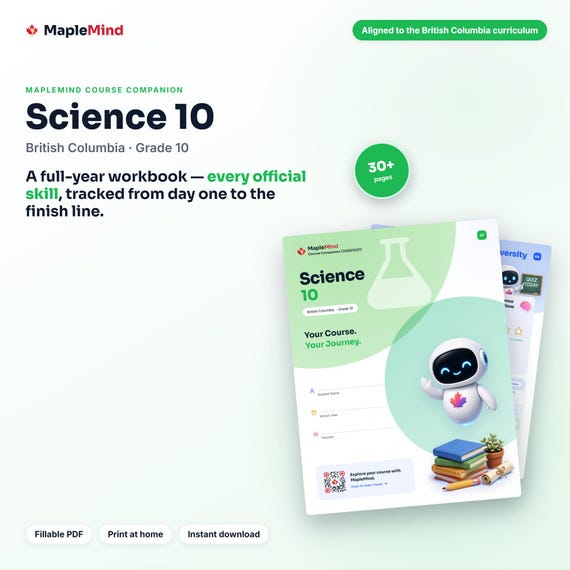
Printable workbook · A keepsake of the year
A Science 10 workbook worth keeping
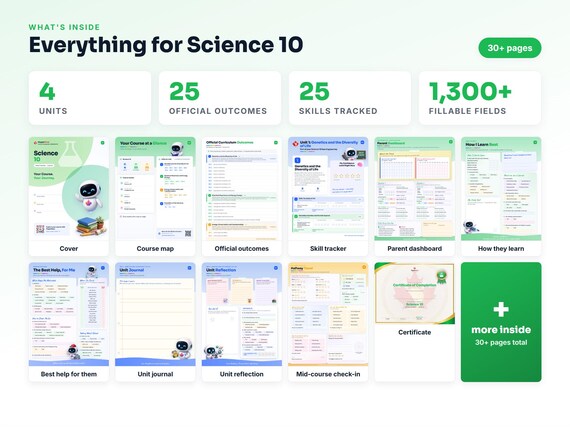
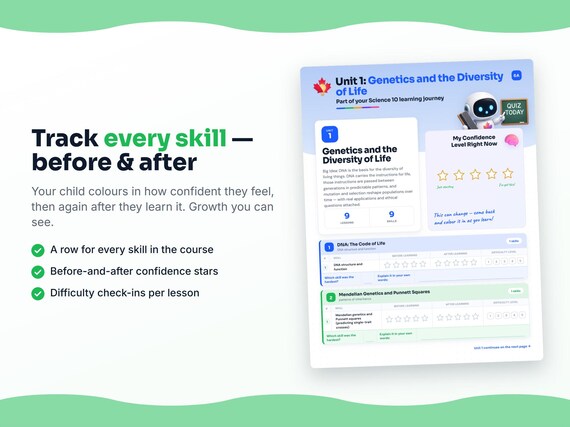
Built from the same official curriculum as this page. Before and after each skill above, your student colours in how sure they feel — so the two of you can see, on one page, what's clicking and what needs another look. It's a quiet way to follow how the year is really going.
By June it's full of their own handwriting: units worked through, confidence grown, a mid-year check-in, notes from parent-teacher night, and a certificate at the end. Less a worksheet, more a record of the year worth keeping on the shelf.
Instant download · see every page, reviews and the full description · five or more workbooks are $2.99 each
What it looks like in the app



Common questions
Can MapleMind help me with Science 10?
Yes. MapleMind's AI tutor covers all 25 skills in British Columbia's Science 10 — you pick the exact skill, and the tutor teaches it step by step: a short lesson, a worked example, solving together, then a skill check to show it stuck.
Is MapleMind aligned to British Columbia's official curriculum?
Yes. Every skill in this course maps to an official outcome code from British Columbia's Grade 10 Science curriculum, and the ministry's own wording is quoted under each unit on this page — with the official government source linked so you can check it yourself.
What does MapleMind cost?
It's free to start — 5 tutoring chats and a practice quiz every day, no credit card. A Pro subscription ($9.99/month or $49.99/year CAD, 7-day free trial) unlocks unlimited tutoring, practice, and exam simulations.
What if I'm stuck on just one topic?
That's the point of skill-level tutoring: open Science 10 in the app, tap the exact skill from the list on this page, and the tutor teaches just that — no wading through lessons you don't need.
Does MapleMind work in French or other languages?
Yes — 14 languages, including French. Both the app and the tutor's explanations switch to the language you choose.
Where can I see the official British Columbia curriculum for Science 10?
The official source is linked on this page — BC's official science curriculum. The outline here follows it: every MapleMind skill carries its official outcome code, and the ministry's own wording is quoted under each unit.
Keep exploring
Ready when you are
Pick a skill from this page and see it taught properly — free, in the browser, in under a minute.