Get help with Chemistry 11
Most tutoring makes you sit through material you already know. MapleMind flips that: pick the exact skill that's causing trouble — any of the 24 below — and the tutor teaches just that one, step by step, as many times as it takes. Ask questions in plain words, any time of day, in English, French, or 12 other languages.
The official British Columbia Chemistry 11 curriculum
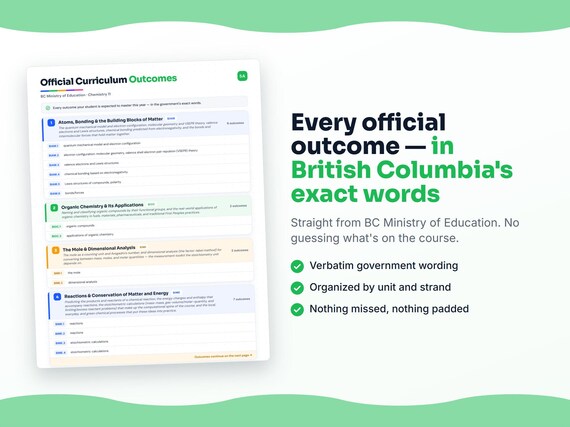
British Columbia defines Chemistry 11 by strands and outcomes. MapleMind teaches the same curriculum reorganized for one-skill-at-a-time tutoring — the table shows exactly where every official strand lands, and the ministry's own wording is quoted under each unit below.
Official source BC's official science curriculumRead it on the government site — curriculum.gov.bc.ca ↗| Official strand | Outcomes | Where MapleMind teaches it |
|---|---|---|
| Big Idea: Atoms and molecules are building blocks of matter. | 6 | Atoms, Bonding & the Building Blocks of Matter |
| Big Idea: Organic chemistry and its applications have significant implications for human health, society, and the environment. | 2 | Organic Chemistry & Its Applications |
| Big Idea: The mole is a quantity used to make atoms and molecules measurable. | 2 | The Mole & Dimensional Analysis |
| Big Idea: Matter and energy are conserved in chemical reactions. | 7 | Reactions & Conservation of Matter and Energy |
| Big Idea: Solubility within a solution is determined by the nature of the solute and the solvent. | 5 | Solubility & Solution Chemistry |
| Curricular Competency 11.CC.7 (Planning and conducting): Apply the concepts of accuracy and precision to experimental procedures and data. | 2 | Lab Numeracy: Accuracy and Precision |
Every skill below, taught one on one.
 Try the first session free
How MapleMind teaches Chemistry 11 — every unit, lesson, and skill
Every skill below runs as a short session: a plain-words lesson, a worked example, solving it together, then a five-question skill check that earns up to three stars. Guided Mode keeps it teaching instead of answer-handing — turning it off needs a parent's password.
Unit 1Atoms, Bonding & the Building Blocks of MatterOfficial strand · Big Idea: Atoms and molecules are building blocks of matter.
The quantum mechanical model and electron configuration, molecular geometry and VSEPR theory, valence electrons and Lewis structures, chemical bonding predicted from electronegativity, and the bonds and intermolecular forces that hold matter together.
The Quantum Mechanical Model & Electron Configuration
- Quantum mechanical model and electron configuration11.ATOM.1 — Describe the quantum mechanical model of the atom — electrons occupying orbitals within energy levels and sublevels rather than fixed orbits — and write electron configurations for atoms using the aufbau principle.
Molecular Geometry & VSEPR Theory
- Molecular geometry and VSEPR theory11.ATOM.2 — Use valence shell electron pair repulsion (VSEPR) theory to predict the three-dimensional shape of a molecule from its Lewis structure, based on electron-pair regions around the central atom repelling each other.
Valence Electrons & Lewis Structures
- Valence electrons and Lewis structures11.ATOM.3 — Identify the valence electrons of an atom from its electron configuration or periodic table position, and draw Lewis (electron dot) structures for atoms, ions, and simple molecules.
Predicting Bonding from Electronegativity
- Chemical bonding based on electronegativity11.ATOM.4 — Use electronegativity differences between bonded atoms to classify a bond as ionic, polar covalent, or nonpolar covalent, and relate this to how electrons are shared or transferred.
Molecular Polarity from Shape
- Molecular polarity from bond dipoles and shape11.ATOM.4b — Determine whether a whole molecule is polar or nonpolar by combining its individual bond dipoles with its VSEPR geometry — recognizing that symmetric shapes (e.g. CO2) can cancel polar bonds to give a nonpolar molecule while bent shapes (e.g. H2O) do not, and connecting molecular polarity to solubility ("like dissolves like").
Bonds and Intermolecular Forces
- Bonds and forces11.ATOM.5 — Distinguish intramolecular bonds (ionic, covalent, metallic) from intermolecular forces (London dispersion, dipole-dipole, hydrogen bonding), and relate the type and strength of bonding or forces present to observable physical properties such as melting point, boiling point, and solubility.
The official wording — 6 outcomes in this unit
- 11.ATOM.1
quantum mechanical model and electron configuration
- 11.ATOM.2
electron configuration: molecular geometry, valence shell electron pair repulsion (VSEPR) theory
- 11.ATOM.3
valence electrons and Lewis structures
- 11.ATOM.4
chemical bonding based on electronegativity
- 11.ATOM.4b
Lewis structures of compounds, polarity
- 11.ATOM.5
bonds/forces
Unit 2Organic Chemistry & Its ApplicationsOfficial strand · Big Idea: Organic chemistry and its applications have significant implications for human health, society, and the environment.
Naming and classifying organic compounds by their functional groups, and the real-world applications of organic chemistry in fuels, materials, pharmaceuticals, and traditional First Peoples practices.
Classifying and Naming Organic Compounds
- Organic compounds11.ORG.1 — Classify organic compounds by their carbon-chain structure and functional group (alkanes, alkenes, alkynes, alcohols, and other common families), and apply IUPAC rules to name and draw structures for simple examples.
Applications of Organic Chemistry
- Applications of organic chemistry11.ORG.2 — Describe real-world applications of organic compounds and reactions — including First Peoples traditional practices such as medicines, pharmaceuticals, petrochemicals, polymers, cosmetics, metabolism, agriculture, food, and biotechnology.
The official wording — 2 outcomes in this unit
- 11.ORG.1
organic compounds
- 11.ORG.2
applications of organic chemistry
Unit 3The Mole & Dimensional AnalysisOfficial strand · Big Idea: The mole is a quantity used to make atoms and molecules measurable.
The mole as a counting unit and Avogadro's number, and dimensional analysis (the factor-label method) for converting between mass, moles, and molar quantities — the measurement toolkit the stoichiometry unit depends on.
The Mole: Counting by Weighing
- The mole and Avogadro's number11.MOLE.1 — Explain the mole as the counting unit chemists use to relate a measurable mass to a number of particles (Avogadro's number), and convert between mass, moles, and number of particles.
Dimensional Analysis
- Dimensional analysis and the factor-label method11.MOLE.2 — Use dimensional analysis (the factor-label / unit-analysis method) to convert between units and solve multi-step chemistry calculations, including mass and molar quantities.
The official wording — 2 outcomes in this unit
- 11.MOLE.1
the mole
- 11.MOLE.2
dimensional analysis
Unit 4Reactions & Conservation of Matter and EnergyOfficial strand · Big Idea: Matter and energy are conserved in chemical reactions.
Predicting the products and reactants of a chemical reaction, the energy changes and enthalpy that accompany reactions, the stoichiometric calculations (mass-mass, gas-volume/molar-quantity, and limiting/excess reactant problems) that make up the computational spine of the course, and the local, everyday, and green chemical processes that put these ideas into practice.
Predicting Products and Reactants of Reactions
- Predicting products and reactants of reactions11.RXN.1 — Classify chemical reactions by type (synthesis, decomposition, single replacement, double replacement, combustion) and predict the products and reactants of a reaction, writing balanced chemical equations that conserve atoms.
Energy Changes and Enthalpy in Reactions
- Energy changes and enthalpy in reactions11.RXN.2 — Classify a reaction as exothermic or endothermic from its energy change, and use qualitative enthalpy (H) to describe whether a reaction releases or absorbs energy.
Mass-Mass Stoichiometry
- Mass-mass stoichiometry11.STOICH.1 — Use a balanced chemical equation and the mole ratio between two substances to calculate the mass of a product formed from a given mass of reactant (mass → moles → moles → mass).
Gas-Volume and Molar-Quantity Stoichiometry
- Gas-volume and molar-quantity stoichiometry11.STOICH.2 — Extend stoichiometric calculations beyond mass to the number of molecules, gas volumes, and other molar quantities, using the mole ratio from a balanced equation.
Limiting and Excess Reactants
- Limiting and excess reactants11.STOICH.3 — Identify the limiting reactant in a chemical reaction, calculate the amount of excess reactant remaining, and use the limiting reactant to determine the theoretical yield of product.
Local and Everyday Chemical Processes
- Local and other chemical processes, including First Peoples practices11.PROC.1 — Describe local and other chemical processes relevant to British Columbia and everyday life, including First Peoples traditional practices such as tanning hides and preparing food, soap, and natural bleach, alongside smelting, pulp and paper production, food chemistry, photosynthesis and cellular respiration, and petrochemical smog.
Green Chemistry
- Green chemistry and sustainable processes11.PROC.2 — Describe the principles of green chemistry — developing sustainable processes and technologies that reduce negative impacts on the environment, such as reducing toxicity, designing benign solvents, and increasing energy efficiency.
The official wording — 7 outcomes in this unit
- 11.RXN.1
reactions
- 11.RXN.2
reactions
- 11.STOICH.1
stoichiometric calculations
- 11.STOICH.2
stoichiometric calculations
- 11.STOICH.3
stoichiometric calculations
- 11.PROC.1
local and other chemical processes
- 11.PROC.2
green chemistry
Unit 5Solubility & Solution ChemistryOfficial strand · Big Idea: Solubility within a solution is determined by the nature of the solute and the solvent.
The solubility of molecular and ionic compounds, molarity and solution-concentration calculations, dilution and the mixing of ionic solutions, and the laboratory analysis techniques chemists use to identify and quantify substances in solution.
Solubility of Molecular and Ionic Compounds
- Solubility of molecular and ionic compounds11.SOL.1 — Predict and explain the solubility of molecular and ionic compounds in water using "like dissolves like" and the dissociation of ions, and write dissociation equations for ionic compounds.
Molarity and Solution Concentration
- Molarity and solution concentration11.SOL.2 — Calculate the molar concentration of a solution from moles and volume, and convert between mass, moles, and concentration when preparing or analyzing an aqueous solution.
Dilution of Solutions
- Dilution of solutions11.SOL.3 — Calculate the concentration of a diluted solution using the dilution effect (C1V1 = C2V2) — adding solvent increases the volume while the moles of solute stay constant, so the solution becomes less concentrated.
Concentration of Ions When Two Solutions Are Mixed
- Concentration of ions when two solutions are mixed11.SOL.3b — Calculate the concentration of each ion when two different ionic solutions are mixed — dissociate each compound into its ions, track each ion's moles into the new total volume, and use a solubility chart to predict whether any ions combine to form a precipitate.
Solution Analysis Techniques
- Solution analysis techniques11.SOL.4 — Use laboratory analysis techniques, such as titration and gravimetric analysis, to identify or quantify a substance dissolved in a solution and evaluate the reliability of the results.
The official wording — 5 outcomes in this unit
- 11.SOL.1
solubility of molecular and ionic compounds
- 11.SOL.2
stoichiometric calculations in aqueous solutions
- 11.SOL.3
dilution effect
- 11.SOL.3b
concentration of ions in solution when two solutions are mixed
- 11.SOL.4
analysis techniques
Unit 6Lab Numeracy: Accuracy and PrecisionOfficial strand · Curricular Competency 11.CC.7 (Planning and conducting): Apply the concepts of accuracy and precision to experimental procedures and data.
Not a Big Idea — the one Curricular Competency taught directly in this course (per the vertical grain memo's uniform senior-science CC policy): significant figures and rounding rules, and measurement uncertainty and scientific notation, as separately-quizzable lab-numeracy skills applied throughout the course's stoichiometric calculations.
Significant Figures and Rounding Rules
- Significant figures and rounding rules11.LABNUM.1 — Determine the number of significant figures in a measurement, and apply significant-figure rounding rules when reporting the result of a calculation.
Measurement Uncertainty and Scientific Notation
- Measurement uncertainty and scientific notation11.LABNUM.2 — Apply the concepts of accuracy and precision to experimental data by stating the uncertainty of a measurement and expressing very large or very small measurements in scientific notation.
The official wording — 2 outcomes in this unit
- 11.LABNUM.1
significant figures
- 11.LABNUM.2
Apply the concepts of accuracy and precision to experimental procedures and data: — significant figures — uncertainty — scientific notation

Printable workbook · A keepsake of the year
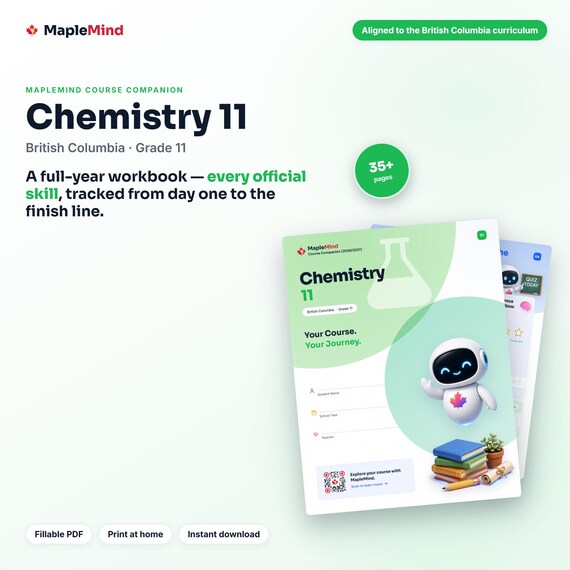
A Chemistry 11 workbook worth keeping
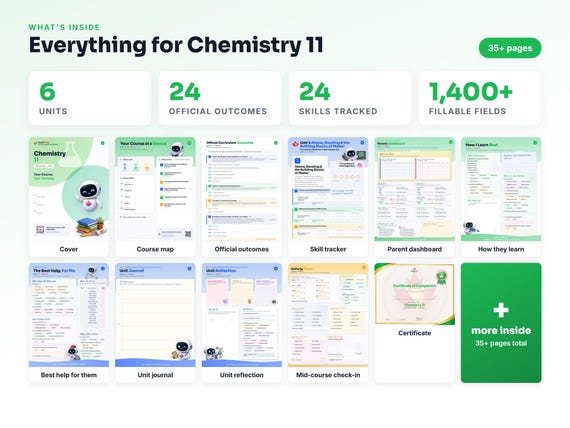
Built from the same official curriculum as this page. Before and after each skill above, your student colours in how sure they feel — so the two of you can see, on one page, what's clicking and what needs another look. It's a quiet way to follow how the year is really going.
By June it's full of their own handwriting: units worked through, confidence grown, a mid-year check-in, notes from parent-teacher night, and a certificate at the end. Less a worksheet, more a record of the year worth keeping on the shelf.
Instant download · see every page, reviews and the full description · five or more workbooks are $2.99 each
What it looks like in the app



Common questions
Can MapleMind help me with Chemistry 11?
Yes. MapleMind's AI tutor covers all 24 skills in British Columbia's Chemistry 11 — you pick the exact skill, and the tutor teaches it step by step: a short lesson, a worked example, solving together, then a skill check to show it stuck.
Is MapleMind aligned to British Columbia's official curriculum?
Yes. Every skill in this course maps to an official outcome code from British Columbia's Grade 11 Science curriculum, and the ministry's own wording is quoted under each unit on this page — with the official government source linked so you can check it yourself.
What does MapleMind cost?
It's free to start — 5 tutoring chats and a practice quiz every day, no credit card. A Pro subscription ($9.99/month or $49.99/year CAD, 7-day free trial) unlocks unlimited tutoring, practice, and exam simulations.
What if I'm stuck on just one topic?
That's the point of skill-level tutoring: open Chemistry 11 in the app, tap the exact skill from the list on this page, and the tutor teaches just that — no wading through lessons you don't need.
Does MapleMind work in French or other languages?
Yes — 14 languages, including French. Both the app and the tutor's explanations switch to the language you choose.
Where can I see the official British Columbia curriculum for Chemistry 11?
The official source is linked on this page — BC's official science curriculum. The outline here follows it: every MapleMind skill carries its official outcome code, and the ministry's own wording is quoted under each unit.
Keep exploring
Ready when you are
Pick a skill from this page and see it taught properly — free, in the browser, in under a minute.