Get help with Physics 11
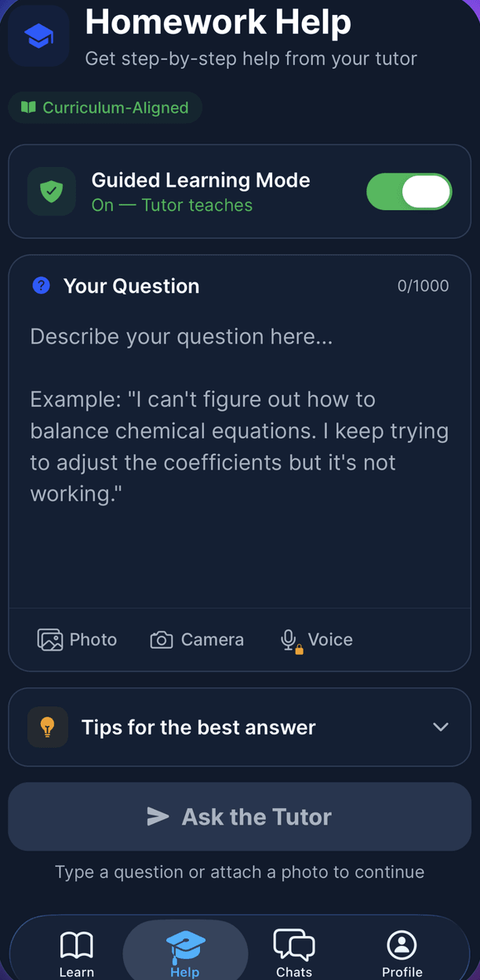
Most tutoring makes you sit through material you already know. MapleMind flips that: pick the exact skill that's causing trouble — any of the 31 below — and the tutor teaches just that one, step by step, as many times as it takes. Ask questions in plain words, any time of day, in English, French, or 12 other languages.
The official British Columbia Physics 11 curriculum
British Columbia defines Physics 11 by strands and outcomes. MapleMind teaches the same curriculum reorganized for one-skill-at-a-time tutoring — the table shows exactly where every official strand lands, and the ministry's own wording is quoted under each unit below.
Official source BC's official science curriculumRead it on the government site — curriculum.gov.bc.ca ↗| Official strand | Outcomes | Where MapleMind teaches it |
|---|---|---|
| Big Idea: An object's motion can be predicted, analyzed, and described. | 8 | Kinematics: Describing Motion |
| Big Idea: Forces influence the motion of an object. | 8 | Forces & Newton's Laws |
| Big Idea: Energy is found in different forms, is conserved, and has the ability to do work. | 7 | Energy, Work, Power & Circuits |
| Big Idea: Mechanical waves transfer energy but not matter. | 6 | Mechanical Waves & Sound |
| Curricular Competency 11.CC.7 (Planning and conducting): Apply the concepts of accuracy and precision to experimental procedures and data. | 2 | Lab Numeracy: Accuracy and Precision |
Every skill below, taught one on one.
 Try the first session free
How MapleMind teaches Physics 11 — every unit, lesson, and skill
Every skill below runs as a short session: a plain-words lesson, a worked example, solving it together, then a five-question skill check that earns up to three stars. Guided Mode keeps it teaching instead of answer-handing — turning it off needs a parent's password.
Unit 1Kinematics: Describing MotionOfficial strand · Big Idea: An object's motion can be predicted, analyzed, and described.
Vectors versus scalars, adding vectors graphically and resolving them with right-angle trigonometry, uniform and accelerated motion, the three projectile-motion cases, and the graphical-methods toolkit used to read motion off graphs.
Vectors and Scalars
- Vectors and scalars: graphical addition and subtraction11.KIN.1 — Distinguish vector quantities (magnitude AND direction — displacement, velocity, acceleration, force) from scalar quantities (magnitude only — distance, speed, time, mass), and add or subtract vectors graphically using head-to-tail diagrams to find a resultant.
Vector Components With Right-Angle Trigonometry
- Vector components with right-angle trigonometry11.KIN.2 — Resolve a vector into perpendicular (x and y) components using sine, cosine, and the Pythagorean theorem, and recombine components into a resultant magnitude and direction.
Uniform and Accelerated Motion
- Horizontal uniform and accelerated motion11.KIN.3 — Analyze horizontal motion at constant velocity (uniform) and with constant acceleration, using $v = \frac{d}{t}$, $a = \frac{\Delta v}{\Delta t}$, and the kinematics equations $d = v_i t + \frac{1}{2}at^2$ and $v_f^2 = v_i^2 + 2ad$.
Vertical-Launch Projectile Motion
- Vertical-launch projectile motion (1D)11.KIN.4 — Analyze a projectile launched straight up or dropped straight down under constant acceleration $g = 9.81\ \text{m/s}^2$, finding time to peak, maximum height, and time of flight.
Horizontal-Launch Projectile Motion
- Horizontal-launch projectile motion11.KIN.5 — Analyze a projectile launched horizontally from a height by treating the horizontal (constant velocity) and vertical (constant acceleration) components independently, to find range and time of flight.
Angled-Launch (Full 2D) Projectile Motion
- Angled-launch (full 2D) projectile motion11.KIN.6 — Analyze a projectile launched at an angle by resolving the initial velocity into horizontal and vertical components, then applying independent horizontal (constant velocity) and vertical (constant acceleration) analysis to find range, time of flight, and maximum height.
Graphical Methods: Slope and Lines of Best Fit
- Graphical methods: slope and lines of best fit11.GRAPH.1 — Plot linear relationships from physical models (e.g. uniform motion, resistance) and calculate the slope of a line of best fit, reporting the correct significant figures and units.
Graphical Methods: Interpolation, Extrapolation and Area Under the Curve
- Graphical methods: interpolation, extrapolation and area under the curve11.GRAPH.2 — Interpolate and extrapolate values from a constructed graph (e.g. position, instantaneous velocity), and calculate and interpret the area under a curve (e.g. displacement from a velocity-time graph, work from a force-distance graph).
The official wording — 8 outcomes in this unit
- 11.KIN.1
vector and scalar quantities
- 11.KIN.2
vector and scalar quantities
- 11.KIN.3
horizontal uniform and accelerated motion
- 11.KIN.4
vertical launch
- 11.KIN.5
horizontal launch
- 11.KIN.6
angled launch
- 11.GRAPH.1
graphical methods in physics
- 11.GRAPH.2
graphical methods in physics
Unit 2Forces & Newton's LawsOfficial strand · Big Idea: Forces influence the motion of an object.
Contact forces and what changes them, mass versus weight and apparent weight, Newton's three laws, drawing free-body diagrams, and analyzing balanced versus unbalanced force systems.
Contact Forces and Their Factors
- Contact forces and their factors11.FOR.1 — Identify contact forces (normal force, spring force, tension force, frictional force) and the factors that affect their magnitude and direction — surface roughness and normal force for friction, spring constant and displacement for spring force.
Mass, Force of Gravity, and Apparent Weight
- Mass, force of gravity, and apparent weight11.FOR.2 — Distinguish mass (amount of matter, invariant) from weight (the force of gravity, $F_g = mg$), and explain apparent weight — why a scale reads differently when accelerating, as in an elevator.
Newton's Laws of Motion
- Newton's First Law: inertia and equilibrium11.FOR.3 — Apply Newton's First Law: an object at rest stays at rest and an object in motion stays in uniform motion unless acted on by a net force, with mass as the measure of an object's inertia — its resistance to a change in motion.
- Newton's Second Law: net force and F = ma11.FOR.3b — Apply Newton's Second Law, $\vec{F}_{net} = m\vec{a}$: the net force from one or more forces produces an acceleration in the same direction, inversely proportional to mass, solving quantitative net-force problems.
- Newton's Third Law: action-reaction pairs11.FOR.3c — Apply Newton's Third Law: for every action force there is an equal and opposite reaction force acting on the OTHER object at the same time, and explain why an action-reaction pair never cancels (the two forces act on different bodies).
Free-Body Diagrams and Net Force
- Free-body diagrams and net force11.FOR.4 — Construct free-body diagrams showing every force acting on an object, then use them to determine net force and write an equation of motion.
Balanced and Unbalanced Forces in Flat and Connected Systems
- Balanced and unbalanced forces in flat and connected systems11.FOR.5 — Analyze one-body and multi-body systems of forces on horizontal or general surfaces — including angled forces and elevators — to determine whether the net force is zero (balanced, constant velocity or at rest) or nonzero (unbalanced, accelerating), and analyze connected bodies that share one acceleration.
Inclined Planes and Angled-Force Analysis
- Inclined-plane and angled-force component analysis11.FOR.5b — Analyze forces on an inclined plane by resolving the weight vector into components parallel and perpendicular to the ramp surface ($mg\sin\theta$ along the slope, $mg\cos\theta$ into it), account for friction on the slope, and determine whether the object stays put or accelerates down the incline.
The official wording — 8 outcomes in this unit
- 11.FOR.1
contact forces and the factors that affect magnitude and direction
- 11.FOR.2
mass, force of gravity, and apparent weight
- 11.FOR.3
the concept of mass as a measure of inertia
- 11.FOR.3b
net force from one or more forces
- 11.FOR.3c
actions/reactions happen at the same time in pairs
- 11.FOR.4
Newton’s laws of motion and free-body diagrams
- 11.FOR.5
one-body and multi-body systems
- 11.FOR.5b
inclined planes
Unit 3Energy, Work, Power & CircuitsOfficial strand · Big Idea: Energy is found in different forms, is conserved, and has the ability to do work.
Conservation of energy and the work-energy principle, power and efficiency, simple machines and mechanical advantage (including First Peoples applications), DC circuits with Ohm's and Kirchhoff's laws, and thermal equilibrium.
Conservation of Energy and the Work-Energy Principle
- Conservation of energy and the work-energy principle11.EN.1 — Apply the principle of work and energy ($W = Fd\cos\theta = \Delta E_k$) and the law of conservation of energy to mechanical systems, tracking kinetic energy $E_k = \frac{1}{2}mv^2$ and gravitational potential energy $E_p = mgh$ as one converts to the other.
Power and Efficiency
- Power and efficiency11.EN.2 — Calculate power as the rate of doing work ($P = \frac{W}{t}$) and efficiency as the ratio of useful energy output to total energy input ($\eta = \frac{E_{useful}}{E_{input}} \times 100\%$), accounting for energy "lost" to heat or sound.
Simple Machines and Mechanical Advantage
- Simple machines and mechanical advantage11.EN.3 — Calculate mechanical advantage ($MA = \frac{F_{out}}{F_{in}}$) for levers, ramps, wedges, pulleys, screws, and wheels-and-axles, and explain that a machine trades force for distance without changing total work (ignoring friction).
Applications of Simple Machines by First Peoples
- Applications of simple machines by First Peoples11.EN.4 — Identify simple-machine principles in First Peoples technologies — such as the wedge in a canoe-building splitting adze, the lever in a halibut hook, or the incline in a fish weir — as evidence-based engineering developed through generations of observation.
DC Circuits: Ohm's Law, Series and Parallel
- DC circuits: Ohm's law, series and parallel11.CIRC.1 — Analyze series and parallel DC circuits using Ohm's law ($V = IR$), calculating equivalent resistance, current, and voltage drops across each configuration.
Kirchhoff's Laws, EMF and Terminal Voltage
- Kirchhoff's laws, EMF and terminal voltage11.CIRC.2 — Apply Kirchhoff's current law (current into a junction equals current out) and voltage law (the sum of voltage rises and drops around a loop is zero) to multi-loop circuits, distinguishing terminal voltage from electromotive force (EMF) when internal resistance is present.
Thermal Equilibrium and Specific Heat Capacity
- Thermal equilibrium and specific heat capacity11.EN.5 — Explain thermal equilibrium (two objects in contact reach the same temperature, net heat flow stops) and calculate heat transfer using specific heat capacity, $Q = mc\Delta T$.
The official wording — 7 outcomes in this unit
- 11.EN.1
conservation of energy; principle of work and energy
- 11.EN.2
power and efficiency
- 11.EN.3
simple machines and mechanical advantage
- 11.EN.4
applications of simple machines by First Peoples
- 11.CIRC.1
electric circuits (DC), Ohm’s law, and Kirchhoff’s laws
- 11.CIRC.2
electric circuits (DC), Ohm’s law, and Kirchhoff’s laws
- 11.EN.5
thermal equilibrium and specific heat capacity
Unit 4Mechanical Waves & SoundOfficial strand · Big Idea: Mechanical waves transfer energy but not matter.
How mechanical waves are generated and propagate, the properties of waves versus the medium they travel through, wave behaviours at boundaries, interference and standing waves, and sound as a special case with resonance.
Generation and Propagation of Waves
- Generation and propagation of waves11.WAV.1 — Explain how a mechanical wave is generated by an oscillating source and propagates by transferring energy through a medium via particle-to-particle interaction, without net transport of the medium itself, distinguishing transverse from longitudinal and linear from circular propagation.
Properties of Waves Versus Properties of the Medium
- Properties of waves versus properties of the medium11.WAV.2 — Distinguish the properties of a wave (amplitude, wavelength, period, frequency, $v = f\lambda$) from the properties of the medium it travels through, and distinguish periodic waves from single pulses.
Wave Behaviours: Reflection, Refraction, Transmission, Diffraction
- Wave behaviours: reflection, refraction, transmission, diffraction11.WAV.3 — Describe and predict wave behaviour at a boundary between media — reflection (open end versus fixed end), refraction, transmission, and diffraction around obstacles or through openings.
Interference, Standing Waves and the Doppler Shift
- Interference, standing waves and the Doppler shift11.WAV.4 — Apply the law of superposition to predict constructive and destructive interference and standing-wave patterns, and explain the Doppler shift as the change in observed frequency when a wave source and observer move relative to each other.
Characteristics of Sound
- Characteristics of sound11.WAV.5 — Describe sound as a longitudinal mechanical wave with characteristics of pitch (frequency), volume (amplitude/intensity), and speed that depends on the medium, including the Doppler effect and sonic boom.
Resonance and Frequency of Sound
- Resonance and frequency of sound11.WAV.6 — Explain resonance as the large-amplitude response of a system driven at its natural frequency, and relate the harmonic, fundamental/natural, and beat frequencies of strings and air columns to the standing waves they support.
The official wording — 6 outcomes in this unit
- 11.WAV.1
generation and propagation of waves
- 11.WAV.2
properties and behaviours of waves
- 11.WAV.3
properties and behaviours of waves
- 11.WAV.4
properties and behaviours of waves
- 11.WAV.5
characteristics of sound
- 11.WAV.6
resonance and frequency of sound
Unit 5Lab Numeracy: Accuracy and PrecisionOfficial strand · Curricular Competency 11.CC.7 (Planning and conducting): Apply the concepts of accuracy and precision to experimental procedures and data.
The one Curricular Competency taught directly in this course (grain-memo CC-TEACH exception): significant figures and rounding rules, then measurement uncertainty and scientific notation — separately-quizzable lab-numeracy skills a physics teacher front-loads before the kinematics, forces, and circuits labs that use them.
Significant Figures and Rounding Rules
- Significant figures and rounding rules11.LABNUM.1 — Identify the number of significant figures in a measurement and apply the rounding rules for significant figures when adding, subtracting, multiplying, or dividing measured quantities.
Measurement Uncertainty and Scientific Notation
- Measurement uncertainty and scientific notation11.LABNUM.2 — Apply the concepts of accuracy and precision to experimental procedures and data by stating the uncertainty of a measured quantity, calculating percent error or difference, and writing very large or very small quantities in scientific notation.
The official wording — 2 outcomes in this unit
- 11.LABNUM.1
significant figures
- 11.LABNUM.2
Apply the concepts of accuracy and precision to experimental procedures and data: — significant figures — uncertainty — scientific notation
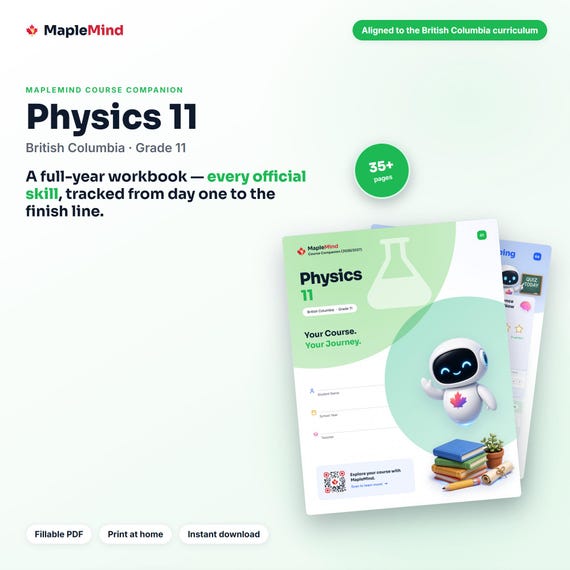
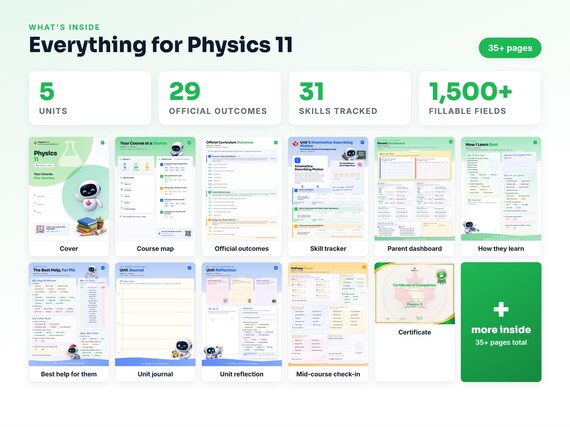
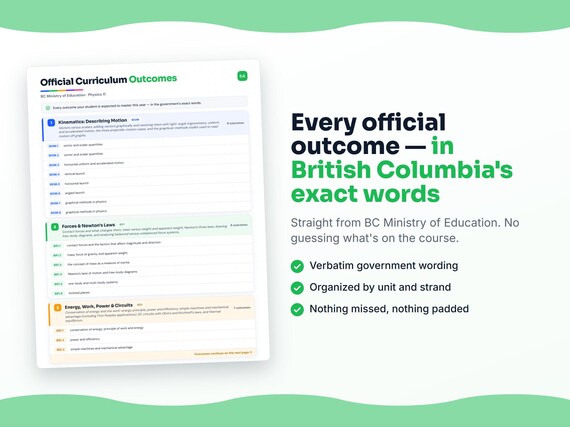

Printable workbook · A keepsake of the year
A Physics 11 workbook worth keeping
Built from the same official curriculum as this page. Before and after each skill above, your student colours in how sure they feel — so the two of you can see, on one page, what's clicking and what needs another look. It's a quiet way to follow how the year is really going.
By June it's full of their own handwriting: units worked through, confidence grown, a mid-year check-in, notes from parent-teacher night, and a certificate at the end. Less a worksheet, more a record of the year worth keeping on the shelf.
Instant download · see every page, reviews and the full description · five or more workbooks are $2.99 each
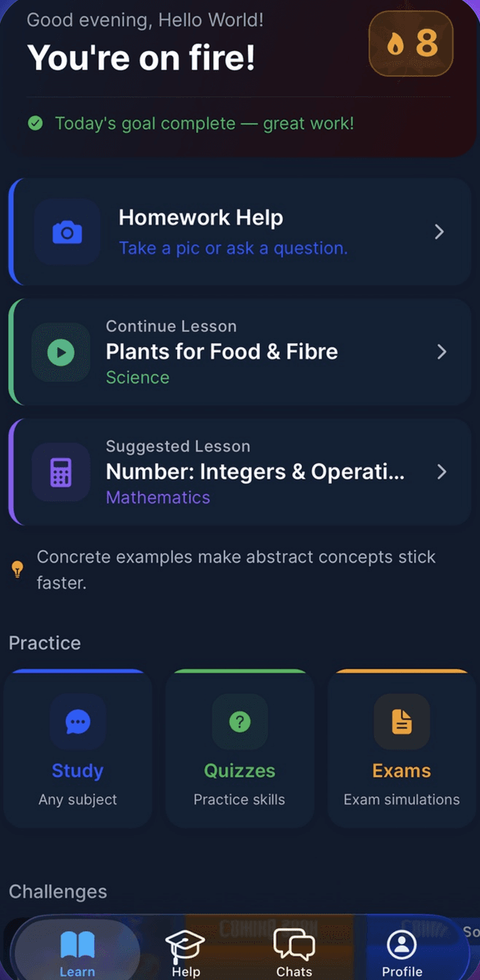
What it looks like in the app
Common questions
Can MapleMind help me with Physics 11?
Yes. MapleMind's AI tutor covers all 31 skills in British Columbia's Physics 11 — you pick the exact skill, and the tutor teaches it step by step: a short lesson, a worked example, solving together, then a skill check to show it stuck.
Is MapleMind aligned to British Columbia's official curriculum?
Yes. Every skill in this course maps to an official outcome code from British Columbia's Grade 11 Science curriculum, and the ministry's own wording is quoted under each unit on this page — with the official government source linked so you can check it yourself.
What does MapleMind cost?
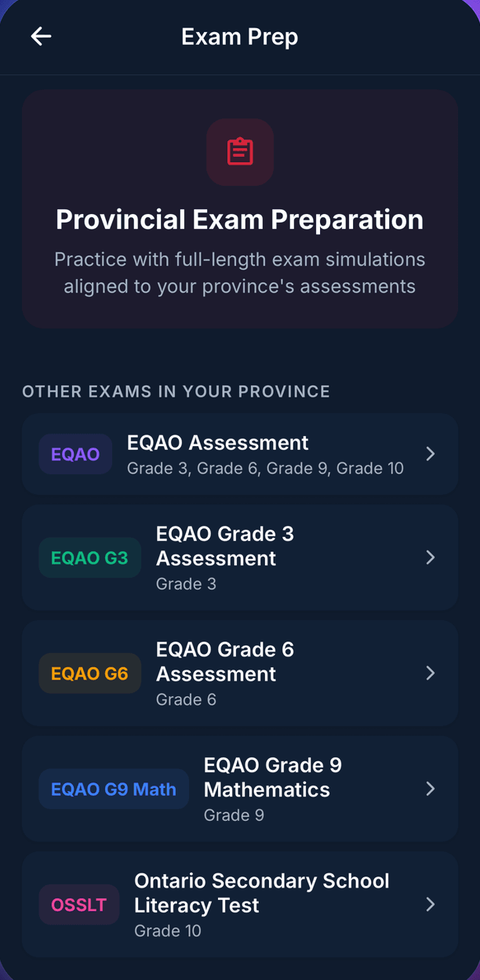
It's free to start — 5 tutoring chats and a practice quiz every day, no credit card. A Pro subscription ($9.99/month or $49.99/year CAD, 7-day free trial) unlocks unlimited tutoring, practice, and exam simulations.
What if I'm stuck on just one topic?
That's the point of skill-level tutoring: open Physics 11 in the app, tap the exact skill from the list on this page, and the tutor teaches just that — no wading through lessons you don't need.
Does MapleMind work in French or other languages?
Yes — 14 languages, including French. Both the app and the tutor's explanations switch to the language you choose.
Where can I see the official British Columbia curriculum for Physics 11?
The official source is linked on this page — BC's official science curriculum. The outline here follows it: every MapleMind skill carries its official outcome code, and the ministry's own wording is quoted under each unit.
Keep exploring
Ready when you are
Pick a skill from this page and see it taught properly — free, in the browser, in under a minute.