Get help with Biology 12
Most tutoring makes you sit through material you already know. MapleMind flips that: pick the exact skill that's causing trouble — any of the 32 below — and the tutor teaches just that one, step by step, as many times as it takes. Ask questions in plain words, any time of day, in English, French, or 12 other languages.
The official British Columbia Biology 12 curriculum
British Columbia defines Biology 12 by strands and outcomes. MapleMind teaches the same curriculum reorganized for one-skill-at-a-time tutoring — the table shows exactly where every official strand lands, and the ministry's own wording is quoted under each unit below.
Official source BC's official science curriculumRead it on the government site — curriculum.gov.bc.ca ↗| Official strand | Outcomes | Where MapleMind teaches it |
|---|---|---|
| Big Idea: Homeostasis is maintained through physiological processes. | 10 | The Chemistry & Cell Biology of Homeostasis |
| Big Idea: Gene expression, through protein synthesis, is an interaction between genes and the environment. | 7 | Genes, Protein Synthesis & Biotechnology |
| Big Idea: Organ systems have complex interrelationships to maintain homeostasis. | 13 | Organ Systems & Health |
| Curricular Competency 12.CC.7 (Planning and Conducting) — the senior sciences' one taught competency. | 2 | Lab Numeracy: Accuracy and Precision |
Every skill below, taught one on one.
 Try the first session free
How MapleMind teaches Biology 12 — every unit, lesson, and skill
Every skill below runs as a short session: a plain-words lesson, a worked example, solving it together, then a five-question skill check that earns up to three stars. Guided Mode keeps it teaching instead of answer-handing — turning it off needs a parent's password.
Unit 1The Chemistry & Cell Biology of HomeostasisOfficial strand · Big Idea: Homeostasis is maintained through physiological processes.
The molecular and cellular foundation of homeostasis: the biological molecules and enzymes that run the body's chemistry, the feedback loops that regulate the internal environment, and the membrane that controls what crosses into and out of every cell.
Biological Molecules
- Water, acids, bases, and buffers in biological systems12.HOM.1 — Explain the properties of water that make it essential to life, and describe how acids, bases, and buffers keep the pH of body fluids within the narrow range cells need to function.
- Dehydration synthesis and hydrolysis reactions12.HOM.2 — Explain how dehydration synthesis (condensation) reactions join monomers into polymers by removing water, and how hydrolysis reactions break polymers back into monomers by adding water.
- The four organic macromolecule classes and ATP12.HOM.3 — Describe the structure and function of the four classes of organic biological molecules — carbohydrates, lipids, proteins, and nucleic acids — and of ATP, the cell's energy currency.
Metabolism and Enzymes
- Metabolism: anabolism, catabolism, and ATP12.HOM.4 — Explain metabolism as the sum of the body's chemical reactions, distinguishing anabolic reactions that build molecules from catabolic reactions that break them down, and describe how ATP is produced and used to power both.
- Enzyme structure and function12.HOM.5 — Describe how an enzyme's shape lets it bind a substrate at its active site (the lock-and-key model), how coenzymes assist that binding, and how enzymes lower the activation energy a reaction needs.
- Regulation of enzyme activity (allosteric inhibition)12.HOM.6 — Explain how cells regulate enzyme activity, including allosteric inhibition, where a molecule binding away from the active site changes the enzyme's shape and slows or stops its reaction.
Feedback Loops and Regulation
- Negative feedback loops12.HOM.7 — Explain how negative feedback loops — a sensor, a control centre, and an effector — return a regulated variable such as body temperature, blood glucose, or blood CO2 back toward its set point.
- Positive feedback loops12.HOM.8 — Explain how positive feedback loops amplify a change rather than reversing it, using oxytocin release during childbirth and the blood-clotting cascade as examples of this rarer feedback pattern.
Crossing the Cell Membrane
- Plasma membrane structure and selective permeability12.HOM.9 — Describe the phospholipid bilayer and embedded membrane proteins, and explain how this structure gives the plasma membrane selective permeability — controlling exactly what crosses into and out of the cell.
- Passive and active transport mechanisms12.HOM.10 — Contrast passive transport processes — diffusion, osmosis, and facilitated transport — that require no cellular energy, with active transport, endocytosis, and exocytosis, which spend ATP to move substances against a gradient or in bulk.
The official wording — 10 outcomes in this unit
- 12.HOM.1
biological molecules
- 12.HOM.2
biological molecules
- 12.HOM.3
biological molecules
- 12.HOM.4
metabolism and enzymes
- 12.HOM.5
metabolism and enzymes
- 12.HOM.6
metabolism and enzymes
- 12.HOM.7
feedback loops and regulation of the body’s internal environment
- 12.HOM.8
feedback loops and regulation of the body’s internal environment
- 12.HOM.9
transport across a cell membrane
- 12.HOM.10
transport across a cell membrane
Unit 2Genes, Protein Synthesis & BiotechnologyOfficial strand · Big Idea: Gene expression, through protein synthesis, is an interaction between genes and the environment.
How DNA stores and copies the cell's genetic information, how that information is expressed as proteins through transcription and translation, how a protein's shape gives it function, and how genomics and biotechnology let us read and apply that information.
DNA: Information and Replication
- DNA as the cell's genetic information12.GENE.1 — Describe DNA's double-helix structure — the sugar-phosphate backbone and complementary base pairing — as the molecule that stores the cell's genetic information.
- DNA replication12.GENE.2 — Explain semiconservative replication — the unwinding of the double helix, complementary base pairing, and proofreading — as the process that copies the genome before a cell divides.
Gene Expression: Protein Synthesis
- Transcription (DNA to mRNA)12.GENE.3 — Explain transcription as the process by which RNA polymerase reads a gene's DNA sequence and builds a complementary mRNA copy of it in the nucleus.
- Translation (mRNA to protein at the ribosome)12.GENE.4 — Explain translation as the process by which a ribosome reads mRNA codons and assembles the corresponding amino acids, carried by tRNA, into a polypeptide chain.
Proteins: Structure Meets Function
- Proteins and their relationship to the structure and function of all cells12.GENE.5 — Explain how a protein's folded three-dimensional shape, built from its amino acid sequence, determines its function — as a structural protein, hormone, or enzyme — in the structure and function of every cell.
Genomics and Biotechnology
- Genomics12.GENE.6 — Describe genomics as the large-scale study of an organism's complete set of DNA, using the Human Genome Project and personal genomics (direct-to-consumer DNA testing) as examples of what genomic information reveals.
- Biotechnology12.GENE.7 — Describe how biotechnologies — cloning, recombinant DNA, genetically modified organisms, transgenic organisms, and gene therapy — apply genetic knowledge to medicine, agriculture, and industry.
The official wording — 7 outcomes in this unit
- 12.GENE.1
the cell’s genetic information
- 12.GENE.2
replication
- 12.GENE.3
gene expression
- 12.GENE.4
gene expression
- 12.GENE.5
proteins and their relationship to the structure and function of all cells
- 12.GENE.6
genomics and biotechnology
- 12.GENE.7
genomics and biotechnology
Unit 3Organ Systems & HealthOfficial strand · Big Idea: Organ systems have complex interrelationships to maintain homeostasis.
The body's hierarchy of organization from molecule to organism, the structure and interdependence of its major organ systems, and how lifestyle, a holistic view of health, and disease connect back to homeostasis.
From Molecule to Organism
- Levels of biological organization12.ORG.1 — Trace the hierarchy of organization in the human body from molecules to organelles to cells to tissues to organs to organ systems to the whole organism, and explain how structure at each level supports the level above it.
Control and Signalling Systems
- The nervous system12.ORG.NERV — Describe the structure and function of the nervous system — neurons carrying fast electrical impulses through the brain, spinal cord, and nerves — and explain its role as one of the body's two control systems, driving rapid, precisely targeted responses that help maintain homeostasis.
- The endocrine system12.ORG.ENDO — Describe the structure and function of the endocrine system — glands releasing hormones into the blood — and explain its role as the body's slower, longer-lasting, more widespread control system, adjusting metabolism, growth, and the stress response to maintain homeostasis.
Transport and Exchange Systems
- The cardiovascular system12.ORG.CARD — Describe the structure and function of the cardiovascular system — the heart, blood vessels, and blood — and explain how it transports oxygen, nutrients, hormones, and wastes to and from every cell, and its role in maintaining homeostasis.
- The respiratory system12.ORG.RESP — Describe the structure and function of the respiratory system — the airways and the thin-walled alveoli where gas exchange occurs — and explain its role in loading oxygen into and removing carbon dioxide from the blood, helping regulate blood O2, CO2, and pH.
Processing and Waste Systems
- The digestive system12.ORG.DIG — Describe the structure and function of the digestive system — the tract and its enzymes that break food down mechanically and by hydrolysis and absorb the resulting nutrients into the blood — and explain its role in supplying the body's chemistry and maintaining homeostasis.
- The urinary system12.ORG.URIN — Describe the structure and function of the urinary system — the kidneys and their nephrons filtering blood, reabsorbing needed substances, and excreting wastes as urine — and explain its central role in regulating the body's fluid, ion, and pH balance to maintain homeostasis.
Defence and Reproduction Systems
- The lymphatic/immune system12.ORG.LYMPH — Describe the structure and function of the lymphatic/immune system, and explain its dual role defending the body against pathogens while also returning excess tissue fluid to the bloodstream to maintain fluid balance.
- The reproductive system12.ORG.REPRO — Describe the structure and function of the reproductive system — the gonads, ducts, and glands — and explain how the endocrine system's hormones regulate its structures and cycles, linking reproduction to the body's broader hormonal control network.
How the Systems Work Together
- Organ-system interdependence and the maintenance of homeostasis12.ORG.INTEG — Explain how the body's organ systems are structurally and functionally interdependent — cardiovascular with respiratory, nervous with endocrine, digestive with urinary — and how, coordinated chiefly through the nervous and endocrine systems, they work together to maintain homeostasis across the whole organism.
Lifestyle and Human Health
- Lifestyle differences and their effects on human health12.ORG.7 — Explain how lifestyle factors — diet, exercise, sleep, smoking, alcohol, and other drugs — measurably affect the body's systems over time, and connect specific lifestyle differences to differences in health outcomes.
A Holistic View of Health
- A holistic approach to health12.ORG.8 — Describe a holistic approach to health that integrates mind, body, spirit, and community, rather than treating the body as a set of unconnected parts or symptoms.
Disease as Homeostasis Disrupted
- Disease as an imbalance in homeostasis12.ORG.9 — Explain disease as a state in which the body's regulatory systems fail to keep a variable within its normal range — an imbalance in homeostasis — using examples such as ulcers, hypertension, diabetes, and HIV-AIDS.
The official wording — 13 outcomes in this unit
- 12.ORG.1
micro to macro organization
- 12.ORG.NERV
organ systems
- 12.ORG.ENDO
organ systems
- 12.ORG.CARD
organ systems
- 12.ORG.RESP
organ systems
- 12.ORG.DIG
organ systems
- 12.ORG.URIN
organ systems
- 12.ORG.LYMPH
organ systems
- 12.ORG.REPRO
organ systems
- 12.ORG.INTEG
organ systems
- 12.ORG.7
lifestyle differences and their effects on human health
- 12.ORG.8
holistic approach to health
- 12.ORG.9
disease as an imbalance in homeostasis
Unit 4Lab Numeracy: Accuracy and PrecisionOfficial strand · Curricular Competency 12.CC.7 (Planning and Conducting) — the senior sciences' one taught competency.
The one Curricular Competency taught as its own cluster rather than woven: applying accuracy and precision to experimental data through significant figures and propagated measurement uncertainty, at the consolidation depth Grade 12 physiological calculations demand.
Accuracy and Precision in Physiological Data
- Significant figures in multi-step physiological calculations12.LAB.1 — Apply significant-figure rules through multi-step physiological calculations — such as rates and concentrations derived from several measurements — reporting a final answer to the correct number of significant figures.
- Propagating measurement uncertainty through derived values, with scientific notation12.LAB.2 — Propagate measurement uncertainty through a derived value calculated from several measured quantities, and express both the value and its uncertainty using correct scientific notation.
The official wording — 2 outcomes in this unit
- 12.LAB.1
Apply the concepts of accuracy and precision to experimental procedures and data
- 12.LAB.2
Apply the concepts of accuracy and precision to experimental procedures and data
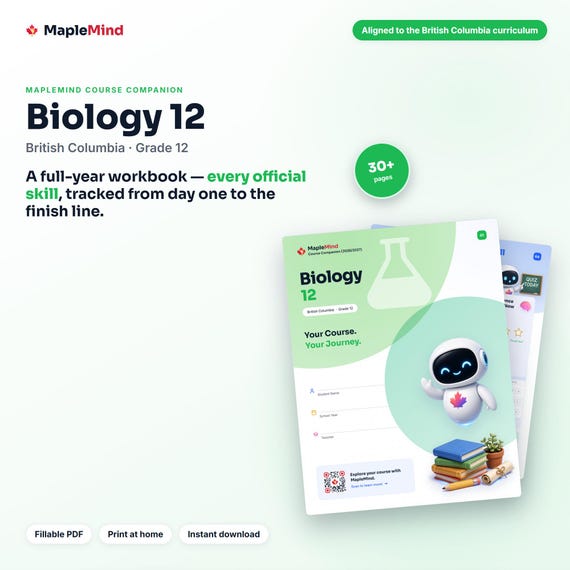
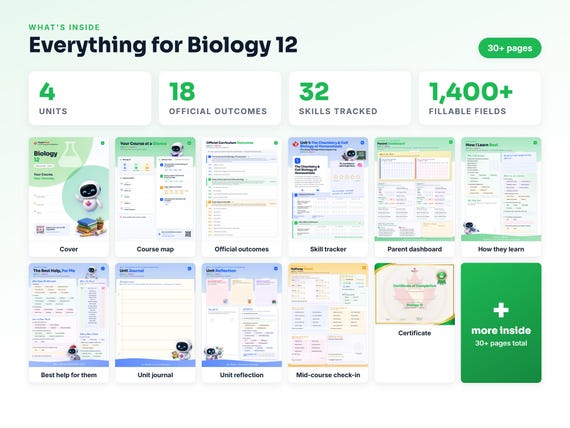


Printable workbook · A keepsake of the year
A Biology 12 workbook worth keeping
Built from the same official curriculum as this page. Before and after each skill above, your student colours in how sure they feel — so the two of you can see, on one page, what's clicking and what needs another look. It's a quiet way to follow how the year is really going.
By June it's full of their own handwriting: units worked through, confidence grown, a mid-year check-in, notes from parent-teacher night, and a certificate at the end. Less a worksheet, more a record of the year worth keeping on the shelf.
Instant download · see every page, reviews and the full description · five or more workbooks are $2.99 each
What it looks like in the app



Common questions
Can MapleMind help me with Biology 12?
Yes. MapleMind's AI tutor covers all 32 skills in British Columbia's Biology 12 — you pick the exact skill, and the tutor teaches it step by step: a short lesson, a worked example, solving together, then a skill check to show it stuck.
Is MapleMind aligned to British Columbia's official curriculum?
Yes. Every skill in this course maps to an official outcome code from British Columbia's Grade 12 Science curriculum, and the ministry's own wording is quoted under each unit on this page — with the official government source linked so you can check it yourself.
What does MapleMind cost?
It's free to start — 5 tutoring chats and a practice quiz every day, no credit card. A Pro subscription ($9.99/month or $49.99/year CAD, 7-day free trial) unlocks unlimited tutoring, practice, and exam simulations.
What if I'm stuck on just one topic?
That's the point of skill-level tutoring: open Biology 12 in the app, tap the exact skill from the list on this page, and the tutor teaches just that — no wading through lessons you don't need.
Does MapleMind work in French or other languages?
Yes — 14 languages, including French. Both the app and the tutor's explanations switch to the language you choose.
Where can I see the official British Columbia curriculum for Biology 12?
The official source is linked on this page — BC's official science curriculum. The outline here follows it: every MapleMind skill carries its official outcome code, and the ministry's own wording is quoted under each unit.
Keep exploring
Ready when you are
Pick a skill from this page and see it taught properly — free, in the browser, in under a minute.