Get help with Physics 12
Most tutoring makes you sit through material you already know. MapleMind flips that: pick the exact skill that's causing trouble — any of the 32 below — and the tutor teaches just that one, step by step, as many times as it takes. Ask questions in plain words, any time of day, in English, French, or 12 other languages.
The official British Columbia Physics 12 curriculum
British Columbia defines Physics 12 by strands and outcomes. MapleMind teaches the same curriculum reorganized for one-skill-at-a-time tutoring — the table shows exactly where every official strand lands, and the ministry's own wording is quoted under each unit below.
Official source BC's official science curriculumRead it on the government site — curriculum.gov.bc.ca ↗| Official strand | Outcomes | Where MapleMind teaches it |
|---|---|---|
| Big Idea: Measurement of motion depends on our frame of reference. | 7 | Frames of Reference & Special Relativity |
| Big Idea: Forces can cause linear and circular motion. | 5 | Equilibrium & Circular Motion |
| Big Idea: Forces and energy interactions occur within fields. | 15 | Fields: Gravitational, Electric & Magnetic |
| Big Idea: Momentum is conserved within a closed and isolated system. | 3 | Momentum & Collisions |
| Curricular Competency 12.CC.7 (Planning and conducting): Apply the concepts of accuracy and precision to experimental procedures and data. | 2 | Lab Numeracy (Accuracy and Precision) |
Every skill below, taught one on one.
 Try the first session free
How MapleMind teaches Physics 12 — every unit, lesson, and skill
Every skill below runs as a short session: a plain-words lesson, a worked example, solving it together, then a five-question skill check that earns up to three stars. Guided Mode keeps it teaching instead of answer-handing — turning it off needs a parent's password.
Unit 1Frames of Reference & Special RelativityOfficial strand · Big Idea: Measurement of motion depends on our frame of reference.
Every measurement of motion is made relative to a chosen frame of reference — from a boat crossing a moving river to the strange consequences that appear when a frame moves close to the speed of light. Includes the graphical-methods toolkit physicists use to extract relationships from data throughout the course.
Frames of Reference & Relative Motion
- What a frame of reference is12.REL.1 — Define a frame of reference as the vantage point — position and state of motion — from which position, velocity, and time are measured; every measurement of motion is made relative to some frame.
- Relative motion within a stationary frame12.REL.2 — Analyze relative motion within a single stationary (ground) reference frame, combining the velocities of two or more moving objects as vectors — e.g. a boat crossing a flowing river, or one car overtaking another.
Special Relativity
- Einstein's postulates of special relativity12.REL.3 — State the postulates of special relativity: the laws of physics are the same in every inertial reference frame, and the speed of light in a vacuum is the same for every observer, regardless of the motion of the source or the observer.
- Time dilation in a moving frame12.REL.4 — Describe and calculate the relativistic change in time within a moving reference frame — time dilation, $\Delta t' = \gamma \Delta t$, where the Lorentz factor $\gamma = \frac{1}{\sqrt{1 - v^2/c^2}} \geq 1$ stretches the time a moving clock records as seen by a stationary observer, as a direct consequence of the postulates.
- Length contraction and relativistic mass in a moving frame12.REL.5 — Describe and calculate the relativistic changes in length and mass within a moving reference frame — length contraction along the direction of motion, $L' = \frac{L}{\gamma}$, and the increase in relativistic mass, $m = \gamma m_0$, both governed by the same Lorentz factor $\gamma = \frac{1}{\sqrt{1 - v^2/c^2}}$.
Graphical Methods in Physics
- Graphing linear, exponential, and inverse relationships12.GRAPH.1 — Graph a linear, exponential, or inverse relationship given a physical model — such as electric or gravitational force and field strength plotted against distance — choosing axes and a plot type that reveal the underlying relationship.
- Linear regression, slope, interpolation, and area under the curve12.GRAPH.2 — Determine the linear regression that results from linearizing an exponential or inverse relationship, calculate the slope of a line of best fit with correct significant figures and units, interpolate and extrapolate from a constructed graph, and calculate and interpret the physical meaning of the area under a curve.
The official wording — 7 outcomes in this unit
- 12.REL.1
frames of reference
- 12.REL.2
relative motion within a stationary reference frame
- 12.REL.3
postulates of special relativity
- 12.REL.4
changes in time
- 12.REL.5
changes in length, and mass
- 12.GRAPH.1
graphical methods in physics
- 12.GRAPH.2
graphical methods in physics
Unit 2Equilibrium & Circular MotionOfficial strand · Big Idea: Forces can cause linear and circular motion.
Forces that balance keep an object at rest, while forces held toward a centre keep it turning in a circle. Static equilibrium and uniform circular motion both come from careful force analysis — including the traditional technologies First Peoples engineered around these same principles.
Static Equilibrium
- Translational static equilibrium12.EQ.1 — Analyze translational static equilibrium, in which the sum of all forces acting on an object equals zero in both the vertical and horizontal directions, so the object remains at rest.
- Rotational equilibrium, torque, and centre of gravity12.EQ.2 — Analyze rotational static equilibrium, in which the sum of all torques acting on an object equals zero, and locate the centre of gravity of a uniform body as the point where its weight can be considered to act.
Uniform Circular Motion
- Centripetal force and acceleration12.CIRC.1 — Analyze uniform circular motion in terms of centripetal acceleration, $a_c = \frac{v^2}{r}$, and centripetal force, $F_c = \frac{mv^2}{r}$, directed toward the centre of the circle.
- Changes to apparent weight in vertical and horizontal circles12.CIRC.2 — Explain and calculate changes to apparent weight produced by circular motion in both vertical and horizontal circles — such as feeling heavier at the bottom of a loop, lighter at the top, on a Ferris wheel, or in a centrifuge.
First Peoples Knowledge of Forces
- First Peoples applications of forces in traditional technologies12.FP.1 — Describe First Peoples knowledge and applications of forces in traditional technologies — for example, the salmon wheel, canoe paddle design, and deadfall traps — as engineered solutions built on the same force principles studied in this unit.
The official wording — 5 outcomes in this unit
- 12.EQ.1
static equilibrium
- 12.EQ.2
static equilibrium
- 12.CIRC.1
uniform circular motion: — centripetal force and acceleration
- 12.CIRC.2
changes to apparent weight
- 12.FP.1
First Peoples knowledge and applications of forces in traditional technologies
Unit 3Fields: Gravitational, Electric & MagneticOfficial strand · Big Idea: Forces and energy interactions occur within fields.
Mass, charge, and moving charge each create a field reaching through the space around them, exerting a force on and storing potential energy in anything else placed within that field — from a dropped stone, to a charged particle in an accelerator, to the current a spinning magnet induces.
The Gravitational Field & Newton's Law
- The gravitational field12.GRAV.1 — Describe the gravitational field surrounding a mass as a vector field that interacts with any other mass through gravitons, and that is always attractive, never repulsive.
- Newton's law of universal gravitation12.GRAV.2 — Apply Newton's law of universal gravitation, $F = \frac{Gm_1m_2}{r^2}$, to calculate the gravitational force of attraction between two masses.
Gravitational Potential Energy
- Gravitational potential energy12.GRAV.3 — Calculate gravitational potential energy using $E_p = -\frac{Gm_1m_2}{r}$, the energy stored by two masses separated within each other's gravitational field, taking the zero of potential energy at infinite separation.
Gravitational Dynamics & Orbits
- Gravitational dynamics and energy relationships12.GRAV.4 — Analyze gravitational dynamics and energy relationships for orbiting bodies — combining centripetal force with gravitational force to find orbital speed and period, and applying conservation of energy to satellite motion, orbit changes, launch velocity, and escape velocity.
The Electric Field & Coulomb's Law
- The electric field12.ELEC.1 — Describe the electric field surrounding a charge as a vector field that interacts with positive or negative elementary charge, can be attractive or repulsive, and takes different forms around single point charges (non-uniform field) versus parallel plates (uniform field).
- Coulomb's law12.ELEC.2 — Apply Coulomb's law, $F = \frac{kq_1q_2}{r^2}$, to calculate the electric force between two point charges.
Electric Potential Energy & Potential Difference
- Electric potential energy12.ELEC.3 — Calculate electric potential energy — the energy stored between a pair of charges as work is done to assemble them within each other's field, measured in joules.
- Electric potential and potential difference12.ELEC.4 — Distinguish electric potential (a property of a point in the field, measured in volts, $V = \frac{E_p}{q}$) from electric potential difference (the change in electric potential between two points), and calculate both.
Electrostatic Dynamics & Energy
- Electrostatic force dynamics on a point charge12.ELEC.5 — Analyze the relationships between force, charge, and distance on a single point charge using Coulomb's law and the electric field — solving the dynamics of a charge interacting with other charges in 1D and 2D, held in orbit by an electrostatic force, and moving between parallel plates, as a force-vector (Newton's-second-law) problem.
- Energy-method analysis of an accelerated charge12.ELEC.6 — Apply the law of conservation of energy and the work-energy principle to a charge accelerated through a potential difference — the electric potential energy lost equals the kinetic energy gained, $qV = \frac{1}{2}mv^2$ — as in a cathode ray tube, mass spectrometer, or particle accelerator.
Magnetic Field & Magnetic Force
- The magnetic field12.MAG.1 — Describe the magnetic field as a vector field induced by moving charges, interacting with magnetic polarity (north/south) to attract or repel, and produced by permanent magnets, straight current-carrying wires, and solenoids.
- Magnetic force and the right-hand rules12.MAG.2 — Calculate the magnetic force acting on a moving charge or a current-carrying wire within a magnetic field, $F = qvB$ and $F = BIL$, and determine its direction using the right-hand rules.
Electromagnetic Induction
- Faraday's law: magnitude of the induced EMF12.MAG.3 — Apply Faraday's law to calculate the MAGNITUDE of the EMF induced by a changing magnetic flux, $\varepsilon = -N\frac{\Delta \Phi}{\Delta t}$, where the flux $\Phi = BA\cos\theta$ changes as field strength, area, or orientation changes while a bar, wire, coil, or single charge moves within the field.
- Lenz's law: direction of the induced current12.MAG.5 — Apply Lenz's law to determine the DIRECTION of the induced current — it always flows so as to oppose the change in magnetic flux that produced it — and explain this as a direct consequence of the conservation of energy.
Applications of Electromagnetic Induction
- Applications: motors, generators, transformers12.MAG.4 — Describe applications of electromagnetic induction — back electromotive force (EMF), direct current (DC) motors, generators, and transformers — in terms of a changing magnetic flux producing an induced current.
The official wording — 15 outcomes in this unit
- 12.GRAV.1
gravitational field and Newton's law of universal gravitation
- 12.GRAV.2
gravitational field and Newton's law of universal gravitation
- 12.GRAV.3
gravitational potential energy
- 12.GRAV.4
gravitational dynamics and energy relationships
- 12.ELEC.1
electric field and Coulomb's law
- 12.ELEC.2
electric field and Coulomb's law
- 12.ELEC.3
electric potential energy, electric potential, and electric potential difference
- 12.ELEC.4
electric potential energy, electric potential, and electric potential difference
- 12.ELEC.5
relationships between force, charge, and distance on a single point charge
- 12.ELEC.6
application of law of conservation of energy and the principle of work and energy
- 12.MAG.1
magnetic field and magnetic force
- 12.MAG.2
magnetic field and magnetic force
- 12.MAG.3
Faraday's law
- 12.MAG.5
Lenz's law
- 12.MAG.4
applications of electromagnetic induction
Unit 4Momentum & CollisionsOfficial strand · Big Idea: Momentum is conserved within a closed and isolated system.
Momentum is conserved whenever objects interact in a closed and isolated system — whether a force acts briefly as an impulse, or two objects collide and bounce, stick, or scatter.
Impulse & Momentum
- Impulse and momentum12.MOM.1 — Define momentum as $\vec{p} = m\vec{v}$ and impulse as $\vec{J} = \vec{F}\Delta t = \Delta \vec{p}$, relating Newton's second law to the change in an object's momentum within a closed and isolated system.
Conservation of Momentum & Energy in Collisions
- Elastic and inelastic collisions in 1D12.MOM.2 — Apply conservation of momentum to one-dimensional collisions between two objects, and determine whether a collision is elastic, inelastic, or completely inelastic by checking whether kinetic energy is also conserved.
- 2D collisions and ballistic pendulums12.MOM.3 — Apply conservation of momentum to collisions among multiple objects in two dimensions, using vector components, and analyze a ballistic pendulum as a two-stage momentum-then-energy problem.
The official wording — 3 outcomes in this unit
- 12.MOM.1
impulse and momentum
- 12.MOM.2
conservation of momentum and energy in collisions
- 12.MOM.3
conservation of momentum and energy in collisions
Unit 5Lab Numeracy (Accuracy and Precision)Official strand · Curricular Competency 12.CC.7 (Planning and conducting): Apply the concepts of accuracy and precision to experimental procedures and data.
The one Curricular Competency taught directly rather than woven: significant figures, measurement uncertainty, and scientific notation are separately-learnable, separately-quizzable lab-numeracy skills, pitched here to the multi-step field and relativistic calculations this course demands.
Significant Figures in Multi-Step Calculations
- Significant figures in multi-step field and relativistic calculations12.LABNUM.1 — Apply significant-figure rules through multi-step calculations that combine several measured quantities — such as inverse-square field formulas and relativistic time-dilation or length-contraction expressions — carrying the correct number of significant figures to the final answer.
Propagating Uncertainty & Scientific Notation
- Propagating uncertainty and scientific notation in derived values12.LABNUM.2 — Apply the concepts of accuracy and precision to experimental procedures and data by propagating measurement uncertainty through a derived value — such as a calculated field strength, force, or relativistic quantity — and expressing very large or very small results correctly in scientific notation.
The official wording — 2 outcomes in this unit
- 12.LABNUM.1
significant figures
- 12.LABNUM.2
Apply the concepts of accuracy and precision to experimental procedures and data: — significant figures — uncertainty — scientific notation
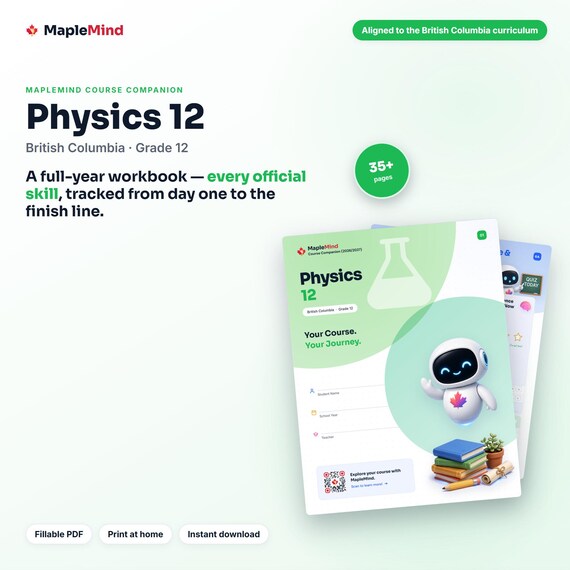
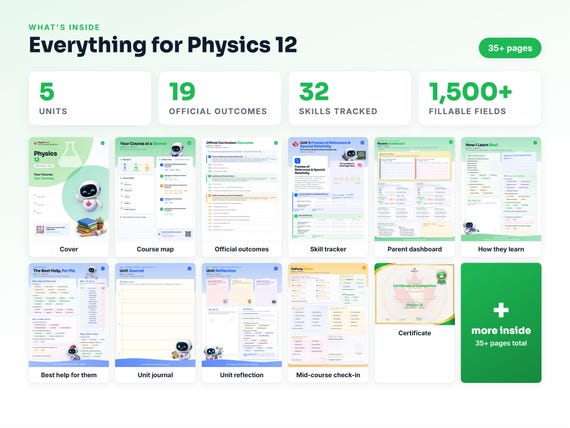


Printable workbook · A keepsake of the year
A Physics 12 workbook worth keeping
Built from the same official curriculum as this page. Before and after each skill above, your student colours in how sure they feel — so the two of you can see, on one page, what's clicking and what needs another look. It's a quiet way to follow how the year is really going.
By June it's full of their own handwriting: units worked through, confidence grown, a mid-year check-in, notes from parent-teacher night, and a certificate at the end. Less a worksheet, more a record of the year worth keeping on the shelf.
Instant download · see every page, reviews and the full description · five or more workbooks are $2.99 each
What it looks like in the app



Common questions
Can MapleMind help me with Physics 12?
Yes. MapleMind's AI tutor covers all 32 skills in British Columbia's Physics 12 — you pick the exact skill, and the tutor teaches it step by step: a short lesson, a worked example, solving together, then a skill check to show it stuck.
Is MapleMind aligned to British Columbia's official curriculum?
Yes. Every skill in this course maps to an official outcome code from British Columbia's Grade 12 Science curriculum, and the ministry's own wording is quoted under each unit on this page — with the official government source linked so you can check it yourself.
What does MapleMind cost?
It's free to start — 5 tutoring chats and a practice quiz every day, no credit card. A Pro subscription ($9.99/month or $49.99/year CAD, 7-day free trial) unlocks unlimited tutoring, practice, and exam simulations.
What if I'm stuck on just one topic?
That's the point of skill-level tutoring: open Physics 12 in the app, tap the exact skill from the list on this page, and the tutor teaches just that — no wading through lessons you don't need.
Does MapleMind work in French or other languages?
Yes — 14 languages, including French. Both the app and the tutor's explanations switch to the language you choose.
Where can I see the official British Columbia curriculum for Physics 12?
The official source is linked on this page — BC's official science curriculum. The outline here follows it: every MapleMind skill carries its official outcome code, and the ministry's own wording is quoted under each unit.
Keep exploring
Ready when you are
Pick a skill from this page and see it taught properly — free, in the browser, in under a minute.