Get help with Earth Science 11
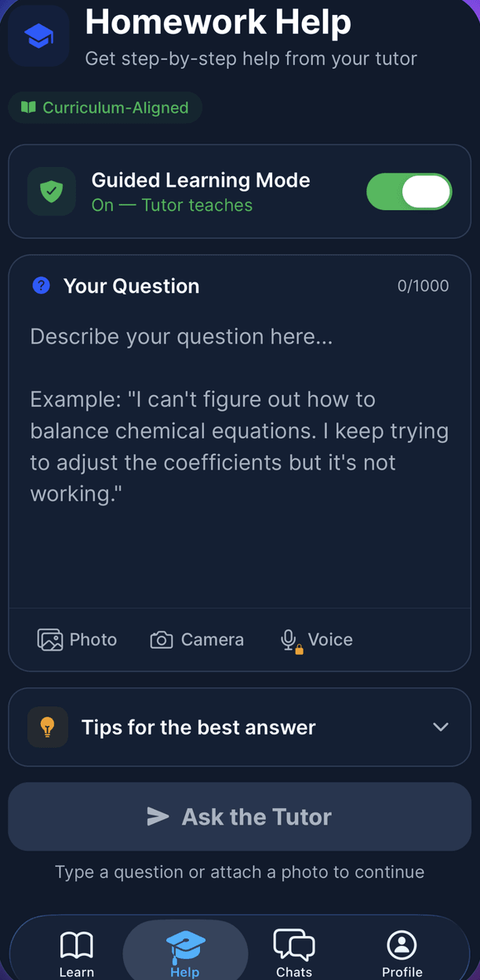
Most tutoring makes you sit through material you already know. MapleMind flips that: pick the exact skill that's causing trouble — any of the 33 below — and the tutor teaches just that one, step by step, as many times as it takes. Ask questions in plain words, any time of day, in English, French, or 12 other languages.
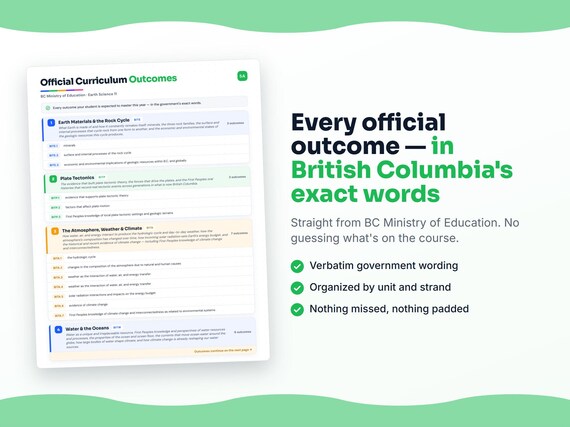
The official British Columbia Earth Science 11 curriculum
British Columbia defines Earth Science 11 by strands and outcomes. MapleMind teaches the same curriculum reorganized for one-skill-at-a-time tutoring — the table shows exactly where every official strand lands, and the ministry's own wording is quoted under each unit below.
Official source BC's official science curriculumRead it on the government site — curriculum.gov.bc.ca ↗| Official strand | Outcomes | Where MapleMind teaches it |
|---|---|---|
| Big Idea theme: Earth materials | 7 | Earth Materials & the Rock Cycle |
| Big Idea theme: Plate tectonic theory | 3 | Plate Tectonics |
| Big Idea theme: atmosphere | 7 | The Atmosphere, Weather & Climate |
| Big Idea theme: water | 6 | Water & the Oceans |
| Big Idea theme: Earth and its solar system | 8 | Earth & Its Solar System |
| Curricular Competency 11.CC.7 (taught): Planning and conducting | 2 | Lab Numeracy: Accuracy and Precision |
Every skill below, taught one on one.
 Try the first session free
How MapleMind teaches Earth Science 11 — every unit, lesson, and skill
Every skill below runs as a short session: a plain-words lesson, a worked example, solving it together, then a five-question skill check that earns up to three stars. Guided Mode keeps it teaching instead of answer-handing — turning it off needs a parent's password.
Unit 1Earth Materials & the Rock CycleOfficial strand · Big Idea theme: Earth materials
What Earth is made of and how it constantly remakes itself: minerals, the three rock families, the surface and internal processes that cycle rock from one form to another, and the economic and environmental stakes of the geologic resources this cycle produces.
Minerals and the Three Rock Families
- Minerals and their identification11.MAT.1 — Identify common minerals found in igneous, metamorphic, and sedimentary environments — including valuable, ore-forming minerals found in B.C. — using physical properties such as hardness, lustre, cleavage, and streak.
- Igneous rocks11.MAT.2 — Classify common igneous rocks (basalt, granite, pumice) as intrusive or extrusive, and relate texture and crystal size to how quickly the rock cooled.
- Sedimentary rocks11.MAT.3 — Classify common sedimentary rocks (conglomerate, shale, coal, limestone) as chemical/biochemical or clastic, based on how their sediments formed and were deposited.
- Metamorphic rocks11.MAT.4 — Classify common metamorphic rocks (slate, schist, gneiss) as foliated or non-foliated, based on the heat and pressure conditions that transformed their parent rock.
- Geologic resources11.MAT.5 — Identify which earth materials qualify as geologic resources — minerals, ores, fossil fuels, metals, and aggregates — setting up why some rocks and minerals carry economic value and others do not.
The Rock Cycle: Surface and Internal Processes
- Surface and internal processes of the rock cycle11.MAT.6 — Trace the surface processes (weathering, erosion) and internal processes (melting, crystallization, metamorphism) that convert each rock type into another, and explain the rock cycle as a continuous, non-linear loop rather than a one-way sequence.
Geologic Resources: Economic and Environmental Implications
- Economic and environmental implications of geologic resources11.MAT.7 — Evaluate the economic and environmental implications of geologic resources within B.C. and globally — economic feasibility, exploration and extraction methods, and site remediation — weighing resource revenue against environmental impact.
The official wording — 7 outcomes in this unit
- 11.MAT.1
minerals
- 11.MAT.2
igneous rocks
- 11.MAT.3
sedimentary rocks
- 11.MAT.4
metamorphic rocks
- 11.MAT.5
geologic resources
- 11.MAT.6
surface and internal processes of the rock cycle
- 11.MAT.7
economic and environmental implications of geologic resources within B.C. and globally
Unit 2Plate TectonicsOfficial strand · Big Idea theme: Plate tectonic theory
The evidence that built plate tectonic theory, the forces that drive the plates, and the First Peoples oral histories that record real tectonic events across generations in what is now British Columbia.
The Evidence That Built Plate Tectonic Theory
- Evidence for plate tectonic theory11.TEC.1 — Evaluate the converging lines of evidence that support plate tectonic theory — continental fit, matching fossils and rock sequences across oceans, seafloor magnetic striping, and the global distribution of earthquakes and volcanoes.
What Drives the Plates
- Factors that affect plate motion11.TEC.2 — Explain the factors that drive plate motion, including heat from the core and mantle radioactivity, mantle convection currents, ridge push at spreading centres, and slab pull where dense oceanic plates subduct.
First Peoples Knowledge of Local Geologic Terrains
- First Peoples knowledge of plate tectonic settings11.TEC.3 — Describe First Peoples knowledge of local plate tectonic settings and geologic terrains in British Columbia, including oral histories that record real geologic events such as earthquakes, tsunamis, and volcanic activity across generations.
The official wording — 3 outcomes in this unit
- 11.TEC.1
evidence that supports plate tectonic theory
- 11.TEC.2
factors that affect plate motion
- 11.TEC.3
First Peoples knowledge of local plate tectonic settings and geologic terrains
Unit 3The Atmosphere, Weather & ClimateOfficial strand · Big Idea theme: atmosphere
How water, air, and energy interact to produce the hydrologic cycle and day-to-day weather, how the atmosphere's composition has changed over time, how incoming solar radiation sets Earth's energy budget, and the historical and recent evidence of climate change — including First Peoples knowledge of climate change and interconnectedness.
The Hydrologic Cycle
- The hydrologic cycle11.ATM.1 — Trace the movement of water through the hydrologic cycle — evaporation, condensation, precipitation, infiltration, and runoff — driven by the transfer of energy within the atmosphere and hydrosphere, between the oceans, atmosphere, land, and living things.
Changes in the Atmosphere
- Changes in the composition of the atmosphere11.ATM.2 — Describe changes in the composition of the atmosphere over time due to natural causes (volcanic outgassing, biological activity) and human causes (fossil fuel combustion, deforestation).
Weather Systems: Air Masses, Pressure, Humidity and Fronts
- Weather as the interaction of water, air, and energy transfer11.ATM.3 — Explain day-to-day weather as the product of interacting water, air, and energy transfer — how air masses, air pressure, humidity, dew point, fronts, and frontal systems combine to produce the weather we experience.
Extreme Weather, Air Currents and El Niño/La Niña
- Extreme weather, air currents and El Niño/La Niña11.ATM.4 — Explain larger-scale weather phenomena that also arise from the interaction of water, air, and energy transfer — extreme weather events, local and global air currents (on-shore breezes, the jet stream), and the El Niño/La Niña oscillation.
Solar Radiation and Earth's Energy Budget
- Solar radiation interactions and the energy budget11.ATM.5 — Explain how incoming solar radiation interacts with Earth's surface and atmosphere — through absorption, reflection, and re-radiation — and how the greenhouse effect, albedo, and changes to carbon sinks and sources impact the energy budget and global temperature.
Evidence of Climate Change
- Evidence of climate change11.ATM.6 — Evaluate historical and recent (the last 100 years) evidence of climate change — ice core data, deep-sea sediments, and First Peoples knowledge.
First Peoples Knowledge of Climate Change
- First Peoples knowledge of climate change11.ATM.7 — Describe First Peoples knowledge of climate change and interconnectedness as related to environmental systems, recognizing how First Peoples perspectives link climate to the health of whole environmental systems.
The official wording — 7 outcomes in this unit
- 11.ATM.1
the hydrologic cycle
- 11.ATM.2
changes in the composition of the atmosphere due to natural and human causes
- 11.ATM.3
weather as the interaction of water, air, and energy transfer
- 11.ATM.4
weather as the interaction of water, air, and energy transfer
- 11.ATM.5
solar radiation interactions and impacts on the energy budget
- 11.ATM.6
evidence of climate change
- 11.ATM.7
First Peoples knowledge of climate change and interconnectedness as related to environmental systems
Unit 4Water & the OceansOfficial strand · Big Idea theme: water
Water as a unique and irreplaceable resource, First Peoples knowledge and perspectives of water resources and processes, the properties of the ocean and ocean floor, the currents that move ocean water around the globe, how large bodies of water shape climate, and how climate change is already reshaping our water sources.
Water as a Unique Resource
- Water as a unique resource11.WAT.1 — Explain why water is a unique resource — considering fresh water (rivers, glaciers, groundwater) and salt water (oceans, salt lakes) — and identify resource concerns such as aquifer depletion, sea water intrusion, and contamination from landfills and industry.
First Peoples Knowledge of Water Resources
- First Peoples knowledge of water resources11.WAT.2 — Describe First Peoples knowledge and perspectives of water resources and processes, recognizing water's central role in First Peoples relationships with the land.
Properties of the Ocean and Ocean Floor
- Properties of the ocean and the ocean floor11.WAT.3 — Describe the properties of the ocean and the ocean floor as determined by remote sensing and direct observation.
Local and Global Ocean Currents
- Local and global ocean currents11.WAT.4 — Explain how local and global ocean currents depend on salinity, temperature, and density.
Influence of Large Bodies of Water on Climate
- Influence of large bodies of water on local and global climates11.WAT.5 — Explain how large bodies of water influence local climate (on-shore breeze, temperature moderation) and global climate (oceans as a carbon sink, the albedo effect).
Effects of Climate Change on Water Sources
- Effects of climate change on water sources11.WAT.6 — Describe the effects of climate change on water sources — ocean acidification, changes to ocean currents, loss of glaciers, and rising sea levels.
The official wording — 6 outcomes in this unit
- 11.WAT.1
water as a unique resource
- 11.WAT.2
First Peoples knowledge and perspectives of water resources and processes
- 11.WAT.3
properties of the ocean and the ocean floor
- 11.WAT.4
local and global ocean currents
- 11.WAT.5
influences of large bodies of water on local and global climates
- 11.WAT.6
effects of climate change on water sources
Unit 5Earth & Its Solar SystemOfficial strand · Big Idea theme: Earth and its solar system
How the solar system formed, what makes Earth uniquely able to support life, how stars are classified and change over their life cycle, the impacts of the Earth-moon-sun system, and how space technologies let us study changes in Earth and its systems.
The Nebular Hypothesis
- The nebular hypothesis and solar system formation11.SOLSYS.1 — Explain the nebular hypothesis — the explanation of the formation and properties of our solar system from a collapsing cloud of gas and dust.
Earth as a Unique Planet
- Earth as a unique planet11.SOLSYS.2 — Explain what makes Earth a unique planet within its solar system — the presence of water, life, a protective magnetic field, moderate temperature, and a life-sustaining atmosphere.
Stars: Classification, Brightness and Life Cycle
- Stellar classification, magnitude and brightness11.SOLSYS.3a — Classify stars by stellar classification (temperature and colour, the Hertzsprung-Russell diagram), and distinguish a star's true light output from its apparent brightness — explaining how measured magnitude and brightness depend on both true output and distance.
- The stellar life cycle11.SOLSYS.3b — Describe the life cycle of a star — formation from collapsing gas and dust, the stable main-sequence phase, and the mass-dependent end-states (giant, then white dwarf, or a dramatic collapse for the most massive stars).
Tides and Eclipses: Gravity and Alignment
- Tides and eclipses: gravity and three-body alignment11.SOLSYS.4a — Explain tides as the result of the moon's and sun's gravity on Earth's oceans (including spring and neap tides from Earth-moon-sun alignment), and eclipses as the result of close three-body alignment of the sun, Earth, and moon.
Seasonal Variation, Albedo and Precession
- Seasonal variation, albedo and precession11.SOLSYS.4b — Explain seasonal variation as the result of Earth's axial tilt (NOT its changing distance from the sun), precession as the slow millennial wobble of that tilted axis, and albedo as the surface reflectivity that governs how much of the seasonally-varying sunlight is reflected versus absorbed.
Moon Phases and Solar Winds
- Moon phases and solar winds11.SOLSYS.4c — Explain moon phases as the changing geometry of the sunlit half of the moon as it orbits Earth (distinct from the shadow geometry that causes eclipses), and solar winds as streams of charged particles from the sun that interact with Earth's magnetic field.
Space Technologies for Studying Earth Systems
- Space technologies for studying Earth systems11.SOLSYS.5 — Describe how space technologies are applied to the study of changes in Earth and its systems.
The official wording — 8 outcomes in this unit
- 11.SOLSYS.1
the nebular hypothesis (explanation of the formation and properties of our solar system)
- 11.SOLSYS.2
Earth as a unique planet within its solar system
- 11.SOLSYS.3a
magnitude, brightness
- 11.SOLSYS.3b
life cycle
- 11.SOLSYS.4a
tides, eclipses
- 11.SOLSYS.4b
seasonal variation, albedo, precession
- 11.SOLSYS.4c
moon phases, solar winds
- 11.SOLSYS.5
application of space technologies to the study of changes in Earth and its systems
Unit 6Lab Numeracy: Accuracy and PrecisionOfficial strand · Curricular Competency 11.CC.7 (taught): Planning and conducting
The one Curricular Competency taught as its own session across BC's senior sciences: applying accuracy and precision to experimental procedures and data — significant figures, measurement uncertainty, and scientific notation — pitched here to earth-material observations and weather-data recording.
Significant Figures and Rounding Rules
- Significant figures and rounding rules11.LABNUM.1 — Apply significant figures and rounding rules when recording measurements of earth materials and weather data, so precision claimed matches precision actually measured.
Measurement Uncertainty and Scientific Notation
- Measurement uncertainty and scientific notation11.LABNUM.2 — Apply the concepts of accuracy and precision to experimental procedures and data — stating the uncertainty of a measurement and expressing geologic or astronomical magnitudes in scientific notation.
The official wording — 2 outcomes in this unit
- 11.LABNUM.1
significant figures
- 11.LABNUM.2
Apply the concepts of accuracy and precision to experimental procedures and data: — significant figures — uncertainty — scientific notation
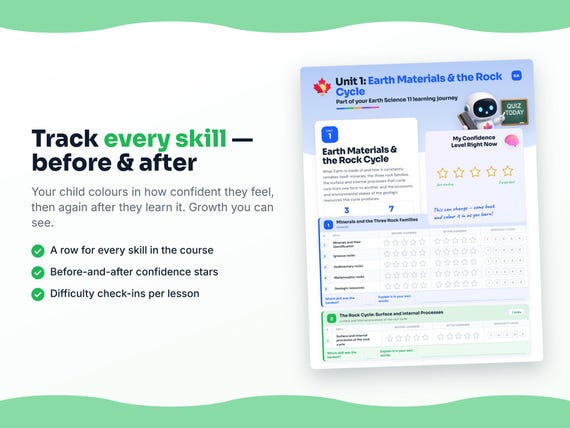
Printable workbook · A keepsake of the year
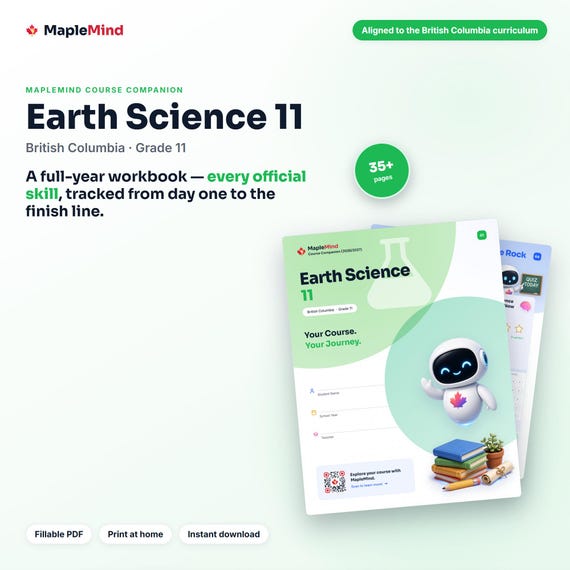
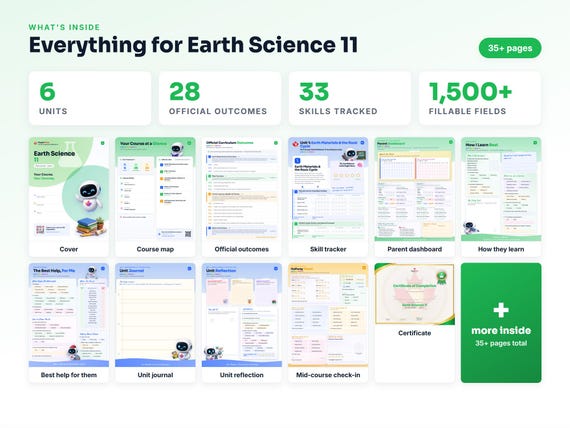
A Earth Science 11 workbook worth keeping
Built from the same official curriculum as this page. Before and after each skill above, your student colours in how sure they feel — so the two of you can see, on one page, what's clicking and what needs another look. It's a quiet way to follow how the year is really going.
By June it's full of their own handwriting: units worked through, confidence grown, a mid-year check-in, notes from parent-teacher night, and a certificate at the end. Less a worksheet, more a record of the year worth keeping on the shelf.
Instant download · see every page, reviews and the full description · five or more workbooks are $2.99 each
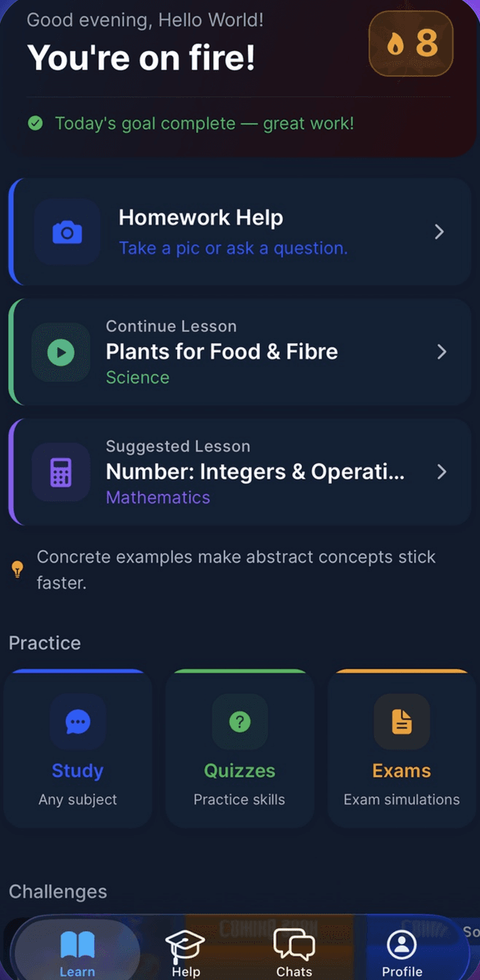
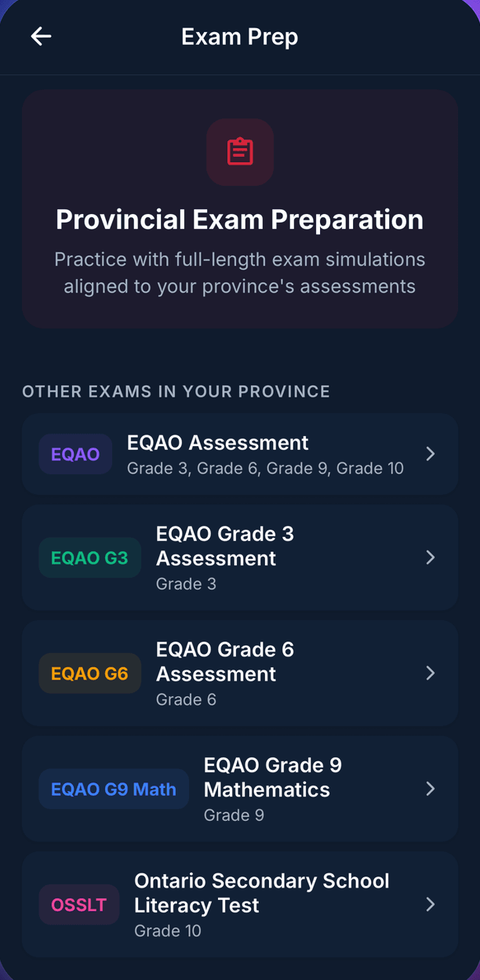
What it looks like in the app
Common questions
Can MapleMind help me with Earth Science 11?
Yes. MapleMind's AI tutor covers all 33 skills in British Columbia's Earth Science 11 — you pick the exact skill, and the tutor teaches it step by step: a short lesson, a worked example, solving together, then a skill check to show it stuck.
Is MapleMind aligned to British Columbia's official curriculum?
Yes. Every skill in this course maps to an official outcome code from British Columbia's Grade 11 Science curriculum, and the ministry's own wording is quoted under each unit on this page — with the official government source linked so you can check it yourself.
What does MapleMind cost?
It's free to start — 5 tutoring chats and a practice quiz every day, no credit card. A Pro subscription ($9.99/month or $49.99/year CAD, 7-day free trial) unlocks unlimited tutoring, practice, and exam simulations.
What if I'm stuck on just one topic?
That's the point of skill-level tutoring: open Earth Science 11 in the app, tap the exact skill from the list on this page, and the tutor teaches just that — no wading through lessons you don't need.
Does MapleMind work in French or other languages?
Yes — 14 languages, including French. Both the app and the tutor's explanations switch to the language you choose.
Where can I see the official British Columbia curriculum for Earth Science 11?
The official source is linked on this page — BC's official science curriculum. The outline here follows it: every MapleMind skill carries its official outcome code, and the ministry's own wording is quoted under each unit.
Keep exploring
Ready when you are
Pick a skill from this page and see it taught properly — free, in the browser, in under a minute.