Get help with Chemistry 12
Most tutoring makes you sit through material you already know. MapleMind flips that: pick the exact skill that's causing trouble — any of the 32 below — and the tutor teaches just that one, step by step, as many times as it takes. Ask questions in plain words, any time of day, in English, French, or 12 other languages.
The official British Columbia Chemistry 12 curriculum
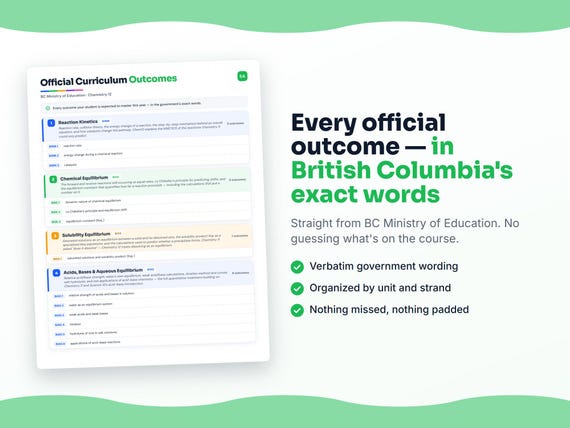
British Columbia defines Chemistry 12 by strands and outcomes. MapleMind teaches the same curriculum reorganized for one-skill-at-a-time tutoring — the table shows exactly where every official strand lands, and the ministry's own wording is quoted under each unit below.
Official source BC's official science curriculumRead it on the government site — curriculum.gov.bc.ca ↗| Official strand | Outcomes | Where MapleMind teaches it |
|---|---|---|
| Big Idea: Reactants must collide to react, and the reaction rate is dependent on the surrounding conditions. | 5 | Reaction Kinetics |
| Big Idea: Dynamic equilibrium can be shifted by changes to the surrounding conditions. | 4 | Chemical Equilibrium |
| Big Idea: Saturated solutions are systems in equilibrium. | 2 | Solubility Equilibrium |
| Big Idea: Acid or base strength depends on the degree of ion dissociation. | 12 | Acids, Bases & Aqueous Equilibrium |
| Big Idea: Oxidation and reduction are complementary processes that involve the gain or loss of electrons. | 7 | Oxidation-Reduction & Electrochemistry |
| Curricular Competency 12.CC.7 (Planning and conducting): Apply the concepts of accuracy and precision to experimental procedures and data. | 2 | Lab Numeracy: Accuracy and Precision |
Every skill below, taught one on one.
 Try the first session free
How MapleMind teaches Chemistry 12 — every unit, lesson, and skill
Every skill below runs as a short session: a plain-words lesson, a worked example, solving it together, then a five-question skill check that earns up to three stars. Guided Mode keeps it teaching instead of answer-handing — turning it off needs a parent's password.
Unit 1Reaction KineticsOfficial strand · Big Idea: Reactants must collide to react, and the reaction rate is dependent on the surrounding conditions.
Reaction rate, collision theory, the energy change of a reaction, the step-by-step mechanism behind an overall equation, and how catalysts change the pathway. Chem12 explains the KINETICS of the reactions Chemistry 11 could only predict.
Measuring Reaction Rate & Collision Theory
- Reaction rate and the factors that affect it12.KIN.1 — Define reaction rate as the change in concentration of a reactant or product per unit time, for both homogeneous and heterogeneous reactions, and identify the factors (concentration, temperature, surface area, catalysts) that change it.
- Collision theory and successful collisions12.KIN.2 — Explain reaction rate using collision theory: particles must collide with sufficient energy and correct orientation (collision geometry) for a reaction to occur, and relate successful collisions to reaction rate.
Energy Change & Reaction Mechanism
- Energy change and potential-energy diagrams12.KIN.3 — Analyze and label the energy change during a chemical reaction — the relationship between potential energy, kinetic energy, enthalpy, and catalysis — using a potential-energy diagram that shows activation energy and the activated complex.
- Reaction mechanisms and the rate-determining step12.KIN.4 — Explain that an overall reaction equation can occur through a series of elementary steps (a reaction mechanism), and that the slowest step — the rate-determining step — sets the overall rate.
Catalysts and Their Applications
- Catalysts and their applications12.KIN.5 — Explain how a catalyst increases reaction rate by providing an alternate pathway with lower activation energy, without being consumed, and connect this to real applications such as catalytic converters, catalysis in the body, and ozone-depleting CFC chlorine.
The official wording — 5 outcomes in this unit
- 12.KIN.1
reaction rate
- 12.KIN.2
collision theory
- 12.KIN.3
energy change during a chemical reaction
- 12.KIN.4
reaction mechanism
- 12.KIN.5
catalysts
Unit 2Chemical EquilibriumOfficial strand · Big Idea: Dynamic equilibrium can be shifted by changes to the surrounding conditions.
The forward and reverse reactions still occurring at equal rates, Le Châtelier's principle for predicting shifts, and the equilibrium constant that quantifies how far a reaction proceeds — including the calculations that put a number on it.
The Dynamic Nature of Equilibrium
- The dynamic nature of chemical equilibrium12.EQ.1 — Describe chemical equilibrium as a dynamic state in a closed system where the forward and reverse reactions continue at equal rates, connecting the reversible nature of the reaction to its potential-energy diagram.
Le Châtelier's Principle & Equilibrium Shift
- Le Châtelier's principle and equilibrium shift12.EQ.2 — Apply Le Châtelier's principle to predict how a system at equilibrium shifts in response to changes in concentration of reactants/products, enthalpy and entropy, or the presence of a catalyst, with real applications such as the Haber process and hemoglobin binding oxygen in the blood.
The Equilibrium Constant, Keq
- The equilibrium constant Keq12.EQ.3 — Write equilibrium-law expressions for homogeneous and heterogeneous systems (omitting pure solids and liquids), and use $K_{eq}$ to judge the extent of a reaction and how it responds to changes in temperature, pressure, concentration, surface area, and a catalyst.
- Keq calculations in equilibrium systems12.EQ.4 — Solve quantitative equilibrium problems using an ICE table — relating initial concentrations, the change, and equilibrium concentrations to calculate $K_{eq}$ or an unknown equilibrium concentration.
The official wording — 4 outcomes in this unit
- 12.EQ.1
dynamic nature of chemical equilibrium
- 12.EQ.2
Le Châtelier’s principle and equilibrium shift
- 12.EQ.3
equilibrium constant (Keq )
- 12.EQ.4
in equilibrium systems
Unit 3Solubility EquilibriumOfficial strand · Big Idea: Saturated solutions are systems in equilibrium.
Saturated solutions as an equilibrium between a solid and its dissolved ions, the solubility product Ksp as a specialized Keq expression, and the calculations used to predict whether a precipitate forms. Chemistry 11 asked "does it dissolve" — Chemistry 12 treats dissolving as an equilibrium.
Saturated Solutions & the Solubility Product
- Saturated solutions and the solubility product Ksp12.SOLEQ.1 — Describe a saturated solution as a solid in equilibrium with its dissolved ions, and recognize the solubility product constant $K_{sp}$ as a specialized $K_{eq}$ expression.
- Ksp calculations and predicting precipitate formation12.SOLEQ.2 — Calculate $K_{sp}$ from solubility data, and use it to predict whether a precipitate will form and to calculate the maximum allowable concentration of an ion in solution.
The official wording — 2 outcomes in this unit
- 12.SOLEQ.1
saturated solutions and solubility product (Ksp )
- 12.SOLEQ.2
in solutions
Unit 4Acids, Bases & Aqueous EquilibriumOfficial strand · Big Idea: Acid or base strength depends on the degree of ion dissociation.
Relative acid/base strength, water's own equilibrium, weak acid/base calculations, titration method and curves, salt hydrolysis, and real applications of acid-base chemistry — the full quantitative treatment building on Chemistry 11 and Science 10's acid-base introduction.
Relative Strength of Acids and Bases
- Relative strength of acids and bases12.AB.1 — Compare the relative strength of acids and bases in solution using electrical conductivity and a table of relative acid strength, and write equations for strong and weak acids and bases dissociating in water.
Water as an Equilibrium System (Kw)
- Water as an equilibrium system (Kw)12.AB.2 — Describe the self-ionization of water as an equilibrium system, defining $K_w$ and using it to relate $[\text{H}_3\text{O}^+]$ and $[\text{OH}^-]$.
- Kw, pH and pOH calculations12.AB.3 — Calculate $[\text{H}_3\text{O}^+]$, $[\text{OH}^-]$, pH, and pOH for aqueous solutions using $K_w$, applying $\text{pH} = -\log[\text{H}_3\text{O}^+]$.
Weak Acids and Weak Bases as Equilibrium Systems
- Weak acids and weak bases as equilibrium systems12.AB.4 — Model the ionization of a weak acid or weak base in water as an equilibrium system, distinct from the complete dissociation of a strong acid or base.
- Ka, Kb and weak acid/base pH calculations12.AB.5 — Use an ICE table with $K_a$ or $K_b$ to calculate $[\text{H}_3\text{O}^+]$, $[\text{OH}^-]$, pH, and pOH for weak acid and weak base solutions.
Titration Method, Equivalence Point & Curves
- Titration method and the equivalence point12.AB.6 — Describe the titration method for finding an equivalence point — setup, technique, and choosing an appropriate indicator.
- Strong acid–strong base titration curves12.AB.7 — Sketch and interpret a strong acid–strong base titration curve, including its symmetric shape and equivalence point at pH 7.
- Weak/strong acid–base titration curves12.AB.8 — Sketch and interpret weak acid–strong base and strong acid–weak base titration curves, including their shifted equivalence point and buffer region.
- Titration pH and indicator calculations12.AB.9 — Calculate the pH of a solution at any point during a titration, and use $K_a$ of an indicator to judge whether it changes colour at the equivalence point.
Hydrolysis of Salt Ions
- Hydrolysis of ions in salt solutions12.AB.10 — Predict whether a salt solution is acidic, basic, or neutral by analyzing the hydrolysis of its component ions in water, including amphiprotic ions.
- pH calculations for hydrolysis of salt ions12.AB.11 — Calculate the pH of an acidic, basic, or neutral salt solution from the hydrolysis of its ions.
Applications of Acid–Base Reactions and Buffers
- Applications of acid-base reactions and buffers12.AB.12 — Describe real-world applications of acid-base chemistry, including non-metal and metal oxides reacting with water and their environmental impacts (such as acid rain), and how buffers resist pH change.
The official wording — 12 outcomes in this unit
- 12.AB.1
relative strength of acids and bases in solution
- 12.AB.2
water as an equilibrium system
- 12.AB.3
in water as an equilibrium system
- 12.AB.4
weak acids and weak bases
- 12.AB.5
in acid-base systems
- 12.AB.6
titration
- 12.AB.7
strong acid–strong base titration
- 12.AB.8
weak acid–strong base titration
- 12.AB.9
in a titration
- 12.AB.10
hydrolysis of ions in salt solutions
- 12.AB.11
pH in hydrolysis of ions in salt solutions
- 12.AB.12
applications of acid-base reactions
Unit 5Oxidation-Reduction & ElectrochemistryOfficial strand · Big Idea: Oxidation and reduction are complementary processes that involve the gain or loss of electrons.
Defining oxidation and reduction, balancing redox equations, the electrochemical (galvanic) and electrolytic cells that put electron transfer to work, and the quantitative calculations — cell voltage and redox titrations — that go with them.
The Oxidation-Reduction Process
- Oxidation numbers and identifying redox12.REDOX.1 — Assign oxidation numbers to atoms in a compound or ion, and use changes in oxidation number to identify what is oxidized and what is reduced in a reaction.
- Balancing redox equations (half-reaction method)12.REDOX.2 — Balance redox equations in acidic and basic solution using the half-reaction method, separating and balancing the oxidation and reduction half-reactions before combining them.
Electrochemical (Galvanic) Cells
- Electrochemical (galvanic) cells and half-reactions12.REDOX.3 — Describe the structure and function of a voltaic (galvanic) electrochemical cell — half-reactions, anode, cathode, and salt bridge — and explain how it produces electricity from a spontaneous redox reaction.
- Cell voltage (E0) and standard reduction potentials12.REDOX.4 — Calculate a cell's standard voltage $E^0$ from standard reduction potentials, and use it to judge spontaneity, connecting to real applications such as lead-acid storage batteries, alkali cells, and hydrogen-oxygen fuel cells.
Electrolytic Cells and Their Applications
- Electrolytic cells and their applications12.REDOX.5 — Describe the structure and function of an electrolytic cell, including the half-reactions, the minimum voltage needed to operate it, and applications such as metal refining (zinc, aluminum) and cathodic protection against corrosion.
Electrochemistry Calculations
- E0 / cell-potential calculations12.REDOX.6 — Calculate the standard cell voltage $E^0 = E^0_{\text{cathode}} - E^0_{\text{anode}}$ from a table of standard reduction potentials, use its sign to judge spontaneity, and determine the number of moles of electrons transferred in a balanced cell reaction.
- Redox-titration stoichiometry calculations12.REDOX.7 — Solve redox-titration calculations — converting between grams, moles, and molarity of the oxidizing and reducing agents using the mole ratio taken from the balanced half-reactions (electrons lost = electrons gained).
The official wording — 7 outcomes in this unit
- 12.REDOX.1
oxidation number
- 12.REDOX.2
balancing redox reactions
- 12.REDOX.3
electrochemical cells
- 12.REDOX.4
electrochemical cells
- 12.REDOX.5
electrolytic cells
- 12.REDOX.6
in an electrochemical cell
- 12.REDOX.7
in a redox titration
Unit 6Lab Numeracy: Accuracy and PrecisionOfficial strand · Curricular Competency 12.CC.7 (Planning and conducting): Apply the concepts of accuracy and precision to experimental procedures and data.
The one Curricular Competency taught as its own cluster in Chemistry 12: significant figures, measurement uncertainty, and scientific notation, pitched to the multi-step equilibrium and electrochemistry calculations that run through the whole course.
Significant Figures, Uncertainty & Scientific Notation
- Significant figures in multi-step equilibrium calculations12.LABNUM.1 — Apply significant-figure rules correctly through multi-step calculations — carrying the right number of sig figs through an ICE table or a log/antilog pH calculation instead of rounding too early or too late.
- Propagating uncertainty through derived values (Keq, Ksp, Ka, E0)12.LABNUM.2 — Apply the concepts of accuracy and precision — significant figures, uncertainty, and scientific notation — to propagate measurement uncertainty through multi-step derived values such as $K_{eq}$, $K_{sp}$, $K_a$, and $E^0$.
The official wording — 2 outcomes in this unit
- 12.LABNUM.1
significant figures
- 12.LABNUM.2
Apply the concepts of accuracy and precision to experimental procedures and data: — significant figures — uncertainty — scientific notation

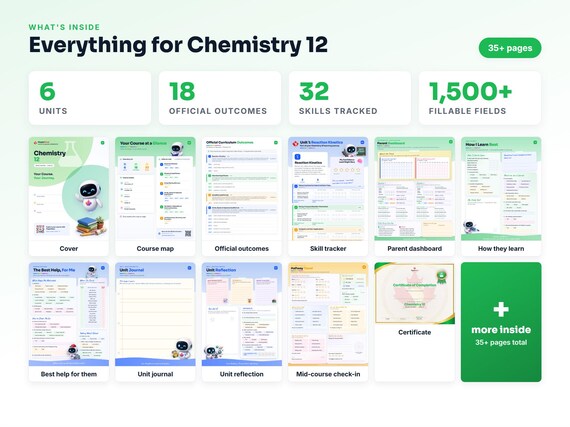

Printable workbook · A keepsake of the year
A Chemistry 12 workbook worth keeping
Built from the same official curriculum as this page. Before and after each skill above, your student colours in how sure they feel — so the two of you can see, on one page, what's clicking and what needs another look. It's a quiet way to follow how the year is really going.
By June it's full of their own handwriting: units worked through, confidence grown, a mid-year check-in, notes from parent-teacher night, and a certificate at the end. Less a worksheet, more a record of the year worth keeping on the shelf.
Instant download · see every page, reviews and the full description · five or more workbooks are $2.99 each
What it looks like in the app



Common questions
Can MapleMind help me with Chemistry 12?
Yes. MapleMind's AI tutor covers all 32 skills in British Columbia's Chemistry 12 — you pick the exact skill, and the tutor teaches it step by step: a short lesson, a worked example, solving together, then a skill check to show it stuck.
Is MapleMind aligned to British Columbia's official curriculum?
Yes. Every skill in this course maps to an official outcome code from British Columbia's Grade 12 Science curriculum, and the ministry's own wording is quoted under each unit on this page — with the official government source linked so you can check it yourself.
What does MapleMind cost?
It's free to start — 5 tutoring chats and a practice quiz every day, no credit card. A Pro subscription ($9.99/month or $49.99/year CAD, 7-day free trial) unlocks unlimited tutoring, practice, and exam simulations.
What if I'm stuck on just one topic?
That's the point of skill-level tutoring: open Chemistry 12 in the app, tap the exact skill from the list on this page, and the tutor teaches just that — no wading through lessons you don't need.
Does MapleMind work in French or other languages?
Yes — 14 languages, including French. Both the app and the tutor's explanations switch to the language you choose.
Where can I see the official British Columbia curriculum for Chemistry 12?
The official source is linked on this page — BC's official science curriculum. The outline here follows it: every MapleMind skill carries its official outcome code, and the ministry's own wording is quoted under each unit.
Keep exploring
Ready when you are
Pick a skill from this page and see it taught properly — free, in the browser, in under a minute.