Get help with Science 30
Most tutoring makes you sit through material you already know. MapleMind flips that: pick the exact skill that's causing trouble — any of the 79 below — and the tutor teaches just that one, step by step, as many times as it takes. Ask questions in plain words, any time of day, in English, French, or 12 other languages.
The official Alberta Science 30 curriculum
Alberta defines Science 30 by strands and outcomes. MapleMind teaches the same curriculum reorganized for one-skill-at-a-time tutoring — the table shows exactly where every official strand lands, and the ministry's own wording is quoted under each unit below.
Official source Alberta's official programs of studyRead it on the government site — alberta.ca ↗| Official strand | Outcomes | Where MapleMind teaches it |
|---|---|---|
| Unit A | 19 | Living Systems Respond to Change |
| Unit B | 18 | Chemistry & the Environment |
| Unit C | 23 | Electromagnetic Energy |
| Unit D | 19 | Energy & the Environment |
Every skill below, taught one on one.
 Try the first session free
How MapleMind teaches Science 30 — every unit, lesson, and skill
Every skill below runs as a short session: a plain-words lesson, a worked example, solving it together, then a five-question skill check that earns up to three stars. Guided Mode keeps it teaching instead of answer-handing — turning it off needs a parent's password.
Unit 1Living Systems Respond to ChangeOfficial strand · Unit A
How the human body moves matter and defends itself, and how the genetic instructions inside every cell are stored, copied, read and changed — the biology that lets living systems respond to a changing environment.
The Heart, Vessels & Blood
- Structures of the heart30-A1.1k — Describe the principal structures and associated blood vessels of the heart — ventricles, atria, septum, valves, aorta, venae cavae, pulmonary arteries and veins, coronary arteries.
- The heartbeat and circulation30-A1.2k — Describe the rhythmic contraction of the heart and its function in circulating blood through the pulmonary and systemic pathways.
- Blood vessels and blood flow30-A1.3k — Describe the structure and function of blood vessels and the flow of blood through arteries, arterioles, venules, veins and capillaries.
- Components of blood30-A1.4k — Describe the main components of blood (plasma, red and white blood cells, platelets, blood proteins) and their roles in transport, clotting, defence against pathogens and distribution of thermal energy.
Pathogens & the Immune Response
- How pathogens enter and harm30-A2.1k — Describe how pathogens in the environment (mosquito-borne parasites, bacteria, viruses) enter the circulatory system and may adversely affect health.
- The body’s barriers30-A2.2k — Describe, in general terms, how body mechanisms — the skin and secretions such as tears and stomach acid — prevent pathogens from entering body tissues.
- The immune response30-A2.3k — Describe, in general terms, how immunity develops and how the immune system responds to a foreign antigen — the roles of macrophages, B cells, helper/killer/suppressor T cells, memory cells and antibodies.
Autoimmunity & Vaccines
- Autoimmune disease30-A2.4k — Explain the interrelationship of autoimmune diseases (multiple sclerosis, arthritis, lupus) and the human immune system.
- How vaccines work30-A2.5k — Analyze how vaccines defend against disease-causing bacteria and viruses.
Chromosomes & Inheritance
- Chromosomes in mitosis, meiosis and fertilization30-A3.1k — Describe, in general, the behaviour of chromosomes during mitosis, meiosis and fertilization.
- Punnett squares and single-trait inheritance30-A3.2k — Explain, with the aid of Punnett squares, the inheritance of single traits using the gene, segregation and dominance.
- Autosomal vs sex-linked inheritance30-A3.3k — Distinguish autosomal from sex-linked patterns of inheritance.
DNA: Structure, Copying & Reading
- The structure of DNA30-A3.4k — Describe the structure of DNA — a double helix built of nucleotides, with complementary base pairings between the two strands.
- DNA replication30-A3.5k — Explain the general process of DNA replication.
- From DNA triplets to protein30-A3.6k — Describe a primary function of DNA: how the amino acid sequence of a polypeptide is determined by the sequence of DNA triplet codes, using a codon table.
Proteins, Mutations & Genetic Change
- The roles of proteins30-A3.7k — Describe the roles of proteins in the human body — as regulatory molecules (enzymes), as structural molecules and as a source of energy.
- Mutations and human disease30-A3.8k — Describe how mutations in DNA affect the proteins produced, resulting in human diseases such as sickle-cell anemia, hemophilia, Huntington’s disease and cystic fibrosis.
- Genetic engineering30-A3.9k — Describe, in general terms, genetic engineering and its application to gene therapy and the development of genetically modified organisms.
- Resistance in bacteria and viruses30-A3.10k — Describe the development of resistance in bacteria and viruses based on mutation, plasmid transfer, transformation and natural selection.
The official wording — 19 outcomes in this unit
- 30-A1.1k
describe the principal structures and associated blood vessels of the heart
- 30-A1.2k
describe the rhythmic contraction of the heart and its function in the general circulation of blood through pulmonary and systemic pathways
- 30-A1.3k
describe the structure and function of blood vessels and the flow of blood through arteries, arterioles, venules, veins and capillaries
- 30-A1.4k
describe the main components of blood
- 30-A2.1k
describe how pathogens in the environment
- 30-A2.2k
describe, in general terms, the function of various body mechanisms, including the skin and body secretions
- 30-A2.3k
describe, in general terms, how immunity to pathogens develops
- 30-A2.4k
explain the interrelationship of autoimmune diseases and the human immune system
- 30-A2.5k
analyze how vaccines defend against disease-causing bacteria and viruses
- 30-A3.1k
describe, in general, the behaviour of chromosomes during mitosis, meiosis and fertilization
- 30-A3.2k
explain, with the aid of Punnett squares, the inheritance of single traits
- 30-A3.3k
distinguish autosomal from sex-linked patterns of inheritance
- 30-A3.4k
describe the structure of DNA
- 30-A3.5k
explain the general process of DNA replication
- 30-A3.6k
describe a primary function of DNA
- 30-A3.7k
describe the role of proteins in the human body
- 30-A3.8k
describe how mutations in DNA affect the proteins produced resulting in human diseases
- 30-A3.9k
describe, in general terms, genetic engineering and its application to gene therapy and the development of genetically modified organisms
- 30-A3.10k
describe the development of resistance in bacteria and viruses
Unit 2Chemistry & the EnvironmentOfficial strand · Unit B
The chemistry of acids and bases and the pH balance that living systems depend on, the organic compounds that power and pollute our world, and the green-chemistry choices that reduce the harm — chemistry read through an environmental lens.
Acids, Bases & pH
- Proton donors and acceptors30-B1.1k — Define acids and bases in terms of proton donors and proton acceptors.
- Identifying acids, bases and salts30-B1.2k — Differentiate among acids, bases, neutral ionic and molecular compounds, and strong and weak acids using appropriate diagnostic tests.
- pH and hydronium ion concentration30-B1.3k — Describe the relationship between pH and hydronium ion ($\text{H}_3\text{O}^+$) concentration.
- How buffers resist pH change30-B1.4k — Explain, qualitatively, how buffers maintain a relatively constant pH when a small amount of acid or base is added to an aqueous system.
pH in Living Systems & the Environment
- Why living systems need constant pH30-B1.5k — Explain the importance of maintaining a relatively constant pH in a living system — e.g. the hydrogen carbonate ion buffering blood, and the Arctic herb Artemisia tilesii resisting acidic moisture.
- The history of acid-base indicators30-B1.6k — Trace the historical use of acid-base indicators, including early Aboriginal methods of using extracts from natural substances.
- Buffering capacity30-B1.7k — Explain what is meant by buffering capacity, e.g. in soil or bedrock.
Acid Deposition
- The chemistry of acid deposition30-B1.8k — Outline the chemical reactions (e.g. combustion) that produce air pollutants — sulfur dioxide ($\text{SO}_2$) and nitrous oxides — that combine with water to result in acid deposition.
- Impacts of acid deposition30-B1.9k — Describe impacts on the biotic and abiotic components of the environment caused by acid deposition — lowered pH, accelerated corrosion, metal leaching and effects on the food chain.
Naming & Using Organic Compounds
- Naming carbon compounds (IUPAC)30-B2.1k — Identify and name carbon compounds with up to three carbons and one functional group using IUPAC nomenclature — halogenated hydrocarbons, alcohols, carboxylic acids and esters.
- Common uses of hydrocarbons30-B2.2k — Describe the common uses of hydrocarbons — CFCs as refrigerants and propellants, ethanol as a solvent and fuel additive, ethanoic acid as vinegar, ethyl ethanoate as nail-polish remover.
- Organic pollutants30-B2.3k — Identify organic compounds commonly considered environmental pollutants — hydrocarbons, organic waste, CFCs, PCBs, dioxins and furans.
Organic Hazards, Smog & Biomagnification
- Hazards of halogenated hydrocarbons and benzene30-B2.4k — List the sources of, and analyze the hazards posed by, halogenated hydrocarbons and benzene derivatives.
- Smog and ozone depletion30-B2.5k — Identify and explain how human activities and natural events contribute to photochemical smog, ozone-layer depletion and increased organic compounds in the environment.
- Biomagnification30-B2.6k — Explain the mechanism and significance of biomagnification.
Greener Chemical Technologies
- Risks and benefits of chemical processes30-B3.1k — Describe the risks and benefits of using chemical processes that may produce products and by-products with the potential to harm the environment.
- Technologies that reduce emissions30-B3.2k — Describe technologies used to reduce the production and emission of harmful chemical compounds — related to internal combustion engines, smelting, pesticide production and sweetening of sour gas.
- Alternatives to chemical technologies30-B3.3k — Describe alternatives to the use of chemical technologies — bioremediation, biological pest controls and biodegradable products.
The official wording — 18 outcomes in this unit
- 30-B1.1k
define acids and bases in terms of proton donors and proton acceptors
- 30-B1.2k
differentiate among acids, bases, neutral ionic compounds, neutral molecular compounds and strong and weak acids, based on appropriate diagnostic tests
- 30-B1.3k
describe the relationship between pH and hydronium ion concentration
- 30-B1.4k
explain, qualitatively, how buffers maintain a relatively constant pH when a small amount of acid or base is added to an aqueous system
- 30-B1.5k
explain the importance of maintaining a relatively constant pH in a living system
- 30-B1.6k
trace the historical use of acid-base indicators
- 30-B1.7k
explain what is meant by buffering capacity
- 30-B1.8k
outline the chemical reactions
- 30-B1.9k
describe impacts on the biotic and abiotic components of the environment caused by acid deposition
- 30-B2.1k
identify and name carbon compounds
- 30-B2.2k
describe the common uses of hydrocarbons
- 30-B2.3k
identify organic compounds commonly considered to be environmental pollutants
- 30-B2.4k
list the sources of, and analyze the hazards posed by, halogenated hydrocarbons and benzene derivatives
- 30-B2.5k
identify and explain how human activities and natural events contribute to the production of photochemical smog, the depletion of the ozone layer and increased concentrations of organic compounds in the environment
- 30-B2.6k
explain the mechanism and significance of biomagnification
- 30-B3.1k
describe the risks and benefits of using chemical processes that may produce products and/or by-products that have the potential to harm the environment
- 30-B3.2k
describe technologies used to reduce the production and emission of chemical compounds that have the potential to harm the environment
- 30-B3.3k
describe alternatives to the use of chemical technologies
Unit 3Electromagnetic EnergyOfficial strand · Unit C
The physics of fields, electric circuits and the electromagnetic spectrum — from the force that acts across empty space, to the electricity that powers our homes, to the light that carries information across the universe.
Fields & Field Strength
- What a field is30-C1.1k — Define a field as a property of the space around a mass, charge or magnet that causes another mass, charge or magnet placed there to experience a force.
- Comparing field interactions30-C1.2k — Compare the interaction between static electric charges with the interaction between magnetic poles and with the interaction between two masses at a distance.
- Properties of vector fields30-C1.3k — Compare the source, direction and strength of gravitational, electric and magnetic vector fields as determined by a test object.
- Gravitational and electric field strength30-C1.4k — Describe gravitational and electric field strength at a given distance from a mass or point charge using the field equations, e.g. $g = \frac{Gm}{r^2}$.
Induction, Circuits & Electrical Energy
- Inducing a current30-C1.5k — Describe the effect of a conductor moving through a magnetic field and inducing an electrical current.
- Series and parallel circuits30-C1.6k — Describe how power, current, voltage and resistance relate for up to three resistors in series and parallel circuits, using $V = IR$, $P = VI$ and $P = I^2R$.
- Electrical energy and cost30-C1.7k — Describe electrical energy in kilowatt hours and joules using $E_e = Pt$ for energy and $P = VI$ for power.
- AC vs DC30-C1.8k — Distinguish between alternating current (AC) and direct current (DC) in terms of electron flow and the electric field.
Transformers, Motors & Electrical Safety
- How transformers work30-C1.9k — Describe the operation of a transformer in terms of current, voltage and turns in the primary and secondary coils, using $\frac{N_p}{N_s} = \frac{V_p}{V_s} = \frac{I_s}{I_p}$.
- Why AC for transmission30-C1.10k — Describe the advantage of AC over DC for transmitting and using electrical energy.
- Motors and generators30-C1.11k — Compare the general design and function of a DC electric motor and a generator.
- Electrical safety technologies30-C1.12k — Describe, in terms of design and electrical energy, the functioning of safety technologies — circuit fuses and breakers, polarized plugs and ground wiring.
The Electromagnetic Spectrum
- The range of the EM spectrum30-C2.1k — Describe the electromagnetic spectrum from long, low-frequency radio waves through microwaves, IR, visible light and UV to short, high-frequency X-rays and gamma rays.
- Comparing the parts of the spectrum30-C2.2k — Compare the constituents of the EM spectrum by source, frequency, wavelength and energy, and their effect on living tissue (UV on skin, gamma on cells, visible light on plants).
- The atmosphere absorbs EMR30-C2.3k — Recognize that Earth’s atmosphere absorbs certain frequencies of electromagnetic radiation.
Behaviour of Light & Waves
- Reflection, refraction, diffraction, polarization30-C2.4k — Investigate and describe, qualitatively, the reflection, refraction, diffraction and polarization of visible light.
- Comparing radiation to visible light30-C2.5k — Compare the properties of radiation from any region of the EM spectrum with those of visible light — wavelength, frequency, speed, reflection, refraction, diffraction and penetrability.
- The universal wave equation30-C2.6k — Investigate and describe the relationships of the variables in the universal wave equation, $v = f\lambda$.
Studying the Universe with EMR
- Telescopes30-C2.7k — Explain, in general terms, the design of reflecting and refracting optical and radio telescopes used to gather EMR from the universe.
- Fusion in the Sun30-C2.8k — Explain that nuclear fusion in the Sun produces a wide spectrum of electromagnetic radiation.
- Spectroscopes and spectra30-C2.9k — Describe, in general terms, how a spectroscope determines the composition of incandescent objects, and the conditions producing emission (bright-line) and absorption (dark-line) spectra.
- Technologies for studying stars30-C2.10k — Describe technologies used to study stars — spectroscopes to estimate surface temperature, and Doppler-shift technology showing that the universe is expanding.
- The evolution of stars30-C2.11k — Describe, in general terms, the evolution of stars and the existence of black holes, white dwarves and neutron stars.
The official wording — 23 outcomes in this unit
- 30-C1.1k
define a field as a property of space around a mass, an electric charge or a magnet that causes another mass, electric charge or magnet introduced in to this region to experience a force
- 30-C1.2k
compare the interaction between static electric charges with the interaction between magnetic poles and with the interaction between two masses at a distance
- 30-C1.3k
compare the basic properties
- 30-C1.4k
describe gravitational and electric field strength at a given distance from a mass or a point charge
- 30-C1.5k
describe the effect of a conductor moving through a magnetic field and inducing an electrical current
- 30-C1.6k
describe the relationships, for up to three resistors, among power, current, voltage and resistance for series and parallel circuits
- 30-C1.7k
describe electrical energy in kilowatt hours and joules
- 30-C1.8k
distinguish between alternating current (AC) and direct current (DC) in terms of electron flow and electric field
- 30-C1.9k
describe the operation of a transformer
- 30-C1.10k
describe the advantage of AC over DC for transmitting and using electrical energy
- 30-C1.11k
compare the general design and function of a DC electric motor and a generator
- 30-C1.12k
describe, in terms of design and electrical energy, the functioning of safety technologies
- 30-C2.1k
describe the range of the electromagnetic spectrum
- 30-C2.2k
compare and contrast, to each other, the various constituents of the electromagnetic spectrum
- 30-C2.3k
recognize that Earth’s atmosphere absorbs certain frequencies of EMR
- 30-C2.4k
investigate and describe, qualitatively, the phenomena of reflection, refraction, diffraction and polarization of visible light
- 30-C2.5k
compare and contrast the properties of radiation, from any region of the electromagnetic spectrum, with those of visible light
- 30-C2.6k
investigate and describe the relationships of the variables in the universal wave equation
- 30-C2.7k
explain, in general terms, the design of telescopes
- 30-C2.8k
explain that nuclear fusion in the sun
- 30-C2.9k
describe, in general terms, how a spectroscope can be used to determine the composition of incandescent objects or substances
- 30-C2.10k
describe technologies used to study stars
- 30-C2.11k
describe, in general terms, the evolution of stars and the existence of black holes, white dwarves and neutron stars
Unit 4Energy & the EnvironmentOfficial strand · Unit D
How society consumes energy, how solar energy is transformed into the renewable and nonrenewable sources we use, and how nuclear, chemical, tidal and geothermal energy compare — energy science weighed against its environmental cost.
Energy Consumption & Sustainability
- The growth of energy consumption30-D1.1k — Compare the energy consumption of contemporary society with traditional cultures and precontact Aboriginal societies, and analyze the exponential growth of global energy consumption.
- Per-capita energy consumption30-D1.2k — Compare Canada’s per-capita energy consumption with developed and developing countries and identify factors that affect it — economy, lifestyle, technology, geography and climate.
- Sustainable development and efficiency30-D1.3k — Apply the concept of sustainable development to increasing the efficient use of energy in the home, in industry and in transportation.
Energy Sources & Their Impact
- Developing energy technologies30-D1.4k — Explain the need to develop technologies that use renewable and nonrenewable energy sources to meet increasing global demand.
- Environmental impact of energy sources30-D1.5k — Describe the environmental impact of developing and using various energy sources — conventional oil, oil sands, solar, wind, biomass, hydroelectricity, coal, nuclear and geothermal.
- An interconnected environment30-D1.6k — Describe how the Aboriginal perspective of an interconnected environment demonstrates the need to balance resource extraction with environmental impact.
Converting Solar Energy
- Hess’s Law and heats of combustion30-D2.1k — Explain how Hess’s Law, $\Delta H^\circ = \sum \Delta_f H^\circ_{\text{products}} - \sum \Delta_f H^\circ_{\text{reactants}}$, leads to prediction of heats of combustion.
- Where solar energy goes30-D2.2k — Contrast the proportion of solar energy that creates wind and drives the water cycle with the small proportion captured by photosynthesis as chemical potential energy.
- Solar energy converted and reconverted30-D2.3k — Describe the conversion of solar energy into renewable forms (wind, hydropower, photosynthesis) and nonrenewable forms (coal, oil, gas), and further conversion into electrical and thermal energy.
- Renewable energy technologies30-D2.4k — Describe the functioning of renewable energy technologies and assess their advantages and disadvantages — solar heating, wind turbines, hydroelectric power, biomass, geothermal and hydrogen fuel cells.
Nuclear Energy
- Fission vs fusion30-D2.5k — Explain the difference between fission and fusion and balance simple nuclear reaction equations to show conservation of nucleons.
- Radioactive decay and ionizing radiation30-D2.6k — Describe the main types and sources of radioactive decay and resulting ionizing radiation — alpha ($\alpha$), beta ($\beta$) and gamma ($\gamma$) decay.
- Mass-energy in nuclear reactions30-D2.7k — Describe mass-energy changes in fission and fusion reactions, as represented by $E = mc^2$.
- Fission reactors and fusion research30-D2.8k — Describe, in general terms, the operation of a fission reactor (e.g. the CANDU reactor) and the current state of fusion research.
Comparing Energy Sources
- Nuclear and geothermal energy30-D2.9k — Trace the relationship between nuclear energy and geothermal energy.
- Comparing power stations30-D2.10k — Compare and contrast conventional coal, oil-fired or hydroelectric power stations with nuclear power stations in terms of purpose, energy conversions, design and function.
- Orders of magnitude of energy30-D2.11k — Contrast, quantitatively, the orders of magnitude of energy produced by nuclear, chemical and phase changes.
- The source of tides30-D2.12k — Explain the source of tides in terms of gravitational attraction and the relative motions of the Sun, Moon and Earth.
- Tidal energy30-D2.13k — Describe the energy transformations in converting tidal energy to electrical energy and compare tidal power to hydroelectric power — e.g. the Bay of Fundy and La Rance stations.
The official wording — 19 outcomes in this unit
- 30-D1.1k
compare the energy consumption of contemporary society with that of traditional cultures and precontact Aboriginal societies
- 30-D1.2k
compare Canada’s per-capita energy consumption with developed and developing countries and identify factors that affect consumption
- 30-D1.3k
apply the concept of sustainable development to increasing the efficient use of energy
- 30-D1.4k
explain the need to develop technologies that use renewable and nonrenewable energy sources to meet the increasing global demand
- 30-D1.5k
describe the environmental impact of developing and using various energy sources
- 30-D1.6k
describe how the Aboriginal perspective of an interconnected environment demonstrates the need to balance resource extraction with environmental impact
- 30-D2.1k
explain how Hess’s Law
- 30-D2.2k
contrast the proportion of solar energy that creates wind and drives the water cycle with the small proportion captured by photosynthesis as chemical potential energy
- 30-D2.3k
describe the conversion of solar energy into renewable forms
- 30-D2.4k
describe the functioning of renewable energy technologies and assess their advantages and disadvantages
- 30-D2.5k
explain the difference between fission and fusion and balance simple nuclear reaction equations to show the conservation of nucleons
- 30-D2.6k
describe the main types and sources of radioactive decay and resulting ionizing radiation
- 30-D2.7k
describe mass-energy changes in fission and fusion reactions
- 30-D2.8k
describe, in general terms, the operation of a fission reactor
- 30-D2.9k
trace the relationship between nuclear energy and geothermal energy
- 30-D2.10k
compare and contrast conventional coal, oil-fired or hydroelectric power stations with nuclear power stations
- 30-D2.11k
contrast, quantitatively, the orders of magnitude of energy produced by nuclear, chemical and phase changes
- 30-D2.12k
explain the source of tides, in terms of gravitational attraction and the relative motions of the sun, moon and Earth
- 30-D2.13k
describe the energy transformations involved in converting tidal energy to electrical energy and compare tidal power to hydroelectric power
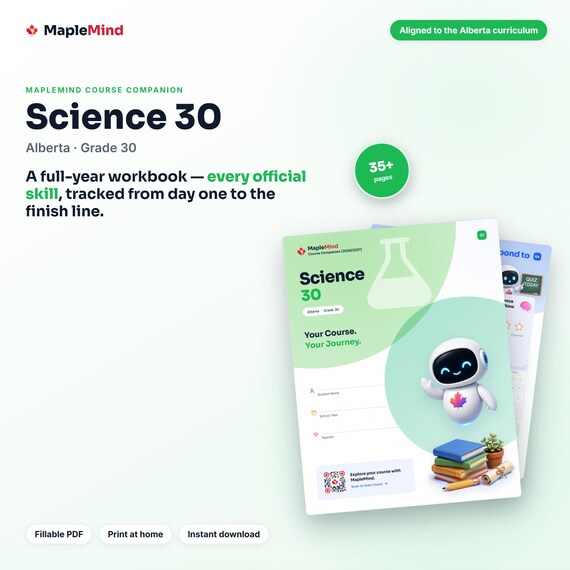
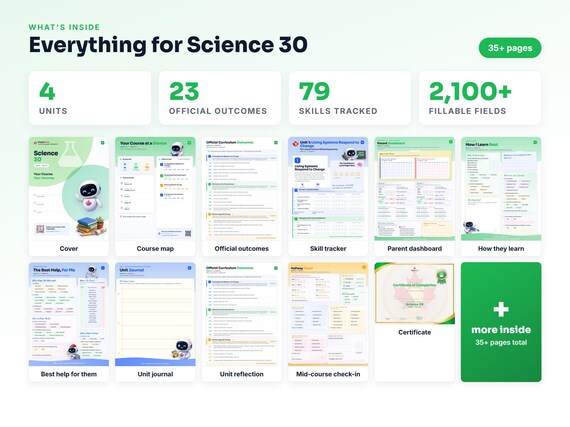


Printable workbook · A keepsake of the year
A Science 30 workbook worth keeping
Built from the same official curriculum as this page. Before and after each skill above, your student colours in how sure they feel — so the two of you can see, on one page, what's clicking and what needs another look. It's a quiet way to follow how the year is really going.
By June it's full of their own handwriting: units worked through, confidence grown, a mid-year check-in, notes from parent-teacher night, and a certificate at the end. Less a worksheet, more a record of the year worth keeping on the shelf.
Instant download · see every page, reviews and the full description · five or more workbooks are $2.99 each
What it looks like in the app



Preparing for the Science 30 Diploma Exam?
Science 30 ends in a provincial Diploma Exam worth a big part of the final mark. MapleMind's exam mode builds a full simulation from the course — timed sections, written responses, and a graded result that shows which skills to review. Our Diploma Exam prep guide has a full study plan.
Common questions
Can MapleMind help me with Science 30?
Yes. MapleMind's AI tutor covers all 79 skills in Alberta's Science 30 — you pick the exact skill, and the tutor teaches it step by step: a short lesson, a worked example, solving together, then a skill check to show it stuck.
Is MapleMind aligned to Alberta's official curriculum?
Yes. Every skill in this course maps to an official outcome code from Alberta's Grade 12 Science curriculum, and the ministry's own wording is quoted under each unit on this page — with the official government source linked so you can check it yourself.
What does MapleMind cost?
It's free to start — 5 tutoring chats and a practice quiz every day, no credit card. A Pro subscription ($9.99/month or $49.99/year CAD, 7-day free trial) unlocks unlimited tutoring, practice, and exam simulations.
What if I'm stuck on just one topic?
That's the point of skill-level tutoring: open Science 30 in the app, tap the exact skill from the list on this page, and the tutor teaches just that — no wading through lessons you don't need.
Does MapleMind work in French or other languages?
Yes — 14 languages, including French. Both the app and the tutor's explanations switch to the language you choose.
Where can I see the official Alberta curriculum for Science 30?
The official source is linked on this page — Alberta's official programs of study. The outline here follows it: every MapleMind skill carries its official outcome code, and the ministry's own wording is quoted under each unit.
Does MapleMind help with the Science 30 Diploma Exam?
Yes. Science 30 ends in a provincial Diploma Exam worth a big part of the final mark. MapleMind's exam mode builds a full simulation from the course — timed sections, written responses, and a graded result that shows which skills to review.
Keep exploring
Ready when you are
Pick a skill from this page and see it taught properly — free, in the browser, in under a minute.