Get help with Chemistry 30
Most tutoring makes you sit through material you already know. MapleMind flips that: pick the exact skill that's causing trouble — any of the 52 below — and the tutor teaches just that one, step by step, as many times as it takes. Ask questions in plain words, any time of day, in English, French, or 12 other languages.
The official Alberta Chemistry 30 curriculum
Alberta defines Chemistry 30 by strands and outcomes. MapleMind teaches the same curriculum reorganized for one-skill-at-a-time tutoring — the table shows exactly where every official strand lands, and the ministry's own wording is quoted under each unit below.
Official source Alberta's official programs of studyRead it on the government site — alberta.ca ↗| Official strand | Outcomes | Where MapleMind teaches it |
|---|---|---|
| Unit A | 14 | Thermochemical Changes |
| Unit B | 16 | Electrochemical Changes |
| Unit C | 11 | Chemical Changes of Organic Compounds |
| Unit D | 11 | Chemical Equilibrium Focusing on Acid–Base Systems |
Every skill below, taught one on one.
 Try the first session free
How MapleMind teaches Chemistry 30 — every unit, lesson, and skill
Every skill below runs as a short session: a plain-words lesson, a worked example, solving it together, then a five-question skill check that earns up to three stars. Guided Mode keeps it teaching instead of answer-handing — turning it off needs a parent's password.
Unit 1Thermochemical ChangesOfficial strand · Unit A
Every chemical change moves energy. This unit tracks that energy — from the sunlight stored in a hydrocarbon bond, through enthalpy, formation data and Hess's law, to the energy diagrams and catalysts that explain how fast and how far a reaction releases or absorbs heat.
Heat, Enthalpy & the Origin of Stored Energy
- Analyzing heat transfer with Q = mcΔt30-A1.1k — Recall and apply $Q = mc\Delta t$ to the analysis of heat transfer, using mass, specific heat capacity and temperature change.
- Stored chemical energy came from the sun30-A1.2k — Explain, in a general way, how the energy stored in the chemical bonds of hydrocarbons originated from the sun via photosynthesis.
- Enthalpy and molar enthalpy30-A1.3k — Define enthalpy (the heat content of a system at constant pressure) and molar enthalpy for chemical reactions.
- Balanced equations that include energy changes30-A1.4k — Write balanced chemical equations that include energy changes, either as a heat term in the equation or as a $\Delta H$ value.
ΔH Notation, Formation Enthalpies & Hess's Law
- Using and interpreting ΔH notation30-A1.5k — Use and interpret $\Delta H$ notation to communicate and calculate energy changes in chemical reactions (negative for exothermic, positive for endothermic).
- Predicting ΔH from standard enthalpies of formation30-A1.6k — Predict the enthalpy change for a chemical equation using standard enthalpies of formation ($\Delta H = \sum \Delta H_f^{\circ}(\text{products}) - \sum \Delta H_f^{\circ}(\text{reactants})$).
- Hess's law for net reactions30-A1.7k — Explain and use Hess's law to calculate the energy change for a net reaction from a series of reactions with known enthalpy changes.
- Enthalpy changes from calorimetry data30-A1.8k — Use calorimetry data (mass, specific heat and temperature change of the surroundings) to determine the enthalpy change of a chemical reaction.
Photosynthesis, Respiration, Combustion & the Energy Barrier
- Reactants and products of key energy reactions30-A1.9k — Identify that liquid $\text{H}_2\text{O}$ and $\text{CO}_2$ gas are reactants in photosynthesis and products of cellular respiration, and that gaseous water and $\text{CO}_2$ are products of hydrocarbon combustion in an open system.
- Classifying reactions as endothermic or exothermic30-A1.10k — Classify chemical reactions as endothermic or exothermic, including photosynthesis, cellular respiration and hydrocarbon combustion.
- Activation energy as the energy barrier30-A2.1k — Define activation energy as the minimum energy barrier that must be overcome for a chemical reaction to occur.
- Energy changes from bonds breaking and forming30-A2.2k — Explain the energy changes during a reaction in terms of bonds breaking (absorbs energy) and forming (releases energy) and the interplay of potential and kinetic energy.
Energy Diagrams & Catalysts
- Analyzing and labelling energy diagrams30-A2.3k — Analyze and label a potential-energy diagram of a reaction, marking reactants, products, enthalpy change ($\Delta H$) and activation energy.
- How catalysts speed reactions30-A2.4k — Explain that a catalyst increases reaction rate by providing an alternate pathway with lower activation energy, without changing the net energy of the reaction (e.g. enzymes in living systems).
The official wording — 14 outcomes in this unit
- 30-A1.1k
recall the application of Q = mcΔt to the analysis of heat transfer
- 30-A1.2k
explain, in a general way, how stored energy in the chemical bonds of hydrocarbons originated from the sun
- 30-A1.3k
define enthalpy and molar enthalpy for chemical reactions
- 30-A1.4k
write balanced equations for chemical reactions that include energy changes
- 30-A1.5k
use and interpret ΔH notation to communicate and calculate energy changes in chemical reactions
- 30-A1.6k
predict the enthalpy change for chemical equations using standard enthalpies of formation
- 30-A1.7k
explain and use Hess' law to calculate energy changes for a net reaction from a series of reactions
- 30-A1.8k
use calorimetry data to determine the enthalpy changes in chemical reactions
- 30-A1.9k
identify that liquid water and carbon dioxide gas are reactants in photosynthesis and products of cellular respiration and that gaseous water and carbon dioxide gas are the products of hydrocarbon combustion in an open system
- 30-A1.10k
classify chemical reactions as endothermic or exothermic, including those for the processes of photosynthesis, cellular respiration and hydrocarbon combustion
- 30-A2.1k
define activation energy as the energy barrier that must be overcome for a chemical reaction to occur
- 30-A2.2k
explain the energy changes that occur during chemical reactions, referring to bonds breaking and forming and changes in potential and kinetic energy
- 30-A2.3k
analyze and label energy diagrams of a chemical reaction, including reactants, products, enthalpy change and activation energy
- 30-A2.4k
explain that catalysts increase reaction rates by providing alternate pathways for changes, without affecting the net amount of energy involved
Unit 2Electrochemical ChangesOfficial strand · Unit B
Chemistry that moves electrons. From defining oxidation and reduction, through ranking agents by strength and balancing redox equations, to the voltaic and electrolytic cells — batteries, corrosion and electroplating — that turn electron transfer into useful electricity or use electricity to force a reaction.
Oxidation, Reduction & Redox Vocabulary
- Defining oxidation and reduction30-B1.1k — Define oxidation and reduction both operationally (observable clues) and theoretically (loss and gain of electrons — "OIL RIG").
- Redox terms: agents, oxidation number, half-reactions30-B1.2k — Define oxidizing agent, reducing agent, oxidation number, half-reaction and disproportionation, and use each term precisely.
- Telling redox reactions apart from other reactions30-B1.3k — Differentiate between redox reactions and non-redox reactions using half-reactions and/or changes in oxidation numbers.
- Redox in living and nonliving systems30-B1.4k — Identify electron transfer, oxidizing agents and reducing agents in everyday redox — living systems (cellular respiration, photosynthesis) and nonliving systems such as corrosion.
Agent Strength & Predicting Spontaneity
- Comparing strengths of oxidizing and reducing agents30-B1.5k — Compare the relative strengths of oxidizing and reducing agents using empirical data from single-replacement experiments.
- Predicting spontaneity from reduction potentials30-B1.6k — Predict the spontaneity of a redox reaction from standard reduction potentials and compare that prediction to experimental results.
Balancing Redox Equations & Redox Titrations
- Writing and balancing redox equations30-B1.7k — Write and balance redox equations in acidic and neutral solutions using half-reactions from a standard reduction potential table, developing simple half-reactions, and assigning oxidation numbers where appropriate; e.g. $\text{Zn} \rightarrow \text{Zn}^{2+} + 2e^-$.
- Calculations for redox titrations30-B1.8k — Perform stoichiometric calculations to determine the quantities of substances involved in a redox titration.
Electrochemical Cells: Parts & Types
- The parts of an electrochemical cell30-B2.1k — Define anode, cathode, anion, cation, salt bridge/porous cup, electrolyte, external circuit, power supply, voltaic cell and electrolytic cell.
- Voltaic vs electrolytic cells30-B2.2k — Identify the similarities and differences between the operation of a voltaic cell (spontaneous, produces electricity) and an electrolytic cell (driven by a power supply).
- Predicting the half-reaction at each electrode30-B2.3k — Predict and write the half-reaction equation occurring at each electrode of an electrochemical cell (oxidation at the anode, reduction at the cathode).
- When predicted reactions do not occur30-B2.4k — Recognize that a predicted reaction does not always occur; e.g. the production of chlorine gas from the electrolysis of brine (overpotential effects).
Cell Potential, Predictions & Faraday's Law
- Reduction potentials relative to the hydrogen electrode30-B2.5k — Explain that all standard reduction potentials are measured relative to 0 volts, the value set for the standard hydrogen electrode at standard conditions.
- Calculating standard cell potential30-B2.6k — Calculate the standard cell potential $E^{\circ}_{\text{cell}} = E^{\circ}_{\text{cathode}} - E^{\circ}_{\text{anode}}$ for an electrochemical cell.
- Spontaneity from cell potential30-B2.7k — Predict whether a redox reaction is spontaneous or non-spontaneous from the standard cell potential (positive → spontaneous) and the relative positions of half-reactions on the reduction potential table.
- Faraday's law and cell stoichiometry30-B2.8k — Calculate mass, amount, current and time in single voltaic and electrolytic cells by applying Faraday's law ($q = It$, moles of electrons) and stoichiometry.
The official wording — 16 outcomes in this unit
- 30-B1.1k
define oxidation and reduction operationally and theoretically
- 30-B1.2k
define oxidizing agent, reducing agent, oxidation number, half-reaction, disproportionation
- 30-B1.3k
differentiate between redox reactions and other reactions, using half-reactions and/or oxidation numbers
- 30-B1.4k
identify electron transfer, oxidizing agents and reducing agents in redox reactions that occur in everyday life, in both living systems
- 30-B1.5k
compare the relative strengths of oxidizing and reducing agents, using empirical data
- 30-B1.6k
predict the spontaneity of a redox reaction, based on standard reduction potentials, and compare their predictions to experimental results
- 30-B1.7k
write and balance equations for redox reactions in acidic and neutral solutions by using half-reaction equations obtained from a standard reduction potential table
- 30-B1.8k
perform calculations to determine quantities of substances involved in redox titrations
- 30-B2.1k
define anode, cathode, anion, cation, salt bridge/porous cup, electrolyte, external circuit, power supply, voltaic cell and electrolytic cell
- 30-B2.2k
identify the similarities and differences between the operation of a voltaic cell and that of an electrolytic cell
- 30-B2.3k
predict and write the half-reaction equation that occurs at each electrode in an electrochemical cell
- 30-B2.4k
recognize that predicted reactions do not always occur; e.g., the production of chlorine gas from the electrolysis of brine
- 30-B2.5k
explain that the values of standard reduction potential are all relative to 0 volts, as set for the hydrogen electrode at standard conditions
- 30-B2.6k
calculate the standard cell potential for electrochemical cells
- 30-B2.7k
predict the spontaneity or nonspontaneity of redox reactions, based on standard cell potential, and the relative positions of half-reaction equations on a standard reduction potential table
- 30-B2.8k
calculate mass, amounts, current and time in single voltaic and electrolytic cells by applying Faraday's law and stoichiometry
Unit 3Chemical Changes of Organic CompoundsOfficial strand · Unit C
The chemistry of carbon — the element behind fuels, plastics, medicines and life itself. This unit names and draws organic molecules by IUPAC rules, links their structure to their properties, and works through the reactions (addition, substitution, esterification, combustion, polymerization) that turn fossil fuels into everyday materials.
What Organic Compounds Are & Naming Them
- Defining organic compounds30-C1.1k — Define organic compounds as carbon-containing compounds, recognizing the inorganic exceptions: carbonates, cyanides, carbides and oxides of carbon.
- Significant organic compounds in daily life30-C1.2k — Identify and describe significant organic compounds in daily life and their origins and applications; e.g. methane, methanol, ethanol, ethanoic acid, propane, benzene, octane, glucose, polyethylene.
- IUPAC naming and drawing organic structures30-C1.3k — Name and draw structural, condensed structural and line diagrams using IUPAC nomenclature for aliphatic (including cyclic) and aromatic compounds up to 10 carbons — halogenated hydrocarbons, alcohols, carboxylic acids and esters; e.g. $\text{CH}_3\text{CH}_2\text{OH}$.
- Identifying compound types from functional groups30-C1.4k — Identify the type of compound from its functional group — hydroxyl (alcohol), carboxyl (carboxylic acid), ester linkage and halogen — given the structural formula.
Isomers, Physical Properties & Separation
- Structural isomerism30-C1.5k — Define structural isomerism as compounds with the same molecular formula but different structural formulas, and relate the different structures to differences in the isomers' properties.
- Comparing boiling points and solubility30-C1.6k — Compare boiling points and solubility both within a homologous series and among different functional groups (aliphatics, aromatics, alcohols, carboxylic acids), explaining trends by intermolecular forces.
- Separating organic compounds from mixtures30-C1.7k — Describe, in general terms, the processes used to separate organic compounds from natural mixtures — fractional distillation and solvent extraction; e.g. petroleum refining, bitumen recovery.
Organic Reactions, Polymers & Fossil Fuels
- The five organic reaction types30-C2.1k — Define, illustrate and give examples of simple addition, substitution, elimination, esterification and combustion reactions of organic compounds.
- Predicting products and balancing organic equations30-C2.2k — Predict the products and write and interpret balanced equations for addition, substitution, elimination, esterification and combustion reactions.
- Monomers, polymers and polymerization30-C2.3k — Define and give examples of monomers (e.g. ethylene), polymers (e.g. polyethylene) and polymerization in living systems (carbohydrates, proteins) and nonliving systems (nylon, polyester, plastics).
- Organic reactions and the fossil-fuel economy30-C2.4k — Relate these organic reactions to the major reactions that produce thermal energy and economically important compounds from fossil fuels.
The official wording — 11 outcomes in this unit
- 30-C1.1k
define organic compounds as compounds containing carbon, recognizing inorganic exceptions such as carbonates, cyanides, carbides and oxides of carbon
- 30-C1.2k
identify and describe significant organic compounds in daily life, demonstrating generalized knowledge of their origins and applications
- 30-C1.3k
name and draw structural, condensed structural and line diagrams and formulas, using International Union of Pure and Applied Chemistry (IUPAC) nomenclature guidelines
- 30-C1.4k
identify types of compounds from the hydroxyl, carboxyl, ester linkage and halogen functional groups, given the structural formula
- 30-C1.5k
define structural isomerism as compounds having the same molecular formulas, but with different structural formulas, and relate the structures to variations in the properties of the isomers
- 30-C1.6k
compare, both within a homologous series and among compounds with different functional groups, the boiling points and solubility of examples of aliphatics, aromatics, alcohols and carboxylic acids
- 30-C1.7k
describe, in general terms, the physical, chemical and technological processes (fractional distillation and solvent extraction) used to separate organic compounds from natural mixtures or solutions
- 30-C2.1k
define, illustrate and provide examples of simple addition, substitution, elimination, esterification and combustion reactions
- 30-C2.2k
predict products and write and interpret balanced equations for the above reactions
- 30-C2.3k
define, illustrate and provide examples of monomers (e.g., ethylene), polymers (e.g., polyethylene) and polymerization in living systems
- 30-C2.4k
relate the reactions described above to major reactions that produce thermal energy and economically important compounds from fossil fuels
Unit 4Chemical Equilibrium Focusing on Acid–Base SystemsOfficial strand · Unit D
Reactions that never truly finish. This unit builds the idea of dynamic equilibrium, predicts how a system shifts under stress with Le Chatelier's principle, then applies equilibrium to acids and bases — Brønsted–Lowry proton transfer, conjugate pairs, buffers, and the constants $K_w$, $K_a$ and $K_b$ that let us calculate pH.
Equilibrium & Le Chatelier's Principle
- Defining equilibrium and its criteria30-D1.1k — Define equilibrium and state its criteria: a closed system, constant macroscopic properties, and equal rates of the forward and reverse reactions.
- Writing equations for systems at equilibrium30-D1.2k — Identify, write and interpret chemical equations for systems at equilibrium, using the double arrow $\rightleftharpoons$.
- Le Chatelier's principle30-D1.3k — Predict qualitatively, using Le Chatelier's principle, how an equilibrium shifts when temperature, pressure, volume, concentration or a catalyst changes, and describe the effect on the equilibrium constant.
- The equilibrium constant Kc and equilibrium-law expressions30-D1.4k — Define $K_c$ as a measure of the extent of a reaction and write equilibrium-law expressions for given equations using lowest whole-number coefficients.
Brønsted–Lowry Acids, Bases & Buffers
- Brønsted–Lowry acids and bases30-D1.5k — Describe Brønsted–Lowry acids as proton ($\text{H}^+$) donors and bases as proton acceptors — a broader definition than Arrhenius.
- Writing Brønsted–Lowry equations and predicting the favoured side30-D1.6k — Write Brønsted–Lowry equations (including indicators) and predict whether reactants or products are favoured for acid-base equilibria of monoprotic and polyprotic acids and bases.
- Conjugate pairs and amphiprotic substances30-D1.7k — Identify conjugate acid-base pairs (differing by one proton) and amphiprotic substances (which can donate or accept a proton), e.g. $\text{HCO}_3^-$.
- Buffers30-D1.8k — Define a buffer as relatively large amounts of a weak acid or base and its conjugate in equilibrium, which maintain a relatively constant pH when small amounts of acid or base are added.
Equilibrium Constants: Kw, Ka, Kb & pH Calculations
- Recalling pH, pOH and ion concentration30-D2.1k — Recall pH and hydronium concentration, and pOH and hydroxide concentration, in relation to acids and bases: $\text{pH} = -\log[\text{H}_3\text{O}^+]$.
- Using Kw, Ka and Kb30-D2.2k — Define $K_w$, $K_a$ and $K_b$ and use them to determine pH, pOH, $[\text{H}_3\text{O}^+]$ and $[\text{OH}^-]$ of acidic and basic solutions.
- Equilibrium constant and concentration calculations30-D2.3k — Calculate equilibrium constants and concentrations for homogeneous systems and Brønsted–Lowry acids and bases (excluding buffers) from equilibrium data or from initial data and one equilibrium value.
The official wording — 11 outcomes in this unit
- 30-D1.1k
define equilibrium and state the criteria that apply to a chemical system in equilibrium; i.e., closed system, constancy of properties, equal rates of forward and reverse reactions
- 30-D1.2k
identify, write and interpret chemical equations for systems at equilibrium
- 30-D1.3k
predict, qualitatively, using Le Chatelier's principle, shifts in equilibrium caused by changes in temperature, pressure, volume, concentration or the addition of a catalyst and describe how these changes affect the equilibrium constant
- 30-D1.4k
define Kc to predict the extent of the reaction and write equilibrium-law expressions for given chemical equations, using lowest whole-number coefficients
- 30-D1.5k
describe Brønsted–Lowry acids as proton donors and bases as proton acceptors
- 30-D1.6k
write Brønsted–Lowry equations, including indicators, and predict whether reactants or products are favoured for acid-base equilibrium reactions for monoprotic and polyprotic acids and bases
- 30-D1.7k
identify conjugate pairs and amphiprotic substances
- 30-D1.8k
define a buffer as relatively large amounts of a weak acid or base and its conjugate in equilibrium that maintain a relatively constant pH when small amounts of acid or base are added
- 30-D2.1k
recall the concepts of pH and hydronium ion concentration and pOH and hydroxide ion concentration, in relation to acids and bases
- 30-D2.2k
define Kw, Ka, Kb and use these to determine pH, pOH, [H 3 O + ] and [OH - ] of acidic and basic solutions
- 30-D2.3k
calculate equilibrium constants and concentrations for homogeneous systems and Brønsted–Lowry acids and bases (excluding buffers) when concentrations at equilibrium are known

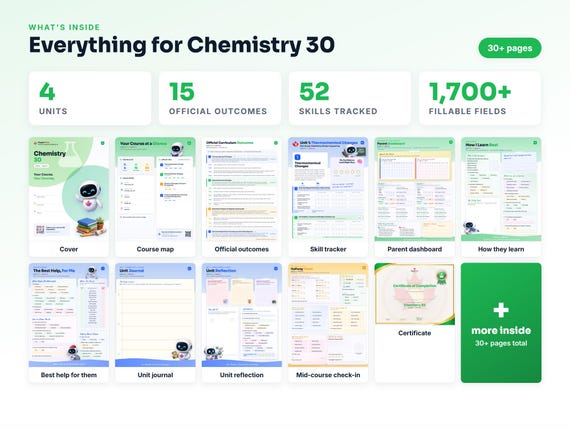


Printable workbook · A keepsake of the year
A Chemistry 30 workbook worth keeping
Built from the same official curriculum as this page. Before and after each skill above, your student colours in how sure they feel — so the two of you can see, on one page, what's clicking and what needs another look. It's a quiet way to follow how the year is really going.
By June it's full of their own handwriting: units worked through, confidence grown, a mid-year check-in, notes from parent-teacher night, and a certificate at the end. Less a worksheet, more a record of the year worth keeping on the shelf.
Instant download · see every page, reviews and the full description · five or more workbooks are $2.99 each
What it looks like in the app



Preparing for the Chemistry 30 Diploma Exam?
Chemistry 30 ends in a provincial Diploma Exam worth a big part of the final mark. MapleMind's exam mode builds a full simulation from the course — timed sections, written responses, and a graded result that shows which skills to review. Our Diploma Exam prep guide has a full study plan.
Common questions
Can MapleMind help me with Chemistry 30?
Yes. MapleMind's AI tutor covers all 52 skills in Alberta's Chemistry 30 — you pick the exact skill, and the tutor teaches it step by step: a short lesson, a worked example, solving together, then a skill check to show it stuck.
Is MapleMind aligned to Alberta's official curriculum?
Yes. Every skill in this course maps to an official outcome code from Alberta's Grade 12 Science curriculum, and the ministry's own wording is quoted under each unit on this page — with the official government source linked so you can check it yourself.
What does MapleMind cost?
It's free to start — 5 tutoring chats and a practice quiz every day, no credit card. A Pro subscription ($9.99/month or $49.99/year CAD, 7-day free trial) unlocks unlimited tutoring, practice, and exam simulations.
What if I'm stuck on just one topic?
That's the point of skill-level tutoring: open Chemistry 30 in the app, tap the exact skill from the list on this page, and the tutor teaches just that — no wading through lessons you don't need.
Does MapleMind work in French or other languages?
Yes — 14 languages, including French. Both the app and the tutor's explanations switch to the language you choose.
Where can I see the official Alberta curriculum for Chemistry 30?
The official source is linked on this page — Alberta's official programs of study. The outline here follows it: every MapleMind skill carries its official outcome code, and the ministry's own wording is quoted under each unit.
Does MapleMind help with the Chemistry 30 Diploma Exam?
Yes. Chemistry 30 ends in a provincial Diploma Exam worth a big part of the final mark. MapleMind's exam mode builds a full simulation from the course — timed sections, written responses, and a graded result that shows which skills to review.
Keep exploring
Ready when you are
Pick a skill from this page and see it taught properly — free, in the browser, in under a minute.