Get help with Biology 20
Most tutoring makes you sit through material you already know. MapleMind flips that: pick the exact skill that's causing trouble — any of the 46 below — and the tutor teaches just that one, step by step, as many times as it takes. Ask questions in plain words, any time of day, in English, French, or 12 other languages.
The official Alberta Biology 20 curriculum
Alberta defines Biology 20 by strands and outcomes. MapleMind teaches the same curriculum reorganized for one-skill-at-a-time tutoring — the table shows exactly where every official strand lands, and the ministry's own wording is quoted under each unit below.
Official source Alberta's official programs of studyRead it on the government site — alberta.ca ↗| Official strand | Outcomes | Where MapleMind teaches it |
|---|---|---|
| Unit A | 9 | Energy & Matter Exchange in the Biosphere |
| Unit B | 11 | Ecosystems & Population Change |
| Unit C | 6 | Photosynthesis & Cellular Respiration |
| Unit D | 20 | Human Systems |
Every skill below, taught one on one.
 Try the first session free
How MapleMind teaches Biology 20 — every unit, lesson, and skill
Every skill below runs as a short session: a plain-words lesson, a worked example, solving it together, then a five-question skill check that earns up to three stars. Guided Mode keeps it teaching instead of answer-handing — turning it off needs a parent's password.
Unit 1Energy & Matter Exchange in the BiosphereOfficial strand · Unit A
How energy flows one way through the biosphere while matter cycles endlessly — the two master patterns that make ecosystems work, and the balance of gases they sustain.
The One-Way Flow of Energy
- One-way flow of energy20-A1.1k — Explain, in general terms, the one-way flow of energy through the biosphere and how stored energy is eventually lost as heat.
- Photosynthesis, chemosynthesis and respiration balance20-A1.2k — Explain how energy in the biosphere can be perceived as a balance between photosynthetic and chemosynthetic activities and cellular respiratory activities, including deep-sea vent ecosystems.
- Trophic levels, food chains and webs20-A1.3k — Explain the structure of ecosystem trophic levels using models such as food chains and food webs.
- Quantitative energy flow and pyramids20-A1.4k — Explain, quantitatively, the flow of energy and exchange of matter in aquatic and terrestrial ecosystems using pyramids of numbers, biomass and energy.
Cycling Matter & Productivity
- Biogeochemical cycles20-A2.1k — Explain and summarize the biogeochemical cycling of carbon, oxygen, nitrogen and phosphorus, and relate it to the reuse of matter.
- Water's role in the cycles20-A2.2k — Explain water's primary role in the biogeochemical cycles, considering its chemical and physical properties (universal solvent, hydrogen bonding).
- Energy, matter and productivity20-A3.1k — Explain the interrelationship of energy, matter and ecosystem productivity (biomass production) — e.g. Antarctic Ocean versus tropical seas.
Gas Exchange & the Changing Atmosphere
- Gas exchange and atmospheric composition20-A3.2k — Explain how the equilibrium between gas exchanges in photosynthesis and cellular respiration influences atmospheric composition.
- Geologic evidence for a changing atmosphere20-A3.3k — Describe the geologic evidence (stromatolites) and scientific explanations for change in atmospheric composition — oxygen and carbon dioxide — from anoxic conditions to the present.
The official wording — 9 outcomes in this unit
- 20-A1.1k
Explain, in general terms, the one-way flow of energy through the biosphere
- 20-A1.2k
explain how energy in the biosphere can be perceived as a balance between both photosynthetic and chemosynthetic activities and cellular respiratory activities
- 20-A1.3k
explain the structure of ecosystem trophic levels, using models such as food chains and food webs
- 20-A1.4k
explain, quantitatively, the flow of energy and the exchange of matter in aquatic and terrestrial ecosystems, using models such as pyramids of numbers, biomass and energy
- 20-A2.1k
explain and summarize the biogeochemical cycling of carbon, oxygen, nitrogen and phosphorus
- 20-A2.2k
explain water’s primary role in the biogeochemical cycles, considering its chemical and physical properties
- 20-A3.1k
explain the interrelationship of energy, matter and ecosystem productivity
- 20-A3.2k
explain how the equilibrium between gas exchanges in photosynthesis and cellular respiration influences atmospheric composition
- 20-A3.3k
describe the geologic evidence (stromatolites) and scientific explanations for change in atmospheric composition, with respect to oxygen and carbon dioxide, from anoxic conditions to the present
Unit 2Ecosystems & Population ChangeOfficial strand · Unit B
What defines an ecosystem, what limits the life in it, how we classify that life, and how populations change over time — the mechanism and evidence of evolution.
Ecosystems & Limiting Factors
- Species, population, community, ecosystem20-B1.1k — Define species, population, community and ecosystem, and explain the interrelationships among them.
- Habitats and niches20-B1.2k — Explain how terrestrial and aquatic ecosystems support a diversity of organisms through a variety of habitats and niches (canopy, forest floor; littoral, limnetic, benthic zones).
- Biotic and abiotic factors in local ecosystems20-B1.3k — Identify biotic and abiotic characteristics and explain their influence in a local aquatic and a terrestrial ecosystem (stream, lake, prairie, boreal forest).
- Limiting factors20-B1.4k — Explain how limiting factors (soil, humidity, moisture, temperature, etc.) influence organism distribution and range.
Classifying Life
- Taxonomy and binomial nomenclature20-B1.5k — Explain the fundamental principles of taxonomy and binomial nomenclature, using modes of nutrition at the kingdom level and morphological characteristics at the genus-species level.
The Mechanism & Evidence of Evolution
- Variability from mutation20-B2.1k — Explain that variability in a species results from heritable mutations, and that some mutations may confer a selective advantage.
- Sexual reproduction and variation20-B2.2k — Discuss the significance of sexual reproduction to individual variation in populations and to the process of evolution.
- Lamarck vs Darwin20-B2.3k — Compare Lamarckian and Darwinian explanations of evolutionary change.
- Lines of evidence for evolution20-B2.4k — Summarize and describe lines of evidence supporting the evolution of modern species from ancestral forms (the fossil record, biogeography, etc.).
- Speciation20-B2.5k — Explain speciation and the conditions required for this process.
- Modern evolutionary theories20-B2.6k — Describe modern evolutionary theories — punctuated equilibrium and gradualism.
The official wording — 11 outcomes in this unit
- 20-B1.1k
define species, population, community and ecosystem and explain the interrelationships among them
- 20-B1.2k
explain how terrestrial and aquatic ecosystems support a diversity of organisms through a variety of habitats and niches
- 20-B1.3k
identify biotic and abiotic characteristics and explain their influence in an aquatic and a terrestrial ecosystem in the local region
- 20-B1.4k
explain how limiting factors influence organism distribution and range
- 20-B1.5k
explain the fundamental principles of taxonomy and binomial nomenclature
- 20-B2.1k
explain that variability in a species results from heritable mutations and that some mutations may have a selective advantage
- 20-B2.2k
discuss the significance of sexual reproduction to individual variation in populations and to the process of evolution
- 20-B2.3k
compare Lamarckian and Darwinian explanations of evolutionary change
- 20-B2.4k
summarize and describe lines of evidence to support the evolution of modern species from ancestral forms
- 20-B2.5k
explain speciation and the conditions required for this process
- 20-B2.6k
describe modern evolutionary theories
Unit 3Photosynthesis & Cellular RespirationOfficial strand · Unit C
The two great energy transactions of life — capturing light energy into organic compounds, then releasing it to power the cell — down to how ATP is actually made.
Capturing & Releasing Energy
- Photosynthesis and energy storage20-C1.1k — Explain, in general terms, how energy is absorbed by pigments and stored, via the light-dependent reactions (NADPH and ATP).
- Light-independent reactions and glucose20-C1.2k — Explain, in general terms, how NADPH and ATP from the light-dependent reactions are used to reduce carbon in the light-independent reactions to make glucose, and where in the chloroplast this occurs.
- Glycolysis and the Krebs cycle20-C2.1k — Explain, in general terms, how glucose is oxidized during glycolysis and the Krebs cycle to produce reducing power (NADH and FADH).
Respiration Pathways & ATP
- Chemiosmosis and ATP synthesis20-C2.2k — Explain, in general terms, how chemiosmosis converts the reducing power of NADH and FADH into chemical potential energy stored as ATP, and where in the mitochondrion this occurs.
- Aerobic vs anaerobic respiration20-C2.3k — Distinguish, in general terms, between aerobic and anaerobic respiration and fermentation in plants, animals and yeast.
- The role of ATP20-C2.4k — Summarize and explain the role of ATP in cellular metabolism (active transport, biochemical synthesis, muscle contraction, etc.).
The official wording — 6 outcomes in this unit
- 20-C1.1k
explain, in general terms, how energy is absorbed by pigments
- 20-C1.2k
how the products of the light-dependent reactions, NADPH and ATP, are used to reduce carbon in the light-independent reactions for the production of glucose
- 20-C2.1k
explain, in general terms, how glucose is oxidized during glycolysis and the Krebs cycle
- 20-C2.2k
explain, in general terms, how chemiosmosis converts the reducing power of NADH and FADH to store chemical potential energy as ATP
- 20-C2.3k
distinguish, in general terms, between aerobic and anaerobic respiration and fermentation in plants, animals and yeast
- 20-C2.4k
summarize and explain the role of ATP in cellular metabolism
Unit 4Human SystemsOfficial strand · Unit D
How the human body exchanges energy and matter with its environment and maintains internal equilibrium — digestion, circulation, immunity, excretion and movement.
Digestion & Enzymes
- Digestive & respiratory structures20-D1.1k — Identify the principal structures of the digestive and respiratory systems (mouth, esophagus, stomach, intestines, lungs, etc.).
- Carbohydrates, lipids, proteins and their enzymes20-D1.2k — Describe the chemical nature of carbohydrates, lipids and proteins and their enzymes — carbohydrases, lipases and proteases.
- Enzyme action20-D1.3k — Explain enzyme action and the factors influencing it — temperature, pH, substrate concentration, feedback and competitive inhibition.
Processing Matter & Gas Exchange
- Processing matter into the blood20-D1.4k — Describe the chemical and physical processing of matter through the digestive system into the circulatory system.
- Breathing, gas exchange and heat loss20-D1.5k — Explain the exchange of matter and transfer of thermal energy between the body and the environment via breathing, gas exchange, removal of foreign material and heat loss.
The Heart & Blood Vessels
- Structures of the heart20-D2.1k — Identify the principal structures of the heart and associated blood vessels (atria, ventricles, septa, valves, aorta, venae cavae, sinoatrial node, etc.).
- The heart and circulation20-D2.2k — Describe the action of the heart, blood pressure, and the general circulation of blood through coronary, pulmonary and systemic pathways.
- Arteries, veins and capillaries20-D2.3k — Describe the structure and function of blood vessels — arteries, veins and capillaries.
- Exchange at the capillary level20-D2.5k — Explain the role of the circulatory system at the capillary level in aiding the digestive, excretory, respiratory and motor systems' exchange of energy and matter with the environment.
Blood, Temperature & Defence
- Components of blood20-D2.4k — Describe the main components of blood and their roles in transport, clotting and resisting pathogens (plasma, erythrocytes, platelets, etc.).
- Blood and body temperature20-D2.6k — Explain the role of blood in regulating body temperature.
- The lymphatic system20-D2.7k — Describe and explain, in general terms, the function of the lymphatic system.
- The human defence system20-D2.8k — List the main cellular and noncellular components of the human defence system and describe their role (skin, macrophage, helper T cell, B cell, killer T cell, memory T cell).
- ABO and Rh blood groups20-D2.9k — Describe the ABO and Rh blood groups on the basis of antigens and antibodies.
Excretion & the Kidney
- Structures of the excretory system20-D3.1k — Identify the principal structures in the excretory system — kidneys, ureters, urinary bladder and urethra.
- The nephron and plasma composition20-D3.2k — Identify the major structures of the nephron (glomerulus, Bowman's capsule, tubules, loop of Henle, collecting duct) and explain their function in maintaining plasma composition.
- Kidney function20-D3.3k — Describe the function of the kidney in excreting metabolic wastes and expelling them into the environment.
- ADH, aldosterone and blood pressure20-D3.4k — Identify the role of antidiuretic hormone (ADH) and aldosterone in water and sodium ion reabsorption, excretion and blood pressure regulation.
The Motor System & Movement
- How the motor system supports the body20-D4.1k — Explain how the motor system supports body functions (digestive, circulatory, respiratory, excretory and locomotory), referencing smooth, cardiac and striated muscle.
- Muscle contraction20-D4.2k — Describe, in general, the action of actin and myosin in muscle contraction and heat production.
The official wording — 20 outcomes in this unit
- 20-D1.1k
identify the principal structures of the digestive and respiratory systems
- 20-D1.2k
describe the chemical nature of carbohydrates, lipids and proteins and their enzymes
- 20-D1.3k
explain enzyme action and factors influencing their action
- 20-D1.4k
describe the chemical and physical processing of matter through the digestive system into the circulatory system
- 20-D1.5k
explain the exchange of matter and the transfer of thermal energy between the body and the environment
- 20-D2.1k
identify the principal structures of the heart and associated blood vessels
- 20-D2.2k
describe the action of the heart, blood pressure and the general circulation of blood
- 20-D2.3k
describe the structure and function of blood vessels
- 20-D2.5k
explain the role of the circulatory system at the capillary level in aiding the digestive, excretory, respiratory and motor systems
- 20-D2.4k
describe the main components of blood and their role in transport, clotting and resisting the influence of pathogens
- 20-D2.6k
explain the role of blood in regulating body temperature
- 20-D2.7k
describe and explain, in general terms, the function of the lymphatic system
- 20-D2.8k
list the main cellular and noncellular components of the human defence system and describe their role
- 20-D2.9k
describe the ABO and Rh blood groups on the basis of antigens and antibodies
- 20-D3.1k
identify the principal structures in the excretory system
- 20-D3.2k
identify the major and associated structures of the nephron
- 20-D3.3k
describe the function of the kidney in excreting metabolic wastes
- 20-D3.4k
identify the role of antidiuretic hormone (ADH) and aldosterone in water and sodium ion reabsorption, excretion and blood pressure regulation
- 20-D4.1k
explain how the motor system supports body functions
- 20-D4.2k
describe, in general, the action of actin and myosin in muscle contraction and heat production
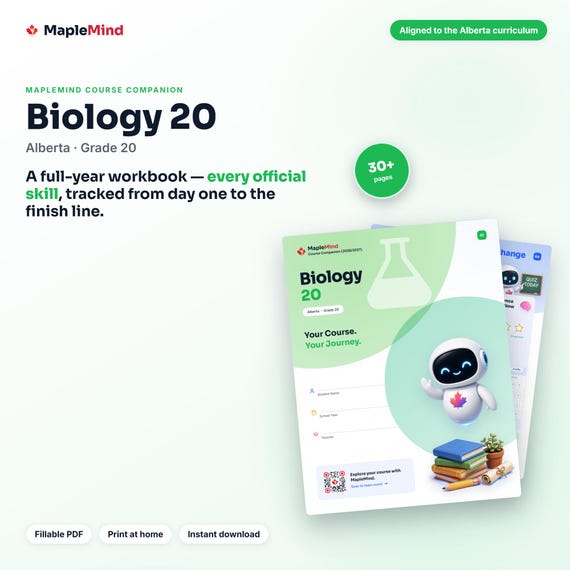
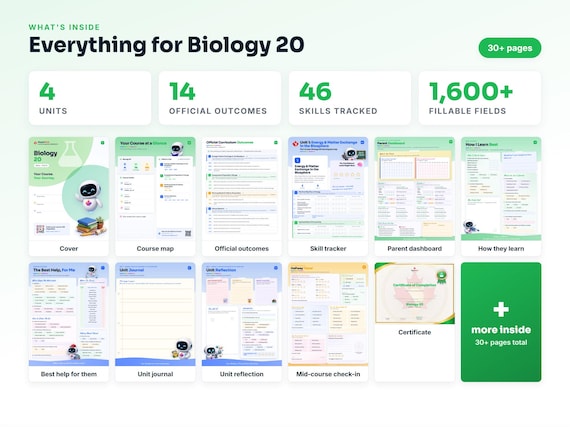


Printable workbook · A keepsake of the year
A Biology 20 workbook worth keeping
Built from the same official curriculum as this page. Before and after each skill above, your student colours in how sure they feel — so the two of you can see, on one page, what's clicking and what needs another look. It's a quiet way to follow how the year is really going.
By June it's full of their own handwriting: units worked through, confidence grown, a mid-year check-in, notes from parent-teacher night, and a certificate at the end. Less a worksheet, more a record of the year worth keeping on the shelf.
Instant download · see every page, reviews and the full description · five or more workbooks are $2.99 each
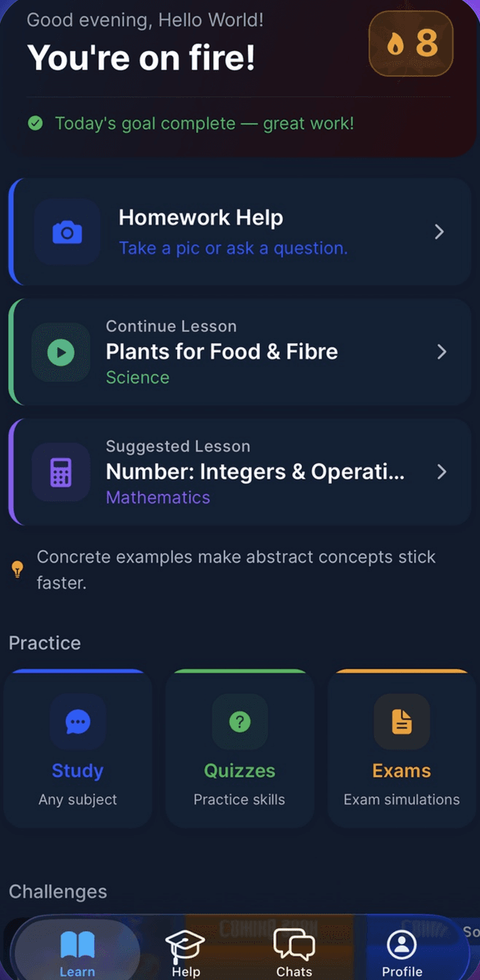
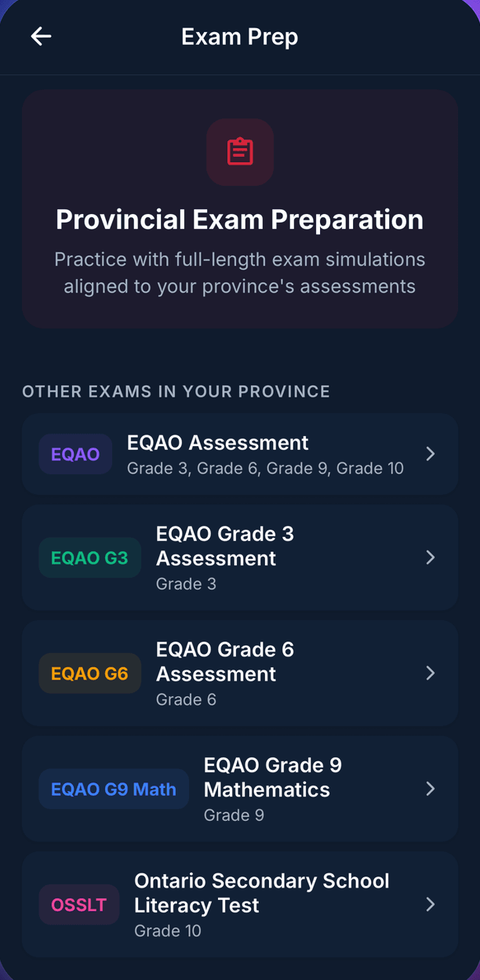
What it looks like in the app

Common questions
Can MapleMind help me with Biology 20?
Yes. MapleMind's AI tutor covers all 46 skills in Alberta's Biology 20 — you pick the exact skill, and the tutor teaches it step by step: a short lesson, a worked example, solving together, then a skill check to show it stuck.
Is MapleMind aligned to Alberta's official curriculum?
Yes. Every skill in this course maps to an official outcome code from Alberta's Grade 11 Science curriculum, and the ministry's own wording is quoted under each unit on this page — with the official government source linked so you can check it yourself.
What does MapleMind cost?
It's free to start — 5 tutoring chats and a practice quiz every day, no credit card. A Pro subscription ($9.99/month or $49.99/year CAD, 7-day free trial) unlocks unlimited tutoring, practice, and exam simulations.
What if I'm stuck on just one topic?
That's the point of skill-level tutoring: open Biology 20 in the app, tap the exact skill from the list on this page, and the tutor teaches just that — no wading through lessons you don't need.
Does MapleMind work in French or other languages?
Yes — 14 languages, including French. Both the app and the tutor's explanations switch to the language you choose.
Where can I see the official Alberta curriculum for Biology 20?
The official source is linked on this page — Alberta's official programs of study. The outline here follows it: every MapleMind skill carries its official outcome code, and the ministry's own wording is quoted under each unit.
Keep exploring
Ready when you are
Pick a skill from this page and see it taught properly — free, in the browser, in under a minute.