Get help with Physics 30
Most tutoring makes you sit through material you already know. MapleMind flips that: pick the exact skill that's causing trouble — any of the 72 below — and the tutor teaches just that one, step by step, as many times as it takes. Ask questions in plain words, any time of day, in English, French, or 12 other languages.
The official Alberta Physics 30 curriculum
Alberta defines Physics 30 by strands and outcomes. MapleMind teaches the same curriculum reorganized for one-skill-at-a-time tutoring — the table shows exactly where every official strand lands, and the ministry's own wording is quoted under each unit below.
Official source Alberta's official programs of studyRead it on the government site — alberta.ca ↗| Official strand | Outcomes | Where MapleMind teaches it |
|---|---|---|
| Unit A | 5 | Momentum & Impulse |
| Unit B | 27 | Forces & Fields |
| Unit C | 18 | Electromagnetic Radiation |
| Unit D | 22 | Atomic & Nuclear (Modern) Physics |
Every skill below, taught one on one.
 Try the first session free
How MapleMind teaches Physics 30 — every unit, lesson, and skill
Every skill below runs as a short session: a plain-words lesson, a worked example, solving it together, then a five-question skill check that earns up to three stars. Guided Mode keeps it teaching instead of answer-handing — turning it off needs a parent's password.
Unit 1Momentum & ImpulseOfficial strand · Unit A
The physics of collisions and explosions — momentum as "mass in motion", the impulse that changes it, and the great conservation law that lets you predict what happens when things crash, bounce or fly apart, in one dimension and two.
Momentum, Impulse & Collisions
- Momentum as a vector30-A1.1k — Define momentum as a vector quantity equal to the product of the mass and the velocity of an object, $\vec{p} = m\vec{v}$, measured in $\text{kg·m/s}$.
- Impulse and change in momentum30-A1.2k — Explain, quantitatively, the concepts of impulse and change in momentum using Newton's laws of motion — impulse $\vec{J} = \vec{F}\Delta t = \Delta \vec{p}$.
- Momentum conservation (qualitative)30-A1.3k — Explain, qualitatively, that the total momentum of an isolated system is conserved — the vector sum of momenta before an interaction equals the vector sum after.
- Momentum conservation in 1-D and 2-D30-A1.4k — Explain, quantitatively, that momentum is conserved in one- and two-dimensional interactions in an isolated system, solving collision and explosion problems by conserving momentum component-by-component.
- Elastic vs inelastic collisions30-A1.5k — Define, compare and contrast elastic and inelastic collisions using quantitative examples, in terms of the conservation of kinetic energy — kinetic energy is conserved only in a perfectly elastic collision.
The official wording — 5 outcomes in this unit
- 30-A1.1k
define momentum as a vector quantity equal to the product of the mass and the velocity of an object
- 30-A1.2k
explain, quantitatively, the concepts of impulse and change in momentum, using Newton's laws of motion
- 30-A1.3k
explain, qualitatively, that momentum is conserved in an isolated system
- 30-A1.4k
explain, quantitatively, that momentum is conserved in one- and two-dimensional interactions in an isolated system
- 30-A1.5k
define, compare and contrast elastic and inelastic collisions, using quantitative examples, in terms of conservation of kinetic energy
Unit 2Forces & FieldsOfficial strand · Unit B
The forces that act across empty space — electric charge and Coulomb's law, the electric field and potential that reshape "action at a distance" into a field, and magnetism: how moving charges make magnetic fields and how those fields push back on moving charges and currents.
Electric Charge & Its Behaviour
- Conservation of charge30-B1.1k — Explain electrical interactions in terms of the law of conservation of charge — charge is never created or destroyed, only transferred from one object to another.
- Attraction and repulsion of charges30-B1.2k — Explain electrical interactions in terms of the repulsion and attraction of charges — like charges repel, opposite charges attract.
- Charging by conduction and induction30-B1.3k — Compare the methods of transferring charge — conduction (direct contact) versus induction (rearranging charge without contact).
- Charge distribution on conductors and insulators30-B1.4k — Explain, qualitatively, the distribution of charge on the surfaces of conductors and insulators — excess charge spreads over a conductor's outer surface but stays put on an insulator.
Coulomb's Law & the Electric Force
- Coulomb's torsion balance experiment30-B1.5k — Explain, qualitatively, the principles pertinent to Coulomb's torsion balance experiment — measuring the tiny force between charges by the twist it produces in a fibre.
- Applying Coulomb's law to two charges30-B1.6k — Apply Coulomb's law, quantitatively, to analyze the interaction of two point charges, $F = \frac{kq_1 q_2}{r^2}$ — the force grows with each charge and falls off as the inverse square of separation.
- Net electric force from multiple charges30-B1.7k — Determine, quantitatively, the magnitude and direction of the electric force on a point charge due to two or more other point charges in a plane, by adding the individual Coulomb forces as vectors.
- Inverse-square: Coulomb vs gravitation30-B1.8k — Compare, qualitatively and quantitatively, the inverse square relationship as expressed by Coulomb's law and by Newton's universal law of gravitation — both fall off as $\frac{1}{r^2}$, but gravity only attracts while the electric force can attract or repel.
Electric Fields & Potential
- Defining vector fields30-B2.1k — Define vector fields as regions of space in which each point is assigned a vector (magnitude and direction) — the framework used for gravitational, electric and magnetic fields.
- Comparing forces and fields30-B2.2k — Compare forces and fields — a force acts on a specific object, while a field describes the influence a source spreads through all of the surrounding space, felt as a force by any object placed in it.
- Gravitational vs electric potential energy30-B2.3k — Compare, qualitatively, gravitational potential energy and electric potential energy — both are energy stored by position in a field, but gravitational potential energy is always tied to attraction while electric potential energy can involve attraction or repulsion.
- Electric potential difference30-B2.4k — Define electric potential difference as the change in electric potential energy per unit of charge, $V = \frac{\Delta E_p}{q}$, measured in volts ($1\ \text{V} = 1\ \text{J/C}$).
- Potential difference in a uniform field30-B2.5k — Calculate the electric potential difference between two points in a uniform electric field, using $V = Ed$ where $E$ is the field strength and $d$ the separation along the field.
Field Intensity, Current & Charges in Fields
- Electric field intensity and direction30-B2.6k — Explain, quantitatively, electric fields in terms of intensity (strength) and direction relative to the source and to the effect on a charge, $E = \frac{F}{q}$, with the field pointing away from positive and toward negative source charge.
- Defining electric current30-B2.7k — Define electric current as the amount of charge passing a reference point per unit of time, $I = \frac{q}{t}$, measured in amperes ($1\ \text{A} = 1\ \text{C/s}$).
- Charge motion in a uniform field30-B2.8k — Describe, quantitatively, the motion of an electric charge in a uniform electric field — a constant force $F = qE$ produces constant acceleration, exactly like projectile motion in gravity.
- Electrical interactions and energy conservation30-B2.9k — Explain, quantitatively, electrical interactions using the law of conservation of energy — work done by the field converts electric potential energy into kinetic energy ($qV = \frac{1}{2}mv^2$).
- Millikan's oil-drop experiment30-B2.10k — Explain Millikan's oil-drop experiment and its significance for charge quantization — balancing gravity against an electric field on tiny drops revealed that charge comes in whole-number multiples of the elementary charge $e$.
Magnetic Fields & Moving Charges
- Magnetic interactions as forces and fields30-B3.1k — Describe magnetic interactions in terms of forces and fields — a magnet sets up a magnetic field in the surrounding space that exerts forces on other magnets and on moving charges.
- Comparing gravitational, electric and magnetic fields30-B3.2k — Compare gravitational, electric and magnetic fields (from permanent magnets and moving charges) in terms of their sources and directions — masses source gravity, charges source electric fields, and moving charges source magnetic fields.
- Oersted, Faraday and electromagnetism30-B3.3k — Describe how the discoveries of Oersted (a current deflects a compass) and Faraday (a changing field induces a current) form the foundation of the theory relating electricity to magnetism.
- A moving charge as a field source30-B3.4k — Describe, qualitatively, a moving charge as the source of a magnetic field, and predict the orientation of that field from the direction of motion using the right-hand rule.
- Magnetic force on a moving charge30-B3.5k — Explain, qualitatively and quantitatively, how a uniform magnetic field affects a moving charge when motion and field are mutually perpendicular, using $F = qvB$ — the force is perpendicular to both velocity and field.
Magnetic Force on Currents
- Charge in combined magnetic and electric fields30-B3.6k — Explain, quantitatively, how uniform magnetic and electric fields affect a moving charge when motion and field are mutually perpendicular — as in a velocity selector where $qE$ balances $qvB$.
- Fields on charges and current-carrying wires30-B3.7k — Describe and explain, qualitatively, the interaction between a magnetic field and a moving charge, and between a magnetic field and a current-carrying conductor — a current is just many moving charges, so the wire feels a force.
- Force on a current-carrying conductor30-B3.8k — Explain, quantitatively, the effect of an external magnetic field on a current-carrying conductor, $F = BIL$ — the basis of the electric motor.
- Moving a conductor in a magnetic field30-B3.9k — Describe, qualitatively, the effects of moving a conductor through an external magnetic field, in terms of the force on the moving charges inside it — the origin of induced current and the electric generator.
The official wording — 27 outcomes in this unit
- 30-B1.1k
explain electrical interactions in terms of the law of conservation of charge
- 30-B1.2k
explain electrical interactions in terms of the repulsion and attraction of charges
- 30-B1.3k
compare the methods of transferring charge (conduction and induction)
- 30-B1.4k
explain, qualitatively, the distribution of charge on the surfaces of conductors and insulators
- 30-B1.5k
explain, qualitatively, the principles pertinent to Coulomb's torsion balance experiment
- 30-B1.6k
apply Coulomb's law, quantitatively, to analyze the interaction of two point charges
- 30-B1.7k
determine, quantitatively, the magnitude and direction of the electric force on a point charge due to two or more other point charges in a plane
- 30-B1.8k
compare, qualitatively and quantitatively, the inverse square relationship as it is expressed by Coulomb's law and by Newton's universal law of gravitation
- 30-B2.1k
define vector fields
- 30-B2.2k
compare forces and fields
- 30-B2.3k
compare, qualitatively, gravitational potential energy and electric potential energy
- 30-B2.4k
define electric potential difference as a change in electric potential energy per unit of charge
- 30-B2.5k
calculate the electric potential difference between two points in a uniform electric field
- 30-B2.6k
explain, quantitatively, electric fields in terms of intensity (strength) and direction, relative to the source of the field and to the effect on an electric charge
- 30-B2.7k
define electric current as the amount of charge passing a reference point per unit of time
- 30-B2.8k
describe, quantitatively, the motion of an electric charge in a uniform electric field
- 30-B2.9k
explain, quantitatively, electrical interactions using the law of conservation of energy
- 30-B2.10k
explain Millikan's oil-drop experiment and its significance relative to charge quantization
- 30-B3.1k
describe magnetic interactions in terms of forces and fields
- 30-B3.2k
compare gravitational, electric and magnetic fields (caused by permanent magnets and moving charges) in terms of their sources and directions
- 30-B3.3k
describe how the discoveries of Oersted and Faraday form the foundation of the theory relating electricity to magnetism
- 30-B3.4k
describe, qualitatively, a moving charge as the source of a magnetic field and predict the orientation of the magnetic field from the direction of motion
- 30-B3.5k
explain, qualitatively and quantitatively, how a uniform magnetic field affects a moving electric charge, using the relationships among charge, motion, field direction and strength, when motion and field directions are mutually perpendicular
- 30-B3.6k
explain, quantitatively, how uniform magnetic and electric fields affect a moving electric charge, using the relationships among charge, motion, field direction and strength, when motion and field directions are mutually perpendicular
- 30-B3.7k
describe and explain, qualitatively, the interaction between a magnetic field and a moving charge and between a magnetic field and a current-carrying conductor
- 30-B3.8k
explain, quantitatively, the effect of an external magnetic field on a current-carrying conductor
- 30-B3.9k
describe, qualitatively, the effects of moving a conductor in an external magnetic field, in terms of moving charges in a magnetic field
Unit 3Electromagnetic RadiationOfficial strand · Unit C
Light as an electromagnetic wave — how accelerating charges radiate, the full spectrum from radio to gamma, and the classic wave behaviours (reflection, refraction, diffraction, interference) that prove light is a wave. Then the twist: the photon and the photoelectric effect reveal light is also a particle.
The Nature & Speed of EMR
- Accelerating charges produce EMR30-C1.1k — Describe, qualitatively, how all accelerating charges produce electromagnetic radiation — a charge that speeds up, slows down or changes direction radiates energy as an EM wave.
- The electromagnetic spectrum30-C1.2k — Compare and contrast the constituents of the electromagnetic spectrum — radio, microwave, infrared, visible, ultraviolet, X-ray, gamma — on the basis of frequency and wavelength.
- Propagation of EMR30-C1.3k — Explain the propagation of EMR in terms of perpendicular electric and magnetic fields varying with time and travelling away from their source at the speed of light, $c = 3.00 \times 10^8\ \text{m/s}$.
- Measuring the speed of EMR30-C1.4k — Explain, qualitatively, various methods of measuring the speed of EMR — from astronomical timing (Rømer) to rotating-mirror methods (Michelson).
- Michelson-type speed calculation30-C1.5k — Calculate the speed of EMR from data given for a Michelson-type rotating-mirror experiment, using the mirror geometry and rotation rate.
Reflection, Refraction & Optics
- Reflection, refraction and total internal reflection30-C1.6k — Describe, quantitatively, reflection and refraction, including total internal reflection, using the law of reflection and Snell's law, $n_1\sin\theta_1 = n_2\sin\theta_2$.
- Lenses and curved mirrors30-C1.7k — Describe, quantitatively, simple single-component optical systems for lenses and curved mirrors, using the thin-lens/mirror equation $\frac{1}{f} = \frac{1}{d_o} + \frac{1}{d_i}$ and the magnification relation.
The Wave Model of Light
- Diffraction, interference and polarization30-C1.8k — Describe, qualitatively, diffraction (waves bending around obstacles), interference (overlapping waves adding or cancelling) and polarization (a wave property unique to transverse waves).
- Young's double-slit and the wave model30-C1.9k — Describe, qualitatively, how the results of Young's double-slit experiment support the wave model of light — the bright-and-dark fringe pattern can only be produced by interference of waves.
- Double-slit and diffraction-grating problems30-C1.10k — Solve double-slit and diffraction grating problems using the standard relations that connect fringe spacing, slit separation, wavelength and screen distance (e.g. $d\sin\theta = m\lambda$).
- Refraction supports the wave model30-C1.11k — Describe, qualitatively and quantitatively, how refraction supports the wave model of EMR, using the change in wave speed between media to explain why the wavelength and direction change while the frequency stays fixed.
- Grating vs prism spectra30-C1.12k — Compare and contrast the visible spectra produced by diffraction gratings and by triangular prisms — a grating separates colours by interference (red bends most), a prism by dispersion in refraction (violet bends most).
Photons & the Photoelectric Effect
- The photon and its energy30-C2.1k — Define the photon as a quantum of EMR and calculate its energy, $E = hf = \frac{hc}{\lambda}$, where $h$ is Planck's constant.
- Classifying the spectrum by photon energy30-C2.2k — Classify the regions of the electromagnetic spectrum by photon energy — higher frequency means higher-energy photons, so gamma photons carry vastly more energy than radio photons.
- The photoelectric effect30-C2.3k — Describe the photoelectric effect in terms of the intensity and wavelength (or frequency) of the incident light and the surface material — electrons are ejected only above a threshold frequency, regardless of intensity.
- Photoelectric emission and energy conservation30-C2.4k — Describe, quantitatively, photoelectric emission using the conservation of energy, $E_{photon} = W + E_{k,max}$ — the photon energy pays the work function $W$ and the rest becomes the electron's kinetic energy.
Wave–Particle Duality of Light
- Photoelectric effect and duality30-C2.5k — Describe the photoelectric effect as a phenomenon that supports the wave–particle duality of EMR — light behaves as a stream of particles (photons) here, even though interference shows it is also a wave.
- The Compton effect30-C2.6k — Explain, qualitatively and quantitatively, the Compton effect as another example of wave–particle duality, applying the conservation of momentum and energy to photons colliding with electrons ($p = \frac{h}{\lambda}$).
The official wording — 18 outcomes in this unit
- 30-C1.1k
describe, qualitatively, how all accelerating charges produce EMR
- 30-C1.2k
compare and contrast the constituents of the electromagnetic spectrum on the basis of frequency and wavelength
- 30-C1.3k
explain the propagation of EMR in terms of perpendicular electric and magnetic fields that are varying with time and travelling away from their source at the speed of light
- 30-C1.4k
explain, qualitatively, various methods of measuring the speed of EMR
- 30-C1.5k
calculate the speed of EMR, given data from a Michelson-type experiment
- 30-C1.6k
describe, quantitatively, the phenomena of reflection and refraction, including total internal reflection
- 30-C1.7k
describe, quantitatively, simple optical systems, consisting of only one component, for both lenses and curved mirrors
- 30-C1.8k
describe, qualitatively, diffraction, interference and polarization
- 30-C1.9k
describe, qualitatively, how the results of Young's double-slit experiment support the wave model of light
- 30-C1.10k
solve double-slit and diffraction grating problems using
- 30-C1.11k
describe, qualitatively and quantitatively, how refraction supports the wave model of EMR, using
- 30-C1.12k
compare and contrast the visible spectra produced by diffraction gratings and triangular prisms
- 30-C2.1k
define the photon as a quantum of EMR and calculate its energy
- 30-C2.2k
classify the regions of the electromagnetic spectrum by photon energy
- 30-C2.3k
describe the photoelectric effect in terms of the intensity and wavelength or frequency of the incident light and surface material
- 30-C2.4k
describe, quantitatively, photoelectric emission, using concepts related to the conservation of energy
- 30-C2.5k
describe the photoelectric effect as a phenomenon that supports the notion of the wave-particle duality of EMR
- 30-C2.6k
explain, qualitatively and quantitatively, the Compton effect as another example of wave-particle duality, applying the laws of mechanics and of conservation of momentum and energy to photons
Unit 4Atomic & Nuclear (Modern) PhysicsOfficial strand · Unit D
How we learned what atoms are made of — from cathode rays and the electron to Rutherford's nucleus and the quantum model that explains spectra. Then inside the nucleus: radioactivity, half-life, fission and fusion, mass–energy equivalence, and the modern particle zoo of quarks and leptons.
Discovering Atomic Structure
- Matter contains discrete charges30-D1.1k — Describe matter as containing discrete positive and negative charges — the starting point for every atomic model, explaining why matter is normally neutral yet can be charged.
- Cathode rays and atomic models30-D1.2k — Explain how the discovery of cathode rays contributed to the development of atomic models — the rays behaved as a stream of negative particles, hinting that atoms had internal parts.
- Thomson's experiment30-D1.3k — Explain J. J. Thomson's experiment and the significance of its results for science and technology — measuring the charge-to-mass ratio of the electron established the electron as a subatomic particle.
- Rutherford's scattering experiment30-D1.4k — Explain, qualitatively, the significance of Rutherford's scattering experiment for scientists' understanding of the relative size and mass of the nucleus and the atom — most alpha particles passed through, so the atom is mostly empty space with a tiny, massive nucleus.
The Quantum Model & Atomic Spectra
- Why the classical atom fails30-D2.1k — Explain, qualitatively, how the emission of EMR by an accelerating charged particle invalidates the classical model of the atom — an orbiting electron should radiate energy and spiral into the nucleus, but atoms are stable.
- Each element has a unique line spectrum30-D2.2k — Describe that each element has a unique line spectrum — a characteristic set of wavelengths that acts as an atomic fingerprint for identifying elements.
- Continuous, emission and absorption spectra30-D2.3k — Explain, qualitatively, the characteristics of, and the conditions needed to produce, continuous, line-emission and line-absorption spectra — hot dense sources give continuous spectra, hot thin gases emit lines, cool gases absorb them.
- Stationary states explain spectra30-D2.4k — Explain, qualitatively, the concept of stationary states (discrete allowed energy levels) and how they explain the observed line spectra of atoms and molecules — light is emitted only when an electron jumps between fixed levels.
- Energy difference between states30-D2.5k — Calculate the energy difference between states using conservation of energy and the emitted photon, $\Delta E = hf = E_{high} - E_{low}$ — the photon carries away exactly the energy the electron loses.
Matter Waves & Quantum Duality
- Electron diffraction and de Broglie30-D2.6k — Explain, qualitatively, how electron diffraction provides experimental support for the de Broglie hypothesis — electrons produce interference patterns, confirming matter has a wavelength $\lambda = \frac{h}{p}$.
- Two-slit electron interference30-D2.7k — Describe, qualitatively, how the two-slit electron interference experiment shows that quantum systems (photons and electrons) may be modelled as particles or waves — the same objects show both behaviours, contrary to intuition.
Radioactivity & Nuclear Reactions
- Alpha, beta and gamma radiation30-D3.1k — Describe the nature, properties and biological effects of alpha, beta and gamma radiation — differing in charge, mass, penetrating power and ionizing ability.
- Writing nuclear decay equations30-D3.2k — Write nuclear equations in isotope notation for alpha, beta-negative and beta-positive decays, including the appropriate neutrino and antineutrino.
- Half-life calculations30-D3.3k — Perform simple, nonlogarithmic half-life calculations — finding remaining quantity, elapsed time or number of half-lives by repeated halving.
- Conservation of charge and mass number30-D3.4k — Use the conservation of charge and mass number to predict the particles emitted by a decaying nucleus — the totals of atomic number and mass number must balance on both sides of a nuclear equation.
Fission, Fusion & Mass–Energy
- Fission versus fusion30-D3.5k — Compare and contrast the characteristics of fission (splitting a heavy nucleus) and fusion (joining light nuclei) reactions — both release energy, and fusion powers the stars.
- Mass defect and released energy30-D3.6k — Relate, qualitatively and quantitatively, the mass defect of a nucleus to the energy released in nuclear reactions, using Einstein's mass–energy equivalence, $E = mc^2$.
Particle Physics & the Standard Model
- Particle tracks and discovery30-D4.1k — Explain how the analysis of particle tracks (in cloud and bubble chambers) contributed to the discovery and identification of subatomic particles — curvature, direction and thickness reveal charge, momentum and mass.
- The strong force and accelerators30-D4.2k — Explain, qualitatively, in terms of the strong nuclear force, why high-energy particle accelerators are required to study subatomic particles — the enormous binding energy must be overcome to probe inside nucleons.
- The quark model of nucleons30-D4.3k — Describe the modern model of the proton and neutron as composed of quarks — a proton is two up quarks and one down, a neutron is one up and two down.
- Comparing fundamental particles30-D4.4k — Compare and contrast the up quark, down quark, electron and electron neutrino, and their antiparticles, in terms of charge and energy (mass–energy) — the first-generation building blocks of ordinary matter.
- Beta decay with elementary fermions30-D4.5k — Describe beta-positive and beta-negative decay using first-generation elementary fermions and the principle of charge conservation — a down quark converting to an up quark (or vice versa) changes a neutron into a proton with emission of a beta particle and (anti)neutrino.
The official wording — 22 outcomes in this unit
- 30-D1.1k
describe matter as containing discrete positive and negative charges
- 30-D1.2k
explain how the discovery of cathode rays contributed to the development of atomic models
- 30-D1.3k
explain J. J. Thomson's experiment and the significance of the results for both science and technology
- 30-D1.4k
explain, qualitatively, the significance of the results of Rutherford's scattering experiment, in terms of scientists' understanding of the relative size and mass of the nucleus and the atom
- 30-D2.1k
explain, qualitatively, how emission of EMR by an accelerating charged particle invalidates the classical model of the atom
- 30-D2.2k
describe that each element has a unique line spectrum
- 30-D2.3k
explain, qualitatively, the characteristics of, and the conditions necessary to produce, continuous line-emission and line-absorption spectra
- 30-D2.4k
explain, qualitatively, the concept of stationary states and how they explain the observed spectra of atoms and molecules
- 30-D2.5k
calculate the energy difference between states, using the law of conservation of energy and the observed characteristics of an emitted photon
- 30-D2.6k
explain, qualitatively, how electron diffraction provides experimental support for the de Broglie hypothesis
- 30-D2.7k
describe, qualitatively, how the two-slit electron interference experiment shows that quantum systems, like photons and electrons, may be modelled as particles or waves, contrary to intuition
- 30-D3.1k
describe the nature and properties, including the biological effects, of alpha, beta and gamma radiation
- 30-D3.2k
write nuclear equations, using isotope notation, for alpha, beta-negative and beta-positive decays, including the appropriate neutrino and antineutrino
- 30-D3.3k
perform simple, nonlogarithmic half-life calculations
- 30-D3.4k
use the law of conservation of charge and mass number to predict the particles emitted by a nucleus
- 30-D3.5k
compare and contrast the characteristics of fission and fusion reactions
- 30-D3.6k
relate, qualitatively and quantitatively, the mass defect of the nucleus to the energy released in nuclear reactions, using Einstein's concept of mass-energy equivalence
- 30-D4.1k
explain how the analysis of particle tracks contributed to the discovery and identification of the characteristics of subatomic particles
- 30-D4.2k
explain, qualitatively, in terms of the strong nuclear force, why high-energy particle accelerators are required to study subatomic particles
- 30-D4.3k
describe the modern model of the proton and neutron as being composed of quarks
- 30-D4.4k
compare and contrast the up quark, the down quark, the electron and the electron neutrino, and their antiparticles, in terms of charge and energy (mass-energy)
- 30-D4.5k
describe beta-positive
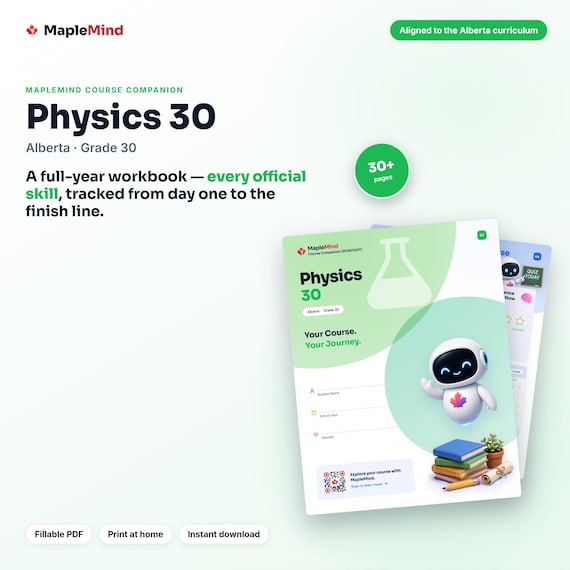
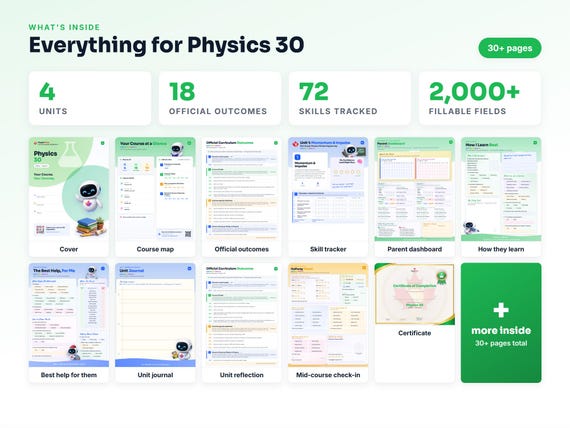


Printable workbook · A keepsake of the year
A Physics 30 workbook worth keeping
Built from the same official curriculum as this page. Before and after each skill above, your student colours in how sure they feel — so the two of you can see, on one page, what's clicking and what needs another look. It's a quiet way to follow how the year is really going.
By June it's full of their own handwriting: units worked through, confidence grown, a mid-year check-in, notes from parent-teacher night, and a certificate at the end. Less a worksheet, more a record of the year worth keeping on the shelf.
Instant download · see every page, reviews and the full description · five or more workbooks are $2.99 each
What it looks like in the app



Preparing for the Physics 30 Diploma Exam?
Physics 30 ends in a provincial Diploma Exam worth a big part of the final mark. MapleMind's exam mode builds a full simulation from the course — timed sections, written responses, and a graded result that shows which skills to review. Our Diploma Exam prep guide has a full study plan.
Common questions
Can MapleMind help me with Physics 30?
Yes. MapleMind's AI tutor covers all 72 skills in Alberta's Physics 30 — you pick the exact skill, and the tutor teaches it step by step: a short lesson, a worked example, solving together, then a skill check to show it stuck.
Is MapleMind aligned to Alberta's official curriculum?
Yes. Every skill in this course maps to an official outcome code from Alberta's Grade 12 Science curriculum, and the ministry's own wording is quoted under each unit on this page — with the official government source linked so you can check it yourself.
What does MapleMind cost?
It's free to start — 5 tutoring chats and a practice quiz every day, no credit card. A Pro subscription ($9.99/month or $49.99/year CAD, 7-day free trial) unlocks unlimited tutoring, practice, and exam simulations.
What if I'm stuck on just one topic?
That's the point of skill-level tutoring: open Physics 30 in the app, tap the exact skill from the list on this page, and the tutor teaches just that — no wading through lessons you don't need.
Does MapleMind work in French or other languages?
Yes — 14 languages, including French. Both the app and the tutor's explanations switch to the language you choose.
Where can I see the official Alberta curriculum for Physics 30?
The official source is linked on this page — Alberta's official programs of study. The outline here follows it: every MapleMind skill carries its official outcome code, and the ministry's own wording is quoted under each unit.
Does MapleMind help with the Physics 30 Diploma Exam?
Yes. Physics 30 ends in a provincial Diploma Exam worth a big part of the final mark. MapleMind's exam mode builds a full simulation from the course — timed sections, written responses, and a graded result that shows which skills to review.
Keep exploring
Ready when you are
Pick a skill from this page and see it taught properly — free, in the browser, in under a minute.