Get help with Science 24
Most tutoring makes you sit through material you already know. MapleMind flips that: pick the exact skill that's causing trouble — any of the 26 below — and the tutor teaches just that one, step by step, as many times as it takes. Ask questions in plain words, any time of day, in English, French, or 12 other languages.
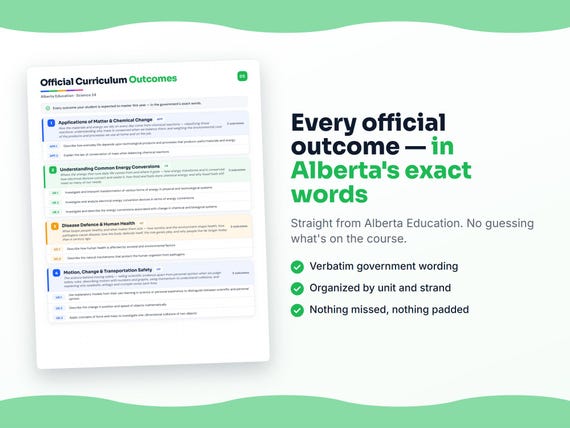
The official Alberta Science 24 curriculum
Alberta defines Science 24 by strands and outcomes. MapleMind teaches the same curriculum reorganized for one-skill-at-a-time tutoring — the table shows exactly where every official strand lands, and the ministry's own wording is quoted under each unit below.
Official source Alberta's official programs of studyRead it on the government site — alberta.ca ↗| Official strand | Outcomes | Where MapleMind teaches it |
|---|---|---|
| Unit A | 4 | Applications of Matter & Chemical Change |
| Unit B | 4 | Understanding Common Energy Conversions |
| Unit C | 5 | Disease Defence & Human Health |
| Unit D | 4 | Motion, Change & Transportation Safety |
Every skill below, taught one on one.
 Try the first session free
How MapleMind teaches Science 24 — every unit, lesson, and skill
Every skill below runs as a short session: a plain-words lesson, a worked example, solving it together, then a five-question skill check that earns up to three stars. Guided Mode keeps it teaching instead of answer-handing — turning it off needs a parent's password.
Unit 1Applications of Matter & Chemical ChangeOfficial strand · Unit A
How the materials and energy we rely on every day come from chemical reactions — classifying those reactions, understanding why mass is conserved when we balance them, and weighing the environmental cost of the products and processes we use at home and on the job.
Everyday Materials & Classifying Reactions
- Technology behind everyday materials and energy24.A.1 — Describe how everyday life depends upon technological products and processes — from fuels to cleaning products to plastics — that produce the useful materials and energy we use at home and work.
- Investigating and classifying chemical reactions24.A.2 — Investigate and classify chemical reactions — such as combustion, corrosion and neutralization — by the signs of change and the type of reaction that produced them.
Conservation of Mass & Environmental Impact
- Conservation of mass and balancing reactions24.A.3 — Explain the law of conservation of mass — that atoms are never lost or created — and use it to balance simple chemical reactions so both sides have equal atoms.
- Analyzing everyday products and processes24.A.4 — Analyze common technological products and processes encountered in everyday life and careers — fuels, plastics, cleaners, road salt — and how they are made and used.
- Their effects on the environment24.A.4 — Analyze the potential effects on the environment of everyday technological products and processes — emissions, waste, and runoff from fuels, plastics, cleaners and road salt.
The official wording — 4 outcomes in this unit
- 24.A.1
Describe how everyday life depends upon technological products and processes that produce useful materials and energy
- 24.A.2
Investigate and classify chemical reactions
- 24.A.3
Explain the law of conservation of mass when balancing chemical reactions
- 24.A.4
Analyze common technological products and processes encountered in everyday life and careers
Unit 2Understanding Common Energy ConversionsOfficial strand · Unit B
Where the energy that runs daily life comes from and where it goes — how energy transforms and is conserved, how electrical devices convert and waste it, how food and fuels store chemical energy, and why fossil fuels still meet so many of our needs.
Transforming & Conserving Energy
- Energy transforming from one form to another24.B.1 — Investigate and interpret how various forms of energy transform from one to another in physical and technological systems — electrical to light and heat, chemical to motion.
- Energy is conserved overall24.B.1 — Interpret the conservation of various forms of energy in physical and technological systems — energy is never destroyed, just changed in form, though some always ends up as low-grade heat.
Electrical Devices, Rate & Efficiency
- Energy conversions in electrical devices24.B.2 — Investigate and analyze everyday electrical energy conversion devices — light bulbs, motors, heaters — in terms of the energy conversions they carry out (electrical into light, motion or heat).
- Rate of energy transfer and efficiency24.B.2 — Analyze electrical energy conversion devices in terms of their rate of energy transfer and efficiency — how fast they use energy and how much is wasted as heat.
Chemical, Biological Energy & Fossil Fuels
- Energy conversions in chemical and biological systems24.B.3 — Investigate and describe the energy conversions tied to change in chemical and biological systems — burning fuel, digesting food, a battery discharging.
- The impact of fossil-fuel technologies24.B.4 — Analyze and describe the impact of fossil fuel based technologies — engines, furnaces, power plants — on daily life and the environment.
- Why fossil fuels still meet human needs24.B.4 — Describe the importance of fossil fuel based technologies in meeting human needs — transportation, heating, electricity and manufacturing — and why they remain so widely used.
The official wording — 4 outcomes in this unit
- 24.B.1
Investigate and interpret transformation of various forms of energy in physical and technological systems
- 24.B.2
Investigate and analyze electrical energy conversion devices in terms of energy conversions
- 24.B.3
Investigate and describe the energy conversions associated with change in chemical and biological systems
- 24.B.4
Analyze and describe the impact of fossil fuel based technologies
Unit 3Disease Defence & Human HealthOfficial strand · Unit C
What keeps people healthy and what makes them sick — how society and the environment shape health, how pathogens cause disease, how the body defends itself, the role genes play, and why people live far longer today than a century ago.
Health, Society & Environmental Pathogens
- Societal and environmental factors in health24.C.1 — Describe how human health is affected by societal and environmental factors — diet, income, housing, pollution and access to care.
- The need for society to act on health24.C.1 — Describe the need for action by society to improve human health — clean water, vaccination, food safety and public-health programs that no one person can provide alone.
- Human health and environmental pathogens24.C.2 — Analyze the relationship between human health and environmental pathogens — the bacteria, viruses and other microbes in food, water and air that can cause disease.
Body Defences, Genes & Longevity
- Natural defences against pathogens24.C.3 — Describe the natural mechanisms that protect the human organism from pathogens — skin, mucus, stomach acid, white blood cells and the immune response.
- Genes, inherited traits and health24.C.4 — Describe the role of genes in inherited characteristics and human health — how traits and some health conditions pass from parents to children.
- Longer lives from understanding disease24.C.5 — Analyze how human longevity has increased over time as a result of a better understanding of pathogens and genetics — germ theory, vaccines and genetic medicine.
- Longer lives from sanitation and hygiene24.C.5 — Analyze how human longevity has increased as a result of improved sanitary conditions and personal hygiene — clean water, sewage treatment, handwashing and safe food handling.
The official wording — 5 outcomes in this unit
- 24.C.1
Describe how human health is affected by societal and environmental factors
- 24.C.2
Analyze the relationship between human health and environmental pathogens
- 24.C.3
Describe the natural mechanisms that protect the human organism from pathogens
- 24.C.4
Describe the role of genes in inherited characteristics and human health
- 24.C.5
Analyze how longevity in humans has increased over time as a result of a better understanding of pathogens and genetics
Unit 4Motion, Change & Transportation SafetyOfficial strand · Unit D
The science behind moving safely — telling scientific evidence apart from personal opinion when we judge safety rules, describing motion with numbers and graphs, using momentum to understand collisions, and explaining why seatbelts, airbags and crumple zones save lives.
Science vs. Opinion & Safety Rules
- Scientific evidence versus personal opinion24.D.1 — Use explanatory models from science or personal experience to tell scientific evidence apart from personal opinion when judging a claim about safety.
- Why we need safety systems and rules24.D.1 — Analyze the need for safety systems and regulations on the road — speed limits, seatbelt laws, vehicle standards — using evidence rather than opinion.
Describing Motion with Numbers & Graphs
- Position and speed with numbers24.D.2 — Describe the change in position and speed of objects mathematically — using $v = \frac{d}{t}$ to calculate how fast something is moving.
- Position and speed with graphs24.D.2 — Describe the change in position and speed of objects graphically — reading and drawing distance–time and speed–time graphs to see the motion at a glance.
Momentum, Collisions & Safety Devices
- Force and mass in a collision24.D.3 — Apply the concepts of force and mass to investigate one-dimensional collisions of two objects — why a heavier or faster vehicle hits harder in a crash.
- Conservation of momentum in a collision24.D.3 — Apply the law of conservation of momentum to investigate one-dimensional collisions of two objects — the total momentum before a crash equals the total after.
- Motion principles behind safety devices24.D.4 — Apply the principles underlying the motion of objects to explain the need for safety devices and practices — seatbelts, airbags, crumple zones and headrests.
The official wording — 4 outcomes in this unit
- 24.D.1
Use explanatory models from their own learning in science or personal experience to distinguish between scientific and personal opinion
- 24.D.2
Describe the change in position and speed of objects mathematically
- 24.D.3
Apply concepts of force and mass to investigate one-dimensional collisions of two objects
- 24.D.4
Apply the principles underlying the motion of objects to explain the need for safety devices and practices
Printable workbook · A keepsake of the year
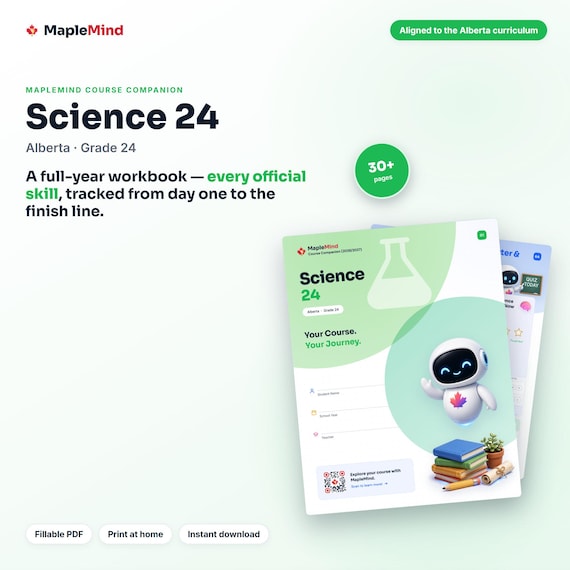
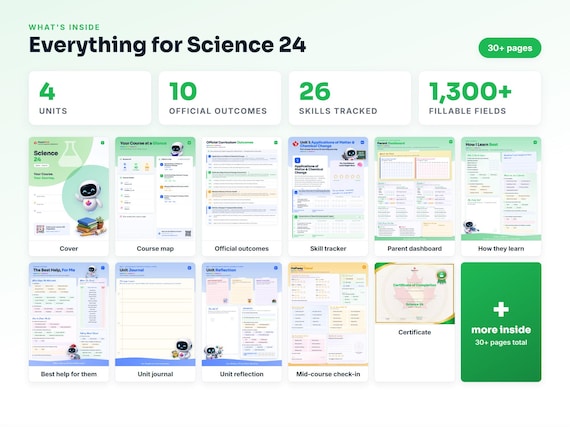
A Science 24 workbook worth keeping
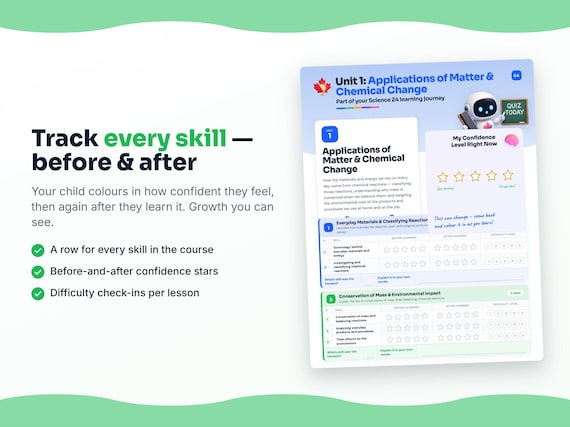
Built from the same official curriculum as this page. Before and after each skill above, your student colours in how sure they feel — so the two of you can see, on one page, what's clicking and what needs another look. It's a quiet way to follow how the year is really going.
By June it's full of their own handwriting: units worked through, confidence grown, a mid-year check-in, notes from parent-teacher night, and a certificate at the end. Less a worksheet, more a record of the year worth keeping on the shelf.
Instant download · see every page, reviews and the full description · five or more workbooks are $2.99 each
What it looks like in the app



Common questions
Can MapleMind help me with Science 24?
Yes. MapleMind's AI tutor covers all 26 skills in Alberta's Science 24 — you pick the exact skill, and the tutor teaches it step by step: a short lesson, a worked example, solving together, then a skill check to show it stuck.
Is MapleMind aligned to Alberta's official curriculum?
Yes. Every skill in this course maps to an official outcome code from Alberta's Grade 11 Science curriculum, and the ministry's own wording is quoted under each unit on this page — with the official government source linked so you can check it yourself.
What does MapleMind cost?
It's free to start — 5 tutoring chats and a practice quiz every day, no credit card. A Pro subscription ($9.99/month or $49.99/year CAD, 7-day free trial) unlocks unlimited tutoring, practice, and exam simulations.
What if I'm stuck on just one topic?
That's the point of skill-level tutoring: open Science 24 in the app, tap the exact skill from the list on this page, and the tutor teaches just that — no wading through lessons you don't need.
Does MapleMind work in French or other languages?
Yes — 14 languages, including French. Both the app and the tutor's explanations switch to the language you choose.
Where can I see the official Alberta curriculum for Science 24?
The official source is linked on this page — Alberta's official programs of study. The outline here follows it: every MapleMind skill carries its official outcome code, and the ministry's own wording is quoted under each unit.
Keep exploring
Ready when you are
Pick a skill from this page and see it taught properly — free, in the browser, in under a minute.